
The complete no-fluff reference guide for test-takers worldwide
If you’ve ever typed a question into Google at midnight before your IELTS exam, this post is for you. These are the 100 most commonly searched IELTS questions online — collected from forums, Reddit threads, Facebook groups, and search engines across dozens of countries — answered clearly, honestly, and without filler.
Bookmark this. Share it. Come back to it.
PART 1: THE BASICS (Questions 1–15)
1. What is IELTS?
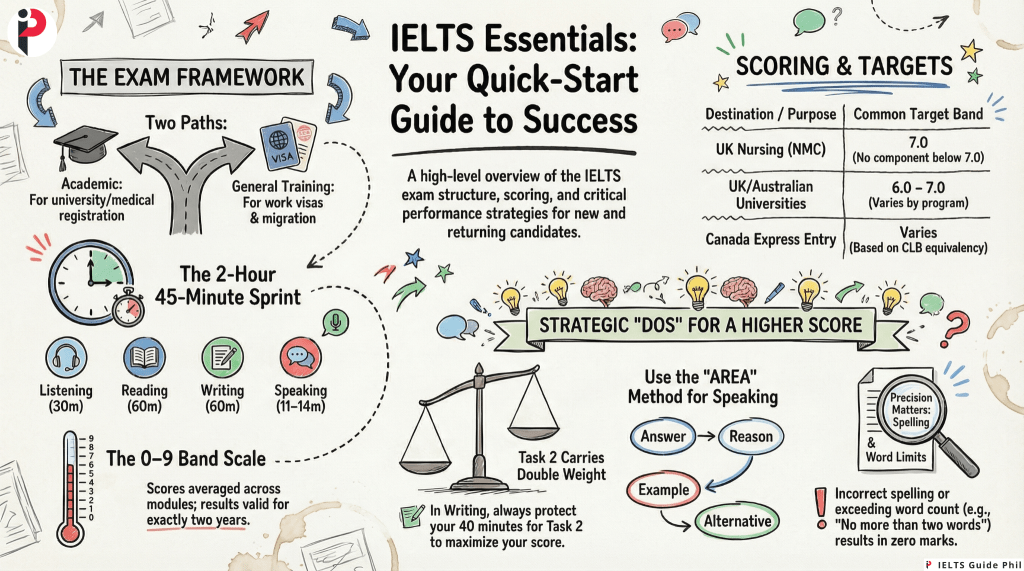
IELTS stands for International English Language Testing System. It is a globally recognized English proficiency exam that measures your ability to Listen, Read, Write, and Speak in English. It is jointly managed by the British Council, IDP: IELTS Australia, and Cambridge Assessment English. More than 11,000 organizations in over 140 countries accept IELTS scores.
2. What are the two types of IELTS?
IELTS Academic — for university admission, professional registration (nursing, medicine, engineering, teaching), and skilled migration.
IELTS General Training — for work visas, non-degree migration programs, and secondary education abroad.
Both share the same Listening and Speaking tests. The Reading and Writing tests differ in content and level of demand.
3. Which one should I take — Academic or General Training?
Check the specific requirement of your target institution, licensing body, employer, or immigration authority. When in doubt, contact the organization directly. Do not assume. A nurse applying to the UK needs Academic for NMC registration. A skilled worker applying for Canadian PR under Express Entry may need General Training. The requirement varies by pathway and country.
4. What is the IELTS band score scale?
The scale runs from 0 to 9 in 0.5 increments. Here is a quick reference:
- 9 — Expert user
- 8 — Very good user
- 7 — Good user
- 6 — Competent user
- 5 — Modest user
- 4 — Limited user
- Below 4 — Extremely limited to non-user
5. What band score do I need?
It depends entirely on your purpose and destination country. Common benchmarks:
- UK Nursing (NMC): Overall 7.0, no component below 7.0
- UK Tier 2 / Skilled Worker Visa: Typically 4.0–6.0 depending on role
- Canada PR (Express Entry): Varies; CLB equivalency affects CRS points
- Australia skilled migration (subclass 189/190): Usually 6.0–7.0 overall
- New Zealand residence: Typically 6.5 overall
- UK and Australian universities: Usually 6.0–7.0 depending on program
- US universities: Varies widely, typically 6.5–7.0
- Medical licensing bodies (GMC, NZMC, etc.): Often 7.5 overall
Always verify the exact current requirement with the receiving institution or authority.
6. How is IELTS scored?
Each of the four modules — Listening, Reading, Writing, Speaking — is scored individually. The four scores are averaged to produce your Overall Band Score, rounded to the nearest 0.5.
Example: L 7.5 + R 7.0 + W 6.0 + S 7.0 = 27.5 ÷ 4 = 6.875 → rounded to 7.0
7. How long is the IELTS exam?
Total testing time is approximately 2 hours and 45 minutes:
- Listening: 30 minutes of audio (plus 10 minutes transfer time for paper-based)
- Reading: 60 minutes
- Writing: 60 minutes
- Speaking: 11–14 minutes (usually scheduled on a different day or time)
8. Can I take IELTS online?
Yes. IELTS Online (Academic only) allows you to complete Listening, Reading, and Writing at home on your own computer. Speaking is conducted via video call with a live certified examiner. Availability varies by country — check IDP’s website for eligibility in your location.
9. What is computer-delivered IELTS?
Computer-delivered IELTS (CD-IELTS) is taken at an official test center on a computer. The content, tasks, and scoring are identical to paper-based. You type your Writing answers. The Speaking test remains face-to-face with a human examiner. CD-IELTS typically offers more test dates per month than paper-based.
10. Is computer-delivered IELTS easier than paper-based?
No. The content and scoring criteria are exactly the same. The only difference is the medium. Some candidates find typing faster and editing easier. Others prefer handwriting. Neither format has a scoring advantage. Choose based on your personal comfort, typing speed, and familiarity with the interface.
11. How much does IELTS cost?
Fees vary significantly by country. As a general range, the exam costs between USD 200–330 (or local equivalent) in most markets. Costs in the UK, Australia, Canada, and the US tend to fall in this range. Check the British Council or IDP website for the current fee in your specific country — fees are updated periodically.
12. Where can I take IELTS?
IELTS is available in over 140 countries at more than 1,600 test locations worldwide. Major test centers are operated by either the British Council or IDP. To find a test center near you, visit ielts.org or the website of your preferred test provider.
13. How do I register for IELTS?
Register online through the British Council (britishcouncil.org) or IDP (idp.com) in your country. You will need a valid passport. Payment methods and processes vary by country but are completed digitally in most markets.
14. What ID do I need for IELTS?
Your passport — the same one used during registration. In most countries, no other form of ID is accepted on test day. Your name and passport number must match your booking exactly. Check your test center’s specific requirements in advance, as some countries have additional identity verification steps.
15. How long are IELTS results valid?
IELTS results are valid for two years from the test date. Most institutions and immigration authorities will not accept results older than two years. Plan your exam timing to ensure your results remain valid through your application process.
PART 2: LISTENING (Questions 16–25)
16. What is the format of the IELTS Listening test?
Four sections, 40 questions, approximately 30 minutes of audio. You hear each recording once only.
- Section 1: Conversation in a social or everyday context
- Section 2: Monologue in a social or everyday context
- Section 3: Conversation in an academic or training context
- Section 4: Monologue in an academic context
The test uses a range of native English accents including British, Australian, North American, and others.
17. Can I read the questions before the audio plays?
Yes, and you must. Use the preview time before each section to read the questions, predict what type of answer is expected (a name? a number? a place?), and identify keywords. This is one of the highest-value strategies in the Listening test.
18. What is the spelling rule in Listening?
Spelling counts. If the answer is “necessary” and you write “necesary,” it is marked wrong. This applies especially to names, addresses, and spelled-out words. Train your ear and your spelling together — they are inseparable in Listening.
19. Can I write in capital letters in Listening?
Yes. You may write all answers in capital letters in both Listening and Reading without any penalty. Many candidates prefer this to avoid ambiguous letter formation, especially under time pressure. It is fully acceptable.
20. What is the word limit rule in Listening?
Instructions specify a word limit: “no more than two words,” “no more than three words and/or a number,” and so on. Count carefully. Writing three words when the instruction says two results in an automatic zero for that answer — even if all three words are correct.
21. Why do I keep missing answers even when I understand the audio?
Common causes:
- You were still writing the previous answer when the next one was spoken
- You lost concentration and missed the signal phrase
- The answer was paraphrased and you were listening for the exact words from the question
Develop speed in writing short answers, train sustained attention across all four sections, and practice identifying paraphrase rather than matching word for word.
22. Does accent affect the Listening score?
No. Your score is based entirely on whether your written answers are correct — not on how easily you recognize specific accents. The test deliberately uses a variety of accents. Broad exposure to different varieties of spoken English is an essential part of Listening preparation.
23. What happens if I miss an answer in Listening?
Move on immediately. Dwelling on a missed answer causes you to miss the next one. Leave a blank or make a quick best guess, then refocus. On paper-based IELTS, use the 10-minute transfer time to revisit uncertain answers. On computer-delivered IELTS, use the review screen at the end.
24. How is the Listening test scored?
Each correct answer = 1 point. 40 points total. Raw scores are converted to band scores. Approximate conversions:
- 39–40 correct → Band 9
- 35–36 correct → Band 8
- 30–31 correct → Band 7
- 23–25 correct → Band 6
25. What is the best way to improve Listening?
Daily exposure to authentic English audio is essential. Podcasts, documentaries, TED Talks, radio broadcasts, news programs, and audiobooks all help. Practice with official IELTS Listening tests under timed conditions. Shadowing — repeating what you hear as you hear it — builds sound recognition and processing speed simultaneously.
PART 3: READING (Questions 26–38)
26. What is the format of the IELTS Academic Reading test?
Three passages, 40 questions, 60 minutes. There is no separate transfer time — all answers must be recorded within the 60 minutes. Texts are long and complex, drawn from academic journals, books, magazines, and newspapers. Topics are non-specialist — you do not need prior subject knowledge — but the language and argument structures are demanding. Texts typically range from 700 to 1,000 words each.
27. What is the format of the IELTS General Training Reading test?
Also three sections, 40 questions, 60 minutes — but the structure differs significantly from Academic Reading. Section 1 contains two or three short texts drawn from everyday sources: notices, advertisements, timetables, workplace policies, and similar functional documents. Section 2 contains two texts related to work and employment contexts — job descriptions, contracts, staff handbooks. Section 3 contains one longer, more complex text similar in demand to Academic Reading passages. The progression from Section 1 to Section 3 is a deliberate increase in difficulty.
28. Is General Training Reading easier than Academic Reading?
Generally, yes — at the lower and middle sections. Sections 1 and 2 of General Training use shorter, more familiar text types. However, Section 3 is comparably demanding to Academic passages. Importantly, the scoring conversion table reflects this: General Training candidates need more correct answers than Academic candidates to achieve the same band score, because the overall difficulty level of the paper is lower. Both tests reward the same core skills — skimming, scanning, close reading, and inference.
29. Should I read the passage first or the questions first?
For most question types, read the questions first, then locate relevant sections of the passage. This is more efficient than reading the whole passage and then hunting for answers. For global tasks such as choosing a title or identifying the writer’s overall argument, a brief structural overview of the passage helps first. In General Training Section 1, where texts are short and functional, scanning for specific information after reading the questions is especially effective.
30. What is skimming and scanning in Reading?
Skimming: Reading rapidly to grasp the general idea, structure, or tone of a passage without processing every word.
Scanning: Moving your eyes quickly over the text to locate a specific piece of information — a name, a statistic, a keyword.
Both skills are essential for completing 40 questions across three passages in 60 minutes. Neither is natural for most test-takers — both must be practiced deliberately. In General Training Reading, scanning is especially important in Sections 1 and 2 where answers are often localized to a specific notice or paragraph.
31. What does “Not Given” mean in True/False/Not Given questions?
“Not Given” means the passage neither confirms nor contradicts the statement. The information is simply absent from the text. This is different from “False,” where the passage directly contradicts the statement. The distinction is critical. Train yourself to ask: “Does the passage say the opposite? No? Then it is likely Not Given — not False.”
32. Can I use my own knowledge to answer Reading questions?
No. Every answer must be based strictly on what the passage states. Even if you know from outside knowledge that a statement is factually true, if the passage does not confirm it, the answer may be Not Given. Personal knowledge can mislead you — read only what is on the page. This applies to both Academic and General Training Reading.
33. What is the word limit rule in Reading?
Same as Listening. “No more than two words” means one or two words — not three. Articles (a, an, the) count as words. Prepositions count as words. Read the instruction carefully before every question set and apply it exactly.
34. Does spelling matter in Reading answers?
Yes. Since answers are usually words lifted directly from the passage, accuracy matters. Copy text carefully. Miscopying a word from the passage costs you a mark that was entirely within your control.
35. How do I manage time in the Academic Reading test?
Aim for approximately 20 minutes per passage. If a single question is consuming too much time, commit to your best answer and move on. No single question is worth more than any other — a difficult question you spend five minutes on costs you exactly as much as an easy question you skip. Time management is a scoring strategy, not just a logistical one.
36. How do I manage time in the General Training Reading test?
Sections 1 and 2 — which use shorter, more accessible texts — should take no more than 15 minutes each, leaving 30 minutes for the longer Section 3 passage. Many candidates waste time in Sections 1 and 2 when the answers are plainly visible with focused scanning. Bank that time for Section 3, where the text is longer and the questions require closer reading.
37. What are the most difficult Reading question types?
Most candidates globally find these most challenging:
- True/False/Not Given (especially distinguishing False from Not Given)
- Yes/No/Not Given (same logic applied to the writer’s claims and opinions)
- Matching headings to paragraphs (requires paragraph-level comprehension)
- Summary completion from a word list (requires understanding meaning and grammar simultaneously)
These appear in both Academic and General Training Reading, predominantly in the more demanding passages.
38. How is the Reading test scored, and does scoring differ between Academic and General Training?
One point per correct answer, 40 total, converted to a band score. The conversion scale differs between Academic and General Training. Because General Training Reading texts are generally less demanding, more correct answers are required to achieve the same band in General Training than in Academic. For example, approximately 34–35 correct answers may yield Band 7 in Academic Reading, while General Training may require 34–38 correct answers for the same band depending on the specific test version. Use official Cambridge score conversion tables for the most accurate reference.
PART 4: WRITING (Questions 39–58)
39. What is the format of the IELTS Writing test?
Two tasks, 60 minutes total.
Task 1 (recommended 20 minutes, minimum 150 words): Academic — describe, summarize, or explain visual data (graph, chart, table, diagram, map, or process). General Training — write a letter (formal, semi-formal, or informal) in response to a given situation.
Task 2 (recommended 40 minutes, minimum 250 words): Write an essay responding to a point of view, argument, or problem. This task is the same for both Academic and General Training candidates.
40. Which task is more important — Task 1 or Task 2?
Task 2 carries twice the weight of Task 1 in the Writing band score calculation. Always protect your Task 2 time. If you are running short on time, it is better to submit a slightly brief Task 1 than to sacrifice Task 2 development. Allocate 40 minutes to Task 2 without compromise.
41. What is General Training Writing Task 1?
In General Training, Task 1 requires you to write a letter of at least 150 words in response to a given situation. The situation is described in the prompt and usually specifies who you are writing to and why. Common scenarios include: writing to a friend about a problem, contacting a landlord about a housing issue, writing to a company to make a complaint or request, or writing to an employer about a work matter. The letter may be formal, semi-formal, or informal depending on the recipient and context specified in the prompt.
42. What are the three letter types in General Training Task 1?
Informal letters are written to someone you know personally — a friend, a family member, a close colleague. The tone is conversational and warm. Contractions, first names, and casual expressions are appropriate.
Semi-formal letters are written to someone you know in a professional or community capacity — a manager, a neighbor, a local official — but with whom you have some personal familiarity. The tone is polite and respectful without being stiff.
Formal letters are written to organizations, institutions, or strangers in an official capacity — a company, a government office, a hotel, a hospital. The tone is professional, impersonal, and precise. Formal salutations and closings are required.
The prompt always signals which type is required. Never use informal language in a formal letter, and never use stiff formal language in an informal one — both are penalized under Lexical Resource and Task Achievement.
43. How do I open and close letters correctly in General Training Task 1?
Salutations and closings must match the letter type consistently:
Formal: “Dear Mr./Ms. [Surname],” → close with “Yours sincerely,” (when you know the name) or “Dear Sir or Madam,” → “Yours faithfully,” (when you do not).
Semi-formal: “Dear [First name],” → close with “Kind regards,” or “Best regards,”
Informal: “Dear [First name],” or even a nickname → close with “Best wishes,” “Take care,” “Lots of love,” or similar warm expressions.
Mixing salutation and closing — for example, “Dear Sir or Madam” with “Yours sincerely” — is a common error that affects your score. Know the conventions and apply them accurately.
44. What are the marking criteria for General Training Task 1?
General Training Task 1 is assessed on the same four criteria as all Writing tasks:
- Task Achievement (TA): Did you address all three bullet points in the prompt fully? Is the purpose, tone, and format appropriate for the situation?
- Coherence and Cohesion (CC): Is the letter logically organized and well-linked?
- Lexical Resource (LR): Is your vocabulary appropriate to the register — formal, semi-formal, or informal — and used accurately?
- Grammatical Range and Accuracy (GRA): Do you use varied grammatical structures with a good degree of accuracy?
Note that the first criterion is Task Achievement — not Task Response, which applies to Task 2 only.
45. What are the three bullet points in General Training Task 1, and must I cover all of them?
Every General Training Task 1 prompt includes three bullet points specifying what your letter must address. For example: explain why you are writing, describe the problem in detail, and say what you would like the recipient to do. You must cover all three. Omitting or only partially addressing one of the bullet points directly lowers your Task Achievement score. Each bullet point should receive at least one full paragraph of development — not a single sentence.
46. How long should each section of a General Training Task 1 letter be?
A minimum of 150 words must be reached, and each bullet point should be addressed with genuine development — not a tokenistic sentence. A typical well-structured letter has an opening line stating the purpose of the letter, one developed paragraph per bullet point (3 paragraphs total), and a closing line. Aim for 170–185 words. Do not pad with repetition, and do not merge multiple bullet points into a single rushed paragraph.
47. Can I invent details in General Training Task 1?
Yes, and you should. The prompt gives you a situation and bullet points, but it does not provide the specific details. You are expected to invent relevant, plausible content: names, dates, specific problems, specific requests. Vague or content-free letters — those that address the bullet points only in the most general terms — score poorly on Task Achievement. Concrete invented detail makes your letter more convincing and fully developed.
48. What are the four Writing band score criteria for Task 2?
- Task Response (TR): Did you fully address all parts of the question? Is your position clear and developed?
- Coherence and Cohesion (CC): Is your essay logically organized and well-connected?
- Lexical Resource (LR): Is your vocabulary range, accuracy, and appropriateness at the required level?
- Grammatical Range and Accuracy (GRA): Do you use varied grammatical structures with a high degree of accuracy?
For Task 1 — both Academic and General Training — the first criterion is Task Achievement (TA), not Task Response. Task Achievement assesses whether you fulfilled the specific requirements of the task: data description for Academic, and appropriate letter content and register for General Training. This distinction must not be confused.
49. What is Task Response (Task 2)?
Task Response measures whether you fully addressed every element of the question, took a clear and consistent position, and developed your ideas with relevant reasons, examples, and explanations. A well-written essay that answers the wrong question — or only half the question — will score low on Task Response regardless of language quality.
50. What is Task Achievement (Task 1 Academic)?
Task Achievement in Academic Task 1 measures whether you accurately identified and described the key features of the visual data, made relevant comparisons where appropriate, and included an overview of the most significant trends or patterns. It does not reward opinion, interpretation of causes, or recommendations — only accurate, organized data description.
51. What is an overview in Academic Task 1?
The overview is a paragraph — usually 1 to 2 sentences — that identifies the most significant overall trend, pattern, or feature visible in the data, without including specific figures. It is not a conclusion. It is one of the most critical components of a high-scoring Academic Task 1. Omitting it significantly lowers your Task Achievement score.
52. Should I give my opinion in Academic Task 1?
No. Academic Task 1 is purely a data description task. Do not speculate about why trends occurred. Do not give recommendations. Do not evaluate whether the data shows something positive or negative. Report only what the visual data objectively shows.
53. What is the minimum word count for Task 1 and Task 2?
Task 1: 150 words minimum for both Academic and General Training. Task 2: 250 words minimum. Writing under the minimum results in a direct penalty to your Task Achievement score. Aim for 170–190 words for Task 1 and 270–300 words for Task 2 — enough to develop your response without padding.
54. What is coherence and cohesion?
Coherence is the logical flow and clarity of your ideas — how well your argument or description progresses from one point to the next.
Cohesion refers to the linguistic tools that connect sentences and paragraphs: transition signals (however, consequently, in contrast), pronouns, synonyms, and ellipsis.
Both must be present naturally. Forced or mechanical cohesion — stuffing connectors into every sentence — is itself penalized. In General Training Task 1 letters, cohesion also includes the natural flow between the opening, the three body paragraphs, and the closing.
55. Is it bad to use too many linking words?
Yes. Overuse of connectors — particularly starting every sentence with “Furthermore,” “Moreover,” “Additionally,” or “In addition” — is explicitly penalized under Coherence and Cohesion. High-scoring essays often use fewer linking words than candidates expect, because well-constructed paragraphs flow logically without requiring constant signposting.
56. What is lexical resource?
Lexical Resource assesses your range, accuracy, and appropriateness of vocabulary. It rewards precise word choice, natural collocations, topic-specific terms, word family flexibility, and effective paraphrasing. It penalizes repeated words, spelling errors, incorrect word form, and memorized phrases deployed without natural fit. In General Training Task 1, register appropriateness — using vocabulary that matches the formal, semi-formal, or informal level required — is a key dimension of Lexical Resource.
57. Is it okay to memorize essay templates?
Structural templates — knowing how to construct an introduction, develop body paragraphs, and write a conclusion for each essay type — are legitimate and useful. Memorized sentences, generic opening lines, or stock phrases inserted regardless of the question are penalized. Examiners worldwide are trained to identify and discount memorized content. The same applies to General Training Task 1 — memorized letter openers that are pasted regardless of the situation are equally visible to examiners.
58. How do I improve my Writing band score?
- Write Task 1 and Task 2 responses regularly under timed, exam-like conditions — and write the Task 1 type relevant to your test version (Academic or General Training)
- Get your writing evaluated by a qualified IELTS examiner or experienced coach — peer feedback is insufficient
- Study the official IELTS Writing band descriptors and understand exactly what each band level requires
- Read high-scoring model answers analytically, not just for content
- Identify and work on your weakest criterion specifically — do not practice generally
PART 5: SPEAKING (Questions 59–70)
59. What is the format of the IELTS Speaking test?
Three parts, 11–14 minutes total, conducted either face-to-face with a certified IELTS examiner or via video call depending on the test format and center. For standard paper-based and computer-delivered IELTS taken at a test center, the Speaking test is typically conducted in person. For IELTS Online, the Speaking test is always conducted via video call with a live certified examiner. Some test centers have also expanded video call Speaking options — check with your specific provider. Regardless of the delivery mode, the format, timing, and assessment criteria are identical.
- Part 1: Introduction and interview (4–5 minutes) — questions on familiar personal topics
- Part 2: Individual long turn / cue card (3–4 minutes) — 1 minute to prepare, then speak for 1–2 minutes
- Part 3: Two-way discussion (4–5 minutes) — abstract questions related to the Part 2 topic
60. What are the four Speaking band score criteria?
- Fluency and Coherence (FC): Do you communicate smoothly, at a natural pace, with organized ideas?
- Lexical Resource (LR): Do you use a wide, accurate, and contextually appropriate range of vocabulary?
- Grammatical Range and Accuracy (GRA): Do you use varied grammatical structures with reasonable accuracy?
- Pronunciation (P): Are you consistently intelligible? Do you use natural features of connected speech?
Each criterion contributes equally — 25% each — to your Speaking band score.
61. Does my accent affect my Speaking score?
No. IELTS Speaking assesses intelligibility and the natural features of spoken language — not the specific accent variety. A strong regional or national accent does not penalize you. What matters is whether the examiner can understand you consistently and whether you use natural stress, rhythm, and intonation patterns. Do not imitate a foreign accent — speak clearly and naturally in your own voice.
62. Can I ask the examiner to repeat a question?
Yes, once per question if you genuinely did not hear or understand. Use natural polite language: “Could you repeat that, please?” or “I’m sorry, could you say that again?” Asking for repetition frequently will negatively affect your Fluency and Coherence score.
63. Is it okay to pause before answering?
Brief, thoughtful pauses are natural and acceptable — particularly in Part 3, which asks abstract questions that require genuine reflection. What lowers your score is frequent long silences, repeated false starts, and excessive filler sounds (“ummm,” “uhhhh,” “like”). Train yourself to think while speaking rather than stopping to organize your thoughts before beginning.
64. Should I memorize answers for Speaking?
No. IELTS examiners are trained to detect rehearsed responses. If they identify a memorized answer, they may redirect the question or the entire response may be discounted. Prepare topics and ideas, not scripts. Develop your thinking on common themes so you can respond naturally to any variation of a question.
65. How long should my Part 2 answer be?
Speak for the full 1–2 minutes. Use your 1-minute preparation time to note your key points for each prompt on the cue card. If you cover the main points quickly, extend naturally by adding personal reflection, a contrast, a related example, or a broader connection. Finishing significantly early signals limited fluency.
66. What if I don’t know the answer to a Part 3 question?
Part 3 questions are deliberately abstract and speculative. There are no factually correct or incorrect answers — only more or less linguistically developed ones. If you are genuinely uncertain, say so and build a tentative position: “I haven’t given this much thought before, but I think one could make the case that…” This demonstrates intellectual honesty alongside the ability to discuss complex ideas — both valued at Band 7+.
67. How do I extend my answers in Part 1?
Use the AREA method: Answer → Reason → Example → Alternative or additional thought.
Question: “Do you enjoy traveling?” Weak: “Yes, I do.” Strong: “Yes, very much. I find it refreshing to step outside my daily routine and experience environments I wouldn’t normally encounter. Last year I visited a coastal town I’d never heard of before, and it completely changed my perspective on how differently people live. I think travel does something to your thinking that reading or watching a documentary simply cannot replicate.”
68. Is the Speaking test recorded?
Yes. All Speaking tests — whether conducted in person or via video call — are recorded for quality assurance and re-marking purposes. The recording is reviewed if you submit an Enquiry on Results. Speak at a clear, consistent volume throughout — not just during answers you feel confident about. For video call Speaking, ensure your microphone and internet connection are stable, and that your environment is quiet before the test begins.
69. Can I speak in my first language during the Speaking test?
No. The Speaking test must be conducted entirely in English. If you cannot recall a specific word, describe or paraphrase the concept rather than switching languages. Code-switching will affect your Lexical Resource and Fluency scores.
70. How do I improve my Speaking score?
- Speak English daily in real communicative contexts — not only during study sessions
- Record yourself regularly and listen critically for specific weaknesses
- Practice with a qualified speaking partner, tutor, or IELTS coach
- Study the Speaking band descriptors to understand exactly what each band level requires
- Address your weakest criterion deliberately rather than practicing generally
PART 6: PREPARATION AND STRATEGY (Questions 71–85)
71. How long should I prepare for IELTS?
It depends on your current English level and target band score. A general framework:
- Already near Band 6: 4–8 weeks of structured, focused preparation
- Currently Band 5 level: 3–6 months of sustained preparation
- Currently below Band 5: 6–12 months or more, including foundational English development
Duration alone does not determine improvement. The quality, consistency, and focus of your preparation matter far more than the number of weeks you spend on it.
72. Can I pass IELTS without a review center or coaching class?
Yes. Many candidates achieve Band 7 and above through rigorous self-study using official materials, reputable online resources, and consistent practice. Coaching can accelerate progress if the coach is qualified and the feedback is genuinely targeted. It is not a prerequisite. What is non-negotiable is consistent, deliberate practice with feedback — wherever that comes from.
73. What are the best materials to use for IELTS preparation?
Begin with official sources:
- Cambridge IELTS Practice Tests series (Books 1–18+) — the most authentic available, and they include both Academic and General Training versions
- Official IELTS Practice Materials from British Council and IDP
- The IELTS.org website — free sample tests, band descriptors, and format guides
Supplement with reputable vocabulary resources, grammar workbooks, and well-reviewed coaching channels. Avoid unofficial “exam dumps,” leaked question sets, and recycled materials — they are unreliable, frequently inaccurate, and potentially unethical.
74. Is it okay to use AI tools for IELTS preparation?
AI tools can support preparation in useful ways: generating vocabulary practice, offering draft feedback, drilling grammar, or simulating topic discussions. However, AI cannot reliably score your writing to actual IELTS examiner standards, and it cannot replicate real exam conditions or human Speaking interaction. Use AI as a supplementary tool — not as a replacement for official practice tests or qualified human feedback.
75. How many practice tests should I take before my exam?
At minimum, complete one full-length practice test per week under genuine exam conditions — timed, uninterrupted, all four modules in sequence. In the two weeks before your exam, increase the frequency. The purpose is not only skill assessment but building exam stamina, time-management habits, and psychological familiarity with the test experience. Ensure your practice tests match your test version — Academic or General Training.
76. What is the most important skill to improve first?
Identify your weakest module through diagnostic practice tests and target it first. Writing typically requires the most time to improve because it involves complex skill integration. Speaking can improve relatively quickly with consistent practice. Reading responds well to strategic training. Listening improves steadily with daily audio exposure. Your individual profile may differ — diagnose before you decide.
77. Should I study grammar specifically for IELTS?
Yes, but purposefully. Focus on structures that directly improve Writing and Speaking performance: complex sentences with subordinate clauses, conditional structures, passive constructions, relative clauses, verb tense accuracy, and subject-verb agreement. Abstract grammar study disconnected from actual IELTS production tasks produces limited results.
78. What vocabulary should I focus on for IELTS?
- The Academic Word List (AWL) — essential for Writing Task 2 and Academic Reading
- Topic-specific vocabulary for recurring IELTS themes: environment, technology, education, health, urbanization, economics, culture, and globalization
- Collocations and word families — understanding how words work together, not just their definitions
- Formal register synonyms for overused general words (use → utilize/employ, show → demonstrate/illustrate, problem → challenge/issue/concern)
- For General Training candidates: functional vocabulary for letters — complaining, requesting, apologizing, explaining, suggesting — in both formal and informal registers
79. How do I avoid running out of time in the Writing test?
Enforce strict time discipline:
- Task 1: 20 minutes maximum (3 minutes planning + 15 minutes writing + 2 minutes checking)
- Task 2: 40 minutes (5 minutes planning + 30 minutes writing + 5 minutes checking)
Practice this timing every time you write — not just occasionally. Time discipline in Writing must become automatic before exam day.
80. What are the most common mistakes IELTS candidates make globally?
- Memorizing templates, model answers, or opening sentences — and inserting them regardless of the question
- Neglecting the overview in Academic Task 1
- Using the wrong register in General Training Task 1 — being too formal in an informal letter or too casual in a formal one
- Writing vague, unsupported claims in Task 2
- Confusing Task Response (Task 2) with Task Achievement (Task 1)
- Overusing cohesive devices mechanically
- Speaking in monotone or relying on rehearsed responses in Speaking
- Spending too long on Task 1 at the expense of Task 2
- Practicing only one or two modules while neglecting others
81. Can I retake IELTS?
Yes. There is no “failure” in IELTS — only not yet reaching your required band score. You may retake the exam as many times as needed, as frequently as test dates permit. There is no mandatory waiting period between attempts. However, retaking without addressing root weaknesses rarely produces meaningfully different results.
82. Will my score improve automatically if I retake?
Not automatically. Score improvement requires preparation improvement. After each attempt, analyze your Test Report Form. Identify which module and which criterion within that module is limiting your score. Target those weaknesses specifically before retaking. Strategic retaking, not repetitive retaking, is what drives improvement.
83. What is the IELTS Test Report Form?
The Test Report Form (TRF) is your official result document. It displays your individual band scores for each module and your Overall Band Score. It is issued by your test provider and sent directly to nominated institutions if requested. The TRF is valid for two years from your test date.
84. Can I send my results to multiple institutions?
Yes. You can nominate receiving organizations during registration — typically up to five at no additional cost. Further organizations can be added after your test for a fee through your test provider. Check the specific policy of your British Council or IDP center.
85. What should I do the night before my IELTS exam?
- Do not attempt to learn new vocabulary or grammar — it will not help and may increase anxiety
- Prepare everything you need: passport, booking confirmation, permitted stationery
- Sleep at a proper hour — cognitive performance on exam day is directly affected by sleep quality
- Eat a proper meal before the exam
- A brief review of the test format and your own strategy notes is acceptable — but keep it light
PART 7: TEST-DAY AND ADMINISTRATIVE QUESTIONS (Questions 86–95)
86. What should I bring on test day?
Essential items:
- Your valid passport — the exact one used during registration
- Your test booking confirmation or reference number
- For paper-based: pencils, eraser, and pencil sharpener
Items not permitted in the testing room: mobile phones, smartwatches, electronic devices, unauthorized notes or materials, food and beverages (unless medically pre-approved). Check your test center’s specific rules in advance — they vary slightly by location and provider.
87. What happens if I arrive late?
Arriving after the test has begun may result in denied entry. Most test centers require candidates to arrive 30–60 minutes before the scheduled start time. Account for travel time, traffic, and check-in procedures. Missing your test due to late arrival forfeits your fee in most cases.
88. Can I leave early during the exam?
Generally no. You are required to remain in the testing room until the session ends. On computer-delivered IELTS, you submit your responses when ready but remain seated. Speak to your test center in advance if you have a specific concern about this policy.
89. What if I feel sick on test day?
Contact your test center as early as possible — ideally before the exam begins. Many providers have medical postponement policies that allow rescheduling with appropriate documentation. Know your test provider’s policy before exam day. Sitting the exam in poor health rarely produces your best performance and cannot be undone once you submit.
90. When do I get my results?
Result release timelines:
- Paper-based IELTS: 13 calendar days after the test date
- Computer-delivered IELTS: 3–5 calendar days after the test date
- IELTS Online: 6–8 calendar days after the test date
Results are released online through your candidate portal and, if nominated, sent directly to institutions.
91. Can I request a re-mark?
Yes. The process is called an Enquiry on Results (EOR). You have up to six weeks from your test date to apply. It is a fee-based service. A different qualified examiner independently re-marks your Speaking and/or Writing. If your score changes, the fee is refunded. EOR for Listening and Reading is available but infrequently changes scores since those modules are objectively marked.
92. What if I lose my Test Report Form?
You may request an additional copy of your TRF from your test provider for a fee, within two years of your test date. After two years, results expire and replacement TRFs are generally not issued. Keep both a physical and digital copy of your TRF from the moment you receive it.
93. Can institutions verify my IELTS score directly?
Yes. Both the British Council and IDP offer secure online score verification services for institutions. Your TRF includes a unique reference number that allows receiving organizations to confirm its authenticity. Altering, falsifying, or misrepresenting IELTS results is fraudulent and carries serious legal and professional consequences.
94. Is there a limit to how many times I can take IELTS?
There is no official limit. You may sit the exam as many times as you wish. Most institutions will request your most recent score and may also review your score history over multiple attempts. Frequent retaking without evident improvement may raise questions in some admission processes.
95. What is IELTS for UKVI?
IELTS for UK Visas and Immigration (UKVI) is a specific version of IELTS approved by the UK Home Office for visa and immigration applications. It uses the same format and scoring as standard IELTS but must be taken at an approved Secure English Language Test (SELT) center. Not all IELTS test centers are SELT-approved. If your purpose is a UK visa application, verify whether you specifically need IELTS for UKVI — standard IELTS is not always accepted for visa purposes in the UK.
PART 8: MINDSET, MYTHS, AND FINAL QUESTIONS (Questions 96–100)
96. Is IELTS harder for non-native speakers from certain language backgrounds?
The test content and scoring criteria are identical for all candidates globally. However, different first-language backgrounds present different preparation challenges. Speakers of languages distant from English in structure (Arabic, Mandarin, Japanese, Korean) may find grammatical accuracy more demanding. Speakers of languages closer to English in vocabulary (Spanish, French, Portuguese) may find lexical range more accessible but still face challenges in academic register and spoken fluency. Whatever your first language, the preparation task is the same: identify your specific gaps and address them systematically.
97. What is the biggest myth about IELTS?
That a high score means you are fluent in English, and a low score means you are not. IELTS measures specific academic and professional language skills under structured, timed conditions. It is a useful and broadly reliable instrument — but it is a test. A Band 5 candidate may communicate effectively in real-world contexts. A Band 8 candidate may still struggle in specialist professional settings. Your score reflects your performance on a specific task format on a specific day. Do not overinterpret it in either direction.
98. I’ve taken IELTS multiple times and my score hasn’t changed. What should I do?
Stop retaking and start diagnosing. Request a full score breakdown. Identify which criterion in which module is acting as your ceiling. Work with a qualified IELTS coach who can give you specific, honest, and actionable feedback. Address the root cause — not the symptom. More practice of the same kind without analysis and correction will not produce a different outcome. Change your approach before you change your test date.
99. Can I get a Band 9?
Yes. Band 9 is a real and achievable score — it represents expert-level use of English. It requires near-flawless performance across all four criteria in all four modules, including accurate and flexible grammar, wide and precise vocabulary, fully developed and coherent writing, natural and highly intelligible speech, and complete comprehension in Listening and Reading. Many native English speakers do not score Band 9 without preparation, because the test has specific task requirements that must be understood and met. Aim for the band you need, work toward it systematically, and let the ceiling take care of itself.
100. What is the single most important thing to remember about IELTS?
The exam measures your ability to use English — not your ability to memorize strategies, templates, or vocabulary lists. The most reliable path to a high band score is genuine English development: reading with attention, listening actively, writing with regular feedback, and speaking with courage and consistency. Test techniques and strategies matter — they are real and worth learning — but they sit on top of actual language ability. No strategy can substitute for the foundation. Build the language first. The score follows from that.
DOS AND DON’TS SUMMARY
DO:
- Bring your valid passport to the test — no other ID is accepted at most centers
- Allocate 40 minutes to Task 2 and a strict 20 minutes to Task 1
- Write an overview in every Academic Task 1 response
- Cover all three bullet points fully in every General Training Task 1 letter
- Match your letter register precisely to the situation — formal, semi-formal, or informal
- Practice all four modules regularly under timed, exam-like conditions
- Study the official IELTS band descriptors — they are the actual marking criteria, not guesswork
- Identify and address your weakest module first and most intensively
- Extend your Speaking answers with reasons, examples, and additional thoughts
- Get your Writing and Speaking assessed by a qualified evaluator — not only by peers
DON’T:
- Memorize essay templates, letter openers, or scripted Speaking answers
- Use conversational idioms or informal language in Academic Writing or formal letters
- Use stiff formal language in an informal General Training letter
- Confuse Task Response (Task 2) with Task Achievement (Task 1)
- Neglect spelling in Listening and Reading answers
- Use bullet points, headers, or numbered lists in IELTS Writing
- Rely exclusively on preparation classes without independent self-practice
- Retake the exam repeatedly without first diagnosing what is holding your score back
- Cram new material the night before your exam
COMMON MISTAKES AND FIXES
Mistake: Writing “In conclusion, to sum up everything that has been discussed above…” → Fix: Write a direct, confident concluding statement that restates your position and key reasoning in fresh language — not a recycled introduction.
Mistake: Opening every body paragraph with “Furthermore, moreover, additionally…” → Fix: Write topic sentences that state the paragraph’s central idea directly. Use connectors only where they add logical value, not as decoration.
Mistake: Writing or saying “I am agree” / “I am disagree” → Fix: “I agree” / “I disagree” — no auxiliary verb. This is one of the most common grammatical errors globally. Drill it until it is automatic.
Mistake: Describing every data point in an Academic Task 1 graph instead of selecting key features → Fix: Identify the 2–3 most significant trends first, write a clear overview, and support with selected representative data. The examiner does not expect exhaustive coverage.
Mistake: Writing a General Training Task 1 letter that addresses all three bullet points in a single paragraph → Fix: Each bullet point deserves its own developed paragraph. Merging them collapses your Coherence and Cohesion score and makes Task Achievement harder to demonstrate.
Mistake: Using formal vocabulary and salutations in an informal General Training letter → Fix: Read the prompt carefully. If you are writing to a friend, write like a human being — warm, natural, and personal. Stiff formal language in an informal letter is penalized, not rewarded.
Mistake: Answering Part 1 Speaking questions in one or two sentences → Fix: Use the AREA method — Answer, Reason, Example, Alternative thought. Every Part 1 response should be a small paragraph in spoken form.
Mistake: Making claims in Task 2 without development → Fix: Every argument requires a reason and a concrete example or explanation. “This has significant benefits for society” is not a developed point — it is a heading. Develop it.
Mistake: Practicing only Writing and Speaking while neglecting Listening and Reading → Fix: All four modules contribute equally to your Overall Band Score. A weak Listening or Reading score pulls down an otherwise strong performance.
This post is part of the ieltsguidephil.com content library — built for IELTS candidates everywhere who want honest, practical, and pedagogically grounded guidance.
#IELTS #IELTSGuidePhil #IELTSWorldwide #IELTSTips #IELTSPreparation #IELTSBandScore #IELTSSpeaking #IELTSWriting #IELTSReading #IELTSListening #IELTSAcademic #IELTSGeneralTraining #IELTSTask1 #IELTSLetter #IELTSOnline #IELTSCoach #IELTSStudy #EnglishProficiency #StudyAbroad #IELTSStrategy
 IELTS Guide Phil
Leave a comment