
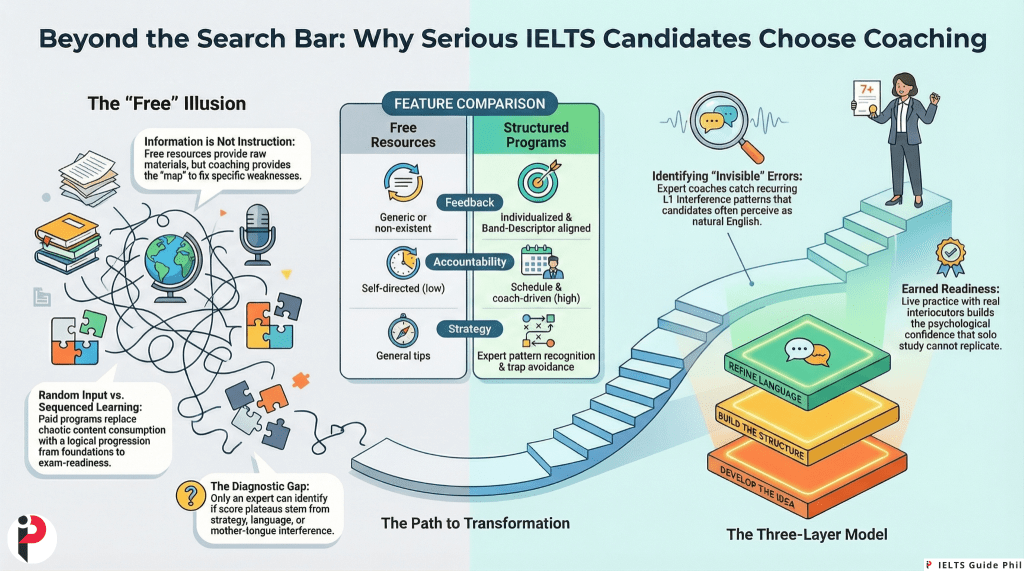
The internet is overflowing with free IELTS content. YouTube tutorials. Sample papers. Band 9 model answers. Grammar explainers. Vocabulary lists. Pronunciation guides. Podcast episodes. Reddit threads. Facebook groups. Blogs exactly like this one.
And yet — serious candidates, especially those aiming for Band 7 and above, keep enrolling in premium, paid, structured IELTS programmes. They pay coaches. They join intensive review classes. They invest in personalised feedback sessions.
Are they wasting their money?
Not even close.
This post makes the full case for why structured, paid IELTS instruction remains one of the smartest investments a serious candidate can make — even in the age of free information.
Part 1: The Free Resource Illusion
Before we defend paid classes, we need to be honest about what free resources actually offer — and what they cannot.
What free resources give you:
Free IELTS content gives you raw material. Sample questions. Practice tests. Explanations of task types. Vocabulary lists. Grammar rules. Listening exercises. They are genuinely useful. Nobody is saying otherwise.
What free resources cannot give you:
Free resources cannot watch you speak and tell you why your fluency score is stuck at 6.5. They cannot read your Task 2 essay and explain why your coherence is weak despite your grammar being clean. They cannot diagnose that the real reason your Reading score keeps dropping is not vocabulary — it is your skimming strategy. They cannot hold you accountable when life gets busy and you skip practice for two weeks.
Free resources give you information. They do not give you instruction.
This is the fundamental distinction that the entire conversation about paid classes rests on.
Part 2: What Paid, Structured IELTS Classes Actually Provide
Here is the comprehensive breakdown of what you are genuinely getting when you enrol in a quality IELTS programme — and why each element matters.
1. Expert Diagnosis of Your Actual Band Level and Specific Weaknesses
Most candidates do not know exactly why they are failing. They know their score. They do not know the cause.
A structured programme begins with diagnostic assessment — a mock test or skills audit that reveals not just your overall band but the specific sub-skills dragging you down.
Are you losing marks in Reading because of time management or because of question-type misreading? Are your Speaking scores suffering because of pronunciation, lexical resource, fluency, or grammatical range — or some combination of all four? Is your Writing Task 1 weak because of data interpretation, language accuracy, or task achievement?
Without expert diagnosis, you are guessing. And guessing wastes preparation time that you do not have.
Example: A Filipino candidate scored 6.0 overall with 5.5 in Speaking. She assumed her problem was vocabulary. After diagnostic assessment with an IELTS coach, the actual issue was identified as over-reliance on Filipino discourse patterns — specifically, she began most answers with hesitation fillers in Tagalog rhythm and avoided extending answers beyond two sentences. The fix was targeted: not vocabulary drills, but answer development techniques and discourse marker training. She retook the exam and scored 7.0 in Speaking.
You cannot get that diagnosis from a YouTube video.
2. Structured, Sequenced Learning — Not Random Content Consumption
Free content is abundant but chaotic. You watch a video on Task 2 opinion essays. Then you do a Reading practice test. Then you watch something on pronunciation. Then you find a vocabulary list for environment topics. Then you get distracted.
This is random input. It is not preparation.
Quality IELTS programmes are sequenced. They move from foundational skills to applied skills to exam-condition practice. They build knowledge in an order that makes sense — where each lesson builds on the previous one, and each week has a clear learning goal.
The structure itself is part of the value. Knowing what to study, in what order, for how long — that is a form of expertise that takes years to develop. A paid programme gives you that expertise on day one.
The IELTS Guide Phil approach: Every programme sprint follows the Three-Layer Model — Idea first, then Structure, then Language. You do not practise vocabulary until you can generate and organise ideas. You do not practise fluency until your thought structure is solid. Sequence matters.
3. Personalised, Detailed Feedback on Your Actual Output
This is the single biggest gap between free and paid preparation — and it is enormous.
When you write an essay and submit it to a free online forum, you might get a comment or two. Maybe someone says “good job” or “watch your grammar.” That is not feedback. That is noise.
When a trained IELTS coach marks your essay, they evaluate it against the actual four-band-descriptor criteria: Task Achievement, Coherence and Cohesion, Lexical Resource, and Grammatical Range and Accuracy. They tell you specifically which criterion is lowest, why it is low, what errors are recurring, and what you need to change.
When a coach listens to your speaking practice, they count hesitations, identify pronunciation patterns that impede communication, note where your discourse lacks extension or examples, and give you targeted correction — not general encouragement.
This is the difference between a mirror and a map. Free resources show you what IELTS looks like. Feedback shows you where you are and how to move forward.
For Filipino candidates specifically: Many IELTS errors made by Filipino test-takers are invisible to the test-taker themselves. Mother-tongue interference from Filipino and regional languages creates grammar patterns — like dropped articles, preposition errors, and subject-verb agreement issues in certain constructions — that feel completely natural because they are consistent with everyday Filipino English. Only an expert eye catches these patterns and names them.
4. Accountability and Commitment Structures
Human beings are not naturally disciplined. We are naturally distracted. Free resources ask nothing of you. You can stop watching at any moment, skip practice without consequence, and avoid the hardest tasks indefinitely.
Paid, structured classes create accountability by design. You have a schedule. You have assignments. You have a class or cohort expecting your participation. You have a coach who will notice if you did not submit your essay this week. You have tuition fees motivating you to get your money’s worth.
This is not a minor benefit. It is a major one.
Countless IELTS candidates have access to all the free materials in the world and still do not prepare consistently. The structure of a paid class — the calendar, the deadlines, the social accountability — is often the difference between a candidate who prepares seriously and one who intends to but never quite does.
Research in educational psychology consistently shows: Structured learning environments with external accountability produce significantly better outcomes than self-directed learning for most learners — not because people lack intelligence or motivation, but because motivation is a finite resource that depletes without reinforcement structures.
5. Exam Strategy and Pattern Recognition
IELTS is not purely a language test. It is also a test of exam strategy. And strategy is something that takes years of teaching experience to fully develop.
A seasoned IELTS coach knows which question types in Reading are highest-risk for time loss. They know which Speaking Part 2 topic categories cause most candidates to go blank. They know the common traps in Listening Section 3 that catch even strong English speakers. They know exactly what the Writing examiner is looking for in a Band 7 Task 2 paragraph versus a Band 6 one — and the difference is often not what candidates assume.
This kind of strategic intelligence is embedded in every lesson of a quality programme. It is not something you can fully replicate by watching free content, because it is born from watching thousands of candidates take the exam, make the same mistakes, and overcome them.
6. Speaking Practice with a Real Interlocutor
This one is non-negotiable.
You cannot fully prepare for the IELTS Speaking test by practising alone. You can record yourself. You can repeat answers in the mirror. You can repeat vocabulary in your head. But none of this replicates the cognitive demands of responding in real time to a real human being, managing the pressure of being evaluated, formulating answers while maintaining eye contact, and recovering gracefully from moments when your answer does not go as planned.
Paid classes give you structured speaking practice with a qualified trainer who can replicate the format of the test, give you real-time correction, push you with follow-up questions, and help you build the specific mental calm that the IELTS Speaking test demands.
For Filipino candidates — who typically have strong foundational English but often experience significant anxiety in formal speaking assessment contexts — this live practice component is especially critical.
7. Writing Correction with Band-Descriptor Alignment
Task 1 and Task 2 writing is the area where candidates most often overestimate their own performance. A candidate reads their own essay and thinks it is excellent. The examiner gives it a 6.0. Why?
Because self-assessment of writing is notoriously unreliable. We cannot see our own gaps. We read what we intended to write, not what we actually wrote. We assume our logic is clear because it is clear to us.
A trained IELTS writing coach reads what you actually wrote. They apply the band descriptors objectively. They identify where your Task Achievement falls short, where your cohesion devices are mechanical or missing, where your vocabulary range is limited or inaccurate, and where your grammatical complexity is insufficient or error-prone.
This quality of writing feedback is simply impossible to get from free resources alone.
8. A Cohort of Serious Learners
One underrated element of structured IELTS programmes is the peer environment. When you are in a class with other serious, motivated candidates — people who have paid to be there and are committed to hitting their target band — the social energy of that environment lifts your own standards.
You hear how other candidates answer Speaking questions. You see how other candidates structure their essays. You learn from their mistakes without making them yourself. You feel the productive pressure of not being the least-prepared person in the room.
This peer dynamic does not exist in solo free-resource consumption. It is one of the real, tangible benefits of structured classroom or cohort learning.
9. Emotional and Psychological Preparation
The IELTS examination is stressful. For many Filipino candidates — especially those whose visa, migration, professional registration, scholarship, or career advancement depends on the score — the psychological weight of the exam is enormous.
A quality IELTS programme does not just teach language skills. It builds exam confidence. It normalises the test format through repeated exposure. It gives candidates a sense of earned readiness — the feeling that comes from weeks of structured preparation and confirmed progress.
This psychological component is real and measurable. Candidates who walk into the exam having completed a rigorous preparation programme feel categorically different from candidates who prepared informally. Confidence in high-stakes assessment is a skill. It is built, not assumed.
10. Efficient Use of Your Most Finite Resource: Time
Perhaps the strongest argument for paid, structured IELTS classes is time efficiency.
Free resource preparation is typically slow and meandering because it has no design. You spend time finding materials. You spend time wondering if what you are studying is relevant. You study things you do not need. You miss things you do. You repeat effort unnecessarily.
Structured programmes are engineered for efficiency. Every lesson has a purpose. Every activity targets a specific skill or descriptor. Every week advances your preparation toward a measurable goal. The curriculum has been designed by someone who has already spent years figuring out what works — so you do not have to figure it out yourself.
For candidates balancing work, family, and exam preparation — which is most Filipino IELTS candidates — this efficiency is not a luxury. It is a necessity.
Part 3: Dos and Don’ts for Getting Maximum Value from Paid IELTS Classes
DOS
Do choose a class led by a qualified, experienced IELTS teacher — not just a fluent English speaker. IELTS band descriptors are technical documents. Teaching to them requires specific training and experience.
Do treat every assignment as a real exam condition. The value of structured classes multiplies when you take the homework seriously. Submit your essays. Record your speaking answers. Do the full timed reading tests.
Do ask your coach to explain the why behind every correction. Understanding the band-descriptor reason behind feedback transforms a correction into a learning principle you can apply independently.
Do use free resources to supplement your structured programme. Free content is excellent for extra vocabulary exposure, additional reading practice, and listening immersion. Use it to add volume to your preparation, not to replace structure.
Do track your progress across the four skills explicitly. Keep a preparation journal. Record your mock test scores each week. Note recurring errors. Measure improvement. Progress visibility sustains motivation.
Do communicate your target band and personal deadline to your coach on day one. A good coach will calibrate your programme accordingly.
Do bring your actual struggles to class. The topics you find most difficult, the question types that confuse you most, the Speaking topics that make you blank — bring these explicitly. Class time is most valuable when it is targeted at real gaps.
DON’TS
Don’t attend class passively. Listening and nodding is not learning. Active participation — attempting every task, asking questions, volunteering answers, requesting clarification — is what produces growth.
Don’t skip speaking practice because it feels embarrassing. The discomfort of speaking in front of others in class is exactly the discomfort you need to overcome before the exam. Use the class environment to build tolerance for evaluation pressure.
Don’t assume your coach’s feedback is about your intelligence. IELTS band scores measure test-specific performance skills, not intellectual ability. A Band 6 essay from a brilliant person is still a Band 6 essay. Separate your ego from your score.
Don’t rely exclusively on paid classes without independent daily practice. Two or three class hours per week are not enough on their own. The class is the engine; daily practice is the fuel.
Don’t compare your progress to classmates. IELTS preparation is not a competition against your cohort. It is a personal journey toward your target band. Some skills develop quickly; others take longer. What matters is your own trajectory.
Don’t stay in a class that is not giving you specific, actionable feedback. Not all paid classes are equal. If your coach only gives general encouragement without specific band-descriptor analysis, you are not in the right programme.
Don’t leave the exam date decision to chance. Work backward from your target exam date when you start your programme. Structure your preparation timeline so your final intensive weeks fall right before you sit.
Part 4: Common Mistakes Candidates Make — and How to Fix Them
Mistake 1: Enrolling in a class but not doing the work between sessions
This is the most common failure pattern in paid IELTS preparation. Candidates pay, attend, listen — and do nothing between lessons.
Fix: Commit to a minimum of one hour of independent IELTS practice on every day that you do not have class. Make it non-negotiable. Writing, reading, listening, or speaking — something every day.
Mistake 2: Treating the class as the totality of preparation rather than the spine of preparation
Some candidates feel that attending class is preparation enough. It is not. Class is the structure. Practice is the substance.
Fix: Think of your IELTS programme as a training schedule. The coach is the trainer. The gym session is the class. But you also need to run, stretch, and condition yourself independently every day.
Mistake 3: Choosing a class based on price alone
The cheapest class is not automatically the least effective, and the most expensive is not automatically the best. Many candidates choose purely on cost without evaluating the qualification and experience of the coach, the quality of feedback systems, or the track record of the programme.
Fix: Before enrolling, ask: Is the coach a certified IELTS trainer or examiner? Do students receive individual written feedback on essays? Are mock tests conducted under realistic conditions? What is the average score improvement of programme graduates?
Mistake 4: Starting a programme too close to the exam date
Meaningful band score improvement — especially crossing from Band 6 to Band 7 — typically requires eight to twelve weeks of consistent, structured preparation. Candidates who enrol two or three weeks before the exam date cannot benefit fully from even the best programme.
Fix: Plan your preparation timeline as your first step. Determine your target exam date. Count back at least eight to ten weeks. That is your enrolment date.
Mistake 5: Focusing all attention on weakest skills while ignoring strong ones
It feels logical to spend all your time on your lowest-scoring skill. But if you neglect your strongest skills entirely, they can deteriorate — and IELTS scores are averaged across all four skills.
Fix: Allocate roughly sixty percent of your preparation time to weak skills and forty percent to maintaining and optimising your stronger ones.
Mistake 6: Memorising model answers instead of understanding the principles behind them
Some candidates spend enormous time memorising Band 9 model essays and model Speaking answers. This strategy backfires. Examiners are trained to identify memorised responses, and a memorised answer that does not fit the question perfectly scores very poorly.
Fix: Study model answers to understand the principles — the structure, the evidence type, the cohesion devices, the vocabulary range. Then generate your own answers applying those principles. Understanding, not memorisation, is the goal.
Mistake 7: Assuming that improvement in general English automatically translates to IELTS score improvement
General English proficiency and IELTS band score are related but not the same thing. IELTS measures specific performance tasks under specific conditions. A candidate can have excellent everyday English and still underperform in IELTS because they have not practised the specific task types.
Fix: Use your structured programme to specifically practise IELTS task types — not just general English exercises. Task-specific practice is irreplaceable.
Part 5: Frequently Asked Questions
Q1: Is a paid IELTS class worth it if I already have a high level of English?
Yes — but for different reasons. High-level English speakers often plateau at Band 7 because their challenge is not language proficiency but IELTS-specific technique. Task 1 report writing conventions, Writing Task 2 argumentative structure, Speaking Part 3 abstract discussion skills, and Reading time management are all test-specific skills that require specific training regardless of your general English level.
Q2: How long should I attend a paid IELTS programme before sitting the exam?
The minimum recommended preparation period for meaningful improvement is eight weeks of intensive study. Twelve weeks is ideal for candidates starting from Band 5.5 or below. Candidates at Band 6.5 targeting 7.5 or above may benefit from focused four-to-six-week sprint programmes targeting specific skill gaps.
Q3: Can I combine free resources with a paid programme?
Absolutely — and this is actually the recommended approach. Use your paid programme for structure, feedback, and accountability. Use free resources for supplementary vocabulary building, additional listening exposure, and extra reading practice. The two complement each other well.
Q4: What should I look for in a quality IELTS coach or programme?
Look for: formal IELTS training or examiner background, written band-descriptor feedback on essays and speaking, mock tests under realistic timed conditions, individualised attention (not just group lectures), a clear curriculum structure, and a verifiable track record of student improvement.
Q5: I failed IELTS twice studying on my own. Should I try a paid class?
Yes — and the two failed attempts actually make the case for it more strongly. You already know that self-directed preparation has not worked for you. A structured programme with expert diagnosis will identify exactly why your scores are stuck and give you a targeted plan to move past them.
Q6: Are online paid IELTS classes as effective as face-to-face?
High-quality online IELTS programmes delivered by experienced coaches with consistent feedback systems are genuinely effective. The modality matters less than the quality of instruction and feedback. That said, for Speaking preparation specifically, live video interaction is strongly preferable to asynchronous recordings.
Q7: Is it worth paying for IELTS classes if my target band is just 6.0?
Yes — because even Band 6.0 requires consistent, deliberate preparation, and many candidates underestimate the difficulty. Arriving at Band 6.0 reliably and on your first attempt is worth far more than attempting it unprepared multiple times. Retake fees add up quickly and are far more expensive than a quality preparation programme.
Q8: What if I cannot afford expensive classes?
Not all quality IELTS programmes are prohibitively expensive. Community-based programmes, university preparation classes, and smaller independent coaches often offer very high-quality instruction at accessible prices. The key variable is the quality of the coach and the quality of feedback — not the price point. Research options in your area and ask specifically about the feedback system before enrolling.
Q9: How do I know if a paid class is actually helping me?
Track your mock test scores before, during, and after the programme. Effective preparation should produce measurable score improvement within four to six weeks of serious work. If your scores are flat after six weeks of consistent effort and attendance, discuss this directly with your coach — a good one will adjust your programme accordingly.
Q10: What makes the IELTS Guide Phil approach different from generic IELTS classes?
The IELTS Guide Phil Method is built on three pillars that separate it from template-based instruction. First, the Three-Layer Model for Writing — Idea before Structure before Language — ensures that candidates develop genuine writing thinking rather than formulaic production. Second, the Speaking Cycle — Thought before Organisation before Delivery — builds real communicative competence rather than scripted performance. Third, every programme element is tailored specifically for Filipino candidates, addressing the exact L1 interference patterns, pronunciation contrasts, and test-taking psychology that are most relevant to the Philippine context. The goal is never just to pass IELTS — it is to produce a genuinely more capable communicator.
Final Word: Information Is Everywhere. Transformation Requires a Coach.
We live in an age of radical information abundance. Whatever you want to learn, you can find it online — for free, in seconds.
But information and instruction are not the same thing. Knowing what to do is not the same as being able to do it. And knowing what to do but having no accountability structure, no feedback mechanism, and no sequenced plan is often worse than knowing nothing — because it creates the illusion of preparation without the substance.
Serious IELTS candidates — especially those with real stakes riding on their score — understand this. That is why they invest in structured, expert-led preparation even when free alternatives are everywhere.
The question was never: Can I find IELTS materials for free?
The question was always: Can I get the score I need, in the time I have, with what I am doing now?
If the answer to that second question is no — a quality paid programme is not an expense. It is the solution.
Published under IELTS Guide Phil | Tuguegarao City | Northeastern Philippines
Listen with concentration. Read with composure. Write with clarity. Speak with confidence.
#IELTSGuidePhil #IELTSPhilippines #IELTSPreparation #IELTSCoaching #IELTSClasses #IELTSReview #IELTSFilipino #IELTSBand7 #IELTSWriting #IELTSSpeaking #IELTSReading #IELTSListening #IELTSTips #IELTSStrategy #IELTSSuccess #LearnEnglishPhilippines #EnglishCoachPH #IELTSCagayan #IELTSNorthernPhilippines #PaidIELTSClasses #IELTSIsWorthIt #ThreeLayerModel #SpeakingCycle #IELTSGuidePhilMethod
 IELTS Guide Phil
Leave a comment