
— And What Smart Candidates Do Instead —
There is something deeply human about turning to a crowd when you are afraid. When the IELTS exam looms and the pressure mounts, the most natural thing in the world is to open Facebook, scroll into a group with 200,000 members, and type: “Any tips for tomorrow’s exam? Speaking Part 2 tips please. Band 7 target.”
Within minutes, the replies pour in. Dozens of strangers offering advice, predictions, guesses, and recycled templates. It feels like help. It looks like a community. But for most candidates, it is one of the most quietly destructive habits in IELTS preparation — and this post will explain exactly why, and what you should do instead.
Understanding the Problem: What “Social Media Tips” Actually Are
Before we discuss strategy, let us be honest about the nature of the content that circulates in IELTS groups and comment threads on platforms like Facebook, TikTok, YouTube Shorts, and Telegram.
Most social media IELTS tips fall into one of the following categories:
Category A — The Well-Meaning but Unqualified Advice These come from fellow test-takers who recently sat the exam and are sharing their personal experience. Their intentions are good. But their band score, their test date, their version of the test, and their interpretation of what helped them are all variables that may have zero relevance to your situation.
Category B — The Template Merchants These are posts or reels that offer fill-in-the-blank scripts. “Say I would like to talk about… then give three points.” These templates are seductive because they feel like shortcuts. But they are often penalised by trained examiners as rehearsed, unnatural, and formulaic — the exact opposite of what communicative competence looks like.
Category C — The Prediction Posts “Topic for tomorrow’s exam: Environment.” “Speaking Part 1: Daily routine.” These circulate constantly and are almost always either fabricated, outdated, or so broad as to be useless. British Council, IDP, and Cambridge do not telegraph exam content on social media. Anyone who claims otherwise is guessing — or worse, deliberately misleading you.
Category D — The Recycled Screenshot Advice A screenshot of a “Band 9 answer” gets shared thousands of times across groups. No one verifies whether it actually received Band 9. No one checks if the strategy is still current. No one asks whether the examiner’s marking was accurately reported. The content spreads because it looks credible, not because it is.
Category E — The Algorithm-Optimised Coach Content Not all coach content on social media is bad. But a significant portion is designed to maximise engagement, not learning. A thirty-second reel with a catchy hook tells you the “one trick” to Band 7 Speaking because that gets shares — not because one trick exists.
Why This Strategy Fails: The Deep Reasons
IELTS Does Not Reward Tips — It Rewards Competence
The IELTS exam, at its core, measures your ability to use the English language to communicate real ideas clearly, coherently, and accurately. The four assessment criteria for Writing and Speaking — Task Achievement/Response, Coherence and Cohesion, Lexical Resource, and Grammatical Range and Accuracy — are not checklist items you can satisfy by following someone’s Facebook advice. They are the product of months or years of genuine language development.
A tip like “use three complex sentences in each paragraph” does not build grammatical range. It builds the illusion of grammatical range — one that trained examiners immediately see through because the complexity is forced, inconsistent, and unnatural.
The Source Has No Accountability
When a qualified IELTS teacher gives you wrong advice, there are professional, reputational, and ethical consequences. When a stranger in a Facebook group gives you wrong advice, they face none. They will never know your score. They will never know the damage their confident-sounding post caused. The asymmetry between their confidence and their accountability is enormous.
Context Collapse
You are preparing for a specific test version (Academic or General Training), on a specific date, in a specific test centre, with a specific English language background shaped by Filipino. A piece of advice from someone who took the GT module six months ago in the UAE, whose first language is Arabic, and who was targeting Band 6, has almost no relevant context overlap with your situation. But social media strips all context out. The tip floats free of its origin and lands in your feed looking universal.
It Creates a False Sense of Preparation
This is perhaps the most insidious effect. Spending two hours scrolling IELTS groups feels productive. You are reading. You are engaging. You are thinking about the exam. But passive consumption of tips is not the same as active skills development. You can spend three months “preparing” by reading Facebook posts and make almost zero measurable progress on your actual band score. The feeling of preparation replaces the reality of preparation.
It Breeds Dependency on External Inputs
Smart IELTS preparation is about internalising a process — a thinking method, an analytical framework, a language habit — that you can deploy independently on any topic, any task, any question. When you rely on social media tips, you are always dependent on the next piece of external information. What if no one posts a tip the morning of your exam? What if the “predicted topic” is wrong? Your preparation has no internal foundation.
Filipino Candidates Face a Specific Compounding Risk
For Filipino IELTS candidates, L1 interference from Filipino and Tagalog is already a documented challenge — particularly in pronunciation, grammatical structures (verb-subject-object patterns, omission of articles, use of “po” discourse fillers), and writing register. Social media tips do not address these specific transfer issues. They offer generic advice that was not designed with Filipino language patterns in mind. Following generic tips while your specific challenges go unaddressed is like taking vitamins when what you need is surgery.
The Specific Dangers of Pre-Exam Social Media Panic
One of the most damaging social media IELTS habits is the last-minute panic scroll — logging into Facebook groups the night before or the morning of your exam to absorb as much advice as possible.
Here is what this actually does to you:
It fragments your focus. Your brain needs consolidation and calm before a high-stakes performance. Flooding it with contradictory inputs the night before splinters your attention and undermines the routines you have built.
It introduces untested strategies. Trying a “tip” you read at 11pm for an exam at 8am is not preparation. It is improvisation. New strategies require practice before they become reliable under pressure.
It activates comparison anxiety. Reading about other people’s preparation, scores, and experiences the night before triggers the most unhelpful question a test-taker can ask: Am I ready enough? That question has no good answer at that stage. It only produces anxiety.
It distorts your natural voice. In Speaking especially, your authentic communicative style — the thing the examiner is actually assessing — gets suppressed when you are mentally rehearsing templates you absorbed from someone else’s post. Your answers become robotic. Your fluency drops. Your eye contact suffers. You sound like a person trying to remember someone else’s advice rather than a person trying to communicate an idea.
What Smart IELTS Candidates Do Instead
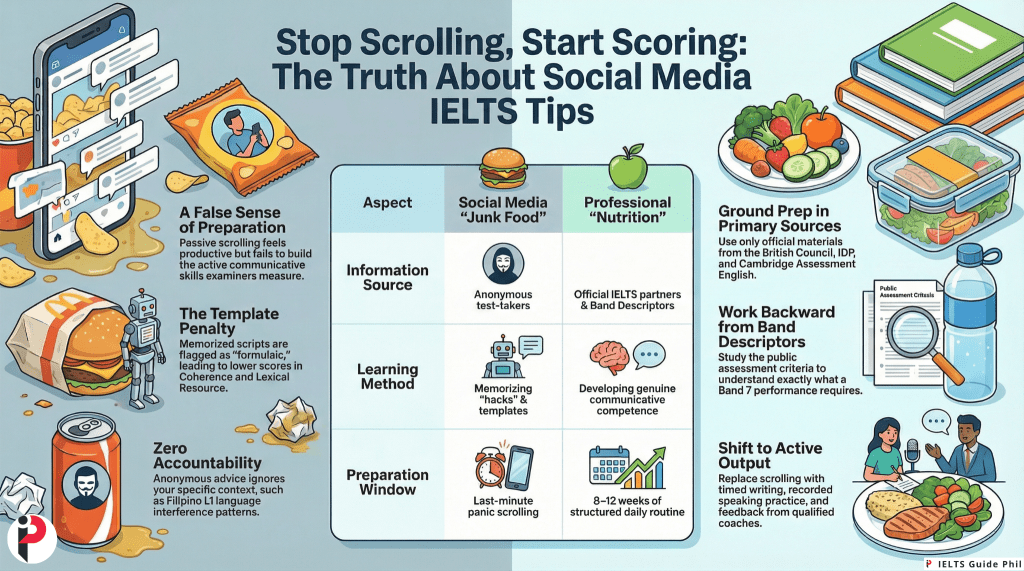
If social media tips are the junk food of IELTS preparation, here is what the nutritional alternative looks like:
Go to Primary Sources
The most reliable IELTS information on the planet is free and publicly available from the people who actually design and administer the test:
- British Council: ielts.org/ielts-for-organisations/test-takers-overview
- IDP: ieltsidpphilippines.com
- Cambridge Assessment English: cambridgeenglish.org/exams-and-tests/ielts
These sources tell you exactly what the exam measures, how it is scored, what the band descriptors look like, and what official practice materials are available. If your preparation is not grounded in these sources, it is grounded in noise.
Work From the Band Descriptors Backward
The IELTS Writing and Speaking band descriptors are publicly available. Print them. Study them. Every preparation activity you do should be traceable back to a specific descriptor at the band level you are targeting. Ask yourself: What does a Band 7 Lexical Resource performance actually look like? What specific vocabulary choices distinguish Band 6 from Band 7? These are answerable questions — but not from Facebook.
Build a Consistent Daily Practice Routine
IELTS is a performance skill. Like playing an instrument or running a race, you develop it through consistent, structured repetition over time — not through tips consumed the week before the exam. A daily routine might include:
- 20 minutes of timed Reading practice on academic texts
- 15 minutes of Listening to authentic academic audio (TED Talks, BBC World Service, university lectures)
- One full Writing Task response per week, self-evaluated against the band descriptors
- Daily Speaking practice with recorded responses and self-review
Get Structured Feedback From a Qualified Source
One piece of feedback from a trained IELTS teacher on a real Writing task you produced is worth more than one thousand Facebook tips. Good feedback is specific, referenced to the band descriptors, and actionable. It tells you exactly what to improve and how. No social media post can do this for you because no social media post has seen your writing.
Use the Three-Layer Model for Writing
When preparing your Writing responses, work through these three layers in sequence:
Layer 1 — Idea: Do you have a clear, relevant, and fully developed response to the task? Is your position consistent throughout?
Layer 2 — Structure: Is your essay logically organised? Do your paragraphs have clear central ideas? Are your cohesive devices used naturally, not mechanically?
Layer 3 — Language: Is your vocabulary precise and varied? Are your sentences grammatically accurate and structurally diverse?
Most social media tips operate exclusively at Layer 3 — surface language tricks. But examiners read all three layers simultaneously.
Use the Speaking Cycle for Oral Responses
For Speaking preparation, train yourself through this cycle:
Thought → Organisation → Delivery
Before you speak, generate a real idea. Before you deliver, organise it briefly. When you deliver, prioritise natural communication over performance. This cycle is what examiners are trained to recognise as genuine communicative competence — and it cannot be replaced by a script you memorised from a reel.
Simulate Exam Conditions Regularly
Timed, full-length practice under realistic conditions is the single most underused preparation strategy among Filipino candidates. Most candidates practise in low-pressure environments — open-book, no timer, no recording — and are then surprised when performance drops under actual exam pressure. Simulate the pressure. Record your Speaking. Time your Writing. Review your own output critically.
Dos and Don’ts
✅ DO:
- Use official Cambridge, British Council, and IDP resources as your primary materials
- Study the publicly available band descriptors for Writing and Speaking
- Practise timed, full-length tasks under exam conditions regularly
- Seek feedback from a qualified, trained IELTS coach who can reference the descriptors
- Build a daily practice habit at least 8–12 weeks before your exam date
- Analyse authentic model answers and identify exactly which descriptor criteria they satisfy
- Record your Speaking responses and evaluate them honestly against fluency, vocabulary, grammar, and pronunciation criteria
- Approach IELTS as a genuine communicative competence development project, not a test-gaming exercise
❌ DON’T:
- Ask for “tips” in Facebook groups or Telegram channels the night before your exam
- Rely on “predicted topics” from social media — these are guesses, not intelligence
- Memorise scripted templates for Speaking — examiners are trained to detect and penalise them
- Use a strategy you read on social media that you have not had time to practise and internalise
- Assume that a tip that worked for someone else will work for you — context always matters
- Treat scrolling IELTS content as a substitute for active, productive practice
- Let social media comparison anxiety distort your confidence the night before your exam
- Believe anyone who claims to know the exact topics or questions that will appear on your specific test date
Common Mistakes and Fixes
Mistake 1: “I joined five IELTS Facebook groups and I read every post. I feel prepared.”
Fix: Passive content consumption is not preparation. Audit how you actually spent your study hours. How many full Writing tasks did you complete? How many Speaking responses did you record and review? If the answer is “not many,” you have been mistaking engagement for learning. Shift immediately to active, output-based practice.
Mistake 2: “Someone posted a Band 9 essay template. I memorised the structure.”
Fix: Template memorisation is one of the most heavily penalised strategies in IELTS Writing. Examiners specifically flag responses that appear pre-written or formulaic under the Task Achievement and Coherence and Cohesion criteria. Instead, practise generating your own argument structure in response to the actual task prompt. The structure should emerge from your thinking about the specific question, not from a memorised skeleton.
Mistake 3: “I asked in a group what topics usually come out and prepared only those.”
Fix: IELTS uses a rotating question bank. There is no reliable way to predict which specific task will appear on your test date. Preparing only predicted topics leaves you catastrophically exposed to any question outside that narrow set. Broad preparation across many topic areas — society, education, technology, environment, health, economics, culture — is always superior to narrow prediction-based preparation.
Mistake 4: “A Facebook post told me to use the word ‘plethora’ to sound academic. I used it five times.”
Fix: Lexical resource is assessed on range, precision, and appropriacy — not on the presence of specific “high-scoring words.” Overusing a single advanced word is actually evidence of limited range. Develop a genuine vocabulary system built around topic-specific collocations, formal register awareness, and precise word choice rather than individual trophy words.
Mistake 5: “I got nervous the night before and spent three hours in an IELTS group reading everyone’s experiences.”
Fix: The night before your exam is not a preparation window — it is a recovery and consolidation window. Your preparation should have been completed days earlier. The night before, review your test centre logistics, sleep well, eat a proper meal, and trust the work you have already done. No tip you read at midnight will improve your performance at 8am. It will only disrupt it.
Mistake 6: “I followed a TikTok coach’s advice to start every Speaking answer with ‘That’s a great question, I’d say…’ to buy time.”
Fix: Fillers that are obviously designed to stall are penalised under Fluency and Coherence. Examiners are specifically trained to identify them. If you need thinking time, you are allowed to pause briefly and naturally — that is not penalised. What is penalised is formulaic delay tactics. Instead, practise thinking and speaking simultaneously about a wide range of everyday topics so you do not feel the need for artificial openers.
Mistake 7: “Someone in a group said Writing Task 1 should always be exactly 200 words.”
Fix: The official minimum for Task 1 is 150 words. Writing exactly 200 words is not a rule — it is one person’s personal approach. What matters is that you cover all required content elements accurately and cohesively within a logical structure. Word count beyond the minimum should be driven by the task requirements, not by a social media prescription.
Frequently Asked Questions
Q1: But what if I find genuinely useful IELTS content on social media? Isn’t it okay to use it?
A: Not all social media content is equally unreliable. Content produced by verified, credentialed IELTS teachers who reference official band descriptors and Cambridge-certified materials can be genuinely useful. The key is source evaluation. Ask: Who produced this? What are their qualifications? Is this grounded in official IELTS criteria or in personal opinion? Is this content designed to build a skill, or to perform well on the algorithm? Apply those filters and you will immediately be able to separate the useful from the noise.
Q2: I don’t have money for a private coach. Social media tips are free. What else can I do?
A: Free, high-quality IELTS preparation is absolutely possible without social media tips. Cambridge’s official website offers free sample materials. The British Council’s IELTS preparation hub has free resources. YouTube channels operated by Cambridge-certified teachers — not random test-takers — offer structured instruction. The IELTS band descriptors themselves are free to download. Your best free strategy is: download the descriptors, complete Cambridge practice tasks under timed conditions, record your Speaking, and self-evaluate against the descriptors. This costs nothing except time and discipline.
Q3: My friend followed social media tips and got Band 7. Doesn’t that prove it works?
A: Your friend’s Band 7 was the result of their cumulative English language development — likely years of education, reading, and exposure — not the specific tips they followed in the final weeks. The tips may have been coincidentally harmless, or they may have succeeded despite the tips rather than because of them. Correlation is not causation. One data point is not evidence of a reliable strategy.
Q4: Is it wrong to be part of IELTS Facebook groups at all?
A: No. IELTS communities can provide motivation, moral support, and accountability — all of which are genuinely valuable during a demanding preparation journey. The problem is not community. The problem is mistaking social engagement for skill development. You can be in a group for encouragement without using that group as your primary source of exam strategy.
Q5: What about IELTS coaches who post content on social media? Isn’t that the same problem?
A: There is a meaningful difference between a qualified IELTS teacher using social media as a delivery channel for structured instruction and an anonymous stranger posting recycled tips. A credentialed coach who explains why a writing technique works — referencing the specific descriptor it addresses — is doing something fundamentally different from someone posting “use these 10 phrases and score Band 7.” Evaluate the content on its depth, accuracy, and grounding in official criteria, not merely on the platform it appears on.
Q6: I have my exam in two days. What should I do right now?
A: Stop preparing new material immediately. At two days out, no new tip, strategy, or vocabulary list will improve your performance — but anxiety, sleep deprivation, and information overload can seriously damage it. Spend the next 48 hours doing the following: review one short piece of official Cambridge material to feel settled and grounded; do one brief, low-pressure Speaking practice to warm up your voice and thinking; organise your test centre logistics (ID, location, time, transport); sleep properly; eat well. The preparation window has closed. Now you manage your performance state.
Q7: Why do so many IELTS candidates still rely on social media tips if it doesn’t work?
A: Because it is easy, immediate, and socially reinforced. Social media tips require no effort to consume. They provide the psychological comfort of feeling informed. And everyone else in your peer group is doing it, which creates a false sense of validity — if 200,000 people are in this group, surely the advice must be good. This is a cognitive bias called social proof, and it is extremely powerful. Recognising it is the first step to moving beyond it.
The Bigger Picture: What IELTS Actually Measures
This post has focused on social media strategy, but the deeper point is about the nature of the IELTS exam itself.
IELTS is not a trivia contest where knowing the right tips unlocks the right score. It is a proficiency assessment — a measurement of your actual ability to use English in real academic and professional contexts. The band descriptors describe genuine language behaviours: coherent argumentation, flexible vocabulary use, natural spoken fluency, accurate grammatical production. These behaviours cannot be faked by tips. They can only be developed through sustained, deliberate, structured practice over time.
The candidates who consistently achieve Band 7 and above are almost never the ones who found the perfect tip. They are the ones who built real skills — systematically, patiently, and with qualified guidance — and walked into the exam ready to simply communicate, not to perform a strategy they memorised from a Facebook comment.
That is the candidate you want to be.
Final Thought
There is a hill in Solana that overlooks Tuguegarao City across the Cagayan River. From that hill, the city looks manageable — small, clear, graspable. IELTS preparation at its best gives you that same elevated vantage point: you see the whole landscape clearly, you know where you are going, and the path beneath your feet is solid because you built it with real work.
Social media tips offer the opposite: a ground-level scramble through noise, with no map, no altitude, and no solid ground.
Build the hill. Take the view. Then walk into that exam knowing that what you carry is yours — not borrowed from a stranger’s post, not assembled from last-minute predictions, but earned through genuine preparation.
That is how Band 7 is built. That is how confidence is earned.
Written for Filipino IELTS candidates who deserve better than recycled tips.
— IELTS Guide Phil
Hashtags:
#IELTSGuidePhil #IELTSPhilippines #IELTSTips #IELTSPreparation #IELTSBand7 #IELTSSpeaking #IELTSWriting #IELTSReading #IELTSListening #IELTSCoach #IELTSOnline #IELTSCoaching #IELTSFilipino #IELTSPh #EnglishForFilipinos #IELTSStrategy #IELTSMistakes #IELTSBandScore #IELTSAcademic #IELTSGeneralTraining #SmartIELTSPrep #IELTSTakeItSeriously #IELTSNotAHack #IELTSRealTalk #CommunicativeCompetence #BandDescriptors #OfficialIELTS #IELTSExamDay #IELTSPhilippines2026
 IELTS Guide Phil
Leave a comment