
What Even Is IELTS?
IELTS stands for International English Language Testing System. It is a globally recognised exam that measures how well you can use English in real-life academic and professional situations.
It was developed jointly by three major organisations: British Council, IDP: IELTS Australia, and Cambridge Assessment English. These three bodies administer the test worldwide, including here in the Philippines.
Think of IELTS as your passport inside a passport. You already have a Philippine passport to travel. IELTS is the proof that you can actually function in an English-speaking environment once you arrive.
Who Needs to Take IELTS?
You need IELTS if you are:
- Applying to study at a university in the UK, Australia, Canada, New Zealand, or Ireland
- Migrating to Australia, Canada, New Zealand, or the UK
- Applying for a professional registration (nursing, medicine, engineering, teaching) in English-speaking countries
- Applying for certain visas, including UK Skilled Worker visas
- Seeking admission to some universities in the US (though many US schools prefer TOEFL)
If your goal involves leaving the Philippines to study, work, or live abroad in an English-speaking country, there is a very strong chance IELTS is standing between you and that goal.
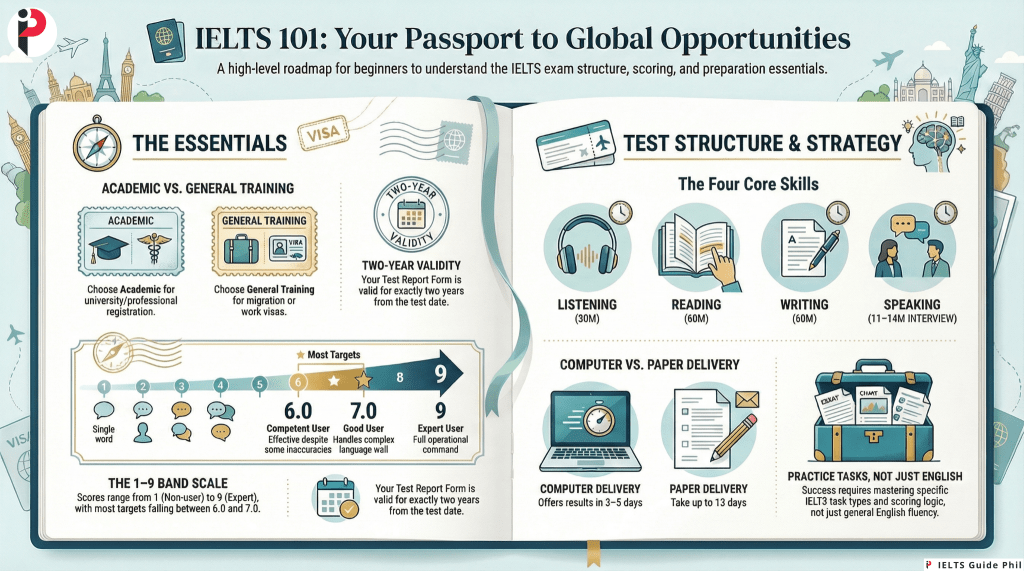
The Two Versions of IELTS: Academic vs. General Training
This is the first and most critical decision every beginner must make.
IELTS Academic is for people applying to undergraduate or postgraduate study, or professional registration (like nursing boards in the UK or Australia). The reading and writing tasks are more complex and use academic-style texts and essay formats.
IELTS General Training is for people applying for migration (PR in Australia or Canada, for example) or secondary education and work experience programmes. The reading uses workplace and everyday texts. The writing includes a letter-writing task instead of an academic graph/chart task.
Both versions share the same Listening and Speaking tests. The difference lies in Reading and Writing.
Quick rule of thumb:
- University or professional registration → Academic
- Migration or work visa → General Training
- Not sure → check the specific requirements of your target institution or visa category
The Four Skills Tested
IELTS tests exactly four skills, in this order on test day:
1. Listening — approximately 30 minutes plus 10 minutes transfer time (in paper-based format). You listen to four recorded sections — conversations and monologues — and answer 40 questions.
2. Reading — 60 minutes. You read three long passages (Academic) or a mix of shorter texts (General Training) and answer 40 questions. No extra time is given to transfer answers.
3. Writing — 60 minutes. You complete two tasks. Task 1 is shorter (minimum 150 words). Task 2 is the essay (minimum 250 words). Task 2 carries more weight in your score.
4. Speaking — approximately 11 to 14 minutes. This is a face-to-face interview with a certified IELTS examiner. It has three parts: an introduction and interview, a short individual talk (the cue card), and a two-way discussion.
How IELTS Scores Work: The Band Scale
IELTS uses a Band Scale of 1 to 9. Each whole number and half number (e.g., 6.5, 7.0, 7.5) represents a level of English proficiency.
Here is a quick reference:
- Band 9 — Expert user. Full operational command of English.
- Band 8 — Very good user. Occasional inaccuracies.
- Band 7 — Good user. Handles complex language well. Some inaccuracies.
- Band 6 — Competent user. Generally effective despite some inaccuracies.
- Band 5 — Modest user. Partial command; frequent mistakes.
- Band 4 and below — Limited to extremely limited proficiency.
You receive a band score for each of the four skills and an Overall Band Score, which is the average of the four, rounded to the nearest whole or half band.
Example: Listening 7.0 + Reading 6.5 + Writing 6.0 + Speaking 7.0 = 26.5 ÷ 4 = Overall Band 6.5
Most universities require an overall band of 6.0 to 7.0, often with minimum scores per module. Australian PR migration typically requires Competent English (Band 6) or Proficient English (Band 7), depending on the visa subclass.
IELTS on Paper vs. IELTS on Computer
As of 2026, IELTS has been transitioning toward computer-delivered testing at most test centres. This means:
- Listening, Reading, and Writing are done on a computer
- Speaking remains face-to-face with a human examiner
- Results are typically available within 3 to 5 days for computer-delivered tests, versus up to 13 days for paper-based
The content and scoring criteria are identical. Your band score will not be higher or lower simply because of the delivery format. The choice comes down to your typing speed, comfort with screens, and test centre availability in your area.
What IELTS Does NOT Test
Many beginners assume IELTS tests grammar in isolation — like a fill-in-the-blank grammar exercise. It does not.
IELTS tests your ability to communicate effectively. Examiners are trained to assess how well you use English to convey meaning, not just whether you can label a sentence as passive voice or identify a gerund.
This means:
- Perfect grammar with nothing to say will not give you Band 7
- A rich idea expressed with some grammatical errors can still score well if communication is clear
- Memorised phrases and templates are detectable and penalised
- Vocabulary range, accuracy, and appropriateness matter more than using the longest word you know
The Four Writing and Speaking Assessment Criteria
Whether in Writing or Speaking, every response is assessed on four equally weighted criteria:
Writing Task 2 (and Task 1):
- Task Achievement / Task Response — Did you answer the question fully and relevantly?
- Coherence and Cohesion — Is your writing logically organised and well-connected?
- Lexical Resource — How varied, accurate, and natural is your vocabulary?
- Grammatical Range and Accuracy — How varied and accurate is your grammar?
Speaking:
- Fluency and Coherence — Can you speak at length without excessive hesitation?
- Lexical Resource — Same as writing
- Grammatical Range and Accuracy — Same as writing
- Pronunciation — Can you be understood clearly? (Does not mean accent elimination)
Understanding these criteria is non-negotiable. Every minute of preparation you invest should be measured against these four criteria.
Common Mistakes Beginners Make (And How to Fix Them)
Mistake 1: Studying English generally instead of studying IELTS specifically
Fix: IELTS has specific task types, question formats, and scoring logic. Watching Netflix improves your general English. Studying IELTS task types improves your band score.
Mistake 2: Ignoring the Writing module until the week before the test
Fix: Writing takes the longest to improve because it requires feedback, revision, and internalised grammar habits. Start writing practice essays on Week 1.
Mistake 3: Memorising essay templates word-for-word
Fix: Examiners are trained to detect templates. Use flexible frameworks — understand the structure, not the script.
Mistake 4: Treating the Speaking test like a performance
Fix: The Speaking test is a conversation, not a monologue recitation. Natural hesitations, topic development, and genuine communication are what examiners reward.
Mistake 5: Aiming for a single overall band without checking module requirements
Fix: Many visa categories and universities require minimum scores per module. A Band 7 overall means nothing if your Writing is at Band 5.5 and the requirement is Band 6.0 in every module.
Mistake 6: Only doing practice tests without reviewing them
Fix: Practice tests identify weaknesses. Review identifies causes. Both are required.
DOs and DON’Ts for IELTS Beginners
DO:
- Identify your target score and the specific module minimums required before you start preparing
- Familiarise yourself with the official IELTS band descriptors (freely available on the British Council and IDP websites)
- Practise all four skills daily, even if only for 20 minutes each
- Write practice essays and have them assessed against the official marking criteria
- Read English texts actively — notice how ideas are connected, how paragraphs are structured, how writers argue
- Record yourself speaking and listen back to identify unclear pronunciation or underdeveloped answers
DON’T:
- Register for the test before you have a realistic sense of your current band level
- Study with only one resource — use official Cambridge practice tests as your baseline
- Try to eliminate your Filipino accent entirely — this is not required and wastes your preparation time
- Cram the night before — IELTS tests habits, not last-minute memorisation
- Assume General Training is easier than Academic — the Listening and Speaking are identical; only the register and text types differ in Reading and Writing
Frequently Asked Questions
Q: How long does it take to prepare for IELTS?
A: This depends entirely on your current English level and your target band. A candidate already functioning at Band 5.5 who needs Band 7 typically requires three to six months of structured preparation. Candidates further from their target band need longer.
Q: How much does IELTS cost in the Philippines?
A: Fees vary by test centre and are subject to change. As of 2025 to 2026, IELTS in the Philippines typically costs between PHP 9,000 and PHP 11,000. Always check the official British Council Philippines or IDP Philippines websites for current pricing.
Q: How long is an IELTS score valid?
A: Your IELTS Test Report Form (TRF) is valid for two years from the date of the test. Most institutions and visa bodies do not accept scores older than two years.
Q: Can I retake only one skill if I failed?
A: Yes. IELTS now offers the One Skill Retake (OSR) option, which allows you to retake a single module within 60 days of your original test date, rather than sitting the full exam again. This is a significant time and cost advantage for candidates who narrowly missed the requirement in just one skill.
Q: Is IELTS accepted everywhere?
A: IELTS is accepted by over 11,000 organisations worldwide, including universities, immigration authorities, and professional bodies. However, the United States primarily uses TOEFL and Duolingo English Test for university admissions, though many US institutions also accept IELTS. Always verify with your specific target institution.
Q: What is the difference between IELTS and IELTS UKVI?
A: IELTS for UKVI (UK Visas and Immigration) is a version specifically approved for UK visa applications. The test content and scoring are the same, but it must be taken at an approved UKVI test centre and uses a specific secure format. If you are applying for a UK visa, confirm with the UK Home Office which version your visa category requires.
Q: Can Filipinos take IELTS in Tagalog or Filipino? A: No. IELTS is conducted entirely in English. All instructions, texts, and responses are in English only.
Your Next Steps as a Complete Beginner
- Clarify your goal — What visa, university, or professional registration are you targeting? What are the exact score requirements, including per-module minimums?
- Assess your current level — Take a free official IELTS practice test (available on the British Council and IDP websites) to get a realistic picture of where you are starting from.
- Choose your version — Academic or General Training?
- Build a preparation plan — Allocate daily time to all four skills. Do not neglect Writing. Do not over-rehearse Speaking at the expense of vocabulary development.
- Use official materials — Cambridge IELTS Practice Tests (Books 1 through 19) are the gold standard. Supplement with high-quality preparation resources from reputable coaches and review centres.
- Register only when ready — Booking pressure is real, but sitting the test before you are ready wastes both money and the two-year validity period of a score you are not happy with.
IELTS is not a test of how intelligent you are. It is a test of how effectively you can use English in real situations. That is a skill. Skills are trainable. The only question is whether you are willing to invest the preparation time that your target band actually requires.
#IELTS #IELTSGuidePhil #IELTSPhilippines #IELTSBeginners #IELTSTips #IELTSGuide #IELTSPreparation #IELTSBand7 #StudyAbroad #MigrateToAustralia #MigrateToCanada #IELTSAcademic #IELTSGeneralTraining #IELTSCoach #EnglishProficiency #IELTSReview #IELTSGuidePhil #FilipinoIELTSCandidates #IELTSScores #BandScore #IELTSWriting #IELTSSpeaking #IELTSListening #IELTSReading
 IELTS Guide Phil
Leave a comment