
What IELTS Writing Task 1 General Training Actually Is
If you are preparing for IELTS General Training, you already know that your Writing test looks different from the Academic version. Academic candidates describe graphs and diagrams. You write a letter.
That single difference changes everything — the structure, the language, the tone, the criteria for success, and the most common mistakes candidates make.
Here is what surprises most General Training beginners: the letter task is not easier than the Academic graph task simply because letters feel more familiar. Familiarity is actually the trap. Most candidates have written letters before — in Filipino, in a casual register, for personal purposes, following conventions that have nothing to do with IELTS Task 1. They bring those habits into the test and wonder why their band score does not reflect the effort they put in.
IELTS Writing Task 1 General Training is a formal academic assessment of your ability to communicate in writing across different purposes, registers, and audiences. The fact that the output looks like a letter does not make it casual, personal, or improvised. It makes it a precisely defined writing task with specific structural requirements, register demands, and assessment criteria that must all be met simultaneously in 20 minutes.
This post teaches you exactly what those requirements are — and how to meet them.
The Basic Facts Every Beginner Must Know
- Word count minimum: 150 words. Sub-150-word responses are penalised under Task Achievement.
- Recommended word count: 160 to 190 words. More is not better.
- Time allocation: 20 minutes out of the 60-minute Writing test total
- Weight: Task 1 carries less weight toward your overall Writing band score than Task 2
- What you are given: A situation and a set of instructions telling you who to write to and what to cover
- What you are asked to produce: A letter that addresses all bullet points in the appropriate register
- Three register types: Formal, semi-formal, and informal — and choosing the wrong one is a Task Achievement failure
- Negative marking: None — but penalties apply for going under the word count, missing bullet points, and using the wrong register
The register decision — formal, semi-formal, or informal — is the first and most critical judgment you make when you read the task. Every word choice, every greeting, every closing, and every sentence structure that follows flows from that single decision. A candidate who writes an informal letter when a formal one is required has failed the task at the level of fundamental judgement — regardless of how grammatically accurate or fluently written the letter is.
The Three Register Types: The Decision That Defines Your Entire Letter
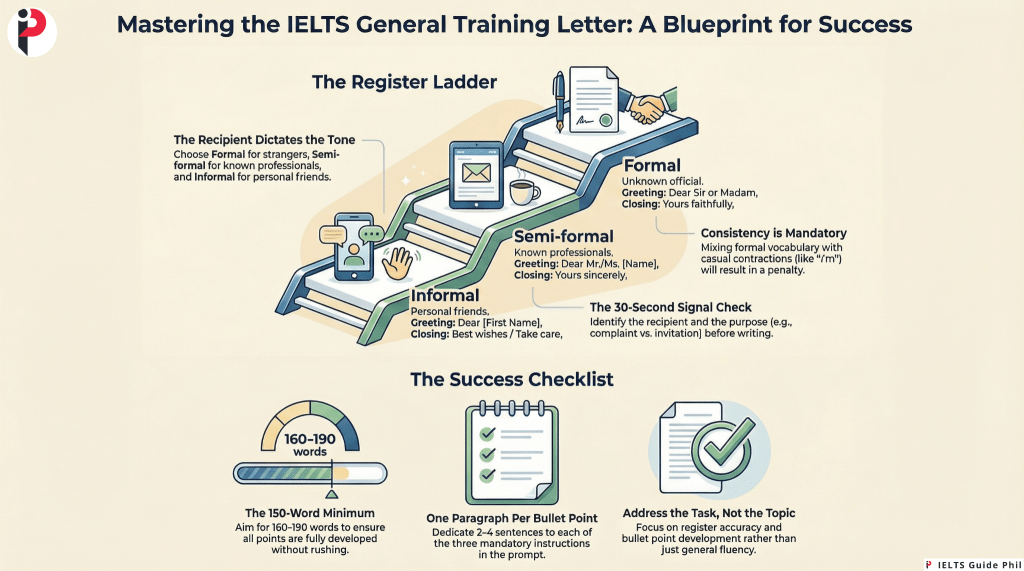
Formal Register
A formal letter is written to someone you do not know personally, in an official or professional capacity — a manager you have never met, a company, a local council, a university admissions office, a newspaper editor.
The relationship is professional and distant. The tone is respectful, polished, and impersonal. You do not use contractions (I’m, it’s, I’d). You do not use casual vocabulary (get, a lot of, really, sort of). You use full forms, elevated vocabulary, and conventional formal structures.
Formal greeting: Dear Sir or Madam, (when the name is unknown) or Dear Mr. Santos, (when the name is given) Formal closing: Yours faithfully, (when the name is unknown) or Yours sincerely, (when the name is given)
Semi-formal Register
A semi-formal letter is written to someone you know in a professional or semi-professional context — a landlord, a teacher, a colleague, a neighbour, a local official you have some existing relationship with.
The relationship is neither purely personal nor purely professional. The tone is polite and clear but not stiff. Some contractions may be used. The vocabulary is standard rather than elevated. The tone acknowledges the existing relationship without becoming casual.
Semi-formal greeting: Dear Mr. Reyes, or Dear Ms. Torres, Semi-formal closing: Yours sincerely, or Kind regards,
Informal Register
An informal letter is written to someone you know personally and well — a close friend, a family member, a flatmate you are comfortable with.
The relationship is personal. The tone is warm, natural, and conversational. Contractions are normal and expected. Casual vocabulary is appropriate. The letter can open with personal references and close with friendly expressions.
Informal greeting: Dear Maria, or Dear Carlos, Informal closing: Best wishes, or Take care, or Love,
How to Identify the Correct Register in 30 Seconds
Read the task carefully. Two signals tell you the register immediately.
Signal 1: Who are you writing to?
- A company, organisation, or unknown official → Formal
- A landlord, teacher, employer you know, or neighbour → Semi-formal
- A friend or family member → Informal
Signal 2: What are you being asked to do?
- Make a complaint to a company, apply for a job, request information from an institution → Formal
- Ask your landlord about repairs, write to your supervisor about time off → Semi-formal
- Tell a friend about your new home, invite a family member to visit → Informal
When both signals agree, the decision is straightforward. When they create ambiguity — which is rare but possible — err toward the more formal option. An examiner reading a slightly over-formal letter will not penalise it the way they will penalise a clearly under-formal one.
The Three Bullet Points: Why All Three Are Non-Negotiable
Every IELTS Task 1 General Training question contains three bullet points. These are not suggestions. They are instructions. Each bullet point defines one component of your letter that must be fully addressed.
A letter that covers two bullet points thoroughly and mentions the third in passing has not completed the task. A letter that addresses all three briefly without developing any of them has not completed the task either.
Each bullet point deserves roughly equal development — approximately one paragraph each in your body paragraphs. Examiners are trained to check for all three, assess whether each is fully addressed, and mark Task Achievement accordingly.
The most common Task Achievement failures in General Training Task 1 are:
- Addressing only two of the three bullet points
- Addressing all three but developing one so minimally it effectively disappears
- Merging all three bullet points into a single undifferentiated paragraph where it is impossible to tell which point is being addressed
Keep each bullet point visually and conceptually distinct in your letter. One paragraph per bullet point is the simplest and most reliable way to ensure this.
The Letter Structure That Works Every Time
Opening — Greeting and Purpose Statement
Dear Sir or Madam, / Dear Mr. Santos, / Dear Maria,
Then immediately state why you are writing. Do not make the examiner read three sentences before understanding your purpose.
Formal: I am writing to express my dissatisfaction with the service I received at your establishment on 14 March. Semi-formal: I am writing regarding the heating issue I mentioned to you last week, which unfortunately has not yet been resolved. Informal: I hope you’re doing well! I’m writing because I have some exciting news to share with you.
Body — Three Paragraphs for the Three Bullet Points
Each paragraph addresses one bullet point. Each paragraph is developed with two to four sentences that fully address that bullet point — not a single sentence mention.
Closing — Summary or Request, and Sign-off
End the letter with a closing sentence that reflects the purpose: a request for action, an expression of anticipation, a friendly closing remark. Then the formal sign-off.
I look forward to your prompt response. (Formal) Please let me know at your earliest convenience. (Semi-formal) I can’t wait to hear back from you! (Informal)
Then: Yours faithfully, / Yours sincerely, / Best wishes,
Then: Your name — for IELTS purposes, you can use a generic name or simply sign off as instructed.
The Five Letter Types You Will Encounter
Just as Task 2 has distinct question types requiring distinct approaches, Task 1 General Training has five recurring letter purposes. Recognising the letter type shapes what you write in the body paragraphs.
1. Complaint Letter
You experienced a problem — with a product, a service, a neighbour, a workplace situation — and you are writing to express dissatisfaction and request resolution.
The three bullet points typically ask you to: describe the situation, explain the problem, and state what you want done.
Register: Almost always formal or semi-formal. Tone: Assertive but professional. Never aggressive, never emotional. State the problem clearly, provide specific details, and make a specific request for resolution.
Key language: I am writing to bring to your attention, I was disappointed to find, I would appreciate it if you could, I expect this matter to be resolved by, I look forward to your response.
2. Request Letter
You need something — information, a service, permission, an explanation — and you are writing to ask for it.
Register: Formal or semi-formal depending on the recipient. Tone: Polite and clear. State what you need, explain why you need it, and specify what form of response or action you require.
Key language: I am writing to enquire about, I would be grateful if you could, could you please provide, I would appreciate receiving, please do not hesitate to contact me.
3. Apology or Explanation Letter
You need to apologise for something, explain a situation, or clarify a misunderstanding.
Register: Varies — could be formal (to an employer), semi-formal (to a teacher), or informal (to a friend). Tone: Sincere and clear. Acknowledge what happened, explain the circumstances, and where appropriate, offer to make amends.
Key language: I sincerely apologise for, I regret that I was unable to, I would like to explain the circumstances, I assure you that this will not happen again, I hope you will accept my apologies.
4. Invitation or Suggestion Letter
You are inviting someone to an event, suggesting a plan, or recommending something.
Register: Often semi-formal or informal. Tone: Warm and positive. Describe what you are inviting them to, provide relevant details, and express genuine enthusiasm.
Key language: I am writing to invite you to, I thought you might be interested in, I would love it if you could join us, I believe you would enjoy, please do let me know if you are able to attend.
5. Informational Letter
You are providing information, giving an update, or describing a situation to someone who needs to know about it.
Register: Varies across all three types depending on the recipient. Tone: Clear and well-organised. Ensure all relevant information is communicated accurately and in a logical sequence.
Key language: I am writing to let you know, I wanted to update you on, I thought it would be helpful to inform you that, please find below the details you requested.
Register in Practice: The Same Situation, Three Different Letters
Nothing illustrates the register difference more clearly than seeing the same bullet point written in all three registers. The situation: you need to explain that you will arrive late.
Formal: I regret to inform you that, due to an unforeseen delay with my connecting flight, I will be unable to arrive at the previously agreed time. I anticipate arriving approximately two hours later than scheduled and sincerely apologise for any inconvenience this may cause.
Semi-formal: I wanted to let you know that I’ll be arriving a couple of hours later than planned. My flight has been delayed, which unfortunately means I won’t make it by the original time. I’m sorry for any inconvenience this causes you.
Informal: Quick heads-up — I’m going to be late! My flight got delayed, so I won’t be there until around two hours after we planned. Really sorry about that — I’ll make it up to you!
The information in all three versions is identical. The vocabulary, sentence structure, contractions, tone, and punctuation are entirely different. An examiner reading the formal version in an informal letter context, or the informal version in a formal letter context, will mark Task Achievement and Lexical Resource accordingly.
The Greeting and Closing: Getting the Conventions Right
These are the most rule-bound elements of the letter and the ones with the clearest right and wrong answers.
Formal — unknown recipient: Greeting: Dear Sir or Madam, Closing: Yours faithfully,
Formal — named recipient: Greeting: Dear Mr. Santos, / Dear Ms. Reyes, Closing: Yours sincerely,
Semi-formal: Greeting: Dear Mr. Santos, / Dear Ms. Reyes, Closing: Yours sincerely, / Kind regards,
Informal: Greeting: Dear Maria, / Dear Carlos, Closing: Best wishes, / Take care, / Warm regards, / Love,
The rule that confuses most beginners: Yours faithfully is used when you do not know the name of the recipient. Yours sincerely is used when you do know the name. This is a British English convention and it is the convention IELTS follows.
Using Yours faithfully after Dear Mr. Santos is a convention error. Using Yours sincerely after Dear Sir or Madam is also a convention error. Neither error is catastrophic, but both signal an incomplete command of formal written English conventions — which is exactly what Lexical Resource and Task Achievement assess.
Common Mistakes and How to Fix Them
Mistake 1: Using the wrong register
A candidate who writes an informal letter to a company manager, using contractions and casual vocabulary, has failed the task at its most fundamental level. Fix: Register identification is your first task — before planning, before writing. Read the task. Identify the recipient. Identify the purpose. Confirm the register. Only then begin writing.
Mistake 2: Missing one of the three bullet points
This is the most common Task Achievement failure in General Training Task 1. Fix: Before writing, number the bullet points. After writing, physically check each one. Did you address bullet point 1? Bullet point 2? Bullet point 3? Is each one developed across two to four sentences?
Mistake 3: Underdeveloping one bullet point
As for the second point, I also want to mention the inconvenience this caused. One sentence for one bullet point is not development — it is a mention. Fix: Every bullet point requires a paragraph of two to four sentences. If you find yourself writing only one sentence for a bullet point, you have not actually addressed it — you have acknowledged it.
Mistake 4: Using the wrong greeting and closing combination
Dear Sir or Madam… Yours sincerely — convention error. Dear Mr. Santos… Yours faithfully — convention error. Fix: Memorise the two rules. Unknown recipient → Dear Sir or Madam + Yours faithfully. Known name → Dear [Name] + Yours sincerely.
Mistake 5: Starting the letter with your name or address
Some candidates, accustomed to formal letter formats from school or workplaces, include a return address, date, and recipient address at the top. IELTS Task 1 does not require these. They consume word count, time, and space without contributing to your score. Fix: Begin directly with the greeting — Dear Sir or Madam, — and nothing above it.
Mistake 6: Copying bullet point language verbatim into the letter
The question might say: Explain what you liked about the course. A candidate writes: I am writing to explain what I liked about the course. This is not paraphrase — it is transcription. Fix: Reformulate the bullet point in your own words. I would like to highlight several aspects of the course that I found particularly valuable.
Mistake 7: Writing a generic letter that could apply to any topic
Template letters — memorised opening paragraphs, generic body content, formulaic closings — are identifiable and penalised. Fix: Every letter must be specific to the situation given. Include details from the task. Reference the specific product, date, person, or circumstance described in the question.
DOs and DON’Ts for IELTS Writing Task 1 General Training
DO:
- Identify the register before writing a single word
- Address all three bullet points with roughly equal development
- Use the correct greeting and closing combination for your register
- Paraphrase the bullet points in your own words rather than copying them
- Include specific details from the task scenario to make the letter concrete
- Match your vocabulary, contractions, and sentence formality to the register throughout
- Leave the last two minutes to read and correct errors
- Aim for 160 to 190 words
DON’T:
- Write a letter in the wrong register — this is a Task Achievement failure
- Address only two of the three bullet points
- Begin with a return address, date, or recipient address — these are not required
- Use contractions in a formal letter
- Use stiff, overly formal vocabulary in an informal letter
- Copy the bullet point language directly into your letter
- Spend more than 20 minutes on Task 1
- Write fewer than 150 words
Frequently Asked Questions
Q: Is General Training Task 1 easier than Academic Task 1?
A: It is different, not easier. General Training Task 1 requires register accuracy, bullet point coverage, and letter convention knowledge that Academic Task 1 does not. Academic Task 1 requires data interpretation and trend language that General Training does not. Both are assessed on the same four criteria at the same standard. Neither is a free band.
Q: Do I need to include a subject line in a formal letter?
A: A subject line — Re: Complaint Regarding Order #12345 — is optional in IELTS Task 1. Including one in a formal letter is acceptable and demonstrates awareness of formal letter conventions. It is not required and does not affect your score positively or negatively.
Q: Can I invent details that are not in the task?
A: Yes — and you should. The task gives you a situation, not a complete set of facts. You are expected to invent specific, plausible details that make the letter concrete and fully developed. Inventing a product name, a specific date, a price, or a sequence of events is entirely acceptable and demonstrates the ability to develop ideas — which contributes to Task Achievement.
Q: What if the task says “write a letter to a friend” — should I use the friend’s name or “Dear Friend”?
A: Use a specific first name. Dear Maria is natural in informal correspondence. Dear Friend is awkward and unnatural in any register. If no name is given in the task, simply invent one. Any first name is acceptable.
Q: How long should each body paragraph be?
A: Two to four sentences per bullet point paragraph is the reliable range. One sentence is underdevelopment. Five or more sentences risks running over the word count and time limit while producing diminishing returns on Task Achievement.
Q: Should I start with “I am writing to…” in every letter?
A: In formal and semi-formal letters, I am writing to… is a perfectly appropriate opening — clear, direct, and professional. In informal letters, it can feel stiff. Informal letters benefit from a warmer, more personal opening: How are you? I hope everything is going well on your end. Then state your purpose. Variety in how you open letters across practice tasks also develops your Lexical Resource range.
Q: Is it acceptable to use bullet points or numbered lists inside the letter?
A: No. IELTS Task 1 General Training requires continuous prose in letter format. Lists, bullet points, and numbered items inside the letter body are not appropriate — they do not demonstrate the grammatical range and cohesion that the assessment criteria require.
Q: Do I lose marks if my handwriting is difficult to read in a paper-based test?
A: Examiners are trained to read a range of handwriting. However, if your handwriting is so unclear that it obscures your intended meaning, communication — and therefore your score — can be affected. Legibility is in your interest.
The Register Ladder: A Quick Reference
Before every Task 1 General Training practice, run your task through this ladder:
Step 1: Who is the recipient? Someone unknown and official → Formal. Someone known in a professional context → Semi-formal. Someone known personally → Informal.
Step 2: What is the purpose? Complaint to a company, formal application, official request → Formal. Landlord issue, workplace request, teacher communication → Semi-formal. Personal news, invitation to a friend, friendly update → Informal.
Step 3: Both signals agree? Proceed with confidence. Signals conflict? Choose the more formal option.
Step 4: Confirm your greeting and closing match the register. Yours faithfully only with Dear Sir or Madam. Yours sincerely with a named recipient. Informal closings only with informal greetings.
Step 5: Check that every word, every contraction decision, and every sentence structure in the letter is consistent with that register from greeting to closing.
One register. Maintained throughout. From the first word to the last.
The One Thing That Separates a Band 5 Letter from a Band 7 Letter
A Band 5 letter addresses the topic. A Band 7 letter addresses the task.
These are not the same thing. Addressing the topic means writing something relevant to the general subject of the question. Addressing the task means: correct register maintained throughout, all three bullet points fully developed, appropriate greeting and closing, specific invented details that make the letter concrete, and language that is varied, accurate, and appropriate to the communicative purpose.
A candidate who writes a warm, friendly, well-intentioned letter in the wrong register has addressed the topic. They have not addressed the task. A candidate who addresses all three bullet points but develops each in a single sentence has addressed the topic. They have not addressed the task.
The letter is the vehicle. The task — the register, the bullet points, the conventions, the development — is the destination. Every preparation session you invest in Task 1 General Training should be measured against that destination, not just against the general quality of your written English.
Write to the task. The band score will follow.
#IELTSWriting #IELTSWritingTask1 #IELTSGeneralTraining #IELTS #IELTSPhilippines #IELTSTips #IELTSPreparation #IELTSBand7 #IELTSBeginners #IELTSGuide #IELTSCoach #EnglishProficiency #IELTSReview #IELTSStrategies #WritingSkills #IELTSGuidePhil #FilipinoIELTSCandidates #BandScore #TaskAchievement #IELTSLetter #FormalLetter #InformalLetter #LetterWriting #Register #MigrateToAustralia #MigrateToCanada
 IELTS Guide Phil
Leave a comment