
What IELTS Speaking Actually Tests
Walk into any IELTS preparation group — online or in person — and you will find candidates drilling model answers, memorising topic vocabulary lists, and practising how to sound more British or American. Almost all of that energy is pointed in the wrong direction.
IELTS Speaking does not test whether you sound native. It does not test whether you have the most impressive vocabulary. It does not test whether your answer matches a model script.
It tests one thing: your ability to communicate effectively and spontaneously in English across a range of topics and task types.
The word spontaneously is doing enormous work in that sentence. A memorised answer delivered fluently is not spontaneous communication — and trained examiners, who assess hundreds of candidates, recognise scripted responses within seconds. When they do, your Fluency and Coherence score suffers. Your Lexical Resource score suffers. Your entire band score suffers — not because your English is poor, but because you demonstrated test performance instead of language ability.
Understanding what is actually being assessed, and why, is the foundation every Speaking preparation strategy must be built on.
The Basic Facts Every Beginner Must Know
- Total duration: 11 to 14 minutes
- Format: Face-to-face interview with a certified IELTS examiner
- Number of parts: 3
- Recorded: Yes — all Speaking tests are recorded for quality assurance and potential re-marking
- Same for Academic and General Training: Yes — the Speaking test is identical for both versions
- Conducted separately from other modules: Yes — the Speaking test may be on the same day as the other modules or on a different day, depending on the test centre
The Three Parts: What Happens in Each
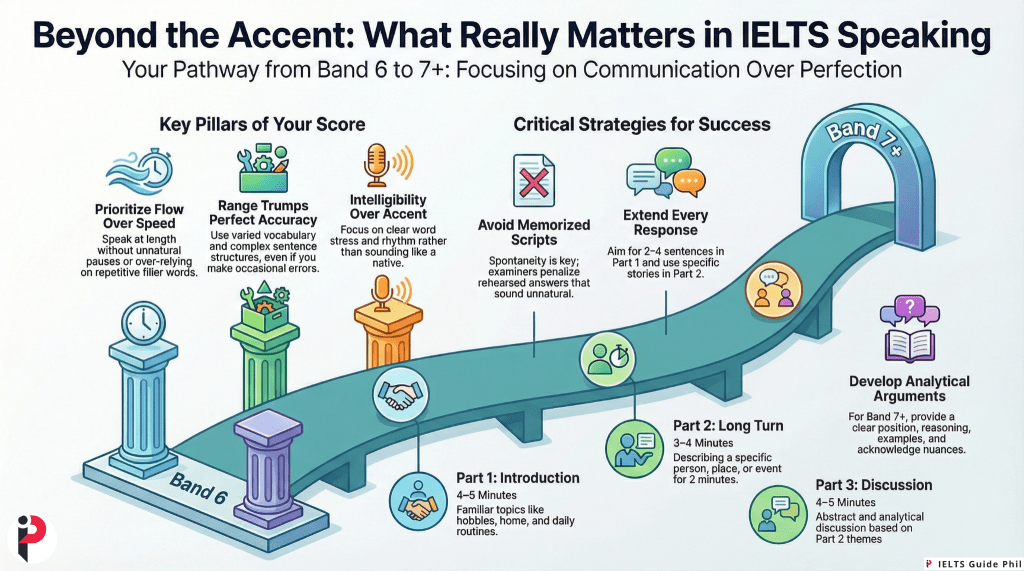
Part 1 — Introduction and Interview (4 to 5 minutes)
The examiner introduces themselves and asks you to confirm your identity. Then you answer questions on familiar, everyday topics: your hometown, your studies or work, your hobbies, daily routines, food preferences, travel, and similar themes.
Part 1 questions are designed to be accessible. They are not designed to be answered with one word. A common beginner mistake is treating Part 1 as a warm-up and giving minimal answers. It is not a warm-up — it is a scored section. Every answer contributes to your band score from the first question.
Aim for two to four sentences per answer in Part 1. Give the direct answer, add a reason or example, and if natural, extend slightly. Do not lecture. Do not recite. Respond conversationally.
Part 2 — Individual Long Turn (3 to 4 minutes)
The examiner hands you a cue card with a topic and bullet points. You have exactly one minute to prepare. Then you speak for one to two minutes on the topic without interruption. The examiner may ask one or two brief follow-up questions after your talk.
The cue card always asks you to describe something: a person, a place, an object, an event, an experience, or an idea. The bullet points suggest aspects to cover, but you are not required to address them in a fixed order or with equal weight.
Part 2 is the section where candidates most visibly either thrive or collapse. Thriving means speaking at length, coherently, with developed ideas and varied language. Collapsing means running out of things to say at the 45-second mark and trailing off into repetition.
Your one minute of preparation time is not for writing full sentences. It is for deciding your main story, identifying two or three specific details or examples, and noting keywords — not scripts.
Part 3 — Two-Way Discussion (4 to 5 minutes)
The examiner asks questions connected to the theme of your Part 2 cue card, but at a more abstract and analytical level. If your cue card described a memorable celebration, Part 3 might ask about the role of traditions in modern society, how celebrations differ across cultures, or whether public holidays should be reduced.
Part 3 is where Band 7 and above is earned or lost. The examiner is not just listening to your English here — they are listening to how you develop, justify, qualify, and extend ideas. This is the section that requires the most sophisticated language: hedging expressions, discourse markers, conditional structures, abstract vocabulary, and the ability to consider multiple perspectives.
Giving short, surface-level answers in Part 3 is the single most common reason candidates plateau at Band 6.
The Four Assessment Criteria: What Your Examiner Is Actually Writing Down
Every response across all three parts is assessed on four equally weighted criteria. Understanding these criteria at a deep level is not optional preparation — it is the entire preparation framework.
1. Fluency and Coherence (FC)
Fluency is not speed. Fluency is the ability to speak at length without excessive or unnatural hesitation, without losing your train of thought, and without needing to repair your speech constantly.
Coherence is the logical organisation of your ideas — whether what you say follows a clear line of thought, whether your sentences connect naturally, whether the listener can follow your reasoning without effort.
What hurts FC: long unnatural pauses mid-sentence, constant repetition of the same idea because you have run out of content, over-reliance on filler phrases like uhh, you know, like, and actually used as stalling devices, and responses that jump between unconnected ideas.
What helps FC: developing ideas fully rather than listing them, using discourse markers naturally (however, on the other hand, what I mean is, for instance, having said that), and speaking at a pace that allows clarity rather than rushing to fill silence.
2. Lexical Resource (LR)
This criterion assesses the range, accuracy, and appropriateness of your vocabulary. It is not about using the longest or most obscure words. It is about using vocabulary that is precise, varied, and natural.
What hurts LR: repeating the same words throughout your answer, using vocabulary that is too basic for the complexity of the idea you are expressing, using words slightly inaccurately (e.g., make a decision → do a decision), and inserting advanced vocabulary so awkwardly that it breaks the natural flow of communication.
What helps LR: using topic-specific vocabulary accurately, paraphrasing rather than repeating, using collocation correctly (strong argument not big argument, raise awareness not lift awareness), and demonstrating awareness of register — knowing when formal versus informal vocabulary is appropriate.
3. Grammatical Range and Accuracy (GRA)
Range means the variety of grammatical structures you use. Accuracy means how correctly you use them.
A candidate who uses only simple present and past tense structures throughout the entire test, even if used perfectly, will not score above Band 5 for GRA regardless of accuracy. Range requires evidence of complex sentences: relative clauses, conditionals, passive voice, perfect tenses, reported speech, modal verbs, and mixed structures.
Accuracy does not mean zero errors. At Band 7, a candidate may make occasional errors but maintains control of complex structures. At Band 8, errors are rare and do not obscure meaning. At Band 9, the candidate uses a full range with complete flexibility and precision.
What hurts GRA: using only simple structures, systematic errors (consistent subject-verb disagreement, consistent wrong preposition use, consistent tense confusion), and avoiding complex structures because you are unsure of them.
What helps GRA: deliberately using complex sentence structures in your answers, self-correcting naturally when you notice an error (this is acceptable and does not heavily penalise you), and practising structures you avoid until they feel natural under pressure.
4. Pronunciation (P)
Pronunciation in IELTS is assessed on whether your speech is consistently clear and easy to understand — not on whether you sound British, American, or Australian.
Your Filipino accent is not a liability. An accent that interferes with intelligibility is. These are entirely different things.
What is assessed: your use of word stress (e.g., PREsent vs. preSENT), sentence stress (emphasising the words that carry meaning), connected speech (how words link naturally in natural speech), intonation (the rise and fall that signals questions, completion, and emphasis), and individual sound accuracy where mispronunciation causes misunderstanding.
What is not assessed: whether you sound like a native speaker, whether you have a regional or national accent, or whether your vowel sounds match British Received Pronunciation.
Common Mistakes and How to Fix Them
Mistake 1: Memorising model answers topic by topic
Examiners are trained to detect rehearsed responses. Memorised answers produce unnatural rhythm, vocabulary that does not match the candidate’s overall level, and an inability to adapt when the examiner asks a slightly different follow-up question. Fix: Practise ideas and frameworks, not scripts. Know what kinds of examples and personal experiences you can draw on for common topic areas. Practise generating responses spontaneously from these raw materials.
Mistake 2: Giving one-sentence answers in Part 1
Q: Do you enjoy cooking? A: Yes, I enjoy cooking. This tells the examiner almost nothing about your language ability. Fix: Answer + reason + example or extension. Yes, I genuinely enjoy cooking, especially on weekends when I have more time. I find it relaxing — there’s something satisfying about turning raw ingredients into an actual meal. I usually try one new recipe a month.
Mistake 3: Running out of content in Part 2 before two minutes
Candidates who run out of ideas at 45 seconds begin repeating themselves, slowing down unnaturally, or simply stopping. Fix: In your one-minute preparation, identify a specific memory or personal experience related to the topic. Specificity generates content. Vague general answers dry up quickly. Specific stories with real details — names, places, feelings, sequences of events — carry you naturally through two minutes.
Mistake 4: Giving surface-level answers in Part 3
Q: Why do you think traditions are important in modern society? A: Because they are part of our culture and history. This is a Band 5 answer. It states the obvious and stops. Fix: State your position, give a reason, give a specific example or elaboration, and acknowledge another perspective or nuance. I think traditions serve as a form of collective identity — they connect people to a shared history in a way that daily modern life often doesn’t. Take annual festivals, for instance: even if the original religious meaning has faded for many participants, the act of gathering together still reinforces a sense of belonging. That said, I think there’s a reasonable argument that some traditions need to evolve rather than be preserved unchanged.
Mistake 5: Obsessing over accent elimination
Candidates spend months trying to sound American or British, which produces stilted, self-conscious speech and does nothing for their band score. Fix: Redirect that energy toward word stress accuracy, sentence rhythm, and clear articulation of individual sounds that cause genuine misunderstanding. Work with what you have — refine it, do not replace it.
Mistake 6: Using filler phrases excessively as stalling devices
That is a very good question. Actually, I think that… you know… it is like… hmm… These phrases signal to the examiner that you are stalling, not thinking. Fix: A natural, brief pause is not penalised. A two-second silence while you genuinely gather your thought is far less damaging than five seconds of filler noise. Train yourself to pause silently rather than fill silence with noise.
Mistake 7: Avoiding complex grammar because of fear of making errors
Candidates who stick exclusively to simple sentences score low on GRA regardless of accuracy. Fix: Make errors in complex structures rather than making no errors in simple ones. An examiner who hears you attempting conditionals, relative clauses, and passive constructions — even imperfectly — is seeing evidence of range. An examiner who hears only I like, I think, I went, I saw is not.
DOs and DON’Ts for IELTS Speaking
DO:
- Understand the four assessment criteria deeply and prepare with them as your framework
- Extend every answer in Part 1 to at least two to three sentences with a reason or example
- Use your one-minute preparation time in Part 2 to identify a specific personal experience and two or three concrete details — not to write sentences
- Develop Part 3 answers with reasoning, examples, and acknowledgement of complexity
- Use a natural range of discourse markers to connect your ideas
- Practise speaking on unfamiliar topics spontaneously — comfort with uncertainty is a core Speaking skill
- Record yourself regularly and listen back critically against the four criteria
- Work on word stress and sentence rhythm rather than accent replacement
DON’T:
- Memorise and recite model answers — this is detectable and penalised
- Give one-word or one-sentence answers to any question in any part
- Use that is a very good question or similar openers — experienced examiners find them artificial
- Speak faster than your accuracy allows — clarity is worth more than speed
- Avoid complex grammar out of fear — attempting range and making occasional errors outscores perfect accuracy in simple structures
- Practise only with other non-native speakers without getting feedback from a qualified source
- Try to eliminate your accent — focus on intelligibility, not nativeness
Frequently Asked Questions
Q: Is the Speaking test the same for Academic and General Training?
A: Yes. The Speaking test is completely identical for both versions — same format, same parts, same duration, same assessment criteria.
Q: What if I do not understand a question?
A: Ask the examiner to repeat or clarify. You are allowed to say Sorry, could you repeat that? or Could you explain what you mean by…? This is natural communicative behaviour and does not penalise you. What penalises you is answering the wrong question because you misunderstood and did not ask for clarification.
Q: Can I ask the examiner for more time to think?
A: You can say Let me think about that for a moment — this is natural and acceptable. What you cannot do is take an extended silence of 10 to 15 seconds or continuously repeat stalling phrases. A brief, genuine thinking pause is completely normal in real conversation and is not penalised.
Q: Does my Filipino accent hurt my score?
A: Not if it does not interfere with intelligibility. The Pronunciation criterion assesses whether you can be consistently understood — not whether you sound like a native speaker. Filipinos who speak clearly, stress words correctly, and use natural sentence rhythm score well on Pronunciation regardless of accent.
Q: What topics should I prepare for?
A: IELTS Speaking covers a broad range of everyday and abstract topics. Common Part 1 themes include home, family, work or study, hobbies, food, transport, weather, and technology. Part 2 and 3 topics often involve experiences, people who influenced you, important places, social issues, education, the environment, and cultural practices. You cannot predict the exact question — you can prepare flexible frameworks and personal examples that transfer across topic areas.
Q: Is it acceptable to disagree with the examiner in Part 3?
A: Yes, and this is actually valued. Part 3 is a discussion, not an interview where you are expected to agree. Respectfully holding and defending a position, or acknowledging a counterargument while maintaining your view, demonstrates exactly the kind of discourse competence that earns high scores.
Q: What happens if I make a grammatical error mid-sentence?
A: Self-correct naturally and continue. A natural self-correction — I went, or rather I had gone there before — is not penalised and in fact demonstrates grammatical awareness. Stopping completely, showing visible distress, or losing your train of thought is more disruptive than the error itself.
Q: How is the Speaking test scored if the examiner is also the interviewer?
A: The examiner assesses you in real time against the four criteria while the test is recorded. Scores are subject to quality monitoring and moderation. If you request a re-mark (EOR — Enquiry on Results), a senior examiner re-assesses the recording independently.
The Part 3 Formula That Moves Candidates from Band 6 to Band 7
Most Band 6 candidates answer Part 3 questions with a position and a single reason. That is sufficient for Band 6. It is not sufficient for Band 7.
Band 7 Part 3 answers consistently do four things:
State a clear position — not hedged into meaninglessness, but genuinely committed to a view.
Develop with reasoning — not just because it is important but a specific causal chain of logic that explains why and how.
Ground with a specific example or elaboration — an abstract claim supported by nothing is philosophy. An abstract claim supported by a concrete reference becomes an argument.
Acknowledge nuance or qualification — although, having said that, it depends on, the exception might be — these phrases signal that you understand the complexity of the topic, which is exactly what the examiner is listening for in an academic discussion.
The full structure takes 45 to 75 seconds to deliver. That is appropriate for Part 3. Short answers in Part 3 do not demonstrate range — they demonstrate avoidance.
The Mindset Shift That Changes Everything
Most candidates walk into the Speaking test trying not to make mistakes. The most successful candidates walk in trying to communicate.
These are opposite orientations, and they produce opposite results.
Trying not to make mistakes produces caution, short answers, simple grammar, and avoidance of any structure or vocabulary you are not completely certain of. It produces a performance — careful, controlled, and ultimately limited.
Trying to communicate produces engagement, extended answers, attempts at complex language, and a natural conversational dynamic with the examiner. It produces language use — authentic, varied, and assessable.
Your examiner is not your judge. They are your conversation partner for eleven to fourteen minutes. The candidates who remember this — and speak accordingly — are the ones whose scores reflect what their English is actually capable of.
#IELTSSpeaking #IELTS #IELTSPhilippines #IELTSTips #IELTSPreparation #IELTSBand7 #IELTSPractice #IELTSBeginners #IELTSGuide #IELTSCoach #EnglishProficiency #IELTSReview #IELTSStrategies #SpeakingSkills #IELTSGuidePhil #FilipinoIELTSCandidates #BandScore #IELTSFluency #IELTSPronunciation #IELTSVocabulary #IELTSGrammar #IELTSCueCard #Part3Discussion #StudyAbroad #MigrateToAustralia #MigrateToCanada
 IELTS Guide Phil
Leave a comment