
What Is the IELTS Listening Test, Really?
Most beginners hear the word “listening” and think: I just need to understand what they’re saying. That is only half the truth.
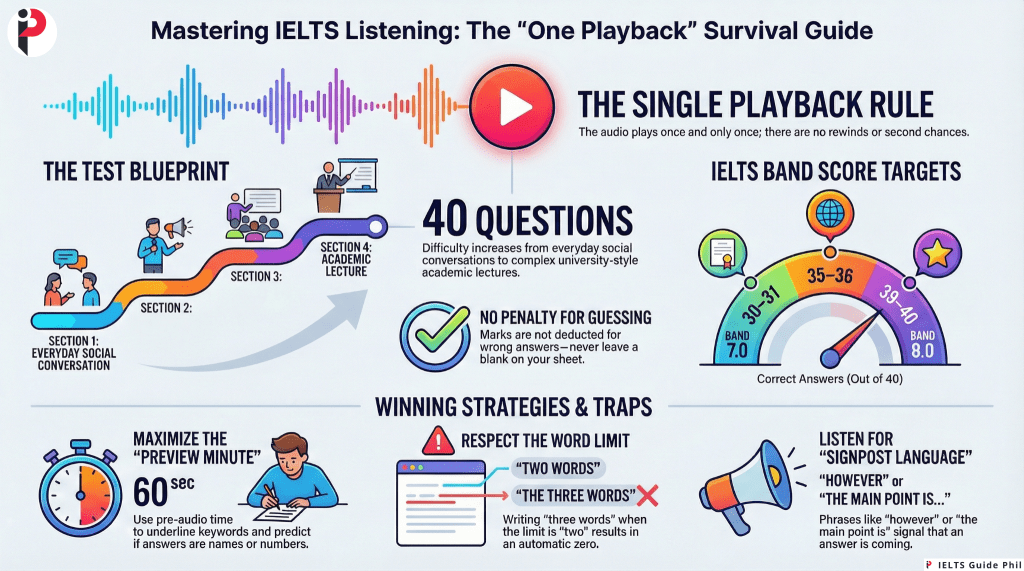
The IELTS Listening test is not a comprehension quiz. It is a test of your ability to locate, process, and record specific information in real time, under time pressure, while audio plays once and only once.
That single playback rule is what separates IELTS Listening from every casual English listening activity you have ever done. On YouTube, you can rewind. On Netflix, you can turn on subtitles. In IELTS, the audio plays, ends, and does not come back.
Understanding this reality is Step 1 of every serious preparation strategy.
The Basic Facts Every Beginner Must Know
- Total questions: 40
- Total sections: 4
- Approximate listening time: 30 minutes
- Answer transfer time (paper-based): 10 minutes at the end
- Answer transfer time (computer-delivered): 2 minutes per section (built in)
- Score contribution: Each correct answer = 1 raw mark. Raw score out of 40 is converted to a band score.
- Band 7 benchmark: Approximately 30 out of 40 correct answers
- Band 8 benchmark: Approximately 35 out of 40 correct answers
No marks are deducted for wrong answers. This means you should never leave a blank. A guess has value. A blank has none.
The Four Sections: What You Actually Hear
The four sections increase in difficulty from Section 1 to Section 4.
Section 1 — Everyday Social Conversation Two speakers in an everyday situation: booking an appointment, enquiring about a service, registering for an activity. This is the most accessible section. The language is clear, the pace is moderate, and the information is concrete (names, numbers, dates, addresses).
Section 2 — Monologue in an Everyday Social Context One speaker giving information of a general nature: a tour guide describing a site, a community announcement, an orientation speech. Still accessible, but you are now tracking a single voice across a longer stretch of speech.
Section 3 — Conversation in an Academic or Training Context Two to four speakers — typically students discussing an assignment, or a student and tutor in a tutorial. The vocabulary becomes more academic. The ideas are more abstract. Opinions, suggestions, and agreements are expressed indirectly.
Section 4 — Academic Monologue One speaker delivering a university-style lecture or talk. This is the most demanding section. The pace is faster, the vocabulary is academic, and the ideas are complex. There are no pauses for dialogue turns to help you orient yourself.
The Question Types You Will Encounter
IELTS Listening uses several recurring question formats. Knowing all of them before test day means zero surprises.
1. Form / Note / Table / Flow-chart Completion You fill in missing information on a structured template. Typically appears in Sections 1 and 2. Tests your ability to catch specific details: numbers, names, spellings, dates, times.
2. Sentence Completion You complete a sentence using words from the audio. The word limit is strictly stated (e.g., no more than two words and/or a number). Exceeding the word limit = automatic zero for that answer, even if the information is correct.
3. Summary Completion Similar to sentence completion but across a connected paragraph. Requires you to track a longer stretch of speech and fill multiple gaps that follow a logical sequence.
4. Multiple Choice You choose the correct answer from three options (A, B, or C), or sometimes select multiple correct answers from a longer list. The trap: all three options are often mentioned in the audio. You must identify which one directly answers the question.
5. Matching You match a list of items (people, places, features) to a set of options. Common in Sections 2 and 3.
6. Plan / Map / Diagram Labelling You label locations on a map or parts of a diagram using words from the audio. Navigation language — opposite, adjacent, between, to the left of — is critical here.
7. Short Answer Questions You answer factual questions in your own words, subject to a word limit. Tests precise detail retrieval.
How the Scoring Works
Raw scores are converted to band scores on the following approximate scale:
| Raw Score (out of 40) | Band Score |
|---|---|
| 39–40 | 9.0 |
| 37–38 | 8.5 |
| 35–36 | 8.0 |
| 32–34 | 7.5 |
| 30–31 | 7.0 |
| 26–29 | 6.5 |
| 23–25 | 6.0 |
| 18–22 | 5.5 |
This table has an important implication: the gap between Band 6.5 and Band 7.0 is as little as one or two additional correct answers. In IELTS Listening, marginal gains are not marginal at all. They are band-changing.
The Accents You Will Hear
IELTS Listening features a range of English accents, reflecting its international character. You will hear:
- British English (the most common)
- Australian English
- New Zealand English
- North American English (occasionally)
For Filipino candidates whose primary English exposure has been American English — through school, media, and everyday life — British and Australian accents can initially feel faster, more clipped, and harder to parse.
This is not a disadvantage you cannot overcome. It is a gap you need to close deliberately through targeted exposure. British and Australian news broadcasts, podcasts, and documentaries are your training tools.
Before the Audio Plays: The Most Underused Minute in IELTS
Before each section begins, you are given a short time to read the questions. Most candidates glance at the questions casually. High-scoring candidates use this time strategically.
Here is what you should be doing during that reading time:
- Identify the question type so you know what kind of information to listen for
- Underline key words in each question — these are your listening anchors
- Predict the answer type — is it a number? A name? A place? A reason? An opinion?
- Notice word limits for completion tasks — Word limit violations are one of the most common and most avoidable ways to lose marks
- Sequence the questions mentally — know what question you are on at all times so you do not fall behind
The audio will not wait for you to catch up. Your preparation before the audio begins determines how much control you maintain while it plays.
During the Audio: Real-Time Strategies
Follow the question order. IELTS Listening questions follow the order of information in the audio. This is a guarantee, not a suggestion. If you are on Question 14 and you hear information that sounds like it belongs to Question 16, you have missed Question 15. Go back mentally, catch what you can, and move forward.
Write as you listen, do not wait. Some candidates wait until they are “sure” before writing anything. By the time they are sure, the audio has moved on. Write your best answer the moment you hear it. You can refine it — you cannot retrieve audio that has already passed.
Listen for signpost language. Speakers signal important information with phrases like the main point is, what’s interesting is, I’d like to emphasise, however, actually — these are flags that the answer is nearby. Train your ear to notice them.
Paraphrase awareness is essential. The audio will rarely repeat the exact words in the question. Instead, the question might say describe the problem and the speaker will say the main challenge they faced. Recognising paraphrase — the same idea in different words — is one of the core skills the Listening test assesses.
Do not panic when you miss an answer. Missing one answer and chasing it mentally while the audio moves on is how you miss three answers. Accept the loss, move forward, and maintain your position in the question sequence.
Common Mistakes and How to Fix Them
Mistake 1: Writing too many words in completion tasks The instruction says no more than two words and/or a number. Three words = zero marks, even if two of those words are correct. Fix: Read the word limit before the audio begins. Highlight it. After writing your answer, count the words before moving on.
Mistake 2: Mishearing numbers, dates, and proper nouns These are the most common error points in Section 1. A candidate who hears “thirteen” instead of “thirty” or “Mackay” instead of “McKay” loses a mark that was entirely within reach. Fix: Practise number dictation specifically. Write numbers you hear while listening to broadcasts. Practise name spelling by listening to spelling sequences in Cambridge practice tests.
Mistake 3: Choosing the first option mentioned in multiple choice IELTS multiple choice is deliberately designed to mention all options but confirm only one. Candidates who select the first thing they hear consistently choose distractors. Fix: Wait for the speaker to confirm, qualify, or negate. The answer is usually the one that survives the conversation — not the one introduced first.
Mistake 4: Ignoring capitalisation and spelling during answer transfer On paper-based tests, spelling errors in the transferred answer cost marks. Recieve instead of receive. Febuary instead of February. Fix: Use the 10-minute transfer time fully. Do not rush. Read each transferred answer once more before submitting.
Mistake 5: Practising only with transcripts visible Reading along while listening is comfortable. It is also not how the real test works. Fix: Always attempt practice tests with audio only. Use transcripts only after to identify what you missed and why.
Mistake 6: Practising only Sections 1 and 2 Section 4 — the academic monologue — is where most band score losses cluster for Band 5.5 to Band 6 candidates. Fix: Dedicate specific sessions to Section 4 practice. Expose yourself regularly to academic lectures and talks (TED Talks, BBC documentaries, university open course recordings).
DOs and DON’Ts for IELTS Listening
DO:
- Use the reading time before each section to preview questions and predict answer types
- Underline key words in questions as listening anchors
- Write your answer immediately when you hear it — refine later, never wait
- Practise with a variety of accents, especially British and Australian
- Use official Cambridge IELTS Practice Tests as your primary practice material
- Review every incorrect answer with the transcript to understand why you got it wrong — not just that you got it wrong
- Practise under timed, exam-condition settings regularly
- Spell-check your answers during transfer time
DON’T:
- Exceed the stated word limit in any completion task under any circumstances
- Panic and freeze when you miss an answer — move forward
- Rely solely on American English exposure to prepare for an internationally accented test
- Practise only passively — always engage with questions, never just listen for enjoyment during preparation sessions
- Leave any answer blank — guess if you must, but never leave a blank
- Assume Section 1 will be easy and skip practising it — spelling and number accuracy errors in Section 1 are extremely common even at higher levels
Frequently Asked Questions
Q: Is IELTS Listening the same for Academic and General Training?
A: Yes. The Listening test is identical for both versions. The same four sections, the same question types, the same scoring scale.
Q: Can I write on the question paper during the test?
A: Yes, in paper-based tests you can write on the question paper as much as you like during the listening. Only your answers transferred to the Answer Sheet are marked. In computer-delivered tests, you type directly into the response fields.
Q: What if I mishear a word and write the wrong spelling?
A: If the spelling is wrong, the answer is marked incorrect. Phonetic approximations and creative spelling are not accepted. British and American spelling variants are both accepted (e.g., colour and color, organisation and organization).
Q: Do I lose marks for wrong answers?
A: No. There is no negative marking in IELTS. Always answer every question, even if you are guessing.
Q: The audio plays only once — is that really true?
A: Yes. In the actual test, the audio plays exactly once with no repetition. This is why reading the questions before the audio begins is not optional — it is your primary compensation strategy for the no-repeat rule.
Q: How do I improve my Listening score quickly?
A: There is no universally “quick” fix, but the highest-impact short-term actions are: eliminate word-limit violations (immediate mark recovery), sharpen number and spelling accuracy in Section 1 (recovers easy marks), and improve your question-preview strategy (improves answer location across all sections). Long-term improvement requires sustained exposure to varied English accents and academic content.
Q: How long should I prepare for IELTS Listening specifically?
A: Listening responds well to consistent daily exposure over six to twelve weeks. Thirty focused minutes of practice per day — active engagement with questions, not passive listening — is more effective than two hours of unfocused audio consumption weekly.
The Single Most Important Mindset Shift for Listening
Stop trying to understand everything. Start trying to answer the questions.
These are not the same activity. The audio in IELTS Listening contains far more information than is tested. Candidates who try to process every word become cognitively overloaded and start missing the specific answers they need. Candidates who use their question previews as filters — listening for specific types of information at specific moments — answer more questions correctly, even with lower overall comprehension.
Your questions are your map. The audio is the territory. Navigate with the map.
#IELTSListening #IELTS #IELTSPhilippines #IELTSTips #IELTSPreparation #IELTSBand7 #IELTSPractice #IELTSBeginners #IELTSGuide #IELTSCoach #EnglishProficiency #IELTSReview #IELTSAccents #IELTSStrategies #ListeningSkills #IELTSGuidePhil #FilipinoIELTSCandidates #BandScore #IELTSAcademic #IELTSGeneralTraining #IELTSSections #IELTSQuestionTypes #StudyAbroad #MigrateToAustralia #MigrateToCanada
 IELTS Guide Phil
Leave a comment