
What IELTS Reading Actually Tests
Here is what most beginners get wrong about IELTS Reading: they think it rewards the candidate who understands the passage best. It does not.
IELTS Reading rewards the candidate who locates the correct answer fastest.
You have 60 minutes. You have 40 questions. You have three long passages — each one between 700 and 900 words in Academic, or a series of shorter texts in General Training. There is no audio to follow, no examiner to respond to, and no extra time to transfer answers. The clock runs from the moment the test begins and does not pause.
A candidate who reads every passage in full, admires the writing, and deeply comprehends every paragraph will run out of time before Question 40. A candidate who reads strategically — knowing what to look for, where to look, and how long to spend — finishes with time to check.
That is the fundamental skill IELTS Reading measures: strategic information retrieval under time pressure.
The Basic Facts Every Beginner Must Know
- Total questions: 40
- Total passages: 3 (Academic) or a series of shorter texts (General Training)
- Total time: 60 minutes — no extra transfer time, unlike Listening
- Answer recording: Directly onto the Answer Sheet as you go (paper-based) or typed directly (computer-delivered)
- Word count per passage: Approximately 700–900 words (Academic); shorter in General Training
- Negative marking: None — always answer every question
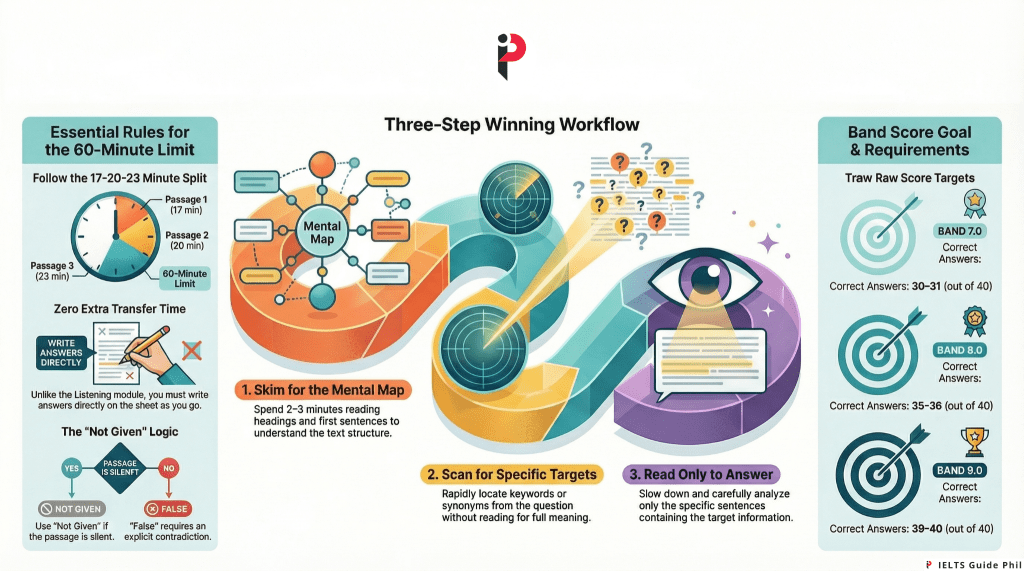
- Band 7 benchmark: Approximately 30 out of 40 correct answers
- Band 8 benchmark: Approximately 35 out of 40 correct answers
The absence of transfer time is the detail most beginners discover too late. In Listening, you have 10 minutes at the end to move answers from your question paper to the Answer Sheet. In Reading, there is no such window. Every answer must go directly onto the Answer Sheet as you work through each passage. Writing answers only on the question paper and planning to transfer them at the end is one of the most costly timing mistakes a candidate can make.
Academic vs. General Training Reading: The Key Differences
Both versions share the same time allocation, question count, and scoring scale. The differences are in the source texts and the level of complexity.
IELTS Academic Reading uses three long texts taken from books, academic journals, magazines, and newspapers written for a non-specialist but educated audience. Topics are broad — science, history, technology, sociology, economics, environmental issues. The language is formal and dense. Arguments are complex. At least one text typically contains an academic argument structure with a clear thesis, supporting evidence, and a conclusion.
IELTS General Training Reading is divided into three sections. Section 1 contains two or three short factual texts from everyday sources — advertisements, notices, timetables, workplace communications. Section 2 contains two texts related to work — job descriptions, training materials, employment policies. Section 3 contains one longer, more complex text similar in style to an Academic Reading passage.
General Training Reading is generally considered more accessible in language level, but this does not mean it is easy. The question types are identical, the time pressure is the same, and the scoring benchmarks for high bands are comparable.
The Question Types You Will Encounter
IELTS Reading uses a wider variety of question types than any other module. Knowing all of them is non-negotiable.
1. Multiple Choice Choose the correct answer from four options (A, B, C, D), or in some cases select two correct answers from a longer list. All four options are typically supported by the passage in some way — the task is to find which one directly and precisely answers the question.
2. Identifying Information — True / False / Not Given You decide whether a statement is: True (the passage confirms it), False (the passage contradicts it), or Not Given (the passage neither confirms nor contradicts it). The distinction between False and Not Given is the most misunderstood concept in the entire IELTS exam. If the passage says nothing about something, the answer is Not Given — not False.
3. Identifying the Writer’s Views — Yes / No / Not Given Similar to True/False/Not Given, but applied to opinions and claims rather than factual statements. Yes means the writer expresses this view. No means the writer expresses the opposite view. Not Given means the writer does not address this point.
4. Matching Headings You match a list of headings to paragraphs in the passage. There are always more headings than paragraphs. This question type tests your understanding of the main idea of each paragraph — not the details within it.
5. Matching Information You identify which paragraph contains specific information. Unlike Matching Headings, you are looking for a detail, example, explanation, or reason — not the main idea.
6. Matching Features You match a list of statements to a list of features — typically people, dates, theories, or places mentioned in the passage.
7. Matching Sentence Endings You match the beginning of a sentence to its correct ending from a list of options. The completed sentence must be grammatically correct and factually supported by the passage.
8. Sentence Completion You complete a sentence using words taken directly from the passage. A word limit applies. The words you use must appear in the passage — you cannot paraphrase.
9. Summary / Note / Table / Flow-chart Completion You complete a structured summary using words from the passage or from a provided word box. The summary covers only part of the passage, not the whole text. Locating which section of the passage the summary refers to is your first task.
10. Diagram Label Completion You label parts of a diagram using words from the passage. This appears less frequently but requires precise vocabulary retrieval.
11. Short Answer Questions You answer factual questions using words from the passage, within a stated word limit.
How the Scoring Works
| Raw Score (out of 40) | Band Score |
|---|---|
| 39–40 | 9.0 |
| 37–38 | 8.5 |
| 35–36 | 8.0 |
| 32–34 | 7.5 |
| 30–31 | 7.0 |
| 26–29 | 6.5 |
| 23–25 | 6.0 |
| 18–22 | 5.5 |
| 15–17 | 5.0 |
As with Listening, the margin between adjacent band scores is often just two or three questions. Candidates who eliminate avoidable errors — word limit violations, True/False/Not Given confusion, answer transfer omissions — frequently discover that their “real” band score is half a band higher than their practice scores suggested.
The True / False / Not Given Problem
This question type deserves its own section because it is, by a significant margin, the most mishandled question type in IELTS Reading.
Here is the core confusion: candidates treat Not Given as a fallback when they are unsure. They think: I’m not sure if this is true or false, so I’ll say Not Given. This is the wrong logic entirely.
The correct logic is:
- Read the statement.
- Search the passage for information about the topic of the statement.
- If you find information that confirms it: True.
- If you find information that directly contradicts it: False.
- If you search carefully and the passage simply does not address that specific point at all: Not Given.
The trap is False versus Not Given. A statement is False only if the passage explicitly says the opposite. A statement is Not Given if the passage is silent on that specific point — even if the topic appears in the passage in a different context.
Example: The passage discusses a scientist named Dr. Reyes and mentions that her research was published in 2019. The question statement says: Dr. Reyes won an award for her research.
If the passage mentions no award: Not Given. The absence of the award in the passage does not mean she did not win one — it simply means the passage does not address it. False would require the passage to say she did not win an award, or that she was specifically overlooked.
This distinction separates Band 6 candidates from Band 7 candidates more reliably than almost any other single skill in IELTS Reading.
Time Management: The Non-Negotiable Framework
Sixty minutes. Three passages. Forty questions. Here is the only time allocation that consistently works:
- Passage 1: 17 minutes (easiest — build accuracy and momentum)
- Passage 2: 20 minutes (moderate difficulty)
- Passage 3: 23 minutes (hardest — academic argument, dense vocabulary)
These are not suggestions. They are boundaries. When your allocated time for a passage ends, you move on — even if you have not answered every question in that passage. Come back only if time permits after completing Passage 3.
Why more time for Passage 3? Because the texts are harder and the question types are more demanding. Candidates who spend 25 minutes on Passage 1 trying to achieve perfection routinely run out of time on Passage 3 — where several of the questions they could have answered correctly simply never get attempted.
A correct answer in Question 5 is worth exactly the same as a correct answer in Question 38. Time management is score management.
Skimming and Scanning: What They Actually Mean
These two terms are thrown around constantly in IELTS preparation. Most candidates have heard them. Few candidates use them correctly.
Skimming means reading quickly to get the general idea — the topic, the argument structure, the tone. You are not reading every word. You are reading the first sentence of each paragraph, any headings or subheadings, the first and last paragraph more carefully, and letting your eye move fast across the rest. Skimming gives you a mental map of the passage before you tackle the questions.
Scanning means moving your eye rapidly across the text to locate a specific piece of information — a name, a number, a date, a keyword from the question. You are not reading for understanding. You are searching for a target. Once you find the target, you slow down and read that section carefully.
The workflow that works: skim the passage first to build your mental map, then scan for the answer location each time you address a question, then read carefully only the specific sentences that contain the answer.
Reading every passage in full before attempting any questions is the single most common cause of running out of time in IELTS Reading.
Paraphrase: The Core Challenge of IELTS Reading
IELTS Reading questions almost never use the exact words from the passage. They paraphrase — they express the same idea using different vocabulary and sometimes different sentence structure.
Example:
- Passage: The construction of the bridge was abandoned due to insufficient government funding.
- Question: The bridge project was halted because of a lack of financial support from authorities.
Every content word has been paraphrased: construction → project, abandoned → halted, insufficient → lack of, government funding → financial support from authorities. The meaning is identical. The words are entirely different.
This means your keyword-matching strategy has a ceiling. You cannot simply scan for the exact words in the question and expect to find the answer that way every time. You must also scan for synonyms, related terms, and conceptual paraphrases of the question’s key ideas.
Building your vocabulary — specifically your knowledge of synonyms and word families — is one of the highest-return investments you can make for IELTS Reading.
Common Mistakes and How to Fix Them
Mistake 1: Writing answers only on the question paper and transferring at the end
There is no transfer time in Reading. When 60 minutes ends, the test ends. Fix: Write every answer directly on the Answer Sheet as you complete each question. Make this a non-negotiable habit from your very first practice test.
Mistake 2: Confusing False and Not Given
Candidates default to False when they cannot find confirmation. False requires explicit contradiction in the passage. Fix: Ask yourself: Does the passage say the opposite? If yes: False. If the passage simply does not mention it: Not Given.
Mistake 3: Exceeding word limits in completion tasks
The instruction says no more than two words. Three words = zero marks. Fix: Count your answer words every single time before writing them on the Answer Sheet.
Mistake 4: Spending too long on one difficult question
One unanswered question at the end of the test costs the same mark as one difficult question you spent four minutes on. Fix: If a question takes more than 90 seconds and you have no answer, mark it, move on, and return later. Never let one question derail your entire timing strategy.
Mistake 5: Reading the full passage before looking at the questions
This consumes 10 to 15 minutes per passage and leaves no time for careful answer location. Fix: Skim for structure first (2 to 3 minutes maximum), then go directly to the questions.
Mistake 6: Choosing answers based on topic familiarity rather than passage content
IELTS Reading tests what the passage says — not what you know about the topic from real life. Outside knowledge is not only irrelevant, it is actively dangerous. Fix: Every answer must be supported by specific text in the passage. If you cannot point to the sentence that supports your answer, your answer may be wrong.
Mistake 7: Ignoring the Matching Headings strategy
Candidates who read the full paragraph before choosing a heading get confused by supporting details. Fix: For Matching Headings, read only the first sentence and last sentence of each paragraph. The main idea is almost always stated in one of those two places.
DOs and DON’Ts for IELTS Reading
DO:
- Write answers directly on the Answer Sheet from the very first question
- Skim each passage for structure before tackling the questions
- Scan specifically for the location of each answer — do not reread the whole passage for every question
- Learn the True/False/Not Given and Yes/No/Not Given distinction thoroughly and practise it until it becomes instinctive
- Build your vocabulary of synonyms and paraphrases — this is your single highest-return preparation activity for Reading
- Allocate time per passage and enforce the boundary even when uncomfortable
- Answer every question — guess if necessary, but never leave a blank
- Practise with official Cambridge IELTS materials under timed, exam-condition settings
DON’T:
- Read every passage word for word from beginning to end before attempting questions
- Use outside knowledge to answer questions — use only the passage
- Exceed the word limit in any completion task
- Spend more than 90 seconds on any single question without moving on
- Assume that because a topic is mentioned in the passage, a statement about that topic must be True — it could be Not Given
- Practise only with untimed reading — time pressure is the defining feature of this module and must be trained
Frequently Asked Questions
Q: Is IELTS Reading the same for Academic and General Training?
A: No. The question types are identical, but the texts differ. Academic uses three long formal texts. General Training uses shorter, more everyday texts across three sections, with the final section most similar to Academic in style and complexity.
Q: Can I use a dictionary during the Reading test?
A: No. No resources or aids of any kind are permitted during the test.
Q: Should I read the questions or the passage first?
A: For most question types, skim the passage briefly first to understand its structure, then read the questions and scan for answers. For Matching Headings specifically, read the headings before reading the paragraphs. The approach is question-type dependent, not a single fixed rule.
Q: What if I genuinely do not know a word in the passage?
A: Use context. IELTS passages are written for educated non-specialists. Unknown words are almost always inferable from the surrounding sentences. More importantly, many questions do not require you to understand every word in the passage — only the specific sentence or section that contains the answer.
Q: How do I get faster at Reading?
A: Speed in IELTS Reading comes from two sources: vocabulary (knowing words instantly, without pausing to decode them) and strategy (not reading what does not need to be read). Both improve with deliberate practice. Timed practice under exam conditions is essential — general reading habits, while valuable, do not replicate the specific time pressure of the test.
Q: How many passages should I practise per week?
A: At minimum, one full Reading test (three passages, 40 questions, 60 minutes) per week under timed conditions, with thorough review of every incorrect and uncertain answer afterward. Review is not optional — it is where the learning actually happens.
Q: Do British and American spelling both get accepted?
A: Yes. Both spelling conventions are accepted in IELTS Reading answers.
The One Habit That Separates Band 6 and Band 7 in Reading
Band 6 candidates read to understand. Band 7 candidates read to answer.
These are genuinely different cognitive activities. Reading to understand is exploratory — you follow the text wherever it leads. Reading to answer is targeted — you use the question as a filter and the passage as a database you are querying.
Every time you pick up a practice passage, ask yourself: Am I reading this, or am I answering questions using this? The moment you internalise that distinction, your approach to every passage will change. And when your approach changes, your score follows.
#IELTSReading #IELTS #IELTSPhilippines #IELTSTips #IELTSPreparation #IELTSBand7 #IELTSPractice #IELTSBeginners #IELTSGuide #IELTSCoach #EnglishProficiency #IELTSReview #IELTSStrategies #ReadingSkills #IELTSGuidePhil #FilipinoIELTSCandidates #BandScore #TrueFalseNotGiven #IELTSAcademic #IELTSGeneralTraining #IELTSQuestionTypes #SkimmingAndScanning #StudyAbroad #MigrateToAustralia #MigrateToCanada
 IELTS Guide Phil
Leave a comment