
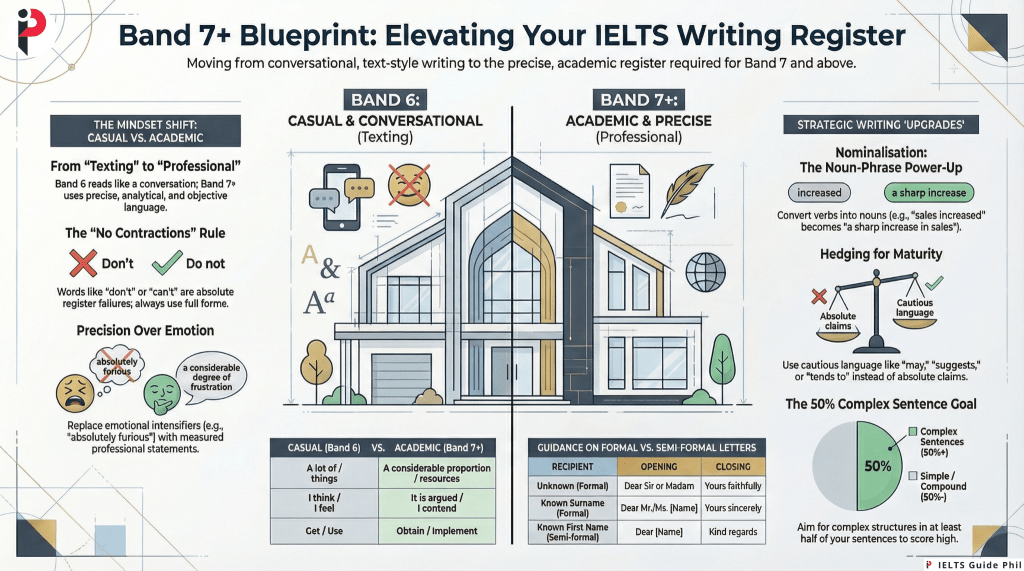
If there is one complaint examiners repeat across thousands of IELTS scripts, it is this: candidates know what to say but not how to say it with the precision, control, and register that the task demands.
You can have brilliant ideas, solid grammar, and a wide vocabulary — and still score Band 6 because your writing reads like a conversation, a social media caption, or a motivational speech instead of a purposeful, controlled piece of academic or professional writing.
Here is what most candidates miss: the same core writing principles underpin every IELTS writing task. Whether you are analysing a bar chart, arguing a position on education policy, complaining to a hotel manager, or requesting leave from your supervisor — the same examiner criteria apply, and the same linguistic habits determine your band score.
This post maps all twelve key features of academic writing across all four IELTS writing contexts: Task 2 essays, Academic Task 1 reports, formal letters, and semi-formal letters — so you are never caught off-guard regardless of which task is in front of you.
The Four IELTS Writing Contexts — and What Each Demands
Academic Task 1 (Report): Describe and analyse visual data — graphs, charts, diagrams, maps, or processes. Audience: an academic reader or assessor. Register: formal, objective, and data-focused throughout. No personal opinion. No emotional language.
Academic / GT Task 2 (Essay): Present a discursive argument, discussion, or evaluation of an issue. Audience: an educated general or academic reader. Register: formal and analytical throughout. Opinion when required — but expressed academically.
GT Task 1 — Formal Letter: Written to an institution, authority, unknown individual, or organisation (a company, a government body, a newspaper editor, an unknown landlord). Register: fully formal — equivalent in standard to academic writing.
GT Task 1 — Semi-formal Letter: Written to someone you know in a professional or semi-personal capacity (a manager you work with, a neighbour, a teacher you are familiar with, a colleague). Register: polite, professional, and clear — warmer than formal but never casual.
Note on Informal Letters: GT Task 1 occasionally requires an informal letter to a close friend or family member. Informal letters follow conversational conventions and fall largely outside the scope of academic writing features. This post focuses on the three formal and analytical contexts where these features directly apply.
Why These Features Matter for Your IELTS Score
In all IELTS writing tasks, your response is assessed on four criteria:
Task Achievement / Task Response (TA/TR): Did you address the task fully, accurately, and with appropriate purpose and register?
Coherence and Cohesion (CC): Is your writing logically organised and does it flow clearly?
Lexical Resource (LR): Do you use a wide, precise, and contextually appropriate range of vocabulary?
Grammatical Range and Accuracy (GRA): Do you use varied and accurate grammatical structures?
Academic writing features feed directly into all four criteria across all tasks. A formal letter in casual language fails on LR. A Task 1 report with personal opinions fails on TA. A Task 2 essay with no logical structure fails on CC. A semi-formal letter full of simple, repetitive sentences fails on GRA.
Register awareness — knowing which feature applies, how, and to what degree — is itself a Band 7+ skill.
The 12 Key Features of Academic Writing — Applied Across All IELTS Writing Tasks
Feature 1: Formal Vocabulary Over Casual Language
The words you choose signal your command of register before the examiner reads a single complete sentence. Formal vocabulary is precise, contextually appropriate, and free of everyday conversational language.
Task 2 (Essay):
Every general claim in a Task 2 essay should be expressed with formal, precise vocabulary that reflects the seriousness of the topic.
Casual → Academic:
- a lot of → a significant number of / a considerable proportion of
- good → beneficial / advantageous / constructive
- bad → detrimental / adverse / harmful
- think → argue / contend / assert / maintain
- show → demonstrate / illustrate / reveal / indicate
- get → obtain / acquire / attain
- use → utilise / employ / implement
Casual: A lot of people think social media is bad for young people. Academic: A considerable number of researchers argue that social media has a detrimental effect on adolescent development.
Academic Task 1 (Report):
Task 1 requires a specialised subset of formal vocabulary — data language — used to describe trends, comparisons, and proportions precisely.
Data verbs (movement): rise, climb, surge, soar / fall, decline, drop, plummet / fluctuate, level off, plateau, remain stable Data adverbs (degree): sharply, significantly, dramatically, steadily, marginally, slightly, considerably Data nouns (for nominalisation): a rise, a decline, a surge, a fluctuation, a peak, a trough, a plateau Proportion language: accounted for, represented, comprised, constituted, made up Comparison language: by contrast, in comparison, whereas, while, unlike, similarly
Casual: The number of users went up a lot between 2010 and 2020. Formal Task 1: The number of users rose sharply between 2010 and 2020, reaching a peak of approximately 4.5 billion by the end of the period.
Vague words like a lot, went up, big, small are never acceptable in an academic report.
Formal Letter (GT Task 1):
Formal letters demand an elevated professional register — equivalent in seriousness to academic writing but oriented toward communicative purpose rather than argumentation.
Casual → Formal letter vocabulary:
- I want to → I am writing to request / I wish to enquire
- I need → I require / I would appreciate
- fix the problem → rectify the issue / resolve the matter
- tell me → kindly inform me / please advise
- as soon as possible → at your earliest convenience
- I’m writing about → I am writing with regard to / in connection with
Casual: I want to complain about the bad service I got at your store. Formal: I am writing to formally express my dissatisfaction with the standard of service I received at your establishment on [date].
Semi-formal Letter (GT Task 1):
Semi-formal letters use clear, professional language — not the stiffest formal constructions, but never casual either.
Casual: I’m getting in touch about a problem with our meeting. Semi-formal: I am writing to let you know about a scheduling conflict that has arisen regarding our agreed meeting date.
✅ DO: Match your vocabulary to your specific task context — data language for Task 1, argumentative language for Task 2, and purpose-driven professional language for letters.
❌ DON’T: Use casual words (stuff, things, really, lots of, a bit) in any formal or semi-formal writing context.
Feature 2: Impersonal and Objective Tone
Academic writing avoids personal, emotional, or subjective language. The degree of impersonality varies by task — but even letters, which are inherently personal documents, require emotional control and professional tone.
Task 2 (Essay):
Arguments must be presented as reasoned positions, not emotional reactions. Even when giving your opinion, the tone remains measured and analytical.
Too personal: I really feel that governments must do something about pollution right now. Academic: It is widely acknowledged that governments bear a primary responsibility for addressing environmental pollution through coordinated policy intervention.
When stating your opinion directly (as some Task 2 question types require): Weak: I think working from home is better. Academic: It is my contention that remote working models offer significant long-term advantages for both productivity and employee wellbeing.
Academic Task 1 (Report):
Task 1 is entirely objective. You describe what the data shows — you do not evaluate it, judge it, or offer opinions about why trends occurred unless the data makes this evident.
Inappropriate opinion: Sadly, the number of people living in poverty increased dramatically, which is very concerning. Objective report language: The proportion of the population living in poverty rose considerably over the period, increasing from 18% to 31% between 2000 and 2020.
Evaluative adjectives (sad, shocking, impressive, worrying) and personal reactions have no place in an academic report.
Formal Letter (GT Task 1):
Formal letters are transactional and purposeful. Even justified frustration in a complaint letter must be expressed through controlled, measured language rather than emotional outbursts.
Too emotional: I am absolutely furious about what happened and demand you fix this immediately. Controlled and formal: I must express my considerable concern regarding this matter and would respectfully request that appropriate remedial action be taken without further delay.
The dissatisfaction is unmistakably present — but communicated through formal structures rather than emotional language.
Semi-formal Letter (GT Task 1):
Semi-formal letters permit a slightly warmer, more direct tone. You may acknowledge the relationship and express mild concern without sounding unprofessional.
Semi-formal (appropriate): I wanted to bring this to your attention as it has caused some inconvenience, and I hope we can find a solution that works for both of us.
✅ DO: In formal letters, convert emotional reactions into measured professional statements. In Task 1 reports, eliminate all personal evaluation.
❌ DON’T: Use exclamation marks, emotional intensifiers (absolutely furious, so disappointed, very worrying), or evaluative adjectives in any formal writing context.
Feature 3: Precise and Specific Language
Vague language is penalised under Lexical Resource across all tasks. In letters, it also undermines Task Achievement because imprecision makes your communication unclear and unactionable.
Task 2 (Essay):
Every claim should be as specific as the argument allows. Vague generalisations weaken both LR and Task Response.
Vague: Technology has changed things in many ways. Precise: Digital technology has fundamentally transformed communication, commerce, and access to educational resources, reshaping the daily lives of people across the socioeconomic spectrum.
Quick fix: every time you write things, stuff, many ways, various aspects, or a lot, stop and ask — what specific thing? Replace it with the actual noun.
Academic Task 1 (Report):
Precision in Task 1 means accurately describing data — specific figures, correct time references, and precise trend language. Approximate figures are acceptable (approximately, around, roughly, just over, just under) but imprecise trend descriptions are not.
Imprecise: The graph shows that sales went up and then went down. Precise: Sales rose steadily from approximately 2,000 units in January to a peak of around 5,500 in June, before declining sharply to 1,800 by December.
Never invent figures. Use approximation language when exact values are unclear from the graph.
Formal Letter (GT Task 1):
Precision in formal letters is both a linguistic requirement and a functional one. A complaint or request without specific details — dates, reference numbers, amounts, locations — is communicatively incomplete and will be penalised under Task Achievement.
Vague: I ordered something from you a while ago and it arrived damaged. Precise: On 14 March 2026, I placed an order (Reference No. 48271) for a laptop stand, which arrived on 21 March in a visibly damaged condition, with two of the structural supports fractured upon inspection.
Semi-formal Letter (GT Task 1):
The same principle applies in semi-formal letters. Specific details make your communication credible and actionable.
Vague: The equipment in the meeting room has been having some problems lately. Precise: The projector in Meeting Room B has been malfunctioning since 10 March, and despite two reports submitted to IT support, the issue remains unresolved.
✅ DO: In all formal writing contexts, name the specific thing, trend, date, figure, or action you are referring to.
❌ DON’T: Rely on vague nouns and broad generalisations. Precision signals linguistic control across every criterion.
Feature 4: Hedging Language (Cautious Claims)
Hedging — qualifying claims rather than asserting them as absolute truths — is a hallmark of academic maturity in essays and reports. In letters, hedging serves a different but equally important purpose: it maintains politeness and signals professional courtesy.
Task 2 (Essay):
Overconfident claims — especially generalisations — undermine your academic credibility.
Without hedging: Social media causes depression in teenagers. With hedging: Social media may contribute to elevated rates of depression among adolescents, particularly when use is excessive or unsupervised.
Common hedging tools for essays:
- Modal verbs: may, might, could, would
- Adverbs: arguably, generally, typically, seemingly
- Verbs: tends to, appears to, suggests, indicates
- Phrases: in many cases, to a large extent, under certain conditions
Academic Task 1 (Report):
In Task 1, hedging applies primarily to projected or estimated data — figures from forecast graphs or inferred comparisons.
Overconfident: The population will reach 10 million by 2050. Appropriately hedged: The population is projected to reach approximately 10 million by 2050.
For clearly visible data, hedging is unnecessary — state it with confidence: Sales rose sharply in Q3. But for projections and approximations, hedging is both academically correct and linguistically rewarded.
Formal Letter (GT Task 1):
In formal letters, hedging softens requests and avoids presumption — making your letter more professional and more likely to achieve its communicative purpose.
Direct and presumptuous: Send me a replacement immediately. Hedged and formal: I would be grateful if you could arrange for a replacement to be dispatched at your earliest convenience.
Hedged request structures for formal letters:
- I would appreciate it if you could…
- I wonder if it might be possible to…
- Should you require further information, I would be happy to provide it.
- It would be most helpful if…
- I trust that this matter can be resolved…
Semi-formal Letter (GT Task 1):
Semi-formal hedging is slightly more direct but still polite:
- It would be great if we could…
- I was hoping you might be able to…
- Please let me know if this works for you.
✅ DO: Hedge generalisations and predictions in essays, projected figures in Task 1 reports, and requests in formal and semi-formal letters.
❌ DON’T: Use imperatives (Do this. Send that. Fix this.) in formal letters. Requests — even urgent ones — must be phrased with professional deference.
Feature 5: Complex and Varied Sentence Structures
GRA rewards your ability to use a range of grammatical structures accurately. Every writing task in IELTS offers an opportunity to demonstrate range — and every task penalises structural monotony.
Task 2 (Essay):
Flat and simple: Crime is increasing. The government should act. People are worried. Complex and varied: As crime rates continue to rise in urban centres, there is mounting pressure on governments to implement more effective preventive measures — a concern increasingly shared by communities across the socioeconomic spectrum.
Structures to deploy in essays:
- Relative clauses: …which suggests / …who argue / …that contribute to
- Adverbial clauses: Although… / Despite… / While… / Given that…
- Passive voice: It has been argued… / The policy was introduced…
- Conditionals: Were governments to invest more heavily… / Should this trend continue…
- Noun phrases: The rapid expansion of digital infrastructure…
Academic Task 1 (Report):
Task 1 naturally calls for complex structures to describe simultaneous trends, contrasts, and cause-and-effect relationships.
Simple: Sales went up. Profits also went up. Complex: As sales rose steadily throughout the first quarter, profit margins expanded correspondingly, suggesting a strong correlation between volume and revenue performance during this period.
Structures especially useful in Task 1:
- Comparative clauses: while, whereas, in contrast to, compared with
- Participial phrases: Having peaked in 2015, the figure declined steadily thereafter.
- Noun phrases for nominalisation: a sharp increase in production / a gradual decline in consumption
- Passive voice for objective description: A significant rise was recorded in…
Formal Letter (GT Task 1):
Formal letters should not consist entirely of short, declarative sentences. Varied structures make the letter linguistically richer and more professionally compelling.
Flat: I bought a product. It was damaged. I contacted customer service. They did not help. I want a refund.*
Varied and formal: Having purchased the above-referenced product on 14 March, I was disappointed to discover upon delivery that it had sustained considerable damage during transit. Despite contacting your customer service department on two separate occasions, I have not yet received a satisfactory resolution and am therefore writing to formally request a full refund.
Semi-formal Letter (GT Task 1):
Semi-formal letters benefit from varied structures too, though they can be shorter and more direct. One or two complex sentences per paragraph is sufficient.
✅ DO: Attempt complex sentence structures in at least 40–50% of your sentences across all tasks — relative clauses, adverbial clauses, participial phrases.
❌ DON’T: Write exclusively in simple subject-verb-object sentences to avoid errors. A flat but error-free response scores lower than a varied response with minor errors.
Feature 6: Cohesive Devices Used Accurately
Academic writing connects ideas logically. But cohesion is not just about adding transition words — it is about structural logic, referencing, and the natural flow of ideas. Mechanical use of cohesive devices is penalised, not rewarded.
Task 2 (Essay):
Mechanical and penalised: Firstly, pollution is bad. Secondly, it affects health. Thirdly, it affects the economy. In conclusion, pollution is a big problem.
Cohesive and natural: Environmental pollution poses substantial risks not only to public health but also to economic stability. The healthcare costs associated with pollution-related illness alone place considerable strain on national budgets, while the long-term degradation of natural resources further undermines productive capacity.
Cohesive devices by function:
- Adding: furthermore, in addition, moreover, equally
- Contrasting: however, nevertheless, on the other hand, despite this
- Cause and effect: consequently, as a result, therefore, thus, hence
- Illustrating: for instance, for example, to illustrate
- Conceding: admittedly, while it is true that, although
Academic Task 1 (Report):
Task 1 cohesion is achieved through accurate data referencing and smooth transitions between trend descriptions. Avoid beginning every sentence with a cohesive device — let the data language carry the flow.
Task 1 cohesion tools:
- Referencing: the former / the latter / the figure / the proportion / this trend
- Contrast: by contrast, while, whereas, on the other hand
- Similarity: similarly, in the same manner, likewise
- Overview signposting: Overall, it is clear that… / The most notable feature is…
Choppy: Sales rose. Profits rose. Then both fell. Then they stabilised. Cohesive: Sales and profits rose in tandem throughout the first half of the year before declining sharply in Q3, after which both indicators stabilised at around their mid-year levels.
Formal Letter (GT Task 1):
Formal letter cohesion is structural as well as linguistic. Letters follow a three-part architecture — opening (purpose) → body (details and development) → closing (action and goodwill) — and cohesion must be maintained within and between these sections.
Formal letter cohesion tools:
- Referencing: the above-mentioned issue / the matter referred to / the product in question
- Sequencing: First and foremost… / In addition to this… / Furthermore… / I would also like to draw your attention to…
- Logical connection: As a result… / In light of the above… / Given the circumstances…
- Closing links: I look forward to your prompt response. / I trust this matter will receive your immediate attention.
Semi-formal Letter (GT Task 1):
Semi-formal cohesion is simpler and more conversational in texture:
- Also… / On top of that… / With that in mind…
- As I mentioned… / To follow up on…
- I look forward to hearing from you.
✅ DO: Use referencing phrases (the matter in question, the above-referenced issue, this trend) to create professional cohesion across all formal writing tasks.
❌ DON’T: Begin every sentence with a cohesive device in any task. Most logical connections should flow naturally through sentence and paragraph structure.
Feature 7: Avoidance of Contractions and Informal Abbreviations
This rule is absolute across all formal and academic writing contexts.
Across All Four Tasks:
Never use:
- don’t → do not
- can’t → cannot
- I’m → I am
- it’s → it is
- they’re → they are
- won’t → will not
- ASAP → at your earliest convenience
- FYI → I would like to bring to your attention
- etc. → and related matters / among other things
A single contraction in any formal writing context immediately signals a register failure to the examiner.
Task-specific notes:
In Task 2 essays and Academic Task 1 reports, contractions never appear. This should be automatic by Band 7 level.
In formal letters, the same absolute rule applies. I’m writing to complain is a register failure. I am writing to formally express my concern is correct.
In semi-formal letters, contractions are still generally avoided, though occasional relaxed constructions may be acceptable depending on the closeness of relationship implied by the prompt. When in doubt — write it out in full.
✅ DO: Treat every apostrophe-contracted word as an automatic red flag in all formal writing.
❌ DON’T: Assume semi-formal means informal. Semi-formal still requires professional, full-form language in most constructions.
Feature 8: Third-Person Perspective and Passive Voice
Academic writing typically avoids I, we, you in favour of third-person constructions. Passive voice is common in academic writing because it shifts focus from the agent to the action or finding. Letters modify this principle — but passive voice remains a powerful tool even in personal correspondence.
Task 2 (Essay):
First person (conversational): I think we should increase funding for public transport. Third person / passive (academic): It has been widely proposed that increased investment in public transportation infrastructure would significantly reduce urban congestion.
You may use I to state your position (I would argue that…) but avoid first person for general claims and reasoning.
Academic Task 1 (Report):
Reports are written in third person and make frequent use of passive voice for objective, formal description.
Active (less formal): The researchers collected data over ten years. Passive (academic report): The data was collected over a ten-year period.
Active: The figures show a sharp rise in 2015. Passive / impersonal: A sharp rise was recorded in 2015. / The figures indicate a significant increase in 2015.
Formal Letter (GT Task 1):
Letters are inherently first-person documents — I am writing… / I would like to… — so third-person avoidance does not apply in the same way. However, passive voice plays an important role by making formal letters feel less confrontational and more professional.
Active (slightly confrontational): You have not issued my refund yet. Passive (professional and measured): My refund has not yet been issued, and I would appreciate clarification regarding the expected timeline.
Other formal letter passives:
- It has come to my attention that…
- I was informed that…
- The matter has not yet been resolved.
- Your response would be greatly appreciated.
Semi-formal Letter (GT Task 1):
Semi-formal letters may use a more active, direct tone but passive constructions are still welcome for politeness and variety.
✅ DO: Use passive voice in formal complaint and request letters to reduce personal confrontation and maintain professionalism.
❌ DON’T: Use passive voice to avoid being clear about what you want. Your request must still be explicit, even when phrased diplomatically.
Feature 9: Nominalisation (Turning Verbs Into Nouns)
Nominalisation — converting verbs or adjectives into noun forms — is one of the most reliable markers of advanced academic and formal writing. It packs meaning into compact noun phrases, elevates register, and boosts Lexical Resource.
Task 2 (Essay):
Verb-heavy: When the economy declined, people became poor and the government failed to respond. Nominalised: The economic decline led to widespread impoverishment and exposed significant failures in governmental response.
Common nominalisations for essays:
- develop → development
- investigate → investigation
- solve → solution
- fail → failure
- decide → decision
- grow → growth
- reduce → reduction
- improve → improvement
Academic Task 1 (Report):
Nominalisation is especially powerful in Task 1 because it allows you to describe trends in compact, precise noun phrases rather than relying exclusively on verb-based constructions.
Verb-based: Sales increased sharply and then they decreased. Nominalised: A sharp increase in sales was followed by a considerable decline.
Verb-based: The number of users grew steadily. Nominalised: Steady growth in user numbers was observed throughout the period.
Noun-based trend descriptions allow you to vary your sentence structure while maintaining precision — a double LR and GRA benefit.
Formal Letter (GT Task 1):
Nominalisation is one of the clearest markers of formal letter register. It shifts the letter from colloquial to professional in a single structural move.
Verb-based (less formal): I am complaining because you delivered the item late and it was damaged. Nominalised (formal): I am writing to formally register a complaint regarding the late delivery and subsequent damage of the item in question.
More formal letter nominalisations:
- to complain about → to register a complaint regarding
- to ask for → to submit a request for
- to apologise → to offer a sincere apology for
- to agree → to confirm agreement / acknowledge receipt
- to explain → to provide clarification regarding
- to decide → to reach a decision regarding
Semi-formal Letter (GT Task 1):
Light nominalisation is appropriate in semi-formal writing, but heavy nominalisation can make the letter feel overly stiff. Use it selectively — one or two nominalisations per letter is sufficient.
Semi-formal (balanced): I wanted to raise a concern about the recent changes to the schedule.
✅ DO: Use nominalisations in formal letter openings, complaint statements, request lines, and closing summaries.
❌ DON’T: Nominalise every clause in any task. In letters especially, natural readability matters alongside formal register.
Feature 10: Evidence-Based and Logical Argumentation
Academic writing builds arguments through clear reasoning, specific evidence, and logical structure — not through feelings, assumptions, or unsupported generalisations.
Task 2 (Essay):
Every body paragraph must follow a clear logical structure. A useful framework is PEEL: Point → Evidence/Explanation → Example → Link.
Weak (assertion only): Education is very important. Everyone should go to school. It helps people get good jobs.
Strong (PEEL): Access to quality education remains one of the most reliable pathways to economic mobility. By equipping individuals with both technical skills and critical thinking capacity, formal education enhances employability across a broad range of industries. In societies where educational access is equitable, income disparities tend to be less pronounced, suggesting a direct correlation between educational investment and social equality.
Academic Task 1 (Report):
Task 1 does not involve argumentation in the essay sense — but it does require evidence-based description: every observation must be supported by data, and no claim should go beyond what the data shows.
Unsupported claim: The country’s economy was clearly performing well. Evidence-based observation: GDP growth averaged 3.2% annually between 2010 and 2020, indicating a period of sustained economic expansion.
The Task 1 equivalent of logical argumentation is accurate data reading + supported observation + meaningful comparison — the analytical skills that distinguish a Band 7 report from a Band 5 description.
Formal Letter (GT Task 1):
The formal letter equivalent of evidence-based argumentation is substantiation — backing up every complaint, request, or concern with specific facts, dates, and details that make your case credible and actionable.
Unsubstantiated: The service at your hotel was terrible and I think I deserve a refund.
Substantiated: During my stay from 12 to 15 March 2026 (Booking Reference: HT-9921), I encountered several issues that fell considerably below the standard advertised. The air conditioning unit in Room 304 was non-functional throughout my stay despite two maintenance requests submitted on 12 and 13 March respectively. Furthermore, the promised complimentary breakfast was unavailable on two of the three mornings. In light of these circumstances, I would respectfully request a partial refund equivalent to one night’s accommodation.
Notice the structure: specific complaint → supporting details → reasonable, proportionate request. This mirrors the PEEL logic of academic essay writing.
Semi-formal Letter (GT Task 1):
The same principle applies in a lighter register: I wanted to mention that the projector in Meeting Room B has been malfunctioning since 10 March. I have already reported it to IT support twice, but the issue remains unresolved. It would be great if we could prioritise a fix before next month’s presentation.
✅ DO: Treat every formal letter complaint or request as a mini-argument — state it, support it, and close with a clear, reasonable action point.
❌ DON’T: List opinions without reasoning in essays, observations without data in Task 1 reports, or complaints without evidence in letters.
Feature 11: Consistent and Appropriate Register Throughout
Register means the sustained level of formality across your entire response. Inconsistent register — formal in one paragraph, casual in the next — signals a lack of linguistic control to the examiner.
Task 2 (Essay):
Maintain a consistently formal, analytical register from introduction to conclusion. Certain phrases are common in spoken English and informal writing — they immediately lower your register.
Register-breaking phrases to eliminate:
- At the end of the day → Ultimately / In the final analysis
- Needless to say → It is evident that / Clearly
- Last but not least → Finally / Of equal significance
- To wrap things up → In conclusion / To summarise
- In today’s world → In contemporary society / In the modern era
- It goes without saying → It is widely acknowledged that
Academic Task 1 (Report):
Task 1 register must remain objective, data-driven, and impersonal from overview to conclusion. Register-breaking elements in Task 1 include personal opinions, evaluative language, and informal data vocabulary.
Register violations in Task 1:
- It is very sad that poverty increased. → The proportion living in poverty rose considerably.
- Sales went up like crazy. → Sales rose sharply.
- I think the most interesting finding is… → The most notable feature of the data is…
- As you can see from the graph… → As illustrated in the graph… / The graph reveals…
Never address the reader directly in an academic report. Never share your personal reaction to the data.
Formal Letter (GT Task 1):
Formal letter register is governed by highly visible conventions — especially the salutation and sign-off — that examiners notice immediately.
Formal letter opening conventions:
- Dear Sir or Madam, — unknown recipient
- Dear Mr. / Ms. [Surname], — known name, no personal relationship
Formal letter closing conventions:
- Yours faithfully, — always paired with Dear Sir or Madam
- Yours sincerely, — always paired with Dear Mr. / Ms. [Surname]
- I look forward to your prompt response.
- I trust this matter will receive your immediate attention.
- Should you require any further information, please do not hesitate to contact me.
Register-breaking mistakes in formal letters:
- Opening with Hello or Hi there
- Closing with Thanks a lot, Take care, Best wishes, Cheers
- Mixing sign-off conventions: Dear Sir or Madam… Yours sincerely ❌
- Using Hope to hear from you soon! in a complaint letter
Semi-formal Letter (GT Task 1):
Semi-formal letters use warmer but still professional conventions.
Semi-formal opening: Dear [First Name],
Semi-formal closing: Kind regards, / Best regards, / Warm regards,
Semi-formal tone markers: I hope this message finds you well. / As you may be aware… / Please feel free to get in touch if you have any questions.
The critical distinction:
- Yours faithfully / Yours sincerely = formal letters only
- Kind regards / Best regards = semi-formal letters
- Take care / Cheers / Thanks = informal only
Mixing these pairings is one of the most common — and most visible — register errors in GT Task 1.
✅ DO: Read your entire response after writing it. If any phrase sounds like something you would say over lunch — rewrite it.
❌ DON’T: Mix formal and informal register within any response. Inconsistency signals a lack of control over linguistic register.
Feature 12: Accurate Use of Formal Vocabulary in Context
Using a sophisticated word incorrectly is worse than using a simpler word correctly. This principle applies to academic vocabulary in essays, data language in Task 1 reports, and formulaic phrases in formal letters.
Task 2 (Essay):
Incorrect: The government should ameliorate the people by giving more jobs. (Ameliorate means to improve a situation, not to benefit people directly.)
Correct: Targeted employment programmes may help ameliorate the social consequences of economic recession.
Commonly misused academic words:
- Mitigate — to reduce severity, not to solve entirely
- Exacerbate — to worsen, not merely to affect
- Advocate — to publicly support, not simply to want
- Attribute — to assign cause, not just to connect
- Comprise — the whole comprises its parts (not is comprised of)
Academic Task 1 (Report):
Data language must be used accurately. Using a trend verb, adverb, or noun incorrectly misrepresents the data — a Task Achievement failure as well as a Lexical Resource error.
Common Task 1 vocabulary errors:
- Increase used for a decrease: always verify the direction of movement before choosing your verb.
- Dramatic used for a gradual change: match the degree adverb to the actual magnitude of the trend.
- Amount used for uncountable data vs. number for countable items: the amount of water ✅ / the number of people ✅ / the amount of students ❌
- Comprise misused: The pie chart comprises five categories. ✅ / Five categories are comprised in the chart. ❌
- Overtake used when two lines merely intersect but do not cross: read the graph carefully before using this verb.
Formal Letter (GT Task 1):
Formal letter phrases must be used in the correct functional context — not scattered randomly to appear formal. Each formulaic expression belongs to a specific part of the letter for a specific communicative purpose.
Commonly misused formal letter phrases:
- I am writing to inform you — delivers information, not requests
- I am writing to enquire — asks for information, not complains
- I wish to draw your attention to — flags a problem, not an introduction
- I look forward to hearing from you — closing phrase; not mid-letter
- Please do not hesitate to contact me — invitation for follow-up; placed at the end only
- With reference to your letter of [date] — used only when replying to a previous correspondence
✅ DO: Learn vocabulary — academic, data, and letter-specific — with its correct meaning, collocation, and grammatical pattern.
❌ DON’T: Use any word or phrase because it sounds impressive. Accurate use of a simpler item always outscores inaccurate use of a sophisticated one.
Common Mistakes Across All Four Writing Contexts (and How to Fix Them)
Mistake 1: Treating all IELTS writing tasks as the same genre
Some candidates write their formal letter like a Task 2 essay — argumentative, impersonal, and structured with Firstly… Secondly… In conclusion. Others write their Task 2 essay with the personal, direct tone of a letter. Fix: Before writing a single word, identify the genre, audience, and purpose. These three factors determine every feature that follows.
Mistake 2: Using the wrong cohesive devices for the task type
Essay discourse markers (Firstly, Furthermore, In conclusion) do not belong in formal letters. Letter phrases (I am writing with regard to) do not belong in essays. Fix: Build a separate phrase bank for each writing context and practise using each phrase in its correct genre.
Mistake 3: Mixing register levels within a single response
Starting formally and drifting into casual language mid-response — or using stiff formal constructions throughout a semi-formal letter. Fix: Read your response aloud. Any phrase that sounds wrong in its context probably is. Re-read model answers in each genre to calibrate your register instinct.
Mistake 4: Ignoring data precision in Academic Task 1
Describing trends in general terms without reference to specific figures, time periods, or units of measurement. Fix: In every Task 1 report, identify the key figures before you write. Integrate at least three to four specific data points — peaks, troughs, starting points, endpoints — into your response.
Mistake 5: Over-relying on memorised phrases without understanding their function
Inserting phrases like It goes without saying, Last but not least, or Please do not hesitate to contact me in the wrong task, wrong position, or wrong context. Fix: For every phrase you memorise, know: (1) which task genre it belongs to, (2) where in the response it should appear, and (3) what communicative function it performs.
Mistake 6: Translating Tagalog sentence structures into English
Sentences shaped by Tagalog syntax — topic-prominent constructions, misplaced modifiers, incorrect preposition patterns — appear across all four task types. Fix: Write in English from the beginning. Do not compose in Tagalog and translate. Train yourself to think in English academic and formal structures.
Frequently Asked Questions
Q: Do formal and semi-formal letters use the same writing criteria as essays?
A: Yes. All IELTS Writing tasks — including GT Task 1 letters — are marked on Task Achievement, Coherence and Cohesion, Lexical Resource, and GRA. The criteria are applied in terms of letter purpose and register rather than essay argumentation, but the linguistic standards are equally demanding.
Q: How do I identify whether a GT Task 1 prompt requires a formal or semi-formal letter?
A: Look at three signals: (1) who you are writing to, (2) your stated relationship to them, and (3) the nature of the situation. Writing to a company, government office, newspaper, or unknown landlord = formal. Writing to a manager you work with, a neighbour, or a familiar teacher = semi-formal. Writing to a close friend or family member = informal.
Q: Should I include addresses and dates in my formal letter response? A: No. IELTS markers do not assess address formatting. Begin directly with your salutation and letter body. Do not waste words or time on layout conventions that are not scored.
Q: Can I use bullet points inside my formal letter or essay?
A: No. All IELTS Writing tasks require continuous prose. Bullet points and numbered lists are not acceptable in any task and negatively affect Coherence and Cohesion.
Q: Is using rare vocabulary automatically worth more marks?
A: No. Lexical Resource rewards a wide range of vocabulary used accurately and appropriately — including less common items. But inaccurate use of complex vocabulary is penalised more than accurate use of simpler vocabulary. Precision and accuracy always outrank rarity.
Q: Is Academic Task 1 or Task 2 harder to score highly in?
A: Most candidates find Task 1 harder to score Band 7+ in, because it requires a specialised vocabulary set (data language), strict objectivity, accurate data reading, and a clear overview — all within 150 words. Task 2 allows more room to demonstrate a range of ideas and language, but also demands more complex argumentation. Both tasks require sustained formal register and linguistic control.
Q: Is semi-formal letter writing harder than formal letter writing?
A: Many candidates find it harder precisely because the register boundaries are less fixed. Formal letters have clear, learnable conventions. Semi-formal letters require you to exercise register judgment — knowing how warm, direct, or professional to be — and that judgment itself is being assessed under Task Achievement.
Q: What is the fastest way to improve across all four writing tasks?
A: Develop four separate but overlapping habits: (1) read academic English regularly — broadsheet opinion pieces, university essay samples, formal correspondence templates; (2) build a task-specific phrase bank for each of the four writing contexts; (3) write one timed response per task type weekly with examiner-aware self-review; (4) study annotated Band 7 and Band 8 model answers in each genre and identify exactly which features earn the marks.
A Final Word: One Set of Principles, Four Contexts
The twelve features in this post are not four separate skill sets to learn independently. They are one coherent system of linguistic habits — precision, formality, logic, and control — that manifest differently depending on the context.
In a Task 2 essay, they produce analytical, well-reasoned arguments. In an Academic Task 1 report, they produce objective, data-grounded observations. In a formal letter, they produce credible, professional, purposeful communication. In a semi-formal letter, they produce measured correspondence that respects both the relationship and the situation.
The candidates who reach Band 7 and above do not have four completely separate writing identities for four different tasks. They have one deeply internalised sense of what controlled, purposeful writing looks like — and they adjust its expression to fit the task in front of them.
That is the standard. That is what this post is pointing you toward. Build these habits once — and let them serve you across every task on exam day.
Written by Coach Phil | IELTS Guide Phil Helping Filipino IELTS candidates go from Band 6 to Band 7+ through smart, examiner-aware preparation.
#IELTSPhilippines #IELTSWriting #AcademicWriting #FormalLetterWriting #SemiformalLetter #IELTSGeneralTraining #IELTSAcademic #IELTSBand7 #IELTSTips #IELTSPreparation #LexicalResource #GrammaticalRange #IELTSGuidePhil #Band7Writing #IELTSTaskOne #IELTSTaskTwo #IELTSReport #EnglishForAcademicPurposes #FilipinoIELTSCandidates #IELTSCoach #WritingSkills #FormalEnglish #IELTSSuccess #DataLanguage #IELTSLetterWriting #IELTSReview #CoachPhil
 IELTS Guide Phil
Leave a comment