
What IELTS Writing Task 2 Actually Is
Every year, thousands of IELTS candidates sit down to write their Task 2 essay and produce something that is, by every measure of general English writing, a perfectly decent piece of work. Organised. Grammatically reasonable. Relevant to the topic.
And they score Band 5.5.
The reason is almost always the same: they wrote a good essay. They did not write an IELTS Task 2 essay. These are not the same thing.
IELTS Writing Task 2 is not a general essay test. It is a highly specific academic writing task with precise requirements, defined question types, explicit assessment criteria, and a marking logic that is entirely different from what most candidates learned in school. A candidate who understands those requirements and writes accordingly will outscore a candidate with objectively stronger English who ignores them — every single time.
This post exists to make sure you are the first candidate, not the second.
The Basic Facts Every Beginner Must Know
- Word count minimum: 250 words. Responses under 250 words are penalised under Task Response.
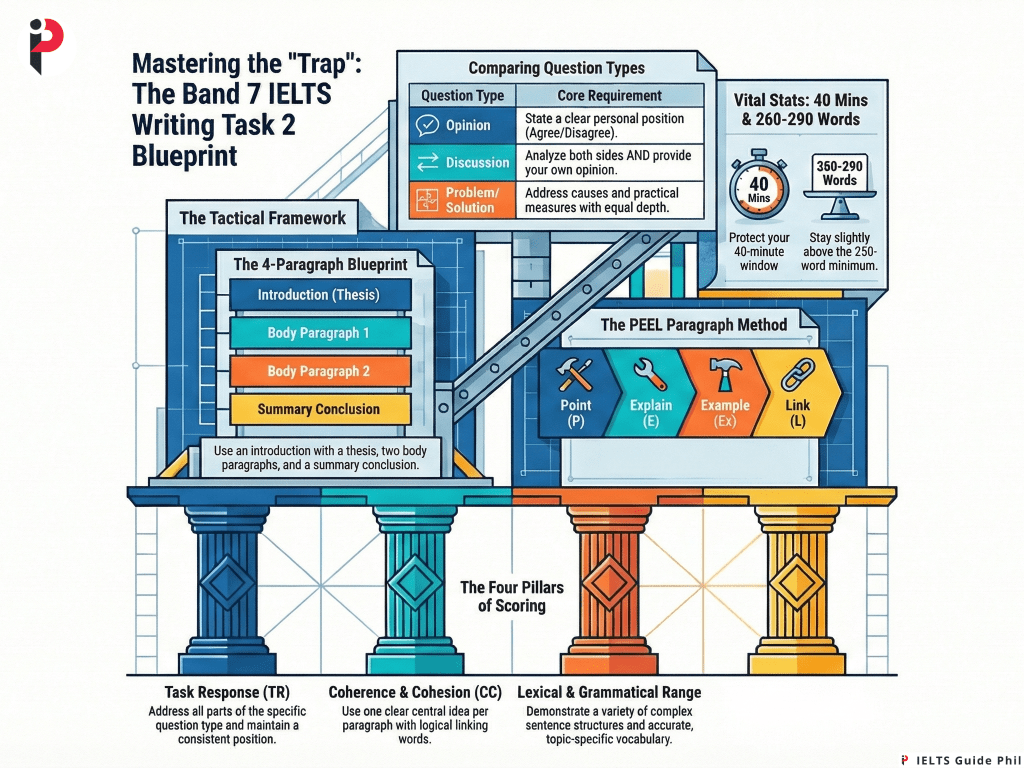
- Recommended word count: 260 to 290 words for most candidates. More is not automatically better.
- Time allocation: 40 minutes — out of the 60-minute Writing test total
- Weight: Task 2 carries more weight toward your overall Writing band score than Task 1
- Question source: A point of view, argument, or problem drawn from everyday topics of general interest
- What you are asked to do: Depends on the question type — discuss, argue, evaluate, problem-solve, or a combination
- Assessment: Four equally weighted criteria, each contributing 25% to your Task 2 band score
- Negative marking: None for attempting — but penalties apply for going under the word count, misaddressing the task, and using memorised content
The weight imbalance between Task 1 and Task 2 is one of the most important structural facts in IELTS Writing. If you spend 30 minutes on Task 1 and only 30 minutes on Task 2, you have distributed your time in direct contradiction of how the marks are distributed. The standard recommended split is 20 minutes for Task 1 and 40 minutes for Task 2. Protect those 40 minutes.
The Four Assessment Criteria: What the Examiner Is Actually Marking
Before you write a single word of practice, you must understand what is being assessed. Every sentence you produce in Task 2 will be evaluated against these four criteria, each weighted equally at 25%.
1. Task Response (TR)
This is the most misunderstood criterion among beginners. Task Response asks: did you fully address what the question actually asked?
This means three things. First, you must identify the correct question type and respond accordingly — not just write about the topic in general terms. Second, you must address all parts of the question. A two-part question that receives a thorough answer on Part 1 and a superficial mention of Part 2 is not fully addressed. Third, your position — if the question requires one — must be clear, consistent, and fully extended throughout the essay, not just stated in the introduction and then abandoned.
A common and costly mistake: writing a brilliant discussion of both sides of an argument when the question asked for your opinion. The topic is addressed. The question is not. Task Response suffers.
2. Coherence and Cohesion (CC)
Coherence is the logical organisation of your ideas — how clearly your essay progresses from introduction to conclusion, how logically your paragraphs are sequenced, and how clearly each paragraph develops a single central idea.
Cohesion is the linguistic glue that holds the essay together — the use of linking words, pronouns, reference words, and sentence connectors that create a smooth, readable flow between sentences and paragraphs.
What hurts CC: body paragraphs with no clear central idea, linking words used incorrectly or mechanically (furthermore used where however is needed), overuse of connectors to the point where every sentence begins with one, and paragraphs that contain two or three unrelated ideas crammed together.
What helps CC: one clear central idea per body paragraph, a topic sentence that announces that idea, supporting sentences that develop and evidence it, and transitions that reflect genuine logical relationships rather than decoration.
3. Lexical Resource (LR)
This criterion assesses the range, accuracy, and appropriateness of your vocabulary across the entire essay. It is not a reward for using the most impressive words. It is an assessment of how well your vocabulary serves your communication.
What hurts LR: repeating the same words and phrases across the essay, using vocabulary slightly inaccurately (raise a problem instead of pose a problem), spelling errors in key vocabulary, and inserting advanced words that do not fit the context naturally.
What helps LR: paraphrasing ideas rather than repeating them, using topic-specific vocabulary accurately, demonstrating awareness of collocation (address a problem, tackle an issue, bridge a gap), and using less common vocabulary that is both accurate and appropriate.
4. Grammatical Range and Accuracy (GRA)
Range means the variety of structures across your essay. Accuracy means how correctly those structures are used.
As in Speaking, range matters as much as accuracy. An essay written entirely in simple present tense structures, even perfectly, will not score above Band 5 for GRA. Evidence of complex sentences — subordinate clauses, relative clauses, conditional structures, passive voice, noun clauses, perfect tenses — is required for Band 6 and above.
At Band 7, occasional errors are acceptable if they do not impede communication and complex structures are used with general control. At Band 8, errors are infrequent and the range of structures is wide and flexible.
The Five Question Types — and Why Misidentifying Them Is Fatal
This is where most beginner preparation goes catastrophically wrong. Candidates learn one essay structure — typically a generic introduction, two body paragraphs, conclusion format — and apply it to every question they encounter. The result is an essay that is organised but fundamentally misaddresses the task.
IELTS Task 2 has five distinct question types, each requiring a specific response approach.
Type 1: Opinion Essay (Agree / Disagree)
Some people believe that [position]. To what extent do you agree or disagree?
This question asks for your personal opinion — directly, clearly, and consistently. You must take a position: fully agree, partially agree, fully disagree, or partially disagree. Your position must be stated in the introduction, developed in the body paragraphs, and restated in the conclusion.
The most common mistake: writing on one hand… on the other hand as if it were a Discussion essay. If the question asks to what extent do you agree or disagree, a balanced both-sides response without a clear personal position fails Task Response.
Type 2: Discussion Essay (Discuss Both Views)
Discuss both views and give your own opinion.
This question requires you to present arguments for both sides AND state your own opinion. Two things — not one. Candidates who present both views but omit their own opinion fail to complete the task. Candidates who state only their opinion fail to discuss both views. Both halves are required.
Type 3: Advantages and Disadvantages Essay
This type appears in several forms:
- Discuss the advantages and disadvantages.
- Do the advantages outweigh the disadvantages?
- What are the advantages and disadvantages?
These are not identical questions. Discuss the advantages and disadvantages requires balanced coverage. Do the advantages outweigh the disadvantages? requires a clear evaluative judgment — which side is stronger, and why.
Treating an evaluative question as a neutral listing task misaddresses the prompt.
Type 4: Problem and Solution Essay
What are the causes of this problem and what measures could be taken to address it?
Or variations: What problems does this cause and what solutions can you suggest?
This question type has two explicit parts. Both must be addressed with roughly equal depth. An essay that spends three paragraphs on causes and one sentence on solutions has not completed the task.
Type 5: Two-Part Question (Direct Questions)
Why is this happening? Is this a positive or negative development?
These questions contain two explicitly stated questions, both of which require full responses. This type is the most frequently underaddressed — candidates answer the first question well and treat the second as an afterthought.
The Essay Structure That Works
There is no single mandatory structure for IELTS Task 2. However, for most question types, the following four-paragraph framework is reliable, examiner-readable, and achievable within 40 minutes.
Paragraph 1 — Introduction Two to three sentences. Paraphrase the topic (do not copy the question). State your position or indicate the essay’s approach clearly. Do not begin developing arguments here.
Paragraph 2 — First Body Paragraph One central idea. A topic sentence that clearly states the idea. Two to three supporting sentences that explain, evidence, or exemplify the idea. A brief concluding or linking sentence if appropriate. Approximately 80 to 100 words.
Paragraph 3 — Second Body Paragraph Same structure as Paragraph 2. A different central idea. Approximately 80 to 100 words.
Paragraph 4 — Conclusion Two to three sentences. Summarise your main points. Restate your position if the question required one. Do not introduce new ideas in the conclusion.
This four-paragraph structure produces a focused, readable essay of approximately 260 to 290 words — comfortably above the 250-word minimum, without padding that dilutes the quality of your argument.
Should you write five paragraphs? You can — a three-body-paragraph essay is acceptable. But for most candidates under time pressure, three body paragraphs risks producing one underdeveloped paragraph. Two well-developed body paragraphs consistently outperform three thin ones.
The Introduction: Three Sentences That Set the Tone
Your introduction does exactly two things: it demonstrates that you understand the topic, and it signals your essay’s direction. Nothing more is required.
Sentence 1 — Paraphrase the background statement. The question gives you a context statement before the actual question. Rewrite it in your own words. Do not copy it. Copying the question verbatim does not demonstrate vocabulary range — it demonstrates avoidance.
Sentence 2 — Introduce the question or the tension. Briefly signal what the essay will address: the debate, the problem, the question at hand.
Sentence 3 — Your thesis. State your position clearly if the question requires one. For Opinion essays: This essay argues that… or In my view… For Discussion essays: While both perspectives have merit, I believe… For Problem-Solution essays: This essay will examine the primary causes and propose practical solutions.
A strong introduction takes three to four minutes to write. Do not spend ten minutes perfecting it. The body paragraphs are where your score is built.
The Body Paragraph: The PEEL Framework
Each body paragraph should function as a self-contained unit of argument. The PEEL framework is a reliable construction method:
P — Point: Your topic sentence. State the central idea of the paragraph in one clear sentence.
E — Explain: Develop the idea. Why is this the case? What is the mechanism or logic behind your point?
E — Example: Provide a specific example, piece of evidence, or elaboration that grounds the abstract claim in something concrete.
L — Link: A brief sentence that connects back to the question or signals the transition to the next idea.
Example of a weak body paragraph: Many people think technology is bad for children. They spend too much time on their phones. This is a problem.
Example of a PEEL body paragraph on the same idea: One significant concern is the impact of excessive screen time on children’s cognitive development. When children spend the majority of their leisure time engaged with digital devices, they have fewer opportunities to develop the sustained attention and independent thinking skills that come from unstructured play and reading. In countries where screen time guidelines for children have been implemented — such as in parts of Scandinavia — studies have suggested improvements in attention span and academic performance. This indicates that while technology itself is not inherently harmful, unmanaged exposure during formative years carries measurable developmental risks.
The second paragraph is not just longer. It is more specific, more logical, more developed, and it demonstrates a wider range of vocabulary and grammar. That is what Task Response, Coherence and Cohesion, Lexical Resource, and GRA reward simultaneously.
Common Mistakes and How to Fix Them
Mistake 1: Misidentifying the question type
A candidate who treats an Opinion essay as a Discussion essay, or a Problem-Solution essay as an Advantages-Disadvantages essay, will address the wrong task no matter how well they write. Fix: Before writing a single word, identify the question type. Read the question twice. Underline the instruction words. Confirm what is actually being asked.
Mistake 2: Going under 250 words
Sub-250-word responses are penalised under Task Response. This penalty is applied regardless of the quality of the writing. Fix: Count your words during practice until you develop a reliable intuitive sense of what 260 words feels like on the page. In the actual test, estimate rather than count — but never estimate downward.
Mistake 3: Copying the question into the introduction
Many candidates reproduce the question statement verbatim as their opening sentence. This contributes nothing to Lexical Resource and signals avoidance. Fix: Always paraphrase. Change vocabulary, sentence structure, and if possible, the grammatical construction. The meaning stays the same; the words should not.
Mistake 4: Using memorised template phrases throughout the essay
Phrases like In today’s modernising world, It is a well-known fact that, In my humble opinion, and Last but not least are instantly recognisable as templates. They contribute nothing to LR and signal memorisation rather than genuine language use. Fix: Replace template openers with direct, specific engagement with the topic. In today’s modernising world, technology plays an important role → Digital technology has become central to how people work, communicate, and access information.
Mistake 5: Listing ideas without developing them
Body paragraphs that contain three or four ideas, each mentioned in one sentence, score poorly on both Task Response and CC. Ideas are stated but never developed — the examiner cannot assess your ability to reason or extend an argument. Fix: Fewer ideas, developed more fully. One idea per paragraph, explained and evidenced across three to four sentences, consistently outperforms a paragraph with four undeveloped ideas.
Mistake 6: Introducing new ideas in the conclusion
The conclusion is a summary and restatement, not a third body paragraph. Fix: Your conclusion should contain no idea that has not already appeared in the body paragraphs. Two to three sentences are sufficient.
Mistake 7: Being inconsistent in your position
Stating I strongly agree in the introduction and then spending two body paragraphs discussing the opposing view with apparent sympathy confuses the examiner and undermines Task Response. Fix: Your position in the introduction must be maintained throughout. If you partially agree, that nuance is fine — but it must be stated clearly upfront and reflected consistently in the body.
DOs and DON’Ts for IELTS Writing Task 2
DO:
- Identify the question type before writing anything
- Allocate 40 minutes strictly to Task 2 and protect that time from Task 1 overrun
- Paraphrase the topic in your introduction — never copy
- State your position clearly in the introduction if the question requires one
- Write one central idea per body paragraph and develop it fully using the PEEL framework
- Use a range of grammatical structures deliberately across the essay
- Paraphrase your own ideas when returning to them — avoid repeating the same words
- Leave two to three minutes at the end to read and correct errors
DON’T:
- Write fewer than 250 words under any circumstances
- Use memorised template opening phrases
- Treat all question types as identical and apply one generic structure to everything
- List multiple underdeveloped ideas in a single body paragraph
- Introduce new ideas in the conclusion
- Change your position between the introduction and the body
- Use advanced vocabulary you are not confident about — an inaccurate impressive word scores worse than an accurate simple one
- Spend more than 20 minutes on Task 1 at the expense of Task 2
Frequently Asked Questions
Q: Does IELTS Task 2 require me to write about my own personal experience?
A: No. Task 2 is an academic-style essay. Personal anecdotes can occasionally be used as examples, but the primary mode of argument should be reasoned claims supported by general knowledge, logical examples, and evidenced elaboration — not personal stories.
Q: Can I use the first person — “I” — in my essay?
A: Yes, and for Opinion and Discussion essays you should. Stating I believe, I argue, In my view is appropriate and expected when the question asks for your opinion. Avoiding the first person and writing it can be argued that throughout an Opinion essay weakens the clarity of your position.
Q: What topics should I prepare for?
A: IELTS Task 2 draws from a predictable set of broad themes: education, technology, environment, health, urbanisation, globalisation, crime and punishment, media and advertising, work and employment, family and society, and culture. You cannot predict the exact question, but you can build a bank of ideas, vocabulary, and examples for each major theme.
Q: How many paragraphs should my essay have?
A: Four paragraphs — introduction, two body paragraphs, conclusion — is the most reliable structure for most candidates within 40 minutes. Five paragraphs (three body paragraphs) is acceptable if all three are well-developed. The number of paragraphs matters far less than the quality of development within each one.
Q: Should I write more than 290 words to impress the examiner?
A: No. Word count beyond approximately 290 to 300 words provides diminishing returns and increases the risk of introducing errors, losing focus, and wasting time you could spend checking. Quality of argument and language is assessed — not quantity of words.
Q: What if I do not have a strong opinion on the topic?
A: It does not matter whether you genuinely hold the opinion you express. IELTS is testing your ability to construct and defend a written argument in English — not the authenticity of your views. Choose the position that gives you the most to write about and develop it fully.
Q: Is it acceptable to disagree with the statement in the question?
A: Yes, completely. There is no correct or incorrect position in IELTS Task 2. Examiners are trained to assess the quality of your argument and language — not whether your opinion aligns with any particular viewpoint.
Q: What is the difference between Task Response and Coherence and Cohesion?
A: Task Response asks did you answer the right question fully and clearly? Coherence and Cohesion asks is your essay logically organised and smoothly connected? A well-organised essay that addresses the wrong task scores well on CC and poorly on TR. A relevant essay that is disorganised scores poorly on CC and better on TR. Both are required for a high overall score.
The Single Most Important Sentence in Your Entire Essay
It is not your most sophisticated sentence. It is not your cleverest vocabulary choice. It is not your most complex grammatical structure.
It is your thesis statement — the sentence in your introduction that tells the examiner exactly what position you are taking and what your essay will do.
Every other sentence in your essay exists to support, develop, or conclude that one sentence. An examiner who reads your thesis and immediately understands your position, your approach, and your essay’s direction is an examiner who can follow your argument from the very first paragraph. An examiner who reaches your conclusion still unsure of what you were actually arguing has experienced a Task Response failure — regardless of how impressive the individual sentences were along the way.
Write the thesis last in your introduction planning, but first in your essay consciousness. Know exactly what you are arguing before you write the first body sentence. Everything else follows from that clarity.
#IELTSWriting #IELTSWritingTask2 #IELTS #IELTSPhilippines #IELTSTips #IELTSPreparation #IELTSBand7 #IELTSEssay #IELTSBeginners #IELTSGuide #IELTSCoach #EnglishProficiency #IELTSReview #IELTSStrategies #WritingSkills #IELTSGuidePhil #FilipinoIELTSCandidates #BandScore #TaskResponse #CoherenceAndCohesion #LexicalResource #GrammaticalRange #IELTSAcademic #StudyAbroad #MigrateToAustralia #MigrateToCanada
 IELTS Guide Phil
Leave a comment