
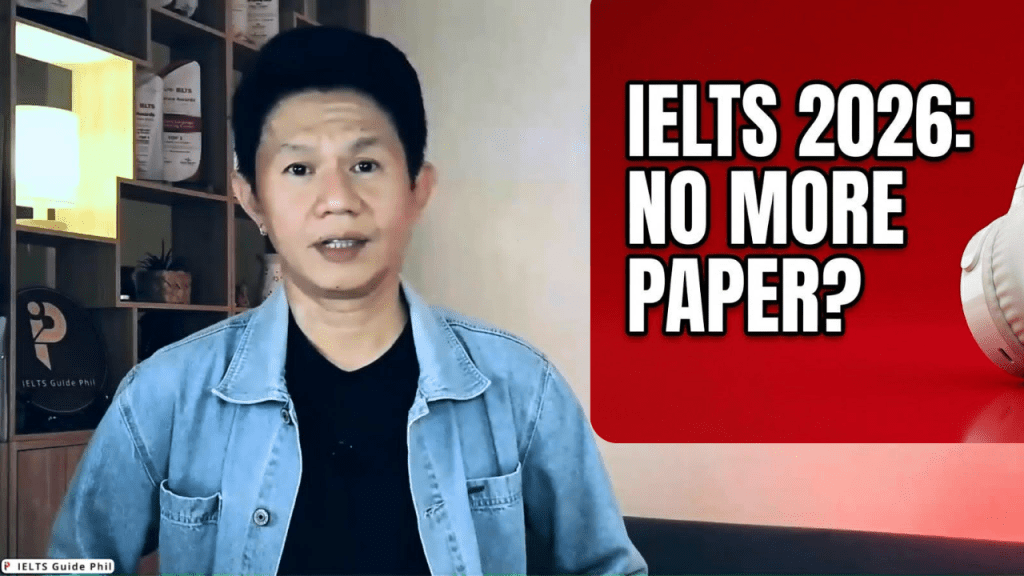
If you’re preparing for IELTS right now, this update matters more than you think.
One of the biggest shifts in IELTS test delivery in years is happening around mid-2026—and while it sounds dramatic, most candidates are misunderstanding what’s really changing.
Before you panic or rush to book a test, watch this quick breakdown:
Watch the Full Explanation:
IELTS 2026 Format Change: The Truth Nobody’s Telling You
The Big Headline: Paper-Based IELTS Is Being Phased Out
Starting around mid-2026, IELTS is moving toward fully computer-delivered testing.
That means:
- No more traditional full paper-based test (in most markets)
- All candidates will take Listening, Reading, and Writing on a computer
This shift didn’t come out of nowhere.
It’s based on years of data showing that candidates prefer:
- Faster results
- More flexible scheduling
- Better overall test experience
In short: this change is about efficiency and accessibility, not difficulty.
Still Prefer Handwriting? You’re Not Completely Losing It
Here’s where things get interesting.
A new option called “Writing on Paper” is being introduced in selected locations.
This means:
- You still take Listening and Reading on a computer
- But you can choose to handwrite your Writing tasks
So if typing slows you down or affects your confidence, you’re not stuck.
You’re getting a hybrid option, not a limitation.
Will This Affect Your Score? No.
This is where a lot of candidates get it wrong.
Your score:
- Does NOT depend on whether you type or handwrite
- Is fully standardized across formats
- Is interpreted the same way by universities and immigration bodies
A Band 7 is a Band 7—regardless of how you wrote your answers.
What Has NOT Changed (This Is Critical)
Let’s cut through the noise.
Despite all the talk about “big changes,” the actual test remains the same:
- Same 4 skills: Listening, Reading, Writing, Speaking
- Same question types
- Same timing
- Same scoring system
- Same global recognition
This is a delivery change, not a content change.
If your preparation is solid, you’re still on track.
One Skill Retake (OSR): One Important Rule
You can still retake just one section of the test.
But here’s the catch:
You must use the same format as your original test.
- Typed your Writing? → Retake it on computer
- Used Writing on Paper? → Retake it by hand
This ensures fairness and consistency across scores.
Access Arrangements Stay the Same
If you require accommodations, nothing changes.
Support options like:
- Large print
- Braille
- Hearing support
…remain fully available.
No one is being left behind in this transition.
Already Took Paper-Based IELTS? Relax.
Your existing result is still valid for the standard 2-year period.
No retake required.
No penalty.
No hidden catch.
What You Should Do Right Now
Don’t overreact—but don’t ignore this either.
Here’s the smart approach:
1. Start practicing on a computer
Typing speed and comfort now matter more than ever.
2. Don’t rush to book a paper test
This change is not something you need to “escape.”
3. Consider your strengths
If you think better with a pen, check if “Writing on Paper” is available in your area.
4. Focus on strategy, not format
Your band score will still come down to:
- Clarity
- Structure
- Vocabulary
- Accuracy
Not whether you used a keyboard or a pen.
Final Thought
This isn’t something to fear.
It’s a shift toward:
- Faster results
- More flexibility
- A more modern testing experience
And if you prepare the right way, it won’t hold you back—it might even give you an advantage.
Recommended Next Steps
- Read more IELTS strategies on ieltsguidephil.com
- Watch more breakdowns on my YouTube channel: IELTS Guide Phil
- Start building your exam strategy early—not just your English
#IELTS #IELTS2026 #IELTSUpdate #IELTSPrep #IELTSWriting #IELTSTips #StudyAbroad #EnglishTest #IELTSOnComputer #IELTSStrategy #IELTSGuidePhil
 IELTS Guide Phil
Leave a comment