
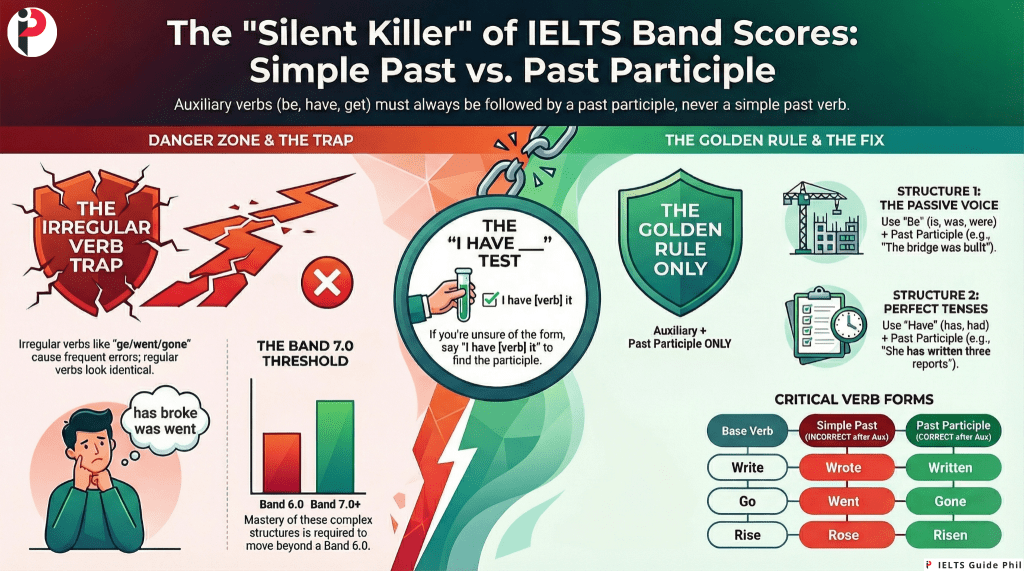
And why your grammar checker probably won’t catch this deadly mistake
If you’ve ever written “The report was wrote by the manager” or “She has went to the library,” congratulations — you’ve just made one of the most common, most penalised, and most misunderstood grammar errors in the IELTS exam. Today, we’re dissecting this mistake with surgical precision so you never make it again.
First, Let’s Understand What’s Actually Going On
English has two verb forms that look similar but function completely differently:
Simple Past Tense → used alone as the main verb of a sentence Past Participle → used after auxiliary verbs like be and have
The golden rule is this:
Auxiliary verbs (be, have, get) are ALWAYS followed by the past participle — never the simple past.
This isn’t a style preference. It’s non-negotiable grammar. Breaking this rule in IELTS Writing or Speaking is a Grammatical Range and Accuracy error that directly pulls your score down.
The Two Big Structures You Must Know
Structure 1: The Passive Voice → BE + Past Participle
The verb to be (is, are, was, were, has been, will be, etc.) combines with the past participle to form passive sentences.
| ✅ Correct | ❌ Incorrect |
|---|---|
| The bridge was built in 1990. | The bridge was build in 1990. |
| The data is presented in a table. | The data is present in a table. |
| The policy was implemented by the government. | The policy was implement by the government. |
| Children are taught critical thinking. | Children are teach critical thinking. |
| Mistakes were made by officials. | Mistakes were make by officials. |
Structure 2: Perfect Tenses → HAVE + Past Participle
The verb to have (have, has, had, will have) combines with the past participle to form perfect tenses.
| ✅ Correct | ❌ Incorrect |
|---|---|
| She has written three reports. | She has wrote three reports. |
| They have taken the test twice. | They have took the test twice. |
| The government had already introduced the law. | The government had already introduce the law. |
| Pollution levels have risen sharply. | Pollution levels have rose sharply. |
| Researchers have shown that… | Researchers have showed that… (acceptable but weaker) |
Why This Mistake Happens: The Psychology Behind the Error
Understanding why you make a mistake is the fastest way to stop making it. Here’s what’s going wrong in your brain:
Reason 1: Your native language doesn’t use auxiliaries this way. Many languages (Arabic, Hindi, Chinese, Korean, Turkish, etc.) don’t combine helper verbs with participles the same way. Your brain defaults to what feels natural — and plugs in the simple past because it sounds finished and past-like.
Reason 2: Simple past and past participle are identical for regular verbs. For verbs like work → worked → worked, the simple past and past participle are the same. So learners assume this pattern applies universally — and then incorrectly transfer it to irregular verbs.
worked = simple past ✅ / past participle ✅ → same word, no problem
wrote = simple past ✅ / past participle = written ❌ → different words, big problem
Reason 3: Speed in speaking. In IELTS Speaking, under pressure, your fluency brain grabs the first past form it knows — usually the simple past — and fires it out before your grammar brain can intervene.
The Irregular Verbs That Trap IELTS Candidates Most Often
These are the verbs where simple past ≠ past participle, and where errors are most common:
| Verb | Simple Past ❌ (after aux) | Past Participle ✅ (after aux) |
|---|---|---|
| write | wrote | written |
| go | went | gone |
| do | did | done |
| see | saw | seen |
| take | took | taken |
| give | gave | given |
| rise | rose | risen |
| fall | fell | fallen |
| break | broke | broken |
| speak | spoke | spoken |
| choose | chose | chosen |
| drive | drove | driven |
| know | knew | known |
| grow | grew | grown |
| show | showed | shown |
| begin | began | begun |
| run | ran | run (same!) |
| become | became | become (same!) |
| come | came | come (same!) |
IELTS Tip: Focus extra memorisation time on the third column — past participles of irregular verbs. This is where the marks are lost.
Dos and Don’ts
DO:
✔ Do memorise irregular verb tables in three columns: base form / simple past / past participle. Always practise them in sentences, not in isolation.
✔ Do use passive voice deliberately in IELTS Writing Task 1 (especially for graphs and processes) and Task 2. Examiners recognise it as a marker of grammatical sophistication — when used correctly.
✔ Do double-check every sentence containing is, are, was, were, has, have, had to confirm the next verb is in its past participle form.
✔ Do use perfect tenses in Task 2 essays to show change over time: “Living standards have improved significantly over recent decades.”
✔ Do read your written work aloud. Errors in auxiliaries often sound wrong even when they look right on the page.
✔ Do learn participial phrases: “Written in 1984, the novel…” — the past participle can lead sentences too.
DON’T:
✖ Don’t assume that because you used a past-sounding word after was or has, it’s automatically correct. Ask yourself: “Is this the past participle, or the simple past?”
✖ Don’t rely on autocorrect or Grammarly to catch these errors. Many tools miss auxiliary + wrong verb form combinations, especially with irregular verbs.
✖ Don’t use the simple past after be even when the meaning feels right:
❌ “The results were saw clearly in the graph.”
✅ “The results were seen clearly in the graph.”
✖ Don’t confuse the passive voice with the past tense. “The law was passed” is passive voice, present in structure, describing a past action. The logic is different from “The government passed the law” (active, simple past).
✖ Don’t neglect this in speaking just because it moves fast. Examiners are specifically listening for grammatical accuracy with complex structures.
✖ Don’t over-correct by avoiding passive voice entirely. Some candidates become so afraid of making this mistake that they never use passive structures — and lose marks for limited grammatical range.
Common IELTS Mistakes and Their Fixes
Mistake 1:
❌ “The population has grew dramatically in recent years.”
Why it’s wrong: Has requires the past participle. “Grew” is the simple past of “grow.” The past participle is “grown.”
Fix:
✅ “The population has grown dramatically in recent years.”
Mistake 2:
❌ “Many buildings were destroyed and several bridges were fell during the earthquake.”
Why it’s wrong: “Fell” is the simple past of “fall.” After “were,” you need the past participle: “fallen.”
Fix:
✅ “Many buildings were destroyed and several bridges had fallen during the earthquake.” (or: bridges fell — active voice)
Mistake 3:
❌ “The graph shows that more money has been spent on education since reforms were began.”
Why it’s wrong: “Began” is the simple past of “begin.” After “were,” the past participle “begun” is required.
Fix:
✅ “…since reforms were begun.” (or more naturally: since reforms began — active)
Mistake 4:
❌ “It has been did many times before.”
Why it’s wrong: “Did” is the simple past of “do.” After “has been,” the past participle “done” is needed.
Fix:
✅ “It has been done many times before.”
Mistake 5:
❌ “The results were showed in a bar chart.”
Why it’s wrong: While “showed” is technically an accepted past participle of “show,” in formal IELTS writing, “shown” is strongly preferred and sounds more academic.
Fix:
✅ “The results were shown in a bar chart.”
Mistake 6:
❌ “Languages are chose based on economic opportunity.”
Why it’s wrong: “Chose” is simple past. After “are,” use the past participle “chosen.”
Fix:
✅ “Languages are chosen based on economic opportunity.”
Quick Practice Drill
Correct these sentences:
- The data has been took from government sources.
- English is spoke by millions of people worldwide.
- The proposal was gave to the committee last week.
- Deforestation rates have rose sharply since 2000.
- The issue has been knew about for many years.
Answers:
- taken | 2. spoken | 3. given | 4. risen | 5. known
Frequently Asked Questions
Q1: Does this rule apply in IELTS Speaking as well as Writing?
Absolutely. IELTS Speaking is assessed on Grammatical Range and Accuracy, and auxiliary + simple past errors are penalised just as they are in writing. The difference is that in speaking, self-correction is allowed and even looked upon favourably. If you catch yourself saying “I have went,” immediately correct it: “…I have gone — sorry, I have gone to that city before.” Examiners appreciate awareness.
Q2: What if I just avoid passive voice and perfect tenses altogether to stay safe?
This is a tempting but catastrophically counterproductive strategy. IELTS Band 7+ requires you to use “a variety of complex structures.” If you avoid passive and perfect constructions entirely, you cap your Grammatical Range score at around Band 5–5.5. The goal is to master these structures, not avoid them.
Q3: How do I quickly remember which form is the past participle?
Use the “I have ___” test. Say the verb in this sentence: “I have ___ it.” Whatever sounds right there is your past participle. “I have written it” ✅ → written is the past participle. “I have wrote it” ❌ → wrote is NOT the past participle.
Q4: Are there verbs where the simple past and past participle are the same, so I don’t need to worry?
Yes — all regular verbs (e.g., walked, completed, introduced, discussed) and some irregular verbs (e.g., cut/cut, put/put, set/set, run/ran/run, come/came/come). For these, no error is possible. The danger zone is exclusively with irregular verbs where the two forms differ — like go/went/gone or write/wrote/written.
Q5: Can “get” also act like “be” with a past participle?
Yes! “Get” + past participle is common in informal/semi-formal English: “She got accepted into university.” “The window got broken.” This is grammatically valid, though in IELTS Writing, “be + past participle” is preferred for academic register. The same rule applies: never use the simple past after “get” in this construction.
Q6: My grammar textbook shows “showed” as an acceptable past participle. Is “showed/shown” both fine?
Technically, both are listed as acceptable past participles of “show” in most dictionaries. However, in academic writing — including IELTS — “shown” is the overwhelmingly preferred form. Examiners may not penalise “showed,” but “shown” signals a higher register and is always the safer choice.
Q7: I memorised verb lists but still make this mistake under exam pressure. What do I do?
Memorising lists isn’t enough — you need automated recall. Practise writing 10 sentences per day using passive and perfect structures with irregular verbs. Do it until the correct form is the first thing your brain produces, not the second. Under exam conditions, your automatic response kicks in, not your studied response.
The IELTS Examiner’s Perspective
Examiners using the official IELTS Writing Band Descriptors look for errors that are “frequent” and “noticeable” at lower bands, and they look for “occasional errors in complex structures” at Band 7. Auxiliary + wrong verb form is classified as an error in a complex structure. One or two such errors in a Task 2 essay may cost you a half-band. Several will cost you a full band in Grammatical Range and Accuracy.
The brutal truth: this is one of the few errors that is both common enough to appear frequently and serious enough to be immediately noticeable to a trained examiner. It signals that the writer hasn’t fully internalised English auxiliary grammar — which is a core competency at the upper-intermediate to advanced level.
Summary: The Three-Second Rule
Every time you write or say a sentence with is, are, was, were, has, have, had, get, got, pause for three seconds and ask:
“Is the verb that follows this auxiliary in its past participle form?”
If yes — move on confidently. If you’re not sure — use the “I have ___” test. If you still don’t know — restructure to the active voice and eliminate the risk entirely.
Master this, and you’ve neutralised one of the top five grammatical error types in IELTS candidate scripts worldwide. That’s not a small win — that’s potentially the difference between a 6.5 and a 7.0.
#IELTSGuidePhil #IELTS #IELTSWriting #IELTSSpeaking #IELTSTips #IELTSGrammar #PastParticiple #PassiveVoice #PerfectTense #IELTSBand7 #EnglishGrammar #IELTSPreparation #GrammarTips #IrregularVerbs #AuxiliaryVerbs #IELTSEnglish #EnglishLearning #IELTSExam #WriteInEnglish #GrammarMatters #IELTSSuccess
 IELTS Guide Phil
Leave a comment