
You’ve probably heard the big advice a hundred times. “Read more. Practice daily. Think in English.” Great. Useful. But also… kind of vague?
What actually moves the needle isn’t the grand strategy. It’s the almost embarrassingly small adjustments — the ones that feel too tiny to matter — that stack up into something transformative by test day.
This is about those tweaks.
Why Small Things Hit Different in IELTS Prep
IELTS is not a knowledge test. It’s a precision test. The examiner isn’t asking do you know English? They’re asking how well can you deploy it, right now, under pressure, with accuracy?
That means the gap between Band 6.5 and Band 7.5 is rarely one massive skill you’re missing. It’s usually ten tiny habits you haven’t formed yet.
Think of it like this: a plane flying from London to Dubai that’s off by just 3 degrees lands in Pakistan. Small angle. Massive destination difference. Your IELTS prep works the same way.
THE TWEAKS — Writing
1. Stop Starting Sentences with “I think that…”
It signals uncertainty right from the first word. Examiners notice.
❌ Don’t: “I think that technology has changed our lives.”
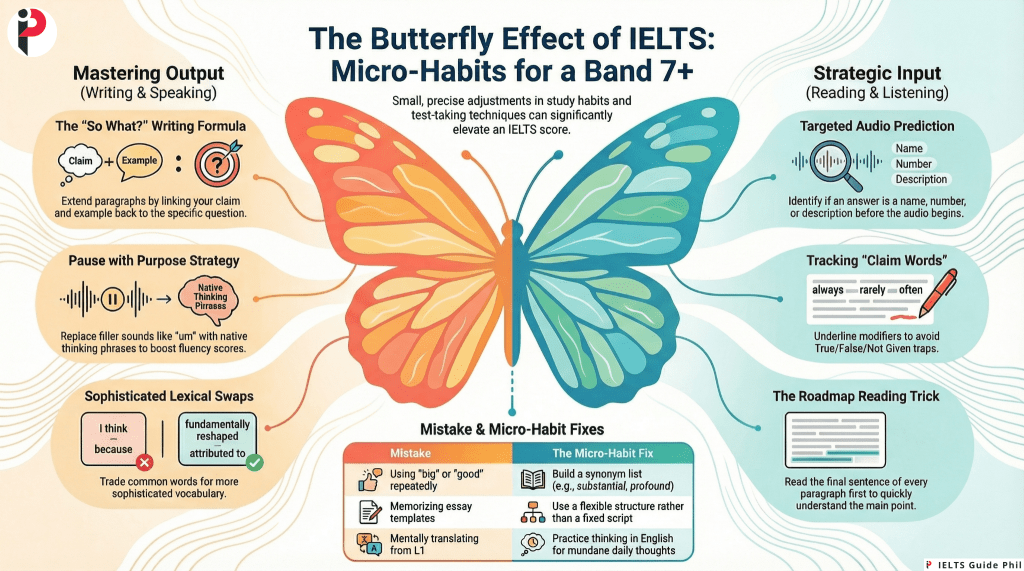
✅ Do: “Technology has fundamentally reshaped the rhythms of modern life.”
The idea is the same. The confidence, sophistication, and lexical range are completely different.
2. Add a “So What?” to Every Body Paragraph
Most candidates explain their point. Fewer candidates extend it. The ones who do jump bands.
The formula: Make claim → Give example → Explain WHY it matters → Link back to the question.
That final “link back” sentence? That’s the tweak 80% of test-takers skip.
3. Replace “because” with a Rotating Set of Cohesive Devices
Using “because” in every sentence is like wearing the same outfit every day of the exam — technically fine, but uninspiring.
Alternatives to rotate in: given that / owing to the fact that / this can be attributed to / as a consequence of / stemming from
One swap per paragraph. That’s all it takes to lift your Coherence & Cohesion score noticeably.
4. Count Your Words — But Not How You Think
Don’t just check that you’ve hit 250 words (Task 2). Count your paragraph distribution. A 9-sentence introduction and a 3-sentence conclusion is structurally weak, regardless of word count.
Healthy distribution (Task 2): Introduction: ~60 words | Body 1: ~90 words | Body 2: ~90 words | Conclusion: ~50 words
5. Proofread Backwards
Read your last sentence first, then the second-to-last, all the way to the top. This kills the brain’s habit of auto-correcting errors it already “knows” are there. You’ll catch subject-verb disagreements and article mistakes you’d have missed completely.
THE TWEAKS — Speaking
6. Record 60 Seconds of Yourself Every Morning
Not a full mock. Just 60 seconds on a random topic — your commute, the weather, what you had for breakfast. Then listen back. You’ll hear your own filler words, your pace, your pauses. You can’t fix what you can’t hear.
7. Master the “Pause with Purpose” Technique
Silence terrifies IELTS candidates. So they fill it with “ummm… like… you know…” — which actively harms their Fluency score.
The fix: Replace filler sounds with a short thinking phrase.
“That’s an interesting angle to consider…” “Let me think about that for a moment…” “This is something I feel quite strongly about, actually…”
These aren’t padding — they’re native-speaker behavior. Examiners respond to them positively.
8. Answer in Three Layers, Not One
When asked “Do you prefer cities or the countryside?”, most candidates say: “I prefer cities because there are more jobs.” Done.
Three-layer answer: Direct preference → Reason → Personal connection or concession
“I’m drawn to city life, largely because of the professional opportunities it creates. That said, I do think there’s something genuinely restorative about open spaces — I just couldn’t imagine living without the energy of an urban environment for very long.”
Same basic opinion. Completely different band ceiling.
9. Vary Your Sentence Starters in Part 2 (Cue Card)
Part 2 is your monologue. Don’t open every sentence with “He/She/It…” or “This person/place/thing…”
Try: “What struck me most about it was…” / “Looking back, I think what made it memorable was…” / “Interestingly, the reason I chose this particular example is…”
THE TWEAKS — Listening
10. Predict the Answer TYPE Before You Hear It
While you have those precious seconds before the audio starts, look at each question and ask: Is the answer a number? A name? A reason? A description?
Your brain becomes a targeted filter rather than a general sponge. You’ll catch answers you’d have floated straight past.
11. Don’t Erase — Cross Out
If you write an answer and then doubt it, don’t erase. Cross it out lightly and write the new one. If you can’t decide, you have both options visible for the transfer stage. Erasing destroys your safety net.
12. Practice With One Hand Covering the Options (Multiple Choice)
This forces you to listen for the answer genuinely rather than pattern-match against written options — which is exactly the trap the test is designed to exploit.
THE TWEAKS — Reading
13. Read the Final Sentence of Each Paragraph First
The final sentence of a paragraph is almost always the conclusion or main point of that paragraph. Skimming final sentences before reading gives you a roadmap of the passage in under 90 seconds.
14. Underline Claim Words, Not Just Keywords
Most candidates underline nouns. Smart candidates also underline claim words like: mainly, often, always, never, some, all, most, rarely. These are exactly where True/False/Not Given traps live.
15. “Not Given” Means NOT in the Text — Not “I’m Not Sure”
The most common Reading mistake in the entire exam. Not Given doesn’t mean you couldn’t find it. It means the text neither confirms nor denies it. If you’re hunting for 90 seconds for a piece of information, it’s almost certainly Not Given. Move on.
COMMON MISTAKES & HOW TO FIX THEM
| Mistake | Why It Hurts | The Fix |
|---|---|---|
| Using “big” and “good” repeatedly | Limits Lexical Resource score | Build a synonym list: significant / substantial / profound / considerable |
| Writing long sentences to “sound advanced” | Creates grammatical errors | Mix short punchy sentences WITH complex ones |
| Memorising essay templates | Sounds robotic; examiners are trained to spot it | Use a flexible structure, not a fixed script |
| Translating from your first language mentally | Slows fluency, creates unnatural phrasing | Practice thinking in English, even for mundane daily thoughts |
| Ignoring the question’s specific instruction | Direct off-topic penalty | Underline the instruction word (discuss, evaluate, to what extent) before writing |
FREQUENTLY ASKED QUESTIONS
Q: How long does it take for small habits to show up in my band score?
A: Consistently applied micro-habits tend to show measurable improvement in 3–6 weeks. The key word is consistently — doing ten things once beats doing one thing ten times in IELTS prep.
Q: Which skill benefits most from small tweaks?
A: Speaking and Writing respond fastest, because the feedback loop is more visible. But Listening prediction habits can produce near-immediate score jumps if you’ve been ignoring them.
Q: Should I focus on fixing weaknesses or building on strengths?
A: Fix weaknesses up to a functional level first (they drag your overall band down). Then amplify strengths — a genuine Band 8 in one skill can compensate meaningfully for a 6.5 elsewhere in some score calculations.
Q: What if I’ve been prepping for months and feel stuck?
A: You’re probably working hard on the right things in the wrong way. Audit your practice: Are you practicing performing or practicing improving? They feel similar but produce completely different results. Add deliberate, uncomfortable, targeted micro-drills. Comfort is the enemy of progress.
Q: Is there a single highest-impact tweak for someone short on time?
A: For Writing — the “So What?” paragraph extension habit. For Speaking — replacing filler sounds with thinking phrases. For Reading — identifying claim words. For Listening — answer-type prediction. Pick the skill that’s costing you most. Start there.
THE MINDSET BEHIND THE MICRO-HABIT
Here’s the thing no prep course tells you clearly enough: IELTS rewards a specific kind of intelligence — the ability to notice what’s expected and deliver it precisely.
That’s a trainable skill. And it’s trained in seconds, not hours. Every time you catch yourself writing “because” for the fifth time and switch it out — that’s a rep. Every time you stop yourself saying “umm” and replace it with a thinking phrase — that’s a rep. Every time you read a paragraph’s final sentence before the first — that’s a rep.
Reps build muscle. Muscle carries you through test day.
The big win isn’t built in the exam hall. It’s built in a hundred tiny moments of deliberate, slightly uncomfortable, almost invisible practice.
Start with one tweak. Today. Just one.
Which of these tweaks are you implementing first? Drop it in the comments.
#IELTSGuidePhil #IELTS #IELTSTips #IELTSPreparation #BandScore7 #IELTSWriting #IELTSSpeaking #IELTSReading #IELTSListening #EnglishLearning #StudyAbroad #IELTSSuccess #MicroHabits #IELTSCoach #LearnEnglish #IELTSExam #Band7 #Band8 #IELTSMotivation #EnglishFluency #TestPrep
 IELTS Guide Phil
Leave a comment