
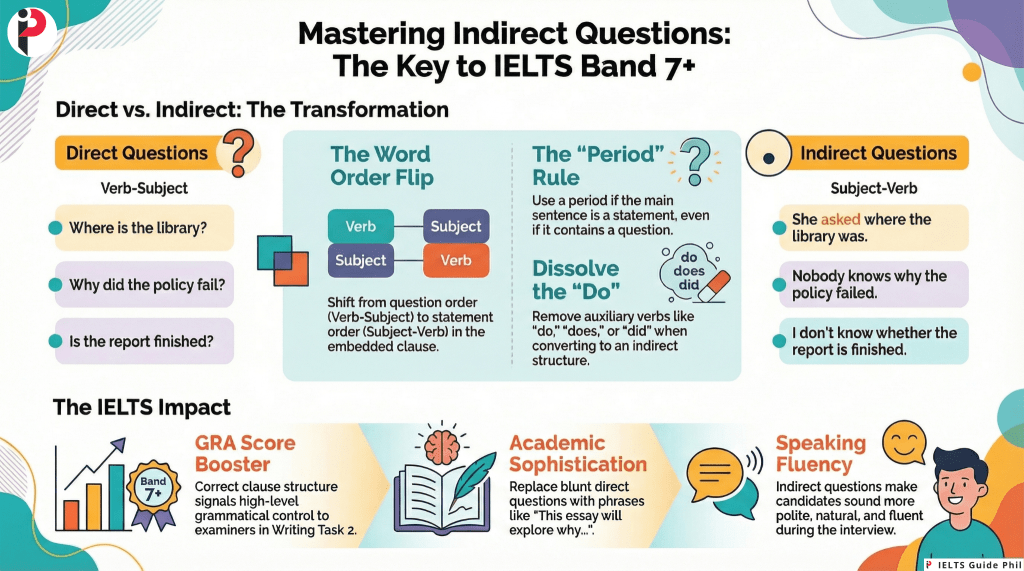
If you’ve ever written “Could you tell me where is the library?” or “I wondered what time does the train leave?” — and capped it off with a confident question mark — this post is your intervention.
Indirect questions are one of the sneakiest grammar traps in the IELTS Writing and Speaking tests. Examiners notice. Band scores drop. And the fix, once you truly understand it, takes about five minutes to master.
Let’s break it all down.
First, What Even IS an Indirect Question?
A direct question asks something outright. It uses question word order (auxiliary verb before subject) and ends with a question mark.
A indirect question embeds a question inside a statement or a polite request. It uses normal statement word order and — here’s the key — ends with a period, not a question mark.
Think of a direct question as knocking loudly on someone’s door. An indirect question is slipping a note under it.
The Core Rule — Memorise This
If the sentence as a whole is NOT a question, do NOT use a question mark.
An indirect question is a subordinate clause. It is part of a statement. The main clause — “I wonder…”, “She asked…”, “He wanted to know…” — determines the punctuation, not the embedded question.
Direct vs. Indirect — Side-by-Side Comparison
This is where most IELTS candidates have their lightbulb moment.
| Direct Question | Indirect Question |
|---|---|
| Where is the nearest hospital**?** | She asked where the nearest hospital was. |
| What time does the flight leave**?** | I wanted to know what time the flight left. |
| How can you ace IELTS**?** | This post explains how you can ace IELTS**.** |
| Why did he resign**?** | Nobody understood why he had resigned. |
| Is the report finished**?** | She asked whether the report was finished**.** |
Notice two transformations happening simultaneously: the word order shifts from question order to statement order, and the question mark disappears.
Why This Matters Specifically for IELTS
In IELTS Writing Task 1 and Task 2, examiners assess you on Grammatical Range and Accuracy. Misusing a question mark after an indirect question signals that you do not understand clause structure — which directly suppresses your GRA score below Band 7.
In IELTS Speaking, you won’t write question marks, but you will use indirect questions when you want to sound sophisticated and polite. Saying “I’m not entirely sure what the solution might be, but…” sounds far more fluent and natural than blurting out “What is the solution?” every time you need to speculate.
In IELTS Writing Task 2, rhetorical sophistication sometimes tempts candidates to write indirect questions with question marks. Examiners flag this immediately.
The Dos
Do recognise the main clause first. Ask yourself: is the overall sentence a question or a statement? Let that answer determine your punctuation.
Do flip the word order when converting. “Where is he?” becomes “…where he is” — the subject comes before the verb.
Do use whether or if for yes/no indirect questions. “Is she coming?” becomes “I don’t know whether she is coming.”
Do use indirect questions deliberately in IELTS Task 2 to sound more academic. Phrases like “This essay will explore why climate change remains a contested issue” are far more sophisticated than “Why does climate change remain contested?”
Do apply the rule to polite requests too. “Could you tell me where the exam hall is.” — yes, that period is correct, because “Could you tell me…” makes the whole thing a request, not a raw question (though this one can also take a question mark since the outer clause IS a question — see the FAQ below for this nuance).
The Don’ts
Don’t auto-pilot a question mark just because you see who, what, where, when, why, or how in a sentence. These words appear in both direct and indirect questions.
Don’t keep question word order inside an indirect question. “I asked where was he” is wrong. It must be “I asked where he was.”
Don’t use do/does/did inside an indirect question. “She wondered what did he mean” is a double error — wrong word order AND a ghost auxiliary. It should be “She wondered what he meant.”
Don’t confuse a rhetorical question with an indirect question. “Is this not the very problem we must address?” is a genuine rhetorical question — it keeps its question mark. An indirect question embedded in a statement does not.
Common Mistakes & How to Fix Them
Mistake 1 — The Phantom Question Mark
❌ This essay discusses how renewable energy can solve the climate crisis?
✔️ This essay discusses how renewable energy can solve the climate crisis.
Why: The main clause is “This essay discusses…” — a statement. The question mark is an intruder.
Mistake 2 — Keeping Question Word Order
❌ Nobody knows why did the policy fail.
✔️ Nobody knows why the policy failed.
Why: Inside an indirect question, the subject (the policy) must come before the verb (failed). The auxiliary did dissolves and tense shifts to past simple.
Mistake 3 — Using “do/does/did” Inside the Clause
❌ The report examines how does technology affect employment.
✔️ The report examines how technology affects employment.
Why: Does is a question auxiliary. In a statement clause, it disappears and the main verb takes the appropriate tense and agreement — affects, not affect.
Mistake 4 — Forgetting “whether” for Yes/No Questions
❌ I am not sure will the economy recover.
✔️ I am not sure whether the economy will recover.
Why: Without a question word like where or why, you need whether (or if in informal contexts) to introduce an embedded yes/no question.
Mistake 5 — Treating Every Polite Question as an Indirect Question
❌ Could you explain why does this work. (wrong word order AND wrong punctuation)
✔️ Could you explain why this works?
Why: Here the outer clause “Could you explain…?” is itself a question, so a question mark IS appropriate. But the embedded clause still follows statement word order: why this works, not why does this work.
Frequently Asked Questions
Q: If the sentence starts with “Could you tell me…” or “Would you mind telling me…”, does it take a question mark?
This is the most debated point. Both are technically acceptable depending on your analysis. If you treat “Could you tell me where the office is” as a polite request (statement-like), a period is fine. If you treat it as a genuine question directed at someone, a question mark is fine. In IELTS academic writing, you will almost never use this structure when directly addressing a reader, so default to a period and statement word order inside the clause — that combination is always correct.
Q: What about the IELTS essay question itself — it uses a question mark. Should I mirror that in my essay?
Never mirror it directly. Your essay body should reference the question topic using indirect question structures. Instead of writing “Why is education important?” as a sentence in your essay, write “This essay will examine why education is so fundamentally important.” The examiner’s question prompt uses direct question format; your academic response should not.
Q: Can I use indirect questions in IELTS Speaking?
Absolutely — and you should. They signal sophisticated, natural fluency. When you speculate, use structures like “I’m not quite sure what the long-term effects might be” or “It’s hard to say whether remote work will become permanent.” These are more impressive than short, choppy direct answers.
Q: Does tense always change in indirect questions?
In reported speech contexts, yes — tense typically backshifts (“He said he was tired”). But in academic writing where you’re not reporting someone’s past words but simply embedding a question into a statement, the tense stays logical and consistent with your argument. “The graph illustrates how emissions have increased” — no backshift needed because you’re describing a present fact, not reporting a past statement.
Q: Is this tested directly on IELTS?
Not as an isolated grammar item, but it feeds into your Grammatical Range and Accuracy score in both Writing tasks. Getting it right demonstrates clause-level grammatical control, which is a hallmark of Band 7+ writing. Getting it wrong — especially the question mark error — signals the kind of mistake that clusters with other lower-band features.
Quick-Fire Practice
Convert these direct questions into indirect questions. Answers below — no peeking.
- Why do cities attract so many migrants? → The essay explores _______________
- Has globalisation benefited developing countries? → Economists debate _______________
- What should governments prioritise? → It remains unclear _______________
Answers:
- The essay explores why cities attract so many migrants.
- Economists debate whether globalisation has benefited developing countries.
- It remains unclear what governments should prioritise.
The One-Line Rule to Tattoo on Your Brain
Question mark = the whole sentence is a question. No question mark = the whole sentence is a statement, even if it contains a question inside it.
Master that, and you’ve just quietly removed one of the most common Band 6 grammar fingerprints from your writing.
Now go check your last IELTS practice essay. How many indirect questions did you accidentally punctuate with a question mark? The comments section doesn’t judge.
#IELTS #IELTSGuidePhil #IELTSWriting #IELTSGrammar #IndirectQuestions #IELTSTips #Band7 #Band8 #IELTSPreparation #EnglishGrammar #AcademicWriting #IELTSSpeaking #GrammarTips #EnglishLearning #IELTSSuccess #WritingSkills #LearnEnglish #IELTSBand7 #CommonMistakes #GrammarRules #EnglishForAcademia
 IELTS Guide Phil
Leave a comment