
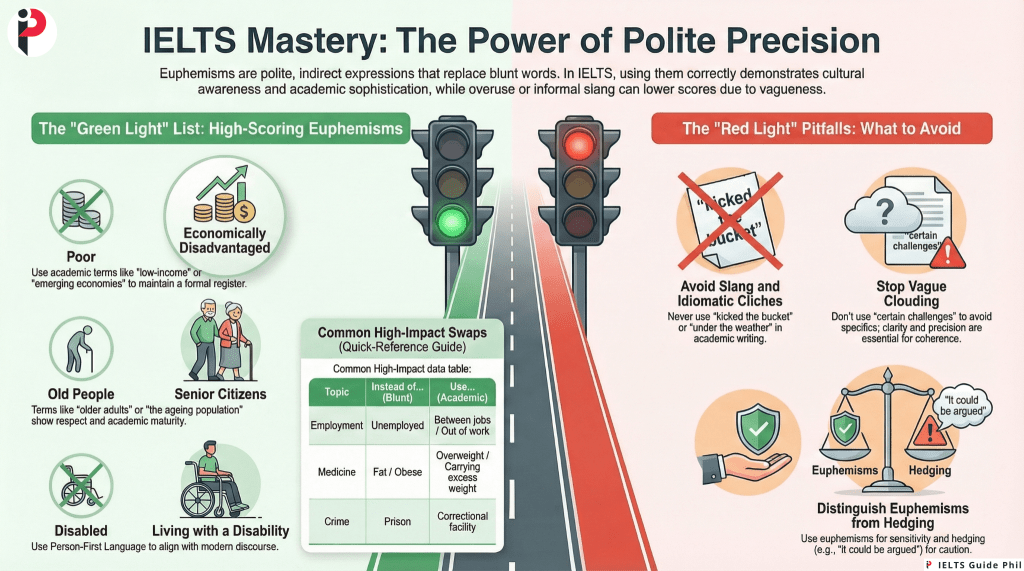
Whether you’re dodging awkward dinner-table topics or navigating sensitive global issues in your IELTS essay, euphemisms — those polite, softened substitutes for blunt or uncomfortable words — are everywhere in academic and conversational English. But here’s the trap thousands of IELTS candidates fall into: they either overuse them, sounding vague and evasive, or they avoid them entirely, sounding tactless and limited. This guide shows you exactly which euphemisms open doors in IELTS — and which ones quietly close them.
First, What Even Is a Euphemism?
A euphemism is a mild or indirect expression used in place of one that might seem too harsh, blunt, or sensitive.
Example:
- Blunt: “Old people are a burden on the healthcare system.”
- Euphemistic: “Elderly individuals place significant demands on healthcare infrastructure.”
The second version isn’t dishonest — it’s academically appropriate, and in IELTS, that distinction is everything.
PART 1: Euphemisms You ABSOLUTELY CAN (and Should) Use in IELTS
These euphemisms signal lexical sophistication, cultural awareness, and register appropriateness — three things your examiner is actively looking for.
1. Health & Medicine
| Instead of… | Use this euphemism | Why it works |
|---|---|---|
| Die / dead | Pass away, lose one’s life, succumb to an illness | Formal, compassionate, widely used in academic writing |
| Fat / obese | Overweight, carrying excess weight | Clinically appropriate; avoids sounding judgmental |
| Mentally ill | Living with a mental health condition | Person-first language; shows awareness of modern discourse |
| Disabled | Living with a disability / differently abled | Academically accepted in many contexts |
| Drug addict | Person with substance dependency / substance use disorder | Clinical register; avoids stigmatizing language |
IELTS Writing Example (Task 2):
❌ “Drug addicts are a problem for society.”
✅ “Individuals struggling with substance dependency pose significant challenges for public health systems and social welfare programmes.”
2. Employment & Economy
| Instead of… | Use this euphemism | Why it works |
|---|---|---|
| Fired / sacked | Made redundant, let go, released from their position | Professional register; common in formal writing |
| Unemployed | Out of work, between jobs, economically inactive | Neutral and formal |
| Poor | Economically disadvantaged, low-income, underprivileged | Academic vocabulary; avoids class stigma |
| Developing countries | Emerging economies, low-income nations, the Global South | Nuanced; shows awareness of political discourse |
| Cheap labour | Low-cost workforce, low-wage employment | Less loaded; academically appropriate |
IELTS Writing Example:
❌ “Poor countries need money from rich ones.”
✅ “Economically disadvantaged nations often rely on financial aid and investment from high-income countries to sustain development.”
3. Social & Political Issues
| Instead of… | Use this euphemism | Why it works |
|---|---|---|
| Illegal immigrants | Undocumented migrants, irregular migrants | Politically neutral; widely used in academic texts |
| Old people / the elderly | Senior citizens, older adults, the ageing population | Respectful; expected in academic register |
| Slums | Informal settlements, low-income urban areas | Academic geography and sociology term |
| Prison | Correctional facility, detention centre | Formal and objective |
| War / conflict | Armed conflict, military engagement, hostilities | Academic register; avoids sensationalism |
4. IELTS Speaking (Parts 2 & 3)
In Speaking, using appropriate euphemisms shows fluency, cultural sensitivity, and range. The key is using them naturally, not stiffly.
✅ Great euphemisms for Speaking:
- “pass away” instead of “die”
- “not doing so well financially” instead of “broke” or “poor”
- “going through a difficult time” instead of “having a breakdown”
- “senior members of society” instead of “old people”
- “between jobs” instead of “unemployed”
Speaking Example (Part 3): Examiner: “Do you think governments should do more for unemployed people?”
❌ “Yes, because being unemployed is very bad and people become poor.”
✅ “Absolutely. Individuals who find themselves out of work, particularly those who have been economically inactive for extended periods, can face serious hardship. I believe governments have a responsibility to support these citizens through retraining programmes and social safety nets.”
PART 2: Euphemisms You Should NEVER Use in IELTS
These will actively hurt your score — they’re too informal, too vague, culturally specific, or downright confusing in an academic context.
1. Overly Colloquial / Slangy Euphemisms
These belong in casual conversation, texting, or stand-up comedy — not your IELTS answer sheet.
| Euphemism | Problem | Fix |
|---|---|---|
| “Kicked the bucket” | Idiomatic slang; examiner may see it as inappropriate | Use “passed away” |
| “Up the duff” (pregnant) | British slang; inappropriate register | Use “expecting a child” or “pregnant” |
| “Going to the loo” | Too colloquial for writing | Not relevant in writing; fine in very casual speaking only |
| “Between a rock and a hard place” | Overused cliché; not a true euphemism but commonly misused | Describe the challenge directly |
| “A bit under the weather” | Too vague and informal for academic writing | Use “experiencing health difficulties” |
2. Culturally Specific Euphemisms That Don’t Travel Well
Some euphemisms are deeply embedded in one culture and can confuse or alienate an examiner from a different background.
| Euphemism | Problem |
|---|---|
| “Pushing up daisies” | British/American idiom for death; not universally understood |
| “Went to a better place” | Religious connotation; not neutral or academic |
| “Economical with the truth” | British political idiom; sounds like you’re calling someone a liar indirectly |
| “In the family way” | Old-fashioned; culturally narrow |
3. Euphemisms So Vague They Destroy Coherence
IELTS Writing rewards clarity and precision. Some euphemisms are so soft they actually make your argument impossible to follow.
| Too vague | What it loses | Better option |
|---|---|---|
| “Certain challenges” (without specifying) | Your argument collapses without specificity | Name the challenge: “financial hardship, unemployment, discrimination” |
| “People in difficult situations” | Who? What situation? Examiner can’t follow | “Individuals experiencing poverty / domestic abuse / job loss” |
| “Issues related to lifestyle choices” | Avoids the topic entirely | Be specific: “sedentary lifestyles and poor dietary habits” |
| “Passed on to a better place” | This is flowery, not academic | “Died” or “passed away” is sufficient |
4. Euphemisms That Introduce Bias or Loaded Meaning
Some euphemisms actually carry hidden political or ideological weight that can make your writing seem one-sided — damaging your Task Response score.
| Euphemism | Hidden bias | Better neutral option |
|---|---|---|
| “Collateral damage” (civilian deaths in war) | Military PR language; minimises harm | “civilian casualties” |
| “Enhanced interrogation” (torture) | Government propaganda term | “coercive interrogation methods” or name the issue directly |
| “Downsizing” when discussing corporate harm | Softens corporate accountability | “large-scale redundancies” or “workforce reductions” |
| “Pro-life / Pro-choice” | Loaded political labels | “opponents / supporters of abortion rights” |
PART 3: Dos and Don’ts — The Quick-Fire List
✅ DO:
- Use person-first language (“a person living with diabetes” not “a diabetic”)
- Match your euphemism to the academic register — if it appears in a textbook or broadsheet newspaper, it’s probably fine
- Use euphemisms purposefully — because they serve clarity and respect, not just to avoid commitment
- In Speaking, use euphemisms naturally and conversationally rather than robotically
- Check that your euphemism is globally understood, not region-specific
❌ DON’T:
- Use euphemisms as a strategy to avoid taking a position — examiners see through this immediately
- String multiple vague expressions together (“certain individuals in some challenging situations”)
- Use colloquial idioms and label them as sophisticated language
- Overdo it — a well-placed euphemism impresses; an essay full of them becomes unreadable
- Confuse euphemisms with hedging language (they’re related but different — more on this below)
PART 4: Common Mistakes and How to Fix Them
Mistake #1: Using euphemisms to dodge the question
❌ “This essay will discuss certain sensitive matters affecting some groups of people.”
This says nothing. You haven’t introduced your argument at all.
✅ Fix: Be direct in your thesis, then use appropriate language for sensitivity: “This essay will examine the growing challenge of youth unemployment and its psychological effects on young adults.”
Mistake #2: Mixing formal euphemisms with informal language
❌ “Senior citizens are totally struggling because the government has been, like, cutting their pensions.”
✅ Fix: Match your register throughout: “Senior citizens are increasingly vulnerable as a result of government reductions in pension funding.”
Mistake #3: Inventing your own euphemisms
❌ “People with monetary shortness” (trying to say “poor people”)
This sounds unnatural and confusing. Stick to established expressions.
✅ Fix: “Individuals from low-income backgrounds” or “economically disadvantaged groups”
Mistake #4: Treating ALL sensitive terms as needing a euphemism
Not every direct word needs softening. In academic writing, “death rate”, “poverty”, and “war” are perfectly acceptable — sometimes more precise than their euphemistic alternatives.
✅ Fix: Ask yourself: “Does using this euphemism make my point clearer and more respectful, or just more vague?” If it’s the latter, use the direct term.
Mistake #5: Using outdated euphemisms
❌ “The mentally handicapped”, “the crippled”, “third-world countries”
These were once considered polite but are now outdated — and an examiner will notice.
✅ Fix: “People with cognitive disabilities”, “individuals with physical disabilities”, “low-income or developing nations”
PART 5: Frequently Asked Questions
Q1: Will using euphemisms actually improve my Lexical Resource score?
Yes — but only if they’re used appropriately and accurately. The Lexical Resource band descriptor rewards “less common and idiomatic vocabulary with some awareness of style and collocation.” A well-chosen euphemism demonstrates exactly that. A misused or vague one, however, can lower your score for precision and clarity.
Q2: Are euphemisms more important in Writing or Speaking?
Both matter, but for different reasons. In Writing, they signal academic register and sensitivity to discourse. In Speaking, they demonstrate natural fluency and social awareness. In Speaking Part 3 especially, using appropriate euphemisms when discussing sensitive social topics can be genuinely impressive.
Q3: What’s the difference between a euphemism and hedging language?
Great question. Hedging is about expressing uncertainty or caution (“It could be argued that…”, “There is some evidence to suggest…”). Euphemisms are about softening the impact of a term or concept. You can use both together: “It could be argued that individuals from economically disadvantaged backgrounds face systemic barriers.” Here, “it could be argued” is hedging; “economically disadvantaged” is a euphemism.
Q4: Is it okay to use the word “die” in an IELTS essay?
Yes, absolutely. “Die” and “death” are standard academic vocabulary. You might use “pass away” in a context where you’re describing personal loss or showing empathy, but “mortality rate”, “death toll”, and “fatalities” are perfectly formal and precise. Don’t euphemise unnecessarily.
Q5: My home language has different social taboos. Do I need to learn English-specific euphemisms?
Yes — and this is crucial. IELTS is assessed against international academic English norms. What counts as respectful or polite language in your first language may not transfer. Focus on person-first language, globally recognised neutral terminology, and vocabulary drawn from academic or journalistic English sources.
Q6: Can using the wrong euphemism actually lower my score?
Yes. If a euphemism is so vague that it makes your meaning unclear, it can hurt Coherence and Cohesion and Task Achievement/Task Response. If it’s colloquial or inappropriate, it damages Lexical Resource. The risk is real — which is why this guide exists.
Bonus: A Quick Cheat Sheet to Bookmark
| Topic | Avoid | Use Instead |
|---|---|---|
| Death | kicked the bucket, croaked | passed away, lost their life |
| Poverty | dirt poor, broke | economically disadvantaged, low-income |
| Unemployment | jobless, on the dole | out of work, economically inactive |
| Aging | old people, wrinklies | older adults, senior citizens |
| Mental health | crazy, nuts, mental | living with a mental health condition |
| Immigration | illegal aliens | undocumented migrants |
| Developing nations | third world, backwards | emerging economies, the Global South |
| Prison | jail, slammer | correctional facility, detention centre |
| Obesity | fat | overweight, carrying excess weight |
| War | war (in some contexts) | armed conflict, military hostilities |
Final Thought: Softness Is Not Weakness
The best IELTS writers and speakers aren’t vague — they’re precise and humane at the same time. A euphemism, used well, doesn’t dodge a topic. It approaches it with the sophistication of someone who understands language, nuance, and the world they’re writing about. That’s exactly the kind of candidate who walks out of the test centre with a Band 7, 8, or 9.
Now go practise — and remember: it’s not about being soft. It’s about being smart.
#IELTSGuidePhil #IELTS #IELTSWriting #IELTSSpeaking #IELTSTips #LexicalResource #Euphemisms #BandScore #IELTSVocabulary #EnglishForAcademicPurposes #IELTSPreparation #AcademicEnglish #IELTSBand7 #IELTSBand8 #IELTSBand9 #EnglishLearning #VocabularyBuilding #IELTSCoach #IELTSExam #FormalEnglish #EnglishTips
 IELTS Guide Phil
Leave a comment