
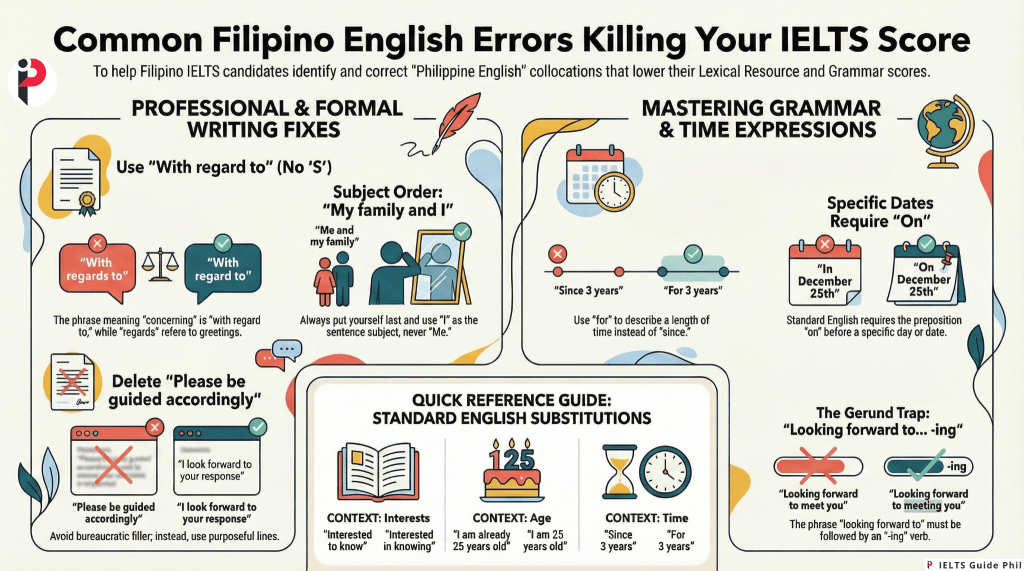
If you’re a Filipino English learner preparing for IELTS, chances are you’ve been making some of these mistakes your whole life — and nobody told you. That’s not your fault. Many of these errors are so common in Philippine English that they sound correct. They’re in offices, classrooms, even on TV. But in IELTS, they cost you band points, especially in Writing Task 1 & 2 and the Speaking test.
Let’s fix them — one painful truth at a time.
What Is a Collocation, Anyway?
A collocation is a pair or group of words that naturally go together in English. Native speakers don’t choose these logically — they just feel right through years of exposure. For example:
- You make a mistake (not do a mistake)
- You take a photo (not get a photo, in formal English)
- You pay attention (not give attention, in most contexts)
Filipino learners often translate collocation patterns directly from Filipino or follow Philippine English conventions that differ from Standard British or American English — the two benchmarks for IELTS.
THE BIG LIST: Common Filipino Collocation Mistakes (and How to Fix Them)
1. ❌ “Me and my family went to Palawan.”
✅ “My family and I went to Palawan.”
Why Filipinos say it: In Filipino casual speech, “Ako at ang pamilya ko” puts the self first. English does the opposite — it’s considered polite to put yourself last. More critically, “me” is an object pronoun. As the subject of the sentence, you need “I.”
IELTS Speaking trap: Examiners notice this immediately in Part 2 (the long turn), where you’re often asked to talk about a person important to you or a family trip.
Quick test: Remove the other person. Would you say “Me went to Palawan”? No. So it’s “I went” → “My family and I went.”
2. ❌ “With regards to your application…”
✅ “With regard to your application…” OR “Regarding your application…”
Why Filipinos say it: This one is incredibly widespread in Philippine professional writing. The phrase “with regards” technically means sending someone your greetings (as in “Give my regards to your mother”). The preposition phrase meaning “concerning” or “about” is “with regard to” — no S.
IELTS Writing Task 1 trap: General Training candidates writing formal letters use this constantly. It signals to examiners that the writer is unfamiliar with formal register.
✅ Alternatives that also work:
- Regarding your application…
- In relation to your application…
- Concerning your application…
3. ❌ “I am interested to know more about this.”
✅ “I am interested in knowing more about this.”
Why Filipinos say it: The pattern interested + to + verb feels logical (you’re interested, you want to do something). But the correct collocation is interested in + gerund (-ing form).
Interested to is used in very specific, mostly British contexts (like “I’d be interested to hear your thoughts”), but as a general rule for IELTS, train yourself to say “interested in doing.”
4. ❌ “I am looking forward to see you.”
✅ “I am looking forward to seeing you.”
Why Filipinos say it: The word “to” feels like it should introduce an infinitive verb. But in this phrase, “to” is a preposition, not part of an infinitive. Prepositions are followed by nouns or gerunds (-ing forms), not base verbs.
IELTS Writing Task 1 trap: This is a classic letter-closing line. Getting it wrong in the last sentence of your letter is a painful way to lose marks.
5. ❌ “She gave birth last March 15.”
✅ “She gave birth on March 15.”
Why Filipinos say it: Filipino often drops prepositions in time expressions, and Philippine English frequently omits “on” before specific dates. In Standard English, specific dates always take “on.”
Rules to remember:
- Specific date → on (on March 15, on a Monday)
- Month or year (no date) → in (in March, in 2024)
- Time of day → at (at 3 PM, at noon)
6. ❌ “I have been here since 3 years.”
✅ “I have been here for 3 years.”
Why Filipinos say it: Direct translation from Filipino (“Nandito na ako simula nang 3 taon”) blurs the line between since and for.
- Since = a specific point in time (since 2021, since Monday, since I was a child)
- For = a duration (for three years, for a long time, for two months)
IELTS Speaking Part 1 trap: Questions like “How long have you lived in your city?” almost always require for, not since.
7. ❌ “I am already 25 years old.”
✅ “I am 25 years old.” / “I’m already 25.” (without “years old” added)
This one’s subtle. “Already” in this context is a direct calque of Filipino “Mayroon na akong 25 taon.” In English, “already” is used for completion or surprise (“I’ve already eaten”), not simply stating your age. Using it to state a plain fact sounds unnatural in IELTS Speaking.
8. ❌ “We are inviting you to attend our event.”
✅ “We would like to invite you to our event.” / “You are cordially invited to…”
Why Filipinos say it: “We are inviting” is a direct translation of the Filipino progressive form used for polite invitations. In English, the present continuous for formal invitations sounds presumptuous and grammatically off. Use modal constructions for formal register.
9. ❌ “Please be guided accordingly.”
✅ (Just delete it. There’s no real fix.)
This is quintessential Philippine bureaucratic English — technically parseable but communicating almost nothing. IELTS Writing rewards precise, purposeful language. Filler sign-offs like this, along with “For your information and guidance,” and “More power to you,” mark your writing as non-standard.
✅ End letters with purpose:
- “I look forward to your response.”
- “Please do not hesitate to contact me if you need further information.”
10. ❌ “I will have my car repaired by tomorrow.” ← (This one’s actually CORRECT — but Filipinos avoid it thinking it’s wrong!)
Many Filipino IELTS candidates avoid the causative “have” construction because it sounds awkward to them, opting instead for “I will ask someone to repair my car” — which is fine but less sophisticated. Train yourself to use causatives: have/get + object + past participle. Examiners love seeing this.
IELTS DOS AND DON’TS FOR FILIPINO LEARNERS
| ✅ DO | ❌ DON’T |
|---|---|
| Write “with regard to” | Write “with regards to” |
| Use “My family and I” as subject | Use “Me and my family” as subject |
| Say “interested in doing” | Say “interested to do” |
| Use “for” with durations | Use “since” with durations |
| Use preposition “on” before specific dates | Drop “on” before dates |
| Use purposeful closing lines | Use “Please be guided accordingly” |
| Use “looking forward to seeing” | Use “looking forward to see” |
COMMON MISTAKES AND THEIR QUICK FIXES AT A GLANCE
Mistake: “Me and my friend discussed the topic.” Fix: “My friend and I discussed the topic.” — Object pronoun → Subject pronoun, self goes last.
Mistake: “With regards to the above matter…” Fix: “Regarding the above matter…” — Drop the S, or use an alternative entirely.
Mistake: “I am looking forward to work with your team.” Fix: “I am looking forward to working with your team.” — Preposition “to” demands a gerund.
Mistake: “She is interested to join the program.” Fix: “She is interested in joining the program.” — “Interested in” + gerund, always.
Mistake: “I lived here since 10 years.” Fix: “I have lived here for 10 years.” — Duration uses “for,” and the tense should be present perfect.
FREQUENTLY ASKED QUESTIONS
Q: Will the examiner really deduct points for “with regards to”? A: Not in a dramatic one-time deduction way, but yes — it contributes to a lower Lexical Resource score (one of the four IELTS Writing criteria). Repeated collocation errors across your essay signal limited vocabulary range.
Q: Is “Me and my family” always wrong? A: As a subject, yes, always. As an object, it can be acceptable in some informal contexts (“She invited me and my family”), though even then “my family and me” is more polished. In IELTS, always put yourself last and use the correct pronoun case.
Q: My teacher in the Philippines taught me “with regards to.” Am I sure it’s wrong? A: Your teacher was reflecting Philippine English conventions, which are valid in a local context. But IELTS is assessed against international Standard English norms, where “with regard to” (no S) is the correct formal preposition phrase. In IELTS, go with Standard English.
Q: How do I stop making these mistakes automatically? A: The single best method is noticing + substitution practice. Every time you write or speak a sentence, pause and ask: Is this a phrase I learned from Filipino, or have I verified it in English sources? Read opinion pieces from The Guardian, The Economist, or BBC. Their formal written English is excellent IELTS modeling.
Q: How many of these collocation errors can I make before it affects my band score? A: There’s no fixed number, but band 7 typically requires that collocation errors are occasional, not systematic. If examiners see a repeated pattern — such as always using “with regards to” or always dropping prepositions — it strongly suggests a systemic gap that pulls your score below 7.
Q: Can I use Philippine English expressions in IELTS Speaking? A: Your accent is never penalized — IELTS explicitly states this. But grammar and collocation choices are assessed under Grammatical Range and Accuracy and Lexical Resource. Non-standard collocations will affect those scores.
FINAL THOUGHT: It’s Not About Shame — It’s About Code-Switching
Philippine English is a rich, legitimate variety of English with its own history and grammar. There’s nothing wrong with saying “Me and my lola cooked adobo” at home. But IELTS asks you to demonstrate command of international Standard English — and that requires consciously code-switching into a different register.
The good news? These mistakes are highly fixable. Unlike pronunciation, which takes years to reshape, collocation accuracy can improve dramatically in weeks with targeted practice. Start with this list. Make flashcards. Read formal English daily. And the next time you’re about to write “With regards to,” let this post haunt you just enough.
You’ve got this.
#IELTSGuidePhil #IELTSPhilippines #IELTSTips #IELTSWriting #IELTSSpeaking #FilipinosAbroad #IELTSPreparation #EnglishGrammar #CollocationsInEnglish #IELTSBand7 #IELTSBand8 #PhilippineEnglish #EnglishForFilipinos #CommonGrammarMistakes #IELTSCoaching #LearnEnglish #GrammarTips #OFWLife #StudyAbroadPhilippines #EnglishFluency #IELTSVocabulary
 IELTS Guide Phil
Leave a comment