
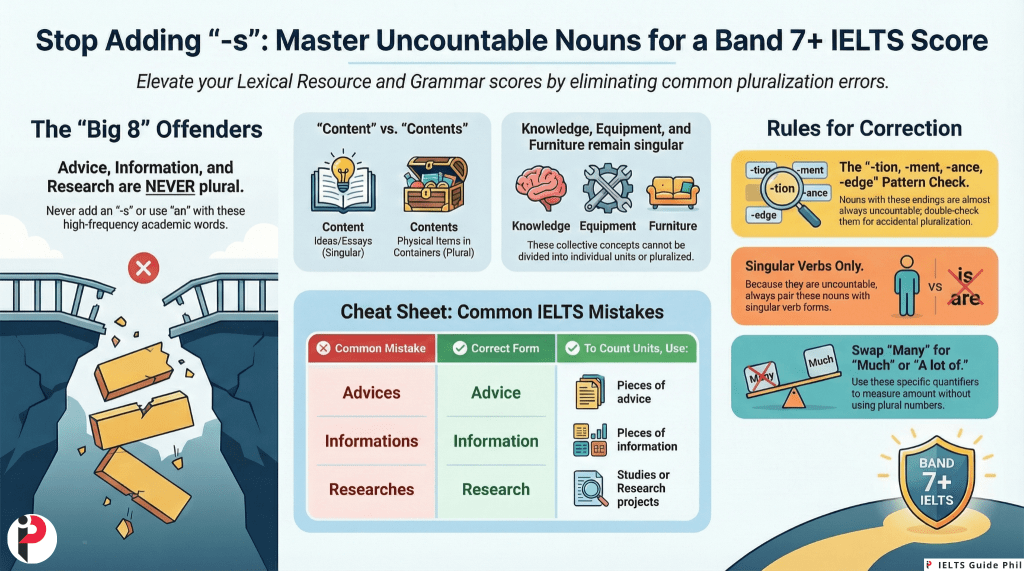
If you’ve ever written “Please give me advices” or listed “the contents of the box” without a second thought, this post is for you. These are some of the most common — and most penalized — grammar errors Filipino test-takers make on the IELTS Writing and Speaking sections. The good news? Once you understand why these words behave the way they do, you’ll never make these mistakes again.
Let’s break it all down.
First, What Even Are Uncountable Nouns?
Uncountable nouns (also called non-count nouns) refer to things that cannot be divided into individual units — at least not in their general sense. You can’t count them the way you count apples or chairs. That means they:
✅ Have no plural form
✅ Never take a / an
✅ Use singular verbs
✅ Are measured using quantifiers (some, much, a lot of, a piece of, etc.)
The tricky part for Filipinos? Filipino (Tagalog/Cebuano) doesn’t grammatically distinguish between countable and uncountable nouns the same way English does. So the mistakes feel completely natural — until an IELTS examiner deducts your Lexical Resource score.
The Big Offenders: Filipino Mistakes with Uncountable Nouns
1. “CONTENTS” — The Classic Trap
This is probably the most widespread mistake among Filipino English speakers, from students to professionals to even some teachers.
The Mistake:
“I will discuss the contents of this essay.” “Check the contents of the report.”
Why It Feels Right: Because in Filipino, we say “mga nilalaman” — and mga signals plurality, so we instinctively pluralize the English equivalent too.
The Fix: When referring to what is inside something abstract (an essay, a speech, a lesson, a book chapter), use “content” — singular and uncountable.
✅ “I will discuss the content of this essay.”
✅ “The content of the report is impressive.”
When IS “contents” correct? Only when referring to the physical items inside a container or when referring to a table of contents (a fixed term).
✅ “The customs officer checked the contents of her bag.” (physical objects)
✅ “Please refer to the table of contents.” (fixed expression)
IELTS Impact: Using “contents” when discussing an essay’s ideas or a report’s information signals a weak command of academic vocabulary — directly hitting your Lexical Resource band score.
2. “ADVICES” — Everyone’s Guilty of This One
The Mistake:
“She gave me many advices about studying abroad.” “The professor’s advices were very helpful.”
Why It Feels Right: Because advice feels like a thing you can count — one advice, two advices. In Filipino, payo can be naturally pluralized as mga payo. So the brain just… adds an “s.”
The Fix: “Advice” is always uncountable. It has no plural form. Ever.
✅ “She gave me a lot of advice about studying abroad.”
✅ “The professor’s advice was very helpful.”
How to express multiple pieces of advice:
| ❌ Wrong | ✅ Right |
|---|---|
| many advices | a lot of advice / much advice |
| an advice | a piece of advice / some advice |
| several advices | several pieces of advice |
| good advices | good advice |
3. “INFORMATIONS” — Very Common in Academic Writing
The Mistake:
“We gathered many informations from the internet.” “The informations provided were incomplete.”
The Fix: “Information” is uncountable. No plural. No article “an.”
✅ “We gathered a lot of information from the internet.”
✅ “The information provided was incomplete.”
IELTS Writing Task 1 Alert: Many Filipino candidates write “the informations shown in the graph” — this immediately signals a grammatical weakness to the examiner.
4. “RESEARCHES” — The Academic Writing Danger Zone
The Mistake:
“Many researches show that climate change is real.” “I conducted two researches for my thesis.”
The Fix: “Research” is uncountable in its general sense.
✅ “Much research shows that climate change is real.”
✅ “I conducted research for my thesis.”
If you need to refer to individual studies, use “studies,” “papers,” or “research projects” instead.
✅ “Many studies show that climate change is real.”
✅ “I conducted two research projects for my thesis.”
5. “EQUIPMENTS” — Common in Technical and Academic Contexts
The Mistake:
“The laboratory has modern equipments.” “We need to buy new equipments.”
The Fix: “Equipment” is uncountable.
✅ “The laboratory has modern equipment.”
✅ “We need to buy new equipment.”
For individual items, say “pieces of equipment” or name the specific item.
6. “FURNITURES” — Home and Interior Topics in IELTS Speaking
The Mistake:
“They bought beautiful furnitures for their new house.”
The Fix:
✅ “They bought beautiful furniture for their new house.”
✅ “They bought several pieces of furniture.”
7. “KNOWLEDGES” — Yes, This Happens Too
The Mistake:
“She has many knowledges in science.”
The Fix:
✅ “She has extensive knowledge of science.”
✅ “She has a great deal of knowledge in science.”
8. “BAGGAGES / LUGGAGES” — Very Common When Talking About Travel
The Mistake:
“I have three luggages.” “How many baggages can I bring?”
The Fix: Both “luggage” and “baggage” are uncountable.
✅ “I have a lot of luggage.”
✅ “How much baggage can I bring?”
✅ “I have three bags / suitcases.” (if you need a number)
Master Cheat Sheet: Common Uncountable Nouns Filipinos Often Pluralize
| ❌ Filipino Mistake | ✅ Correct Form | Use Instead |
|---|---|---|
| advices | advice | pieces of advice |
| informations | information | pieces of information |
| researches | research | studies / research projects |
| contents (abstract) | content | — |
| equipments | equipment | pieces of equipment |
| furnitures | furniture | pieces of furniture / items |
| knowledges | knowledge | areas of knowledge |
| luggages / baggages | luggage / baggage | bags / suitcases |
| works (abstract) | work | tasks / assignments |
| homeworks | homework | assignments / tasks |
| feedbacks | feedback | pieces of feedback |
| evidences | evidence | pieces of evidence |
| traffics | traffic | — |
| weathers | weather | — |
| moneys | money | sums of money / funds |
DOS and DON’TS
✅ DO use quantifiers like much, a great deal of, a lot of, some, any, little with uncountable nouns.
✅ DO use “pieces of,” “items of,” “bits of” when you need to express individual units.
✅ DO double-check every noun in your IELTS essay that ends in “-tion,” “-ment,” “-ance,” or “-edge” — these are almost always uncountable.
✅ DO read academic texts in English regularly — exposure helps you internalize correct usage.
❌ DON’T add “-s” just because the Filipino equivalent uses mga.
❌ DON’T use “an” before uncountable nouns (an advice, an information are both wrong).
❌ DON’T use plural verbs with uncountable nouns (“The informations are…” → “The information is…”).
❌ DON’T rely on spell-check — “informations” sometimes passes through uncorrected.
Common Mistakes & Fixes: IELTS Writing Examples
Mistake 1:
❌ “The graph provides informations about the population growth of three countries.”
Fix:
✅ “The graph provides information about the population growth of three countries.”
Mistake 2:
❌ “Researches have shown that regular exercise improves mental health.”
Fix:
✅ “Research has shown that regular exercise improves mental health.”
✅ “Studies have shown that regular exercise improves mental health.”
Mistake 3:
❌ “The government should give advices to citizens on how to save energy.”
Fix:
✅ “The government should give advice to citizens on how to save energy.”
Mistake 4:
❌ “I will now discuss the contents of my argument.”
Fix:
✅ “I will now discuss the content of my argument.”
Mistake 5:
❌ “She has many knowledges about environmental issues.”
Fix:
✅ “She has extensive knowledge of environmental issues.”
Frequently Asked Questions
Q1: Is “content” or “contents” correct when talking about a book?
It depends. “Content” (uncountable) refers to the ideas, themes, or substance of the book. “Contents” (countable, plural) refers specifically to the list of chapters — the table of contents. In IELTS essays, you’ll almost always want “content.”
Q2: Can “research” ever be countable?
In very formal academic writing, some style guides allow “a research” or “researches” in specific fields (like social sciences in some non-native English traditions). However, for IELTS purposes, always treat it as uncountable. Examiners follow standard British/Australian English norms.
Q3: What’s a quick way to remember which nouns are uncountable?
Ask yourself: “Can I put a number directly in front of it?” — two advices? three informations? — if it sounds strange, it’s probably uncountable. Also memorize the “-tion, -ment, -edge, -ance” pattern.
Q4: Does this affect my IELTS Speaking score too?
Absolutely. In IELTS Speaking, uncountable noun errors affect your Grammatical Range and Accuracy score. Examiners notice repeated patterns of error, especially with high-frequency academic words like research, information, and advice.
Q5: What about “feedback”? My teacher always writes “feedbacks.”
Respectfully — your teacher is mistaken (it happens!). “Feedback” is uncountable. The correct form is always “feedback,” never “feedbacks.” You can say “a piece of feedback” or “some feedback.”
Q6: How do I improve naturally, not just memorize rules?
Consume authentic English content — BBC articles, academic journals, TED Talks. When you encounter a word you’d normally pluralize in Filipino-style English, notice how native writers actually use it. That pattern recognition is more powerful than any memorization drill.
Quick IELTS Score Tip
On IELTS Writing Task 2, uncountable noun errors are noticed under two scoring criteria:
Grammatical Range and Accuracy — plural forms where none should exist signal limited grammatical control.
Lexical Resource — using “advices” or “informations” suggests you don’t fully control academic vocabulary, even if your ideas are strong.
Fixing these errors is one of the fastest ways to push your score from Band 6 to Band 7, because these are systematic, rule-based fixes — not vague “write better” improvements.
Summary: The Golden Rules
- Advice, information, research, content, equipment, furniture, knowledge, feedback — all uncountable. No “-s.” No “an.” Singular verbs only.
- When you want to count them, use “pieces of,” “items of,” or find a countable synonym (study, bag, task).
- The mga instinct from Filipino is natural — but train yourself to pause before adding that “-s.”
- In IELTS essays, read your draft backward sentence by sentence and flag every noun ending in -tion, -ment, -ance, -edge — then double-check if you’ve accidentally pluralized it.
Kaya mo ‘yan. One grammar rule at a time, Band 7+ is absolutely within reach.
#IELTS #IELTSGuidePhil #IELTSPhilippines #IELTSTips #FilipinoProblem #EnglishGrammar #UncountableNouns #IELTSWriting #IELTSSpeaking #GrammarMistakes #LearnEnglish #EnglishForFilipinos #IELTSPrep #Band7 #CommonMistakes #AcademicEnglish #FilipinasAbroad #OFWLife #StudyAbroad #EnglishTips #GrammarNerd
 IELTS Guide Phil
Leave a comment