
If you’re a Filipino preparing for the IELTS Speaking or Writing exam, you’ve probably hit this wall at least once: “How do I describe adobo in English without just saying adobo?” Maybe the examiner asked about your favourite dish, a memorable meal, or your country’s food culture — and suddenly your brain went completely blank because the English word simply… doesn’t exist.
Good news: there is a way to talk about Filipino food in fluent, accurate, sophisticated English — and it can actually boost your IELTS band score if done well. Let’s break it down.
Why This Matters for IELTS
In IELTS Speaking Part 1, 2, and 3, you might be asked:
- “Describe a meal you enjoy.”
- “Talk about a dish from your culture.”
- “How has food changed in your country?”
In IELTS Writing Task 2, food culture, globalisation, and tradition are common themes. If you can describe Filipino food with precise, confident English vocabulary — including smart use of paraphrasing and defining culturally-specific terms — examiners will notice your lexical resource, which is one of the four scoring criteria.
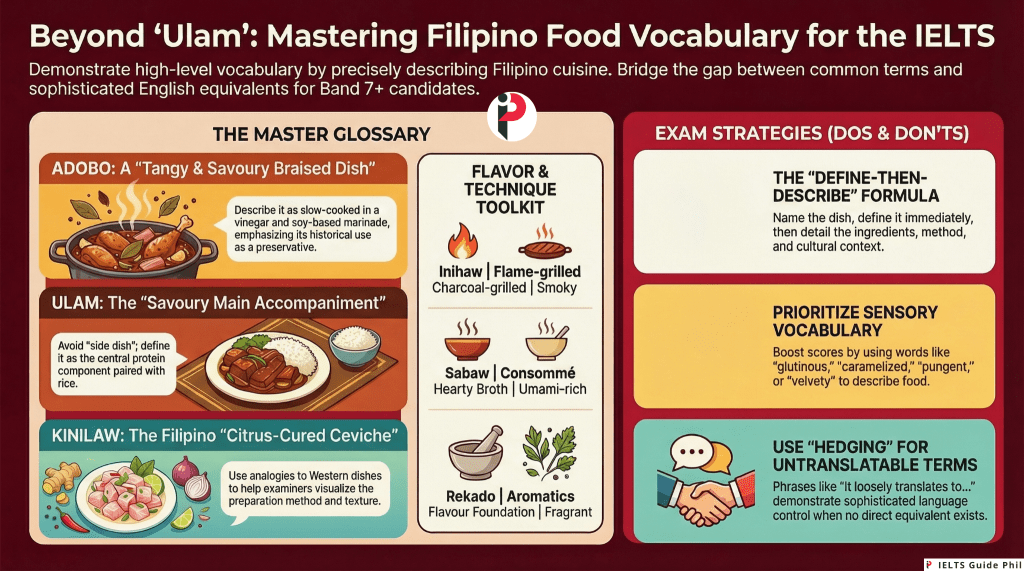
THE MASTER GLOSSARY: Filipino Food Terms → Standard English
1. ADOBO
What Filipinos say: “Gusto ko ‘yung adobo!”
What IELTS candidates should say:
“Adobo is a traditional Filipino braised dish — typically chicken or pork — slow-cooked in a tangy, savoury marinade of vinegar, soy sauce, garlic, bay leaves, and black pepper. It’s considered by many to be the country’s unofficial national dish.”
Key English vocabulary to use:
- Braised / slow-cooked
- Tangy (pleasantly sharp or acidic)
- Savoury (not sweet; rich in flavour)
- Marinade / marinated
- Soy-based sauce
- Preserved / preserving technique (because vinegar acts as a natural preservative)
IELTS-worthy sentence: “What makes adobo particularly fascinating from a culinary standpoint is that the vinegar not only adds a distinct tartness but also acts as a natural preservative, which was especially practical before refrigeration became widespread.”
2. PANCIT
What Filipinos say: “Pancit para sa mahabang buhay!”
What IELTS candidates should say:
“Pancit is a broad category of Filipino noodle dishes with Chinese culinary origins. The noodles are typically stir-fried with a combination of vegetables, meat or seafood, and seasoned with soy sauce and calamansi juice. It is traditionally served at birthdays as the long noodles are believed to symbolise longevity.”
Key English vocabulary to use:
- Stir-fried noodle dish
- Chinese-influenced / of Chinese origin
- Garnished with (calamansi, spring onions)
- Symbolise longevity / cultural symbolism
- Variants include… (pancit canton, bihon, palabok)
IELTS-worthy sentence: “Pancit is a wonderful example of how Filipino cuisine has absorbed and adapted foreign culinary influences — in this case, from Chinese immigrants — and transformed them into something distinctly local.”
3. ULAM
What Filipinos say: “Anong ulam natin?”
This one is tricky because “ulam” has no single English word equivalent. It refers to any savoury main dish eaten alongside steamed rice.
What IELTS candidates should say:
“In Filipino meal structure, there is always a central savoury dish — or sometimes several — served alongside steamed white rice. This accompaniment could be anything from grilled fish and braised meat to sautéed vegetables. The entire concept of a Filipino meal revolves around this rice-and-dish pairing.”
Key English vocabulary to use:
- Main dish / savoury accompaniment
- Side dish (though ulam is actually the main part — worth clarifying!)
- Paired with / served alongside
- The centrepiece of the meal
- Protein component
Pro tip for IELTS: Defining a concept that has no direct translation is actually a great way to demonstrate sophisticated lexical resource. Don’t be afraid to say: “There is no direct English equivalent, but it roughly translates to the main savoury dish served with rice.”
4. SABAW
What Filipinos say: “Masabaw na sopas!”
What IELTS candidates should say:
“Sabaw refers to broth or soup — specifically the liquid component of a dish. Filipino cuisine features a rich tradition of broth-based dishes, ranging from light, clear consommés to rich, hearty stews.”
Key English vocabulary to use:
- Broth / stock
- Consommé (clear, refined soup)
- Soup-based dish
- Light / hearty / rich broth
- Simmered / slow-simmered
- Stew vs. soup distinction
Examples you can use in IELTS:
- Sinigang → “A sour, tamarind-based broth with vegetables and meat or seafood — similar in concept to a Southeast Asian sour soup.”
- Tinola → “A clear ginger-infused chicken broth with green papaya and chilli leaves.”
- Bulalo → “A slow-simmered beef bone marrow soup with a deeply rich, collagen-rich broth.”
5. REKADO
What Filipinos say: “May rekado na ba?”
What IELTS candidates should say:
“Rekado refers to the aromatics or base flavourings used in cooking — typically a combination of garlic, onion, and tomato that forms the foundational flavour base of many Filipino dishes. It’s comparable to the French concept of a mirepoix or the Spanish sofrito.”
Key English vocabulary to use:
- Aromatics
- Flavour base / flavour foundation
- Sautéed aromatics
- Base ingredients
- Comparable to a sofrito or mirepoix
IELTS-worthy sentence: “Filipino cooking almost always begins with sautéing a fragrant base of garlic, onion, and tomato — a technique that mirrors similar foundational methods found in Mediterranean and Latin American cuisines.”
6. PULUTAN
What IELTS candidates should say:
“Pulutan refers to finger food or bar snacks traditionally consumed alongside alcoholic beverages, particularly during social gatherings. It is roughly equivalent to the Spanish concept of tapas or what Westerners might call bar bites or appetisers.”
Key English vocabulary:
- Finger food / bar snacks / appetisers
- Consumed alongside drinks
- Social eating / communal dining culture
- Tapas-style / small plates
7. KAKANIN
What IELTS candidates should say:
“Kakanin is a collective term for traditional Filipino rice-based delicacies and confections, typically made from glutinous rice, coconut milk, and sugar. They are often steamed, moulded, or wrapped in banana leaves and are commonly sold as street food or served during festivals and celebrations.”
Key English vocabulary:
- Rice-based confections / delicacies
- Glutinous rice / sticky rice
- Steamed / moulded
- Coconut milk-based
- Artisanal / traditional / indigenous
8. KINAMATISAN / GINISA / NILAGA / INIHAW (Cooking Methods)
These are cooking methods — and in IELTS, being able to name cooking techniques precisely is a major lexical resource booster.
| Filipino Term | Standard English |
|---|---|
| Inihaw | Grilled / charcoal-grilled / flame-grilled |
| Nilaga | Boiled / simmered / poached |
| Ginisa | Sautéed (in oil with aromatics) |
| Kinamatisan | Cooked in tomatoes / tomato-braised |
| Pinangat / Sinangag | Braised / garlic-fried |
| Inihawin | Barbecued / grilled over open flame |
| Kinilaw | Cured in citrus / citrus-marinated (similar to ceviche) |
DOS AND DON’TS FOR IELTS
DO:
1. Define before you use the term. If you say “adobo,” immediately follow it with a definition. Examiners appreciate cultural confidence paired with clear communication.
“My favourite dish is adobo — a Filipino braised meat dish cooked in vinegar and soy sauce…”
2. Use comparison to make it relatable.
“Kinilaw is somewhat similar to Latin American ceviche — raw seafood cured in an acidic liquid, though we use calamansi and vinegar rather than lime.”
3. Use sensory language. IELTS Speaking rewards vivid, descriptive language. Use words like:
- Tangy, smoky, umami-rich, aromatic, velvety, hearty, delicate, pungent, subtly sweet
4. Mention cultural or historical context.
“Adobo’s use of vinegar as a preservative reflects the pre-refrigeration ingenuity of early Filipinos — it was practical as much as it was delicious.”
5. Use hedging language when you’re unsure of a translation.
“There isn’t a perfect English equivalent, but it could be described as…” “It loosely translates to…” “The closest analogy in Western cuisine would be…”
DON’T:
1. Don’t just say the Filipino word and stop.
❌ “My favourite food is sinigang.” ← The examiner may not know what this is.
✅ “My favourite food is sinigang, which is a Filipino sour soup made with tamarind broth and your choice of pork, shrimp, or fish.”
2. Don’t over-translate to the point of being vague.
❌ “It’s like… a dish. With meat. And sauce.”
✅ “It’s a slow-braised pork dish in a soy and vinegar reduction, garnished with garlic.”
3. Don’t apologise for your food culture.
❌ “I know it sounds weird but…”
✅ Simply explain it with pride and precision.
4. Don’t use informal or colloquial filler.
❌ “It’s like, you know, the viand thing?”
✅ “It refers to the main savoury dish served alongside rice in a typical Filipino meal.”
5. Don’t confuse method with dish name.
❌ Saying “inihaw” when you mean a specific dish like Inihaw na Liempo
✅ Say: “Grilled pork belly, known locally as inihaw na liempo, which is marinated in soy sauce, calamansi juice, and garlic before being charcoal-grilled.”
COMMON MISTAKES AND HOW TO FIX THEM
Mistake #1: Translating “ulam” as “side dish”
This is the most common error. Ulam is NOT a side dish — it IS the main dish. Rice is technically the base, and ulam is the centrepiece.
❌ “Adobo is a side dish in the Philippines.”
✅ “Adobo is the main savoury dish in a Filipino meal, typically served alongside steamed rice.”
Mistake #2: Saying Filipino food is “just” like something else
Comparisons are useful, but flattening Filipino food undermines your answer.
❌ “Kare-kare is just like a peanut stew.”
✅ “Kare-kare is a rich, oxtail and vegetable stew in a thick peanut-based sauce, traditionally served with shrimp paste on the side to balance the richness — it’s a dish with no real equivalent in other cuisines.”
Mistake #3: Forgetting texture and appearance vocabulary
IELTS examiners love sensory detail. Filipino candidates often describe taste but forget:
- Texture: tender, gelatinous, flaky, crispy, chewy, glutinous, silky
- Appearance: golden brown, caramelised, deep red, translucent
- Aroma: smoky, garlicky, pungent, fragrant
Mistake #4: Using the wrong register
IELTS is an academic and professional English exam. Avoid:
❌ “It’s super yummy and my lola makes the best one.”
✅ “It’s an incredibly flavourful dish, and traditional home-cooked versions are often considered superior to restaurant preparations.”
Mistake #5: Mispronouncing food-related English words
Watch out for these:
- Vinegar → /ˈvɪnɪɡər/ (not “vi-NAY-gar”)
- Marinated → /ˈmærɪneɪtɪd/
- Sautéed → /ˈsɔːteɪd/
- Braised → /breɪzd/
- Glutinous → /ˈɡluːtɪnəs/
- Aromatics → /ˌærəˈmætɪks/
FREQUENTLY ASKED QUESTIONS
Q1: Can I use Filipino food words in IELTS Writing Task 1 or Task 2?
Yes, but use them strategically. In Task 2, if the essay topic involves food culture, tradition, or globalisation, you can absolutely reference Filipino dishes — as long as you define them clearly. Examiners are not penalised for not knowing specific cultural terms; you are responsible for making your meaning clear.
Q2: Will I lose marks for using a Filipino food word the examiner doesn’t know?
Not if you explain it well. In fact, using culturally specific vocabulary with clear explanation actually demonstrates high lexical resource — one of the four marking criteria. The key is precision and clarity, not avoidance.
Q3: What’s the best way to describe a Filipino dish in IELTS Speaking Part 2?
Follow this formula:
- Name the dish (and define it immediately)
- Describe the main ingredients
- Describe the cooking method
- Describe the taste, texture, and aroma
- Give cultural or personal context
Example: “The dish I’d like to talk about is sinigang — a distinctly Filipino sour soup that uses tamarind as its souring agent. It typically contains pork ribs or shrimp, along with vegetables such as water spinach, radish, and eggplant, all simmered in a light but intensely flavoured broth. The result is a beautifully balanced soup — sharp, slightly earthy, and deeply comforting. For many Filipinos, including myself, it’s the ultimate comfort food, especially during the rainy season.”
Q4: How do I handle it if the examiner asks me to clarify?
Stay calm and rephrase using simpler vocabulary. Never panic — rephrasing is a skill the examiner is also testing.
“What I mean is that it’s a dish where the meat is cooked slowly in an acidic liquid — vinegar — which makes it both tender and tangy.”
Q5: Are there IELTS Writing Task 2 topics where Filipino food knowledge helps?
Yes! These common essay themes are perfect opportunities:
- Globalisation and culture: “Traditional foods are disappearing due to Western fast food influence.”
- Tourism: “Food tourism is becoming increasingly popular.”
- Health and diet: “Traditional diets are healthier than modern ones.”
- Cultural identity: “Food is the most important expression of national identity.”
Q6: What score-boosting vocabulary can I use when describing food in general?
Here’s a quick power list:
- Culinary heritage / gastronomic tradition
- Indigenous ingredients / locally sourced
- Flavour profile / taste profile
- Umami-rich / deeply savoury
- Slow-cooked / braised / simmered
- Cultural significance / symbolic meaning
- Cross-cultural influence / culinary fusion
- Staple ingredient / dietary staple
- Artisanal preparation
- Distinctive / nuanced / complex flavour
BONUS: SAMPLE IELTS SPEAKING PART 2 ANSWER
Prompt: Describe a dish from your country that you would recommend to a foreign visitor.
“I’d like to talk about adobo, which is widely regarded as the Philippines’ unofficial national dish. It’s a braised meat dish — usually chicken or pork — slow-cooked in a savoury, tangy marinade of soy sauce, vinegar, garlic, bay leaves, and black pepper. The cooking process is beautifully simple, yet the result is a remarkably complex flavour profile: the vinegar gives it a pleasant sharpness, the soy sauce adds depth and saltiness, and the garlic infuses a richness throughout.
What I find particularly interesting about adobo is that it actually varies from region to region. In some provinces, coconut milk is added to create a creamier version, while others use turmeric, giving it a golden colour. This regional diversity speaks to how deeply embedded the dish is in Filipino culture.
I would absolutely recommend it to any foreign visitor because it’s not only delicious but it also tells a story — about colonial history, about the ingenuity of Filipino cooks, and about the central role that rice-and-dish pairings play in everyday Filipino life. I genuinely believe that tasting adobo is one of the most authentic ways to understand Filipino culinary identity.”
Band score analysis of this answer:
- Fluency: Well-structured, connected ideas, no long pauses implied
- Lexical Resource: braised, marinade, tangy, savoury, flavour profile, regional diversity, culinary identity
- Grammar: Complex sentences, conditionals, relative clauses
- Pronunciation tip: Stress natural English intonation on content words
FINAL THOUGHTS
The gap between Filipino food knowledge and English food vocabulary is smaller than you think — it just needs a bridge. That bridge is made of precise vocabulary, sensory language, cultural confidence, and smart comparison. The next time someone asks you what adobo is, don’t shrink. Lean in. Describe it the way a food critic would. That confidence, that clarity — that’s what gets you a Band 7, 8, or 9.
Pro Tip: Practice describing three Filipino dishes out loud every day this week — without using any Filipino words. Time yourself for 2 minutes each. That’s your IELTS Speaking Part 2 training right there.
#IELTSGuidePhil #IELTSPhilippines #IELTSSpeaking #IELTSWriting #IELTSPrep #FilipinoFoodInEnglish #LearnEnglish #IELTSVocabulary #EnglishForFilipinos #FilipinoEnglish #IELTSTips #Band7AndAbove #FilipinoFood #AdoboInEnglish #CulinaryEnglish #IELTSBandScore #EnglishFluency #FoodVocabulary #IELTSCoaching #FilipinoIELTS #SpeakingPractice
 IELTS Guide Phil
Leave a comment