
Your passport to unexpected destinations where English proficiency opens doors
Introduction
When you think of IELTS (International English Language Testing System), countries like the UK, USA, Canada, and Australia probably come to mind. But here’s a surprise: dozens of non-English speaking countries across Europe, Asia, and beyond also require or accept IELTS scores for visa applications. Whether you’re pursuing work opportunities, higher education, or permanent residency, understanding where your IELTS score holds value can dramatically expand your global possibilities.
This comprehensive guide reveals the non-English speaking nations where your IELTS certification can be your golden ticket to new opportunities.
Why Do Non-English Countries Require IELTS?
Before diving into specific countries, let’s understand the rationale:
Globalization of Education: Many universities worldwide offer programs in English to attract international students and enhance their global rankings.
International Business Language: English serves as the lingua franca of international commerce, making it essential for skilled workers in global markets.
Integration Requirements: Some countries use English proficiency as part of their points-based immigration systems, even when English isn’t the primary language.
Academic Standards: Universities need to ensure international students can handle coursework, participate in discussions, and complete assignments in English-medium programs.
Non-English Countries That Require or Accept IELTS
Europe
1. Germany
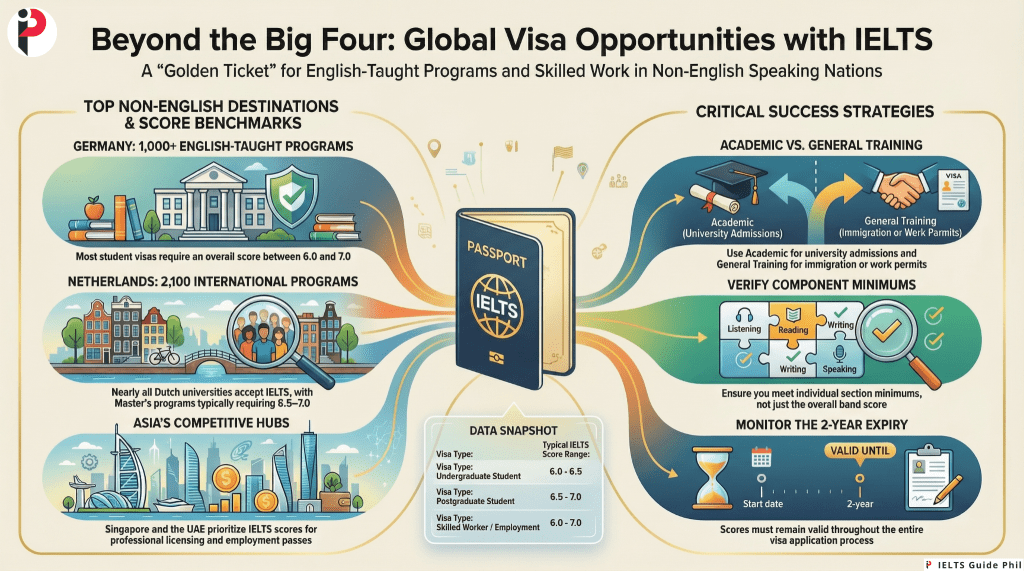
Germany has become one of the most sought-after destinations for international students and skilled workers, with many universities offering English-taught programs.
IELTS Requirements:
- Student visas: Minimum 6.0-6.5 overall (varies by university and program)
- Master’s programs: Often require 6.5-7.0
- EU Blue Card (skilled workers): While not mandatory, IELTS can strengthen applications
Key Points:
- Over 1,000 English-taught programs available
- Many technical universities (TU) prefer IELTS Academic
- Some states accept IELTS for integration purposes
2. Netherlands
The Dutch higher education system is highly internationalized, with approximately 2,100 English-taught programs.
IELTS Requirements:
- Bachelor’s programs: Minimum 6.0-6.5
- Master’s programs: Minimum 6.5-7.0
- PhD programs: Usually 7.0+
- Highly Skilled Migrant visa: IELTS may support application
Notable Features:
- Nearly all Dutch universities accept IELTS
- Some institutions waive IELTS if you studied in English previously
- Business schools particularly strict about requirements
3. France
While French is the official language, France’s grandes écoles and universities increasingly offer English programs.
IELTS Requirements:
- English-taught programs: 6.0-7.0 depending on institution
- Business schools (HEC, ESSEC, INSEAD): 6.5-7.5
- Talent Passport visa: IELTS can be advantageous
Special Considerations:
- Sciences Po and other elite institutions have strict requirements
- Some regions may require both French and English proficiency
4. Sweden
Sweden offers over 900 English-taught programs and is known for its innovation-friendly environment.
IELTS Requirements:
- Bachelor’s programs: 6.0-6.5
- Master’s programs: 6.5-7.0
- Work permits: IELTS not mandatory but helpful
5. Denmark
Danish universities are internationally recognized, with many programs conducted entirely in English.
IELTS Requirements:
- Minimum 6.5 overall for most programs
- Individual components often require 5.5-6.0
- PhD positions: 7.0+
6. Norway
Despite having Norwegian as the official language, Norway’s universities offer numerous English programs.
IELTS Requirements:
- Master’s programs: 6.0-7.0
- Some institutions require specific component scores
- Work visa applications may benefit from IELTS scores
7. Switzerland
Switzerland’s multilingual environment includes many English-medium programs, particularly at business schools.
IELTS Requirements:
- Universities: 6.0-7.0
- Top business schools (IMD, St. Gallen): 7.0+
- Residence permits for skilled workers: IELTS beneficial
8. Austria
Austrian universities, especially in Vienna, offer growing numbers of English programs.
IELTS Requirements:
- Bachelor’s programs: 6.0+
- Master’s programs: 6.5-7.0
- Red-White-Red Card: IELTS can add points
9. Belgium
Both Flemish and French-speaking regions offer English-taught programs.
IELTS Requirements:
- 6.0-7.0 depending on university and program level
- KU Leuven, Ghent University particularly accepting of IELTS
10. Poland
Poland has emerged as an affordable study destination with quality English programs.
IELTS Requirements:
- 5.5-6.5 for most universities
- Medical programs: 6.0-7.0
- Generally more flexible than Western European countries
Asia
11. Singapore
While English is an official language, Singapore is ethnically and linguistically diverse.
IELTS Requirements:
- Universities (NUS, NTU): 6.0-7.0
- Employment Pass applications: IELTS advantageous
- Permanent Residency: Can strengthen application
12. Hong Kong
Hong Kong’s universities are world-ranked and primarily English-medium.
IELTS Requirements:
- Bachelor’s programs: 6.0-6.5
- Postgraduate programs: 6.5-7.0
- Work visas: IELTS demonstrates employability
13. United Arab Emirates (UAE)
The UAE, particularly Dubai and Abu Dhabi, attracts global talent and students.
IELTS Requirements:
- Higher education institutions: 5.0-6.5
- Professional licensing: Varies by field (nursing, engineering, etc.)
- Residence visas for skilled workers: Often required 6.0+
14. Malaysia
Malaysia offers affordable English-medium education at international branch campuses.
IELTS Requirements:
- Local universities: 5.0-6.0
- International branch campuses: 5.5-6.5
- Student pass applications: IELTS frequently requested
15. China
China’s top universities increasingly offer English-taught programs to attract international students.
IELTS Requirements:
- English-medium programs: 6.0-7.0
- Top universities (Tsinghua, Peking): 6.5+
- Work permits: Generally not required but beneficial
16. Japan
While Japanese proficiency is valuable, many graduate programs operate in English.
IELTS Requirements:
- English-medium programs: 5.5-7.0
- Top universities: 6.5+
- Highly Skilled Professional visa: IELTS adds points
17. South Korea
South Korea’s universities offer numerous English programs, especially at graduate level.
IELTS Requirements:
- 5.5-6.5 for most programs
- KAIST, Seoul National University: 6.5+
18. Thailand
Thailand’s international programs and teaching positions often require IELTS.
IELTS Requirements:
- International programs: 5.0-6.5
- Teaching positions: 6.0-7.0
- Work permits for educators: IELTS beneficial
Middle East
19. Qatar
Qatar’s education city hosts international university branches.
IELTS Requirements:
- Universities: 5.5-7.0
- Professional licensing: Field-dependent
- Work visas: Often 6.0+
20. Saudi Arabia
Saudi Arabia’s universities and Vision 2030 initiatives embrace English.
IELTS Requirements:
- Scholarship programs: 5.0-6.5
- Professional positions: 6.0-7.0
- Iqama (residence permit) applications for skilled workers
21. Oman
Oman’s universities and healthcare sector frequently require IELTS.
IELTS Requirements:
- Higher education: 5.0-6.5
- Healthcare professionals: 6.5-7.0
Other Regions
22. Brazil
Brazil’s top universities offer select English programs.
IELTS Requirements:
- English-medium programs: 6.0+
- Scholarship programs: Variable
23. Turkey
Turkey’s universities increasingly offer English-medium instruction.
IELTS Requirements:
- 5.5-6.5 for undergraduate programs
- 6.0-7.0 for postgraduate studies
IELTS Requirements by Visa Type
Student Visas
- Typical Range: 5.5-7.5 depending on program level and institution prestige
- Undergraduate: Usually 6.0-6.5
- Postgraduate: Usually 6.5-7.0
- Doctoral: Often 7.0+
- Foundation/Pathway programs: 4.5-5.5
Skilled Worker/Employment Visas
- Typical Range: 6.0-7.0
- Healthcare professionals: Often 7.0+ (especially for nursing, medicine)
- Engineers and IT professionals: 6.0-7.0
- Business professionals: 6.5-7.5
- Teaching positions: 7.0+ (often require specific component scores)
Permanent Residency/Settlement
- Points-based systems: Higher scores yield more points
- Integration requirements: Some countries use IELTS for language integration
- Typical minimums: 6.0-7.0 depending on country
Family/Dependent Visas
- Usually not required but may strengthen applications
- Some countries: May require spousal visa applicants to demonstrate basic English (5.0-5.5)
The Dos and Don’ts of Using IELTS for Non-English Country Visas
DOS
Do verify current requirements directly with the institution or embassy Immigration policies change frequently. Always check official sources for the most up-to-date information.
Do check if IELTS Academic or General Training is required Academic IELTS is typically for education purposes, while General Training suits immigration and some professional licensing.
Do confirm score validity periods Most institutions accept IELTS scores valid for 2 years from the test date, but some may require more recent scores.
Do check if specific component scores are required Some programs require minimum scores in each section (Listening, Reading, Writing, Speaking), not just an overall score.
Do consider retaking the test if you’re close to the requirement A 0.5 band difference can make or break your application. If you scored 6.0 but need 6.5, retaking may be worthwhile.
Do keep original score reports safe You’ll need official scores sent directly from the test center to institutions. Keep copies for your records.
Do prepare strategically for the specific score you need Tailor your preparation to achieve balanced scores across all components if required.
Do check for exemptions Some institutions waive IELTS if you completed previous education in English or are from certain countries.
Do research alternative English tests Some countries also accept TOEFL, PTE, or Cambridge exams. Compare to find your best option.
Do submit IELTS even if optional When IELTS is “recommended but not required,” submitting a good score strengthens your application.
DON’TS
Don’t assume all non-English countries have the same requirements Requirements vary dramatically by country, institution, and program type.
Don’t submit expired test scores Even if you scored well previously, expired scores won’t be accepted.
Don’t rely solely on IELTS for visa approval IELTS is one component. You still need to meet financial, health, character, and other requirements.
Don’t use IELTS General Training for academic purposes Universities require IELTS Academic. Using the wrong test type will result in rejection.
Don’t assume a low score means automatic rejection Some institutions offer conditional admission or pathway programs for students slightly below requirements.
Don’t ignore country-specific English requirements Some countries have unique requirements, such as medical practitioners needing Occupational English Test (OET).
Don’t forget to request official score reports Free reports are typically limited. Budget for additional official reports sent to institutions.
Don’t assume IELTS exemptions apply to you without confirmation Contact the admissions office to confirm your exemption eligibility rather than assuming.
Don’t take the test without adequate preparation IELTS fees are significant. Prepare thoroughly to avoid retaking the test.
Don’t submit only your overall score when component scores are required Some programs specify minimums for individual sections, which you must meet even if your overall score is sufficient.
Common Mistakes and How to Fix Them
Mistake 1: Taking IELTS General Instead of Academic (or vice versa)
The Problem: Students take General Training for university applications or Academic for immigration when General is required.
The Fix:
- Confirm the exact test type with the institution before registering
- IELTS Academic: For university admissions and professional registration in some fields
- IELTS General Training: For work experience, training programs, and immigration to some countries
- When in doubt, IELTS Academic is generally more widely accepted
Mistake 2: Not Meeting Minimum Component Scores
The Problem: Achieving the required overall score (e.g., 6.5) but failing to meet individual component minimums (e.g., 6.0 in each section).
The Fix:
- Carefully read the complete requirements, not just the overall score
- Focus preparation on your weakest component
- Practice balanced improvement across all four skills
- Consider specialized courses targeting specific components
Mistake 3: Letting IELTS Scores Expire
The Problem: Planning your application timeline poorly, allowing scores to expire before submission.
The Fix:
- Note your test date and calculate the 2-year expiry
- Plan application timelines to ensure scores remain valid through the entire visa process
- If applying to multiple programs over time, schedule retests strategically
- Some countries may require valid scores through your entire program duration
Mistake 4: Not Ordering Enough Official Score Reports
The Problem: Applying to multiple institutions but not requesting sufficient official reports, then facing delays and additional costs.
The Fix:
- Identify all potential institutions before taking the test
- Order free reports (typically 5) during registration
- Budget for additional official reports (usually $20-30 USD each)
- Plan for reports to be sent directly from the testing organization
Mistake 5: Assuming English Proficiency Equals IELTS Success
The Problem: Fluent English speakers underestimate IELTS and don’t prepare adequately.
The Fix:
- Understand that IELTS tests academic English and specific skills
- Familiarize yourself with the test format, timing, and question types
- Practice under timed conditions
- Even native speakers benefit from understanding scoring criteria
- Take practice tests to identify areas needing improvement
Mistake 6: Ignoring Institutional Waivers and Exemptions
The Problem: Taking IELTS unnecessarily when you qualify for an exemption.
The Fix:
- Check if you’re exempt based on previous education in English
- Verify if your nationality provides automatic exemption
- Ask if professional experience in English-speaking environments counts
- Confirm exemption criteria with admissions offices directly
Mistake 7: Not Understanding Country-Specific Nuances
The Problem: Applying IELTS requirements from one country to another without verification.
The Fix:
- Research each country’s specific visa requirements
- Understand that IELTS may be mandatory, recommended, or used for points-based systems
- Check if alternative tests are preferred in certain countries
- Verify requirements change based on visa subclass
Mistake 8: Poor Test Day Performance Due to Lack of Familiarity
The Problem: Being unfamiliar with test format, timing, or logistics leads to underperformance.
The Fix:
- Take full-length practice tests under exam conditions
- Visit the test center beforehand if possible
- Understand exactly what to bring (ID, test confirmation)
- Practice time management for each section
- Know what to expect in the Speaking test format
Mistake 9: Not Appealing or Requesting Remarking When Appropriate
The Problem: Accepting a score that seems inconsistent with your performance without exploring remarking options.
The Fix:
- Understand the Enquiry on Results (EOR) process
- Request remarking if your score seems unexpectedly low, especially in Writing or Speaking
- Act within the deadline (typically 6 weeks from test date)
- Note that scores can stay the same, improve, or theoretically decrease
- Budget for the remarking fee (refunded if score changes)
Mistake 10: Inadequate Documentation of English Language Exemptions
The Problem: Claiming exemption without providing proper documentation, leading to application rejection.
The Fix:
- Provide official transcripts showing English as medium of instruction
- Obtain letters from previous institutions confirming English-taught programs
- Include all required documents as specified by the institution
- Translate documents officially if they’re not in English
Frequently Asked Questions (FAQs)
General Questions
Q1: How long is my IELTS score valid for visa applications?
IELTS scores are generally valid for two years from the test date. However, some institutions or countries may have stricter requirements, requesting scores from the past 12 months. Always verify with the specific institution or embassy.
Q2: Can I use IELTS General Training for university applications in non-English countries?
No, universities typically require IELTS Academic for degree programs. IELTS General Training is designed for work experience, training programs, and immigration purposes, not academic admissions.
Q3: Do I need to take IELTS if I studied my previous degree in English?
Many institutions offer exemptions for students who completed their previous degree in an English-medium institution, but this is not automatic. You must provide documentation and get confirmation from the admissions office.
Q4: What happens if I don’t meet the IELTS requirement by a small margin (e.g., 0.5 bands)?
Options include:
- Retaking the IELTS test
- Applying for conditional admission if offered
- Enrolling in a pre-sessional English course
- Considering pathway or foundation programs
- Requesting Enquiry on Results (remarking) if you believe your score was too low
Q5: Are there countries that don’t accept IELTS at all?
Most countries with English-language programs accept IELTS, but some institutions may prefer other tests like TOEFL iBT, PTE Academic, or Cambridge exams. Additionally, some French-speaking or German-speaking universities may require language proficiency in those languages instead.
Test-Specific Questions
Q6: What’s the difference between IELTS on Paper and IELTS on Computer?
The content, timing, and scoring are identical. The main differences are:
- Format preference (typing vs. handwriting for Writing section)
- Result timing (computer results in 3-5 days vs. 13 days for paper)
- Test availability and frequency
- Personal comfort with technology
Q7: Can I send my IELTS scores to universities after I’ve taken the test?
Yes, you can request additional Test Report Forms (TRFs) to be sent to institutions after your test date. There’s typically a fee per additional report, and you can request them online through your IELTS account.
Q8: What score do I need for skilled migration visas?
This varies significantly by country:
- Australia: Typically 6.0-7.0 depending on points claimed
- Canada: CLB 7 (approximately 6.0) minimum for Express Entry
- UAE: Often 6.0-7.0 for professional licensing
- Singapore: Not mandatory but advantageous for Employment Pass
Q9: Is IELTS UKVI accepted in non-English countries?
IELTS UKVI (UK Visas and Immigration) is specifically for UK visa applications. For other countries, standard IELTS Academic or General Training is appropriate. However, IELTS UKVI scores are valid as regular IELTS scores for non-UK purposes.
Q10: How many times can I take the IELTS test?
There’s no limit to how many times you can take IELTS. However, you can only take the test once every 7 days (once per week). This applies across all test formats (paper, computer, UKVI).
Visa and Immigration Questions
Q11: Do all European countries accept IELTS for student visas?
Most European countries with English-taught programs accept IELTS, but requirements vary:
- Western European countries (Netherlands, Germany, Sweden): Widely accepted
- Some countries may also accept TOEFL or Cambridge exams
- A few institutions may have their own English proficiency tests
- Always verify with the specific institution
Q12: Can IELTS help me get a work visa in Germany even though German is the main language?
Yes, IELTS can support your application in several ways:
- EU Blue Card applications benefit from demonstrable English proficiency
- International companies in Germany often require English
- It demonstrates your broader skills and employability
- Some integration programs recognize English proficiency However, learning German remains crucial for long-term success.
Q13: Do I need IELTS for a dependent/spouse visa in non-English countries?
Generally, IELTS is not required for dependent visas in non-English speaking countries. However:
- Some countries may request basic language skills for integration
- It can strengthen your application if you plan to work or study
- Primary visa holder requirements don’t automatically apply to dependents
Q14: Can I use an old IELTS score if I retake the test and get a lower score?
You can use whichever valid score (within 2 years) you prefer. Institutions don’t see all your test attempts, only the scores you send them. This allows you to retake the test without risk and submit your best score.
Q15: Will a higher IELTS score increase my chances of visa approval?
For student visas, meeting the minimum requirement is usually sufficient. However, higher scores can:
- Make you a more competitive applicant for scholarships
- Demonstrate strong language skills for teaching assistantships
- Add points in points-based immigration systems
- Strengthen borderline applications
Preparation and Strategy Questions
Q16: How long should I prepare for IELTS?
Preparation time depends on your current English level:
- Advanced speakers (target 7.0+): 4-6 weeks of focused practice
- Intermediate speakers (target 6.0-6.5): 2-3 months
- Basic speakers (target 5.0-5.5): 3-6 months or longer
- Consider intensive courses for faster improvement
Q17: Is IELTS easier in some countries than others?
No, IELTS maintains consistent standards globally. The test content, scoring criteria, and examiner training are standardized worldwide. Perceived differences are usually due to test-taker familiarity with the format rather than actual difficulty variations.
Q18: Should I focus more on one section to improve my overall score?
It depends on your requirements:
- If only overall score matters: Focus on your weakest section for maximum improvement
- If component scores are required: Ensure all sections meet minimums before focusing on improvement
- Writing and Speaking typically take longer to improve than Reading and Listening
Q19: Are there any free resources to prepare for IELTS?
Yes, numerous free resources exist:
- Official IELTS practice materials on ielts.org
- British Council IELTS preparation resources
- YouTube channels dedicated to IELTS preparation
- Free practice tests online
- IELTS preparation apps
- Public library resources in many countries
Q20: What’s the best strategy for the IELTS Speaking test?
Key strategies include:
- Speak naturally and fluently, don’t memorize answers
- Expand your responses beyond yes/no answers
- Use a variety of vocabulary and grammatical structures
- Practice speaking about common IELTS topics
- Record yourself to identify areas for improvement
- Focus on communication, not perfection
- Stay calm and conversational
Special Considerations
Field-Specific Requirements
Healthcare Professionals: Countries like UAE, Saudi Arabia, Qatar, and Oman have stringent IELTS requirements for doctors, nurses, and allied health professionals, often requiring 7.0+ overall with specific component scores.
Teaching Positions: English language teaching positions typically require IELTS 7.0 or higher, with particular emphasis on Speaking and Writing scores.
Engineering and Technical Fields: Requirements are generally moderate (6.0-6.5) but vary by country licensing bodies.
Business and Management: MBA programs and business schools often require higher scores (6.5-7.5) due to the language demands of case studies and presentations.
Points-Based Immigration Systems
Several countries use points-based systems where IELTS scores translate to points:
Australia: Uses the Competent English benchmark (IELTS 6.0 in each component) as minimum, with higher scores yielding more points for skilled migration.
Canada: Uses CLB (Canadian Language Benchmark) levels, where higher IELTS scores improve Express Entry rankings.
New Zealand: Skilled Migrant Category requires minimum IELTS 6.5, with higher scores earning more points.
Conclusion: Expanding Your Horizons
Understanding IELTS requirements for non-English speaking countries opens up a world of opportunities that many people overlook. From the innovative tech hubs of Germany and Netherlands to the emerging education powerhouses of Asia and the strategic locations of the Middle East, your IELTS score can be the key that unlocks doors to unexpected destinations.
The global education and employment landscape is increasingly interconnected, with English serving as the common thread. Whether you’re a student seeking world-class education at a fraction of Anglophone costs, a professional eyeing international career advancement, or someone dreaming of a new life abroad, these non-English countries offer compelling alternatives to traditional English-speaking destinations.
Remember these key takeaways:
- Verify current requirements directly with institutions and embassies
- Plan your IELTS test timeline to ensure valid scores throughout your application process
- Prepare strategically for the specific score and test type you need
- Consider exemptions and alternatives before committing to the test
- Research thoroughly, as requirements vary significantly between countries and institutions
Your journey to global opportunities starts with understanding where your IELTS score holds value. Don’t limit yourself to the obvious choices when so many exceptional alternatives await.
Take Action Today
- Research: Identify programs and countries that align with your goals
- Verify: Confirm current IELTS requirements with official sources
- Prepare: Invest time in strategic IELTS preparation
- Plan: Create a timeline that ensures valid scores throughout your application
- Apply: Submit strong applications backed by adequate IELTS scores
Your global adventure is waiting—and IELTS might just be your passport to making it happen.
#IELTS #IELTSGuidePhil #IELTSPreparation #StudyAbroad #InternationalEducation #StudentVisa #SkilledMigration #WorkAbroad #GlobalOpportunities #StudyInEurope #StudyInAsia #VisaRequirements #EnglishProficiency #IELTSExam #InternationalStudents #EducationAbroad #ImmigrationTips #WorkVisa #StudyInGermany #StudyInNetherlands #StudyInSingapore #IELTSAcademic #IELTSGeneralTraining #OverseasEducation #GlobalCareer #LanguageTest #EnglishTest #StudyPermit #ResidencyVisa #IELTSScore #IELTSTips #ExpatLife #InternationalVisa #HigherEducation #GlobalMobility #StudyInEurope2026 #StudyInAsia2026 #IELTSSuccess #StudentLife #InternationalCareer #MigrationGoals
Disclaimer: Visa and IELTS requirements change regularly. Always verify current requirements with official government websites, educational institutions, and authorized testing centers before making decisions. This guide is for informational purposes and should not be considered legal or immigration advice.
Last Updated: February 2026
 IELTS Guide Phil
Leave a comment