
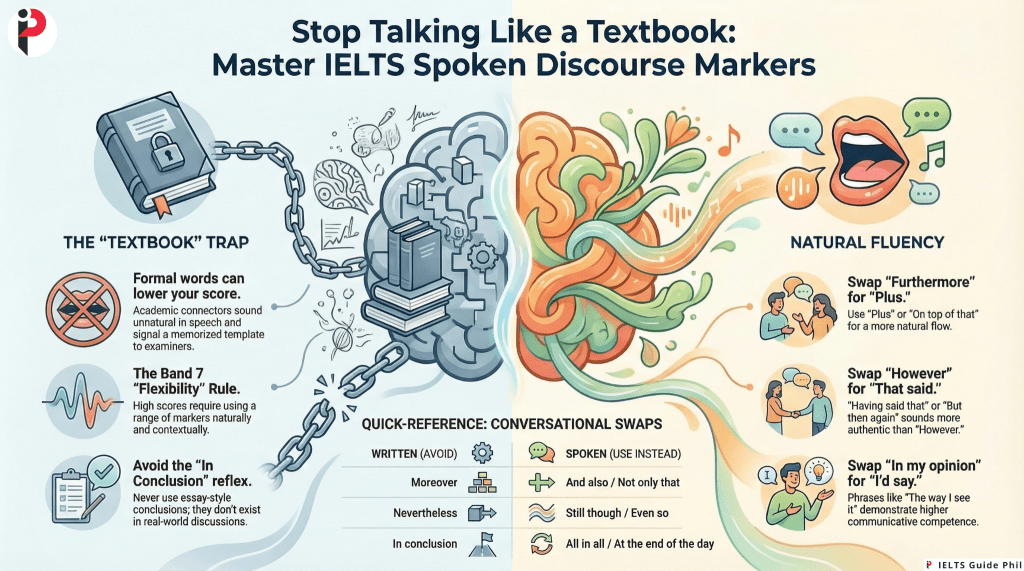
If you’ve ever said “Furthermore, I would like to add that…” or “In conclusion, to summarise my aforementioned points…” in the IELTS Speaking test, this post is for you.
Here’s the truth that most review centres won’t tell you: using written, academic linking words in speaking doesn’t impress examiners. It actually hurts your score.
This is one of the most common — and most damaging — mistakes Filipino IELTS candidates make. You spend weeks memorising formal connectors from grammar books, then you march into the speaking room and deliver what sounds like a walking essay. The examiner notices. And not in a good way.
This post breaks down everything you need to know about natural spoken discourse markers — what they are, why they matter, how to use them, and how to stop sounding like a textbook in a room that’s testing your ability to have a real conversation.
What Are Spoken Discourse Markers — And Why Are They Different?
A discourse marker is a word or phrase that organises your speech, signals your intention, or manages the flow of a conversation. Think of them as the glue that holds your spoken ideas together.
The key word here is spoken. Discourse markers exist in two very different registers:
Written/Academic register: Furthermore, Moreover, Nevertheless, In addition, To conclude, It is worth noting that, Notwithstanding the aforementioned
Spoken/Conversational register: You know, I mean, Right, Actually, So, Having said that, The thing is, To be honest, What I’m trying to say is
In everyday English — and in the IELTS Speaking test — fluent speakers use the spoken register automatically. When you swap them out for the written register, your speech sounds unnatural, robotic, and rehearsed. And “rehearsed” is the last word you want an IELTS examiner to associate with your speaking.
What the Band Descriptors Are Actually Looking For
Before we get into the list, let’s ground this in the IELTS Speaking assessment criteria — specifically Fluency and Coherence, which is worth 25% of your Speaking score.
The Band 7 descriptor says a candidate uses a “range of discourse markers” and uses them “flexibly.”
The Band 6 descriptor says a candidate uses discourse markers, but “not always appropriately.”
The Band 5 descriptor mentions discourse that is “clearly arranged” but with limited range and frequent lapses.
Notice what the descriptor does NOT say: it does not say “uses a wide range of academic linking words.” The word is discourse markers — and in speaking, that means spoken discourse markers.
Flexibility is the other key word. Flexibility means the markers feel natural, contextually appropriate, and varied. That only happens with spoken markers you’ve actually internalised — not with formal connectors you’ve memorised from a worksheet.
50 Natural Spoken Discourse Markers for IELTS Speaking (Organised by Function)
🔷 CATEGORY 1: To Add Information
(Replace: Furthermore, Moreover, In addition, Additionally)
These are not discourse markers you should eliminate completely — the problem is using them in isolation as if you’re writing an essay. In speech, adding ideas sounds different.
- And also — “It’s a great place to visit, and also the food is incredibly cheap.”
- On top of that — “The commute is terrible. On top of that, the rent is through the roof.”
- Not only that — “She speaks three languages. Not only that, she’s also a licensed engineer.”
- Plus — “It saves time. Plus, it’s much more convenient.”
- What’s more — “The course is free. What’s more, you get a certificate at the end.”
- And then there’s also — “There’s the issue of cost, and then there’s also the question of quality.”
- Another thing is — “Another thing is, people here don’t really prioritise physical activity.”
- On a related note — “On a related note, young people today are also spending less time outdoors.”
🔷 CATEGORY 2: To Contrast or Qualify
(Replace: However, Nevertheless, Notwithstanding, On the contrary)
- But then again — “I think social media is harmful. But then again, it does keep families connected.”
- Having said that — “Online learning is convenient. Having said that, nothing replaces face-to-face interaction.”
- At the same time — “We need economic growth. At the same time, we can’t ignore environmental damage.”
- Then again — “I’d love to live abroad. Then again, I’d miss my family too much.”
- That said — “It’s an expensive city. That said, the opportunities are incredible.”
- Even so — “The traffic is awful. Even so, I still prefer living in Manila.”
- Mind you — “It’s quite a long process. Mind you, it’s worth it in the end.”
- Still though — “I understand the policy. Still though, it doesn’t seem entirely fair.”
- To be fair — “The government has its flaws. To be fair, they’ve made some real improvements.”
🔷 CATEGORY 3: To Give an Example
(Replace: For instance, For example, To illustrate — these are acceptable in speaking, but vary them)
- Like — “A lot of people struggle with pronunciation, like vowel sounds especially.”
- Say, for example — “Say, for example, you’re applying for a job abroad — your English has to be really strong.”
- Take [noun] for example — “Take my sister, for example. She passed IELTS without a review centre.”
- As an example — “As an example, many call centre agents here have near-native fluency.”
- Something like — “They could create more green spaces — something like community parks or urban gardens.”
- Think of it this way — “Think of it this way: you wouldn’t go to a job interview without preparing, right?”
- A good example of this is — “A good example of this is the way Filipinos code-switch in professional settings.”
🔷 CATEGORY 4: To Introduce Your Opinion
(Replace: I believe that, It is my opinion that, In my view — vary these in speaking)
- Personally — “Personally, I think remote work is the future.”
- To be honest — “To be honest, I wasn’t really interested in it at first.”
- If you ask me — “If you ask me, the education system needs a complete overhaul.”
- From where I stand — “From where I stand, it’s really a matter of priorities.”
- The way I see it — “The way I see it, both sides have valid arguments.”
- I’d say — “I’d say the biggest challenge is definitely the time pressure.”
- Honestly speaking — “Honestly speaking, I don’t think that’s a realistic solution.”
- In my experience — “In my experience, people respond better to encouragement than criticism.”
🔷 CATEGORY 5: To Clarify or Rephrase
(Replace: That is to say, In other words — these sound too written)
- I mean — “It was really challenging — I mean, I had to study almost every night.”
- What I mean is — “It’s not that I dislike it — what I mean is, I think there are better options.”
- In other words — (acceptable in speaking when used naturally, not formulaically) — “It’s just too risky. In other words, the downside far outweighs the benefit.”
- Or rather — “I finished the course last year — or rather, I completed the first two modules.”
- What I’m trying to say is — “What I’m trying to say is, it’s not just about money.”
- To put it simply — “To put it simply, the system is broken.”
- You know what I mean? — (used to check understanding, sparingly) — “It’s one of those things that just grows on you, you know what I mean?”
🔷 CATEGORY 6: To Signal You’re Developing an Idea
(Replace: With regard to, With respect to, Concerning)
- As for — “As for the cost, that’s really a secondary concern.”
- When it comes to — “When it comes to technology, younger generations adapt really quickly.”
- Speaking of — “Speaking of education, I think the curriculum here needs updating.”
- On the topic of — “On the topic of health, diet plays a much bigger role than people think.”
- In terms of — “In terms of environmental impact, electric vehicles are definitely better.”
🔷 CATEGORY 7: To Signal Your Conclusion or Final Thought
(Replace: In conclusion, To summarise, To conclude)
- All in all — “All in all, I think it’s been a positive change.”
- At the end of the day — “At the end of the day, what matters most is your health.”
- When all is said and done — “When all is said and done, I think family is what keeps people grounded.”
- So yeah — (casual wrap-up, natural-sounding) — “So yeah, that’s basically my experience with it.”
- I suppose what I’m saying is — “I suppose what I’m saying is, balance is the key.”
- Overall, I’d say — “Overall, I’d say the benefits definitely outweigh the drawbacks.”
Dos and Don’ts: The Spoken Discourse Marker Rules
✅ DO THIS
Do use discourse markers that match conversational speed. Natural markers are short and low-effort. You produce them without slowing down. If you’re searching for a discourse marker, it’s not yet internalised.
Do vary your markers across Parts 1, 2, and 3. Part 1 is casual, so use lighter markers (honestly, I mean, like, actually). Part 3 is more analytical, so slightly more structured markers are appropriate (having said that, when it comes to, at the end of the day).
Do let discourse markers emerge from your thinking. Fluent speakers use discourse markers to process their ideas in real time — not to signal that they’re “now doing contrast.” Think of them as thinking tools, not decorations.
Do practise out loud. You cannot internalise spoken discourse markers by reading them. You have to say them — in mock answers, in conversations, in shadowing activities.
Do combine markers. Real speech layers markers naturally: “To be honest, I mean, it’s not something I’ve thought about a lot — but having said that, I think the government should definitely invest more in it.”
❌ DON’T DO THIS
Don’t open with “First and foremost.” It screams template. Examiners hear it dozens of times a day. It signals that you’ve memorised a structure rather than developed genuine fluency.
Don’t say “In conclusion” in Part 3. You are not writing an essay. Part 3 is a discussion. Nobody concludes a discussion with “In conclusion.” Use “All in all” or “At the end of the day” instead.
Don’t use “Furthermore” unless it comes naturally to you. If you’re reaching for “Furthermore” in a conversation about your favourite childhood memory, something has gone wrong.
Don’t cluster all your markers at the beginning of sentences. Real speech distributes markers throughout — mid-sentence, at the end, and sometimes as standalone filler turns (“You know,” / “I mean,” / “Right.”)
Don’t memorise a fixed set and repeat them. Using “having said that” five times in one answer is worse than not using it at all. Variety signals genuine lexical range.
Don’t confuse discourse markers with filler words. “Um,” “uh,” “like” (overused) are not discourse markers — they’re hesitation devices. A couple are fine, but they should not replace genuine markers.
Common Mistakes Filipino IELTS Candidates Make (and How to Fix Them)
❌ Mistake 1: “Furthermore, I would like to add that in my opinion, it is essential to consider…”
This opening stacks three written-register elements in a single sentence. It sounds like a composed paragraph, not a spoken turn.
✅ Fix: “And also — I think what’s really important here is…” or simply lead with your idea and add the marker mid-flow.
❌ Mistake 2: Using “In conclusion” to wrap up a Part 3 answer
“In conclusion, both the government and individuals have a shared responsibility.”
This makes your answer sound rehearsed and formula-driven. It also implies you’re summarising a five-paragraph essay — not responding to a discussion question.
✅ Fix: “At the end of the day, I think it comes down to shared responsibility — between the government and ordinary people.”
❌ Mistake 3: “On the other hand” — used without a first hand
Candidates often launch into “On the other hand” without having stated the first perspective clearly, making the contrast meaningless.
✅ Fix: State your first point clearly, then use “But then again” or “Having said that” to introduce the contrast naturally.
❌ Mistake 4: Over-relying on “such as” and “for example” back to back
“There are many problems, such as pollution — for example, air pollution and water pollution, for instance in Manila…”
This is redundant and makes the answer feel padded rather than developed.
✅ Fix: Choose one exemplification marker and commit. “Take air pollution, for example — it’s become a serious issue in Metro Manila especially.”
❌ Mistake 5: Treating discourse markers as fillers to buy time
“Hmm… furthermore… I think… moreover… the government should…”
Using formal written connectors as hesitation devices is doubly damaging — they sound unnatural AND they signal you’re stalling.
✅ Fix: Use thinking phrases instead: “That’s a good question — let me think about that for a second… I’d say the government should…” These are natural, accepted, and examiner-friendly.
❌ Mistake 6: Using the same opening for every Part 1 answer
“Well, first and foremost, I would say that…” (for every single answer)
This becomes a visible template pattern within the first two or three exchanges. Examiners notice.
✅ Fix: Rotate your Part 1 openers: “Honestly…” / “Actually…” / “To be honest…” / “I’d say…” / “You know, it’s funny — I was just thinking about this…”
Part-by-Part Guide: Which Markers Work Best Where
Part 1 (Introduction and Interview)
Keep it light and conversational. Part 1 is designed to put you at ease. Match that register.
Best markers here: Honestly, To be honest, Actually, I mean, You know, I’d say, Personally, Like, And also
Avoid: Furthermore, Nevertheless, In conclusion, It is worth noting
Part 2 (Long Turn / Cue Card)
You have 1–2 minutes to speak with some internal structure. A light degree of organisation is appropriate — but it should still sound like a narration, not a presentation.
Best markers here: So, And then, What I found was, I mean, Having said that, The thing is, What made it special was, All in all
Avoid: In conclusion, To summarise, Firstly — Secondly — Thirdly (mechanical list)
Part 3 (Two-Way Discussion)
This is your highest-register part. Slightly more formal spoken markers are appropriate here — but still conversational, not academic.
Best markers here: Having said that, At the same time, When it comes to, The way I see it, To be fair, That said, All in all, At the end of the day, In terms of, What’s more
Acceptable here (used naturally): However, On the other hand, Nevertheless — but only if they come out naturally, not mechanically.
Frequently Asked Questions
Q: Can I use “however” and “nevertheless” in Speaking at all?
Yes — but only if they come out naturally and are not overused. “However” is borderline acceptable in Part 3 because it appears in educated spoken English. “Nevertheless” is riskier — it almost always sounds written when spoken. A good rule of thumb: if you’d say it in a casual conversation with a friend, it’s probably safe. If it only appears in your writing, leave it out of your speaking.
Q: My teacher taught me to use “First, Second, Third” to organise my answers. Is this wrong?
It’s not wrong — but it’s limiting and mechanical when overused. A light “First of all…” is fine once. But candidates who structure every answer as a numbered list sound robotic rather than fluent. Mix in other markers: “One thing I’ve noticed is… and I think what’s equally important is…” feels far more natural.
Q: If spoken discourse markers are more casual, won’t I sound less educated?
No — and this is a critical misconception. Fluent, educated native English speakers use natural spoken discourse markers constantly. Sounding educated in speech means sounding appropriately sophisticated for the context — not transplanting written academic language into oral discourse. Using natural markers correctly actually demonstrates higher communicative competence than using formal written connectors incorrectly.
Q: How many discourse markers should I aim to use per answer?
There’s no target number — and chasing a number will make your speech sound forced. Think of it this way: a natural, well-developed answer to a Part 3 question will organically contain four to six discourse markers simply because ideas connect to other ideas. Focus on developing your answers fully, and the markers will follow.
Q: Will the examiner deduct marks if I occasionally say “furthermore” in speaking?
No — it’s not a single-word penalty system. The issue is pattern and frequency. One “furthermore” in a natural flow is not damaging. But if your entire answer sounds like a written essay, the examiner will mark you down on Fluency and Coherence because your discourse doesn’t reflect genuine spoken fluency.
Q: Should I practise these markers by memorising a list?
Reading a list is a starting point — but internalisation only happens through use. The most effective method is shadowing native speaker content (podcasts, interviews, TED talks), pausing to notice what discourse markers they use, and then replaying those same patterns in your own mock speaking answers. Repetition in speaking — not reading — is what makes markers feel automatic.
Q: What’s the single most common marker mistake among Filipino IELTS candidates?
Opening with “First and foremost” and closing with “In conclusion” — and using both in every single answer. These two alone signal a memorised template more than almost anything else. Replace them with natural spoken alternatives and your Fluency and Coherence score will immediately feel more authentic to the examiner.
Quick Reference: Written vs. Spoken Swaps
| ❌ Written (Avoid in Speaking) | ✅ Spoken (Use Instead) |
|---|---|
| Furthermore | What’s more / On top of that |
| Moreover | And also / Not only that |
| Nevertheless | Even so / Still though / That said |
| However | But then again / Having said that |
| In addition | Plus / And then there’s also |
| In conclusion | All in all / At the end of the day |
| To summarise | So yeah / I suppose what I’m saying is |
| It is worth noting | Mind you / The thing is |
| With regard to | When it comes to / As for |
| In my opinion | The way I see it / If you ask me |
| For instance / For example | Like / Take [X] for example / Say, for example |
| That is to say | I mean / What I mean is |
| Notwithstanding | Even so / That said |
| In other words | To put it simply / What I’m trying to say is |
Final Word: Speak Like a Human, Score Like a Pro
The IELTS Speaking test is not a written exam delivered verbally. It is an oral proficiency assessment — and oral proficiency means sounding like a real person having a real conversation, not a student reciting a prepared essay.
The examiners who assess you are trained to recognise genuine spoken fluency. They know the difference between a candidate who has developed discourse skills and one who has memorised a list of connectors. Natural spoken discourse markers are one of the clearest signals of real communicative competence — and communicative competence is exactly what IELTS Speaking is designed to measure.
Stop talking like a textbook. Start sounding like someone who actually speaks English.
#IELTSGuidePhil #IELTSSpeaking #IELTSDiscourseMarkers #IELTSFluency #IELTSBand7 #IELTSBand8 #IELTSTips #IELTSPhilippines #IELTSCoach #SpokenEnglish #IELTSGuidePhil #FluentEnglish #IELTSPreparation #IELTSSpeakingTips #EnglishFluency #IELTSCoherence #NaturalEnglish #CommunicativeCompetence #IELTSFilipinoLearners #IELTSSpeakingMistakes #IELTSPractice
 IELTS Guide Phil
Leave a comment