
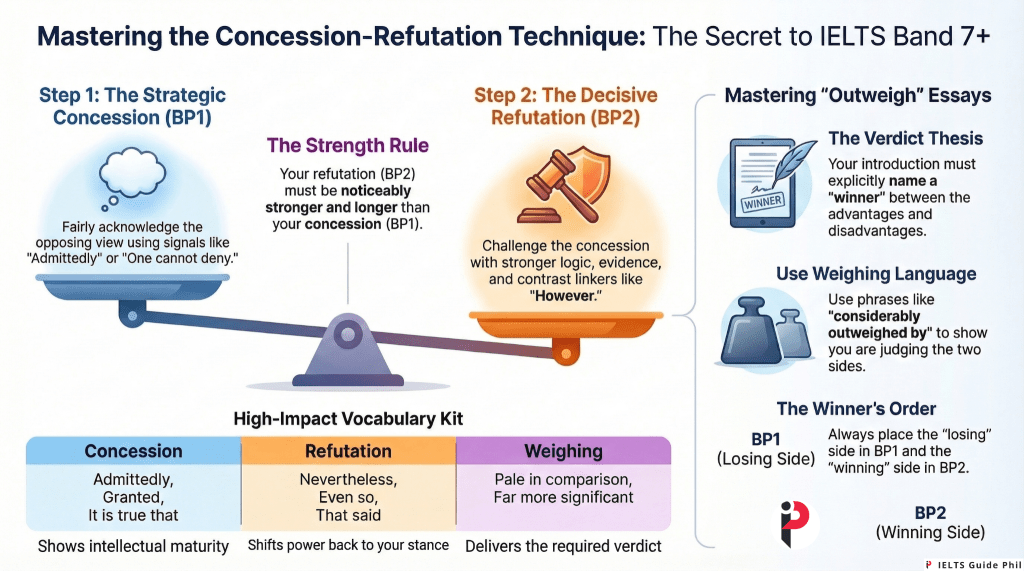
The Concession-Refutation Framework That Examiners Secretly Reward
If you’ve ever been told to “discuss both sides” in an IELTS opinion essay, chances are you’ve been doing it wrong — or at least, doing it in the weakest possible way. Most Filipino test-takers list opposing points and supporting points like a grocery list, never connecting them, never pushing back, never demonstrating the kind of critical thinking that separates Band 6 from Band 7, 8, or 9.
The concession-refutation technique changes all of that.
It is arguably the most intellectually sophisticated paragraph structure available to you in IELTS Writing Task 2. Done correctly, it shows the examiner that you can acknowledge complexity, hold two competing ideas in your mind at once, and still argue your position with conviction. That is exactly what Task Response and Coherence and Cohesion reward at the upper bands.
This post breaks down everything you need to know — how the structure works, how each paragraph is built, what Filipino candidates typically get wrong, and how to fix it before test day.
First, What Exactly Is the Concession-Refutation Technique?
The concession-refutation technique is a two-paragraph strategy used in argumentative and opinion essays where:
- Body Paragraph 1 (Concession): You acknowledge that the opposing side has a valid or understandable point — even if you personally disagree with it.
- Body Paragraph 2 (Refutation): You come back with a stronger argument that challenges, qualifies, or overturns what you conceded in Paragraph 1, reinforcing your own position.
Think of it like a debate where you say: “I understand why people believe X, and there is some truth to it — BUT here is why my position is ultimately more persuasive.”
It is not wishy-washy. It is not sitting on the fence. It is an advanced rhetorical move that signals intellectual maturity.
Who Should Use This Technique?
This structure works best for the following Task 2 question types:
“Do you agree or disagree?” You concede the opposing view in BP1, then refute it with your own stance in BP2. Your thesis must be clear from the introduction.
“To what extent do you agree or disagree?” You concede partial validity in BP1, then argue in BP2 why the opposing view is limited, conditional, or outweighed by your position.
“Some people think X. Others think Y. Discuss both views and give your own opinion.” Use BP1 for the view you find less convincing — acknowledged fairly and charitably. Use BP2 for the view you support, reinforcing it with your personal stance.
“Do the advantages outweigh the disadvantages?” / “Are the benefits greater than the drawbacks?” This is perhaps the most natural home for the concession-refutation technique among all Task 2 question types. You are being explicitly asked to weigh two sides and deliver a verdict. In BP1, you concede that the disadvantages (or drawbacks) are real and worth acknowledging. In BP2, you argue that the advantages (or benefits) are more significant, more widespread, or more enduring — thereby justifying your thesis that one side outweighs the other. The structure mirrors the question itself.
This technique is less ideal for pure descriptive essays — such as cause/effect or straightforward advantages/disadvantages essays where the prompt asks you to simply identify and explain rather than argue a position.
A Special Note on “Outweigh” Questions
Before applying the concession-refutation technique to outweigh questions, you must make one critical decision in your introduction: which side wins?
Your thesis must explicitly state your verdict. Do not write a vague introduction that says “there are both advantages and disadvantages.” That is a non-answer. The examiner is waiting for your judgment.
Strong outweigh thesis statements:
- Although this development has certain drawbacks, I believe the advantages far outweigh them.
- While the benefits of this trend are widely acknowledged, I would argue that the disadvantages are more significant and harder to ignore.
- In my view, the drawbacks of this policy outweigh its benefits, primarily because the long-term consequences are more severe than its short-term gains.
Notice that each thesis names a winner — and briefly signals why. That signal becomes the argument you develop in BP2.
Once your thesis is set, the concession-refutation structure follows naturally:
- BP1 = The side that loses the weighing (stated fairly and developed honestly)
- BP2 = The side that wins the weighing (argued more forcefully, with stronger evidence and reasoning)
The Anatomy of Body Paragraph 1 — The Concession
Your concession paragraph does not mean you surrender your argument. It means you are generous enough to acknowledge the other side — strategically.
A strong concession paragraph has four components:
1. A Concession Signal (Topic Sentence)
Open with a phrase that signals you are acknowledging the opposing view. Do not begin this paragraph with your own opinion — that weakens the structure.
Strong concession openers:
- Admittedly, there are those who argue that…
- It is true that…
- One cannot deny that…
- There is some merit in the argument that…
- Granted, proponents of this view contend that…
- To be fair, it is understandable why many believe that…
- For outweigh essays: It must be acknowledged that the disadvantages of this trend are not insignificant…
- For outweigh essays: Admittedly, the drawbacks of this policy deserve serious consideration…
2. The Opposing Claim Stated Fairly
State the opposing argument clearly and charitably. Do not set up a straw man. Do not make the other side sound ridiculous. If you present a weak version of their argument, your refutation in BP2 will feel hollow.
3. Support or Elaboration for the Opposing View
Briefly explain why people hold this view — or why the disadvantage or drawback is real. Give it a reason to exist. This might be one piece of evidence, a logical explanation, or a real-world example.
4. A Pivot (Optional but Powerful)
You may end BP1 with a subtle pivot phrase that hints you are about to challenge this view — or you can let the refutation paragraph open with that challenge. Either works.
Pivot phrases:
- However, this view has significant limitations.
- Nevertheless, a closer examination reveals a more complex picture.
- Despite this, the argument does not hold up under scrutiny.
- For outweigh essays: That said, these disadvantages are ultimately less consequential than they first appear.
- For outweigh essays: Even so, these drawbacks are outweighed by more compelling considerations on the other side.
Sample Body Paragraph 1 — Concession (Agree/Disagree Essay)
Essay Prompt: Some people believe that university education should be free for all students. Others argue that students should pay tuition fees. Discuss both views and give your own opinion.
(Writer’s opinion: Students should contribute to tuition costs)
Admittedly, there is a compelling case for making university education entirely free of charge. Proponents of this view argue that financial barriers prevent talented individuals from low-income families from accessing higher education, thereby perpetuating cycles of poverty and social inequality. In countries such as Germany and Norway, where tertiary education is largely state-funded, participation rates among disadvantaged groups have increased significantly, suggesting that removing tuition fees can indeed produce a more equitable society. It is therefore understandable why many regard free university education as a matter of basic social justice.
Sample Body Paragraph 1 — Concession (Outweigh Essay)
Essay Prompt: The increasing use of technology in the classroom has more benefits than drawbacks. To what extent do you agree or disagree?
(Writer’s thesis: The benefits outweigh the drawbacks)
Admittedly, the growing reliance on technology in educational settings is not without its drawbacks. Critics rightly point out that excessive screen time may impair students’ ability to concentrate for extended periods, and that the constant availability of digital entertainment creates significant potential for distraction during lessons. Furthermore, schools in lower-income communities often lack the infrastructure and technical support needed to implement classroom technology effectively, meaning that digital tools can deepen rather than close the educational divide between wealthy and disadvantaged students. These are genuine concerns that any serious discussion of educational technology must honestly acknowledge.
Why this works:
- Acknowledges the losing side generously — the examiner can see you understand the issue’s complexity
- Develops two distinct disadvantages rather than simply naming them
- Uses measured language (not without its drawbacks, rightly point out) — it is honest but not catastrophic
- Ends in a way that implies a pivot is coming without committing to one yet
The Anatomy of Body Paragraph 2 — The Refutation
This is where you take back the argument — not aggressively, but decisively. The refutation paragraph must feel like the natural, stronger conclusion that follows from what you acknowledged in BP1.
A strong refutation paragraph has four components:
1. A Refutation Signal (Topic Sentence)
Open with a contrast or concession-limiting phrase. This is the most important sentence in your essay structure — it tells the examiner that you have weighed both sides and are now asserting your position.
Strong refutation openers:
- However, this argument fails to account for…
- Despite these merits, the opposing view overlooks…
- Nevertheless, a more critical analysis suggests that…
- While there is some truth to this claim, it is important to recognise that…
- Even so, the evidence ultimately supports the position that…
- This argument, while emotionally compelling, is undermined by…
- For outweigh essays: However, these disadvantages are considerably outweighed by the benefits that…
- For outweigh essays: Despite these drawbacks, the advantages of this development are both more numerous and more far-reaching…
- For outweigh essays: Nevertheless, when weighed against the broader benefits, these concerns prove to be relatively minor…
2. Your Counter-Claim
State your own position clearly. Do not hedge excessively. The examiner needs to hear your voice here.
3. Evidence or Reasoning That Supports Your Position
This is where you win the argument. Your evidence or reasoning here must be demonstrably stronger — or at least more nuanced — than what you presented in BP1. This is the intellectual payoff of the entire two-paragraph structure.
4. A Concluding Reinforcement
End the paragraph by reinforcing your stance. Do not drift back to the other side. Close it with conviction.
Sample Body Paragraph 2 — Refutation (Agree/Disagree Essay)
(Continuing the university tuition fees essay)
However, the argument for completely free university education fails to account for the long-term financial sustainability of publicly funded higher education systems. When governments bear the full cost of university provision, the burden inevitably falls on taxpayers, including many who never attended university themselves — a form of regressive redistribution that disproportionately benefits the already privileged. Moreover, evidence from countries that have experimented with free tuition models suggests that quality often deteriorates when institutions are underfunded, ultimately harming the very students such policies aim to help. A more equitable solution, therefore, is a needs-based model in which wealthy students contribute tuition fees while scholarships and grants ensure that financial hardship does not prevent access. This approach preserves both quality and equity without placing an unsustainable burden on public finances.
Sample Body Paragraph 2 — Refutation (Outweigh Essay)
(Continuing the classroom technology essay)
However, these disadvantages are considerably outweighed by the transformative benefits that technology brings to modern education. Interactive digital platforms enable personalised learning at a pace and depth that traditional classroom instruction simply cannot match — a student struggling with algebra, for instance, can receive immediate, targeted feedback from an adaptive programme rather than waiting for the teacher’s attention. On a broader scale, technology expands access to world-class educational content for students in remote or underserved areas, effectively dismantling geographical barriers that have historically limited opportunity. While the risk of distraction is real, research consistently indicates that when digital tools are integrated thoughtfully — with clear guidelines and purposeful tasks — student engagement and academic performance improve measurably. The drawbacks of classroom technology are therefore not inherent to the tools themselves, but are challenges of implementation that responsible educators and policymakers are well positioned to address.
Why this works:
- Opens with an explicit outweigh judgment (considerably outweighed)
- Introduces stronger, more developed benefits than the drawbacks stated in BP1
- Directly engages with the distraction concern raised in BP1 (not ignoring it — reframing it)
- Ends by further diminishing the conceded side, reinforcing the verdict
The Full Essay Structure With This Technique
Introduction
- Paraphrase the topic
- State your thesis / position clearly — including your outweigh verdict if applicable
Body Paragraph 1 — Concession
- Acknowledge the opposing view, disadvantage, or drawback fairly
- Support it briefly with reasoning or example
- Hint at a pivot (optional)
Body Paragraph 2 — Refutation
- Challenge the concession with a stronger counter-argument
- For outweigh essays: explicitly state that your side outweighs the conceded side
- Support your position with reasoning and evidence
- Reinforce your stance — close with conviction
Conclusion
- Restate your position and your outweigh verdict if applicable
- Offer a final thought, recommendation, or prediction
Dos and Don’ts
✅ DOS
Do open BP1 with a genuine concession signal. Phrases like Admittedly, It is true that, and One cannot deny tell the examiner immediately what rhetorical move you are making. They are part of your Coherence and Cohesion score.
Do present the opposing argument generously. The stronger you make the opposing side in BP1, the more impressive your refutation in BP2 will appear. A weak opposing argument makes for a weak essay overall.
Do use explicit weighing language in outweigh essays. Phrases like considerably outweighed by, far more significant than, more widespread and enduring than its drawbacks, and pale in comparison to tell the examiner you are directly responding to the question’s demand for a verdict. Never leave the weighing implicit.
Do make your refutation argument noticeably stronger than your concession. The examiner should finish reading BP2 feeling that your side has clearly won the intellectual exchange. If both paragraphs feel equal in strength, your opinion essay loses its argumentative edge.
Do use a strong contrast linker to open BP2. Words like However, Nevertheless, That said, and Even so are structural signals. They tell the examiner: “I have acknowledged the other side. Now here is my stronger argument.” This directly supports your Coherence and Cohesion score.
Do maintain your thesis position throughout. Your introduction says where you stand — including which side outweighs the other. Your BP2 defends that stand. Your conclusion restates it. The essay must be consistent in its argumentation.
Do vary your concession and refutation vocabulary. Examiners notice when candidates always open with However. Show range: Despite this, Be that as it may, All the same, Even so, Nonetheless, That said.
❌ DON’TS
Don’t turn BP1 into a full endorsement of the opposing view. You are conceding, not converting. BP1 should acknowledge — not celebrate — the other side. If your BP1 sounds like you fully agree with the drawbacks being catastrophic, your refutation in BP2 will feel contradictory.
Don’t forget to actually refute in BP2. The most common structural failure among Filipino candidates is writing two body paragraphs that each present different sides without any refutation language. That is a discussion, not a concession-refutation structure.
Don’t leave the weighing verdict implicit in outweigh essays. Writing “the benefits are numerous and significant” is not enough. You must say “the benefits significantly outweigh the drawbacks” or equivalent. The examiner needs to hear your judgment stated explicitly — not inferred from the content.
Don’t use weak refutation openers. Avoid: On the other hand, Meanwhile, In contrast. These signal a shift in topic, not a challenge to a previous argument. Reserve However and Nevertheless for genuine counter-arguments.
Don’t make BP2 shorter than BP1. Your argument deserves more space than your concession. A longer concession and shorter refutation sends the wrong signal about where your confidence lies.
Don’t end BP2 with a concession. Do not close your refutation paragraph with phrases like “both sides have merit” or “it is difficult to say which side truly wins.” You have argued your position — own it.
Don’t ignore the prompt type. This technique is for opinion and argumentative essays, including outweigh essays. If the prompt is “What are the causes and effects of…” — this structure is not appropriate.
Common Mistakes and How to Fix Them
Mistake 1: The “Balanced But Opinionless” Essay
What it looks like:
BP1: Technology in classrooms has disadvantages such as distraction. BP2: On the other hand, technology also has benefits such as improved engagement.
The problem: There is no concession, no refutation, no weighing verdict, and no writer’s voice. This is a list of two sides — not an argumentative essay. In outweigh essays, this is particularly damaging because the question explicitly demands a verdict.
The fix: In BP2, do not just present the second view. Challenge the first view using refutation language, stronger reasoning, and an explicit weighing judgment.
Mistake 2: Conceding Too Strongly
What it looks like:
It is undeniably true that technology in classrooms is deeply harmful, creates serious addiction, destroys concentration permanently, and has no place in modern education. These are catastrophic problems with no solution.
The problem: You have argued the conceded side so forcefully that your BP2 refutation will feel like a contradiction. No weighing verdict can convincingly follow this.
The fix: Acknowledge the opposing view with measured, qualified language — not without drawbacks, these concerns are not without merit, critics rightly point to certain limitations. Present the conceded side as real but manageable — not devastating.
Mistake 3: Refutation Without Engagement
What it looks like:
However, I believe technology is beneficial because it helps students learn.
The problem: This refutation does not engage with what was said in BP1. It ignores the specific concerns about distraction and inequality raised in the concession. It sounds like the writer started a new paragraph rather than answering the previous one.
The fix: Your refutation must address the logic of the concession. If BP1 argued technology causes distraction, your BP2 must explain why that concern is overstated, conditional, or solvable — not simply pivot to a different benefit.
Mistake 4: Missing the Weighing Language in Outweigh Essays
What it looks like:
However, technology has many benefits for students. It makes learning more interactive and engaging. It also helps students access information more easily…
The problem: The writer is presenting benefits — but never explicitly connects them to the question’s demand: do they outweigh the drawbacks? This paragraph could exist in any essay on technology. It does not answer the outweigh question.
The fix: Insert explicit weighing language: These benefits are considerably more significant than the drawbacks outlined above, or When measured against the concerns discussed in the previous paragraph, these advantages prove far more consequential.
Mistake 5: Using “On the Other Hand” to Open BP2
What it looks like:
On the other hand, technology has more advantages than disadvantages…
The problem: On the other hand is a topic-shift phrase, not a refutation phrase. It signals that you are moving to a second, separate point — not challenging the first. In an outweigh essay, this is especially weak because the question demands a verdict, not merely a second perspective.
The fix: Replace with: However, these drawbacks are considerably outweighed by… / Despite these concerns, the benefits of classroom technology are more far-reaching and enduring… / Nevertheless, when weighed objectively, the advantages prove to be more significant…
Mistake 6: Vague or Non-Committal Thesis in Outweigh Essays
What it looks like:
There are many advantages and disadvantages to the use of technology in classrooms. This essay will discuss both sides.
The problem: This introduction does not state a thesis. It does not tell the examiner which side outweighs the other. Without a thesis, your BP2 has nothing to defend, and your conclusion has nothing to restate. Task Response will suffer significantly.
The fix: Always commit to a verdict in your introduction: While classroom technology presents certain challenges, I firmly believe that its benefits far outweigh its drawbacks, particularly in terms of personalised learning and expanded access to education.
Mistake 7: Filipinismo Transfer in Concession Language
What it looks like:
Even though the other side, it is also true that my opinion is different. But yes, I understand their point however my point is stronger.
The problem: These are direct L1 transfer errors — the structure of Filipino/Tagalog argumentative speech translated awkwardly into English. They fail both Grammatical Range and Accuracy and Lexical Resource.
The fix: Memorise and practise the concession-refutation phrase bank below until it becomes automatic. Do not construct these phrases on the spot from Tagalog logic.
Phrase Bank — Concession and Refutation Language
Concession Phrases (BP1 Openers)
- Admittedly,…
- It is true that…
- One cannot deny that…
- There is some validity in the argument that…
- Granted, it can be argued that…
- To be fair,…
- It is understandable why many contend that…
- Proponents of this view argue convincingly that…
- There is a degree of merit in the claim that…
- It must be acknowledged that the drawbacks of this development are real…
- The disadvantages of this approach are not insignificant…
- Critics of this trend are not entirely without justification…
Refutation Phrases (BP2 Openers)
- However, this argument fails to account for…
- Nevertheless, a more critical analysis reveals that…
- Despite these merits, the opposing view overlooks…
- Even so, the evidence points more strongly to…
- That said, this reasoning is undermined by…
- Be that as it may, the stronger argument lies in…
- While there is some truth to this claim, it must be noted that…
- This position, though understandable, does not withstand scrutiny because…
- All the same, the drawbacks of this approach far outweigh its benefits.
Outweigh-Specific Refutation Phrases
- However, these disadvantages are considerably outweighed by…
- Despite these drawbacks, the benefits of this development are far more significant…
- Nevertheless, when weighed objectively, the advantages prove more numerous and more enduring…
- These concerns, while valid, pale in comparison to the broader benefits of…
- The drawbacks outlined above are real but ultimately minor when set against…
- Even accounting for these limitations, the case in favour remains far more compelling…
- On balance, the advantages of this trend are both more widespread and more consequential than its disadvantages…
How This Technique Affects Your Band Score
| Band Descriptor | How Concession-Refutation Helps |
|---|---|
| Task Response | Demonstrates a clear, sustained position with a verdict; directly addresses outweigh questions rather than listing two sides |
| Coherence and Cohesion | Shows sophisticated use of cohesive devices; logical paragraph progression with a clear weighing arc |
| Lexical Resource | Requires advanced concession/refutation/weighing vocabulary; reduces reliance on basic linking words |
| Grammatical Range and Accuracy | Naturally generates complex sentences: Although… nevertheless…, Despite the fact that…, it remains the case that…, While X is acknowledged, Y proves more significant |
Frequently Asked Questions
Q1: Is the concession-refutation technique only for “agree or disagree” essays?
No — it works across all opinion-based question types, including outweigh essays, “to what extent” essays, and “discuss both views” essays. It is most powerfully suited to outweigh questions because the question itself is asking you to perform a weighing comparison — which is precisely what this structure delivers. For cause/effect or pure advantages/disadvantages essays without an opinion demand, a different paragraph structure is more appropriate.
Q2: In an outweigh essay, does BP1 always contain the losing side?
Yes — and this is a structural rule worth memorising. BP1 holds the side you are conceding (the side that loses the weighing in your thesis). BP2 holds the side you are arguing wins. If your thesis says advantages outweigh disadvantages, BP1 presents the disadvantages and BP2 argues the advantages are stronger. Never reverse this order — ending on the conceded side undermines your entire argument.
Q3: What if I genuinely think both sides are equal in an outweigh essay?
IELTS does not reward fence-sitting in outweigh essays. If you write “the advantages and disadvantages are roughly equal,” you have not answered the question. Even if you see both sides as genuinely balanced, you must choose the stronger side for the purposes of the essay and argue it convincingly. IELTS Writing tests your ability to construct and sustain a position — not to accurately represent your personal uncertainty.
Q4: What if I genuinely agree with both sides and cannot decide which to concede and which to support?
Choose the side you can argue more convincingly — not necessarily the side you personally believe in. IELTS Writing is a test of your English and argumentative ability, not a survey of your real opinions. Pick the side with stronger argumentative potential for your thesis and treat the other as your concession.
Q5: Can I use this structure if I only have 40 minutes?
Yes — and it is worth it. Practise this structure so many times before your test that it becomes automatic. The goal is that you sit down, read the prompt, and your mental template activates immediately: Introduction (with verdict) → BP1 Concession → BP2 Refutation with weighing language → Conclusion. Fluency with the structure saves time, not costs it.
Q6: Does the concession always have to go first?
Conventionally, yes — because placing it first and refuting it second gives your essay a sense of momentum and conclusion. If you put your argument first and then the concession second, the essay ends on the opposing side’s note, which undermines your thesis. Always: concede first, refute second.
Q7: What is the difference between a “concession” and just “presenting the other side”?
A concession is an active rhetorical acknowledgment that the opposing side has merit — followed by a challenge. “Presenting the other side” is passive reporting. Compare:
- Presenting: Technology has some disadvantages in classrooms.
- Conceding: One cannot deny that the risks associated with classroom technology — particularly around student distraction and unequal access — are legitimate concerns that deserve serious consideration.
The second version shows engagement, critical thinking, and advanced language use. That is the difference between Band 6 and Band 7.
Q8: How long should each body paragraph be?
Aim for a minimum of 150–180 words per body paragraph for a well-developed Task 2 essay. Your refutation paragraph (BP2) should be equal to or slightly longer than your concession (BP1). Never let your concession outweigh your refutation in length or depth — this is especially important in outweigh essays, where BP2 carries the burden of your verdict.
Q9: Can I use this technique for GT (General Training) Task 2?
Absolutely. The GT Task 2 assessment criteria are identical to Academic Task 2. Opinion, argumentative, and outweigh prompts appear in both modules. The concession-refutation technique applies equally.
Q10: Is it acceptable to have three body paragraphs instead of two?
Yes. Some test-takers use three body paragraphs: BP1 (concession/losing side), BP2 (first supporting argument for winning side), BP3 (second supporting argument for winning side). This works particularly well in outweigh essays where you want to develop two strong advantages against one acknowledged disadvantage. However, three underdeveloped paragraphs are worse than two fully developed ones — use this structure only if you can maintain depth in all three.
Quick Reference Summary
- BP1 = Concession. Acknowledge the opposing side, disadvantage, or drawback fairly. Support it briefly. Signal a pivot.
- BP2 = Refutation. Challenge BP1’s argument directly. State your position and support it with stronger reasoning.
- In outweigh essays: state your verdict explicitly. Use weighing language — considerably outweighed by, far more significant than, pale in comparison to.
- Use concession vocabulary — Admittedly, Granted, It is true that — not neutral language.
- Use refutation vocabulary — However, Nevertheless, Despite these merits — not topic-shift language like On the other hand.
- BP2 must engage with BP1. Not just present a second opinion — challenge the first one.
- Your thesis controls the whole essay. Introduction states your verdict. BP2 defends it. Conclusion restates it.
- Never end BP2 with a concession. Close with conviction — especially in outweigh essays where the question demands a clear winner.
Master this technique and you are no longer just writing an IELTS essay. You are constructing an argument, delivering a verdict, and demonstrating the kind of analytical thinking that gets you to Band 7 and beyond.
Written for Filipino IELTS candidates aiming for Band 7–9 | IELTS Guide Phil
#IELTSGuidePhil #IELTSWritingTask2 #IELTSTips #IELTSPhilippines #IELTSEssayTips #IELTSBand7 #IELTSBand8 #IELTSOpinionEssay #IELTSArgumentativeEssay #IELTSOutweighEssay #AdvantagesDisadvantages #ConcessionRefutation #IELTSBodyParagraph #IELTSCoherence #IELTSTaskResponse #IELTSWritingTips #IELTSGuidePhil #IELTSReview #IELTSPractice #LearnEnglish #AcademicWriting #EnglishForFilipinos #IELTSCoach
 IELTS Guide Phil
Leave a comment