
Why your ChatGPT habit might be the reason you’re still stuck at Band 6
Why This Topic Matters Right Now
Let’s be honest. Almost every IELTS candidate today has typed something into ChatGPT, Gemini, or some AI writing tool and thought, “Okay, this is going to change everything.”
And it can — but not in the way most candidates are using it.
The problem isn’t that AI exists. The problem is that most learners are using it as a replacement for thinking, rather than a trainer for thinking. And on exam day, when the screen goes blank and the clock starts ticking, no AI is coming to save you.
This post will show you exactly how to use AI tools to sharpen your IELTS skills — and exactly where the line is between smart preparation and slow self-sabotage.
Part 1: What AI Can (and Cannot) Do for Your IELTS Preparation
Before anything else, you need to understand what kind of tool AI actually is.
AI language models are pattern machines. They are extraordinarily good at generating fluent, well-structured English. That’s also why they are dangerous for IELTS learners — because fluency generated by a machine is not fluency owned by you.
What AI Is Actually Good For in IELTS Prep
1. Getting instant feedback on your writing Instead of waiting days for a tutor to mark your Task 2 essay, you can paste it into an AI tool and ask for specific feedback — on your thesis, your topic sentences, your vocabulary range, or your grammatical accuracy. Done right, this collapses your feedback loop dramatically.
2. Generating vocabulary in context Ask AI to show you how a word is used in five different sentence structures, across formal and semi-formal registers. This is far more useful than memorising a word list. You see the word behave in its natural environment.
3. Creating personalised practice prompts AI can generate an unlimited supply of IELTS-style Task 1 charts, Task 2 essay questions, Speaking Part 2 cue cards, and Reading passage questions. This solves the common problem of running out of fresh material.
4. Explaining grammar rules with examples Ask AI to explain the difference between the present perfect and the simple past in IELTS Writing. You will get a clearer, more example-rich explanation than many textbooks offer — and you can ask follow-up questions immediately.
5. Simulating a speaking partner For candidates who are shy or who have no English-speaking environment, AI can act as a speaking prompt generator and even give basic feedback on transcribed answers.
6. Paraphrasing training Give AI a sentence and ask it to show you five different ways to express the same idea. Then study the differences. This is how you build paraphrasing flexibility — one of the most tested skills in IELTS Reading and Writing.
7. Error analysis Paste a paragraph you wrote and ask AI: “What grammatical errors did I make and why are they errors?” This is a powerful diagnostic tool when used actively.
What AI Cannot Do for Your IELTS Preparation
1. Take the test for you This seems obvious, but candidates forget it during preparation. Every minute you spend reading AI-generated essays instead of writing your own is a minute your brain is not building the muscle it needs.
2. Accurately replicate IELTS band descriptors Most AI tools are not trained on the official IELTS band descriptor rubric. When they “score” your essay, they are estimating. Some AI feedback is genuinely useful. Some is dangerously wrong. Always triangulate AI scores with official sample answers and, when possible, a qualified examiner.
3. Teach you fluency through exposure alone Reading perfect AI output does not transfer that perfection into your own production. Your brain needs to struggle, make errors, receive correction, and try again. That productive struggle is where real acquisition happens.
4. Replace genuine reading and listening immersion AI cannot simulate the cognitive load of authentic IELTS Reading passages written by real journalists, academics, and essayists. You need real texts at real difficulty levels.
5. Build your instinct for test timing Timed practice under exam conditions trains a specific kind of mental stamina. AI cannot manufacture that. Only a clock can.
Part 2: The AI Trap — How Candidates Accidentally Hurt Their Scores
The Copy-Edit Trap
This is the most common mistake. A candidate writes an essay, pastes it into AI, gets a polished version back, reads it, thinks “Yes, that’s better” — and learns absolutely nothing.
The polished version belongs to the AI. The candidate’s Band score is still where it was.
The fix: When AI improves your writing, do not just read the improved version. Study it line by line. Ask: What specifically changed? Why is that version stronger? Can I reproduce that technique in my next essay from scratch?
The Template Trap
Many candidates ask AI to generate “Band 9 essay templates” and memorise them. Examiners are trained to spot formulaic writing. A memorised template produces writing that is technically fluent but communicatively hollow — and that kills your Task Achievement and Coherence and Cohesion scores.
The fix: Use AI to study principles, not templates. Ask it to explain why a particular essay structure works. Then build your own version.
The Vocabulary Theft Trap
A candidate encounters a sophisticated word in an AI-generated essay — say, exacerbate — and drops it into their own writing without fully understanding its collocations, register, or typical sentence position. The result is an error that looks like overcorrection, which examiners notice.
The fix: When AI uses a word you want to adopt, ask it: “Show me five natural sentences using ‘exacerbate’ in formal academic writing. Now show me three common errors candidates make with this word.” Own the word before you use it.
The Passive Learning Trap
Many candidates use AI to generate study plans, vocabulary lists, grammar explanations — and then just read them. Passive consumption of well-formatted content produces the feeling of progress without the substance of it.
The fix: After every AI interaction, close the chat and reproduce what you just learned. Write it. Say it. Teach it back to the AI incorrectly and let it correct you. Active retrieval is where learning happens.
The Overconfidence Trap
AI feedback is often too encouraging. Many tools will tell you your essay is “Band 7–8 level” when an experienced examiner would score it Band 5.5. Candidates walk into the test overconfident and underprepared.
The fix: Seek out honest human feedback to calibrate your true level. AI is a first-pass tool, not a final verdict.
Part 3: The IELTS-Smart Way to Use AI — A Practical Framework
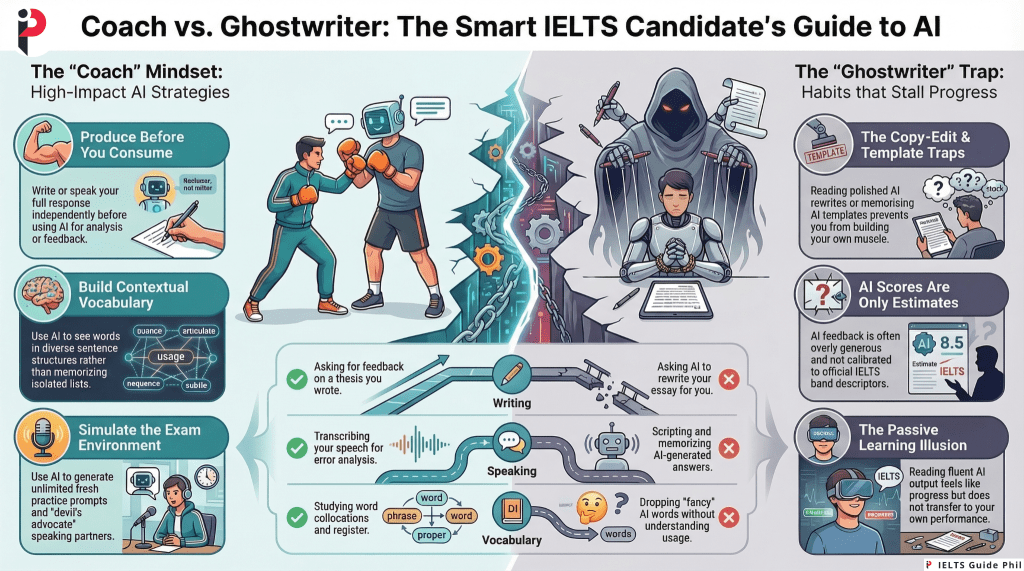
Think of AI as a personal training assistant, not a ghostwriter. A training assistant watches you lift, corrects your form, and suggests drills. It does not lift the weight for you.
For IELTS Writing
✅ Write your essay first, completely, without AI.
✅ Then ask AI for specific feedback: “Evaluate my thesis statement for clarity and directness.”
✅ Ask AI to identify your top three grammatical weaknesses in the essay.
✅ Ask AI to suggest two stronger alternatives for your weakest vocabulary choices — then rewrite those sentences yourself without looking at the suggestions.
✅ Compare your essay to a Band 8 model on the same question — but write a paragraph explaining exactly what the model does that yours does not.
❌ Do not ask AI to rewrite your essay.
❌ Do not submit an AI-generated essay as your own practice.
❌ Do not treat AI’s band score estimate as authoritative.
❌ Do not memorise AI-generated phrases without understanding their grammar and register.
For IELTS Speaking
✅ Use AI to generate fresh Part 1, Part 2, and Part 3 questions and practice answering them aloud.
✅ Record your answer, transcribe it (manually or with a transcription tool), and then paste the transcript into AI for fluency and coherence feedback.
✅ Ask AI: “What vocabulary would a Band 8 speaker use when discussing this topic?” — then practice using those words in your own sentences.
✅ Ask AI to play devil’s advocate and challenge your Part 3 opinions, forcing you to extend and justify your arguments.
❌ Do not script your answers using AI.
❌ Do not memorise AI-generated model answers and recite them — examiners are trained to identify rehearsed content, and it collapses your Fluency and Coherence score.
❌ Do not rely on AI for pronunciation feedback — it is not equipped for this. Use recorded native speaker models and, if possible, a qualified coach.
For IELTS Reading
✅ After completing a Reading practice test, paste difficult sentences into AI and ask it to break down the grammar and meaning.
✅ Ask AI to teach you the vocabulary from a passage in depth — etymology, collocations, register.
✅ Ask AI to explain why a particular answer is correct and another is wrong — this develops your test logic.
❌ Do not use AI to find the answers before you attempt the questions yourself.
❌ Do not use AI as a substitute for reading full authentic texts. Read newspapers, academic articles, and long-form essays independently.
For IELTS Listening
✅ Use AI to generate transcripts of content you want to practise listening comprehension on.
✅ Ask AI to explain vocabulary and idiomatic expressions from listening transcripts you have already worked through.
❌ Do not expect AI to train your ear. Only real audio with real accents does that. Use official IELTS practice audio, the BBC, TED Talks, and authentic podcasts.
Part 4: Dos and Don’ts — The Complete Reference
✅ DO:
- Use AI as a diagnostic tool — to identify where your weaknesses are
- Use AI to expand vocabulary in context, not in isolation
- Use AI to generate unlimited practice prompts across all four modules
- Use AI to understand your errors after writing or speaking, not instead of writing or speaking
- Use AI to study models analytically — breaking down what makes them effective
- Use AI as a Socratic partner — ask it to argue against you, challenge your reasoning, and force you to elaborate
- Use AI to explain grammar rules you do not understand
- Use AI to practice paraphrasing as a conscious, deliberate skill
❌ DON’T:
- Don’t let AI write anything you plan to treat as your own work
- Don’t use AI band score estimates as your primary measure of progress
- Don’t memorise AI-generated templates for Writing or Speaking
- Don’t mistake reading fluent AI output for developing your own fluency
- Don’t use AI to check your answers before you have genuinely attempted them
- Don’t skip timed, unsupported, exam-condition practice in favour of AI-assisted sessions
- Don’t use AI as an emotional crutch — if you cannot attempt a task without AI support, that is important diagnostic information, not a problem to hide
Part 5: Common Mistakes and Fixes
Mistake 1: “I asked ChatGPT to improve my essay and now I use that version for practice.”
Fix: That version is not your essay. It is ChatGPT’s essay. Practice requires your brain to produce the output. Read the improved version carefully, identify the techniques used, close the chat, and rewrite your own version from scratch using what you observed.
Mistake 2: “AI told me my essay was Band 7.5, so I think I’m ready.”
Fix: AI scoring is approximate and often generous. Cross-reference with official IELTS sample essays at published band levels. If you have access to a qualified IELTS instructor, have them evaluate the same essay. The discrepancy may surprise you.
Mistake 3: “I use AI to generate vocabulary lists and I read them every day.”
Fix: Reading a list activates recognition memory, not production memory. You need to use each word in a sentence you write yourself, then use it in a response you speak aloud, then encounter it in a real reading text, then hear it in authentic audio. That four-stage cycle is how vocabulary becomes yours.
Mistake 4: “I practice Speaking by asking ChatGPT questions and typing my answers.”
Fix: IELTS Speaking requires real-time oral production. Typing answers bypasses all the cognitive processes — articulation, prosody, spontaneous word retrieval under pressure — that the Speaking test actually evaluates. Speak your answers aloud, record them, then use AI on the transcript.
Mistake 5: “I only study with AI now because it’s more convenient than books.”
Fix: Convenience is not the same as effectiveness. IELTS Reading requires sustained engagement with dense, complex texts. No AI interaction replicates that experience. Keep authentic reading as the backbone of your preparation.
Mistake 6: “I memorised twenty AI-generated phrases like ‘It is widely acknowledged that’ to impress the examiner.”
Fix: Memorised phrases are detectable and penalised under Lexical Resource and Task Achievement. Examiners reward language that feels communicatively genuine, not language that sounds assembled from a phrase bank. Use AI to study how sophisticated writers think and structure ideas — not to harvest lines to reproduce.
Part 6: Frequently Asked Questions
Q: Can AI tools accurately score my IELTS Writing?
A: Not reliably. AI tools can give you useful qualitative feedback on structure, grammar, and vocabulary, but their numerical band estimates are approximations not calibrated to the official IELTS band descriptors. Treat them as a starting point for reflection, not a definitive grade. Official sample essays at published band levels remain your most reliable benchmarks.
Q: Is it cheating to use AI for IELTS preparation?
A: Using AI as a learning tool — for feedback, vocabulary study, grammar explanation, and practice prompt generation — is entirely legitimate. What crosses the line is submitting AI-generated work as your own in a practice context, because it creates a false picture of your actual ability and slows genuine development. On the actual exam, no AI assistance is permitted.
Q: Which AI tools are most useful for IELTS preparation?
A: General-purpose language models like ChatGPT and Claude are useful for writing feedback, vocabulary work, grammar explanation, and prompt generation. Grammarly can supplement grammar checking. Dedicated IELTS platforms with built-in AI scoring are growing in number, though their accuracy varies. The tool matters less than how you use it — the framework described in this post applies regardless of which AI you choose.
Q: How much of my daily study time should involve AI?
A: A useful rule of thumb is that AI should support no more than 30–40% of your active study time. The remainder should be spent on independent timed practice, authentic reading and listening, speaking aloud without a script, and reviewing official IELTS materials. If you find yourself unable to study without AI, that is worth examining.
Q: My AI tool says I have a wide vocabulary range, but my examiner said my Lexical Resource was limited. Who is right?
A: Your examiner. Vocabulary range in IELTS is not just about knowing many words — it is about using them accurately, naturally, and appropriately to the task. AI tools often reward vocabulary quantity over quality. An examiner evaluating Lexical Resource is looking at precision, collocation, register awareness, and absence of repetition. These are harder to evaluate algorithmically.
Q: Can I use AI to prepare for the IELTS Speaking test?
A: Yes, strategically. AI is useful for generating fresh speaking prompts, analysing transcripts of your spoken answers, and expanding your topic vocabulary. It is not useful for evaluating your pronunciation, genuine fluency, or the interactive qualities of your speech. A human interlocutor — a tutor, a language exchange partner, or a practice examiner — remains essential for Speaking preparation.
Q: What is the single most important principle for using AI in IELTS prep?
A: Always produce before you consume. Write or speak your own response first, fully, without AI assistance. Then bring AI in to analyse, challenge, and improve what you produced. Never begin with the AI’s output. Your brain needs the struggle of production — that is where growth lives.
The Final Word: Your Band Score Lives in Your Brain, Not the Chat Window
Here is the truth that no AI tool will tell you: the discomfort you feel when you sit in front of a blank page and have to write something coherent, grammatically accurate, and well-argued — that discomfort is the feeling of your brain growing.
The moment you outsource that struggle to a machine, you also outsource the growth.
Use AI like a coach who gives you better drills. Use it like a mirror that shows you where your technique breaks down. Use it like a library that never closes and never judges you for asking beginner questions.
But when the timer starts and the examiner says “Go” — that moment belongs entirely to you.
Train accordingly.
Written for Filipino IELTS candidates aiming for Band 7 and above, and for educators looking for a sharper way to guide their students through the AI era of language learning.
#IELTSGuidePhil #IELTSPhilippines #IELTSTips #IELTSWriting #IELTSSpeaking #IELTSReading #IELTSListening #IELTSBand7 #IELTSPreparation #IELTSCoach #AIforIELTS #IELTSFilipino #LearnEnglish #EnglishLearning #IELTSPractice #IELTSVocabulary #IELTSGrammar #StudySmarter #IELTSSuccess #IELTSOnline
 IELTS Guide Phil
Leave a comment