
For the Filipino test-taker who keeps saying “bukas na lang” — this one’s for you.
Why “Working Hard” Is Not the Only Way to Pass IELTS
Let’s be honest.
You have opened YouTube to study IELTS and ended up watching three cooking videos, a cat compilation, and a documentary about the Bermuda Triangle. You have downloaded five IELTS apps. You have used exactly one of them. You have a Cambridge practice book that still smells new because you have opened it twice.
And yet, here you are — still wanting that Band 7.
Here is the truth nobody tells you: IELTS does not reward effort. It rewards strategy.
The test does not ask how many hours you studied. It asks whether you can communicate effectively in English. That is a completely different question — and it is one that smart, strategic, even “lazy” learners can answer correctly.
This post is your blueprint. Not a 12-week grind plan. A smarter way.
Section 1: The Lazy Learner’s Mindset Reset
Before the tips, you need to understand one thing: laziness is often misdiagnosed.
Most “lazy” IELTS candidates are not lazy. They are one of the following:
- Overwhelmed — too many resources, no clear direction
- Bored — studying the wrong way for their learning style
- Intimidated — afraid of the gap between their current level and Band 7
- Unfocused — studying without understanding what the examiner actually wants
The fix is not to become a different person who wakes up at 5am and does grammar drills for three hours. The fix is to study less but smarter — targeting only what moves your band score needle.
Section 2: The 10 Lazy-Smart Strategies That Actually Work
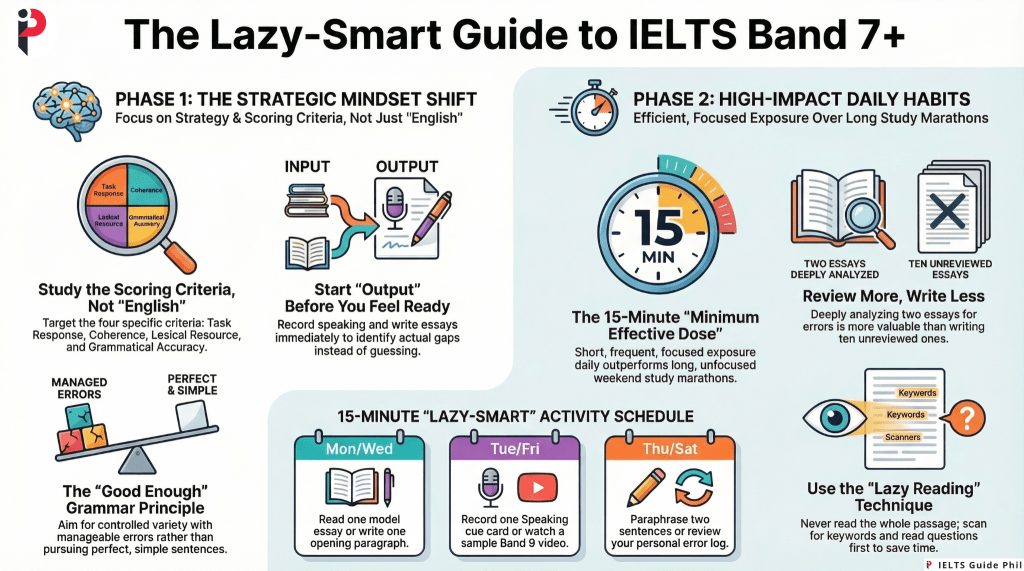
Strategy 1: Forget “Studying English.” Study the IELTS Scoring Criteria Instead.
Most candidates waste months improving their general English when they should be improving their IELTS-specific performance.
The four Writing and Speaking criteria — Task Achievement/Response, Coherence and Cohesion, Lexical Resource, and Grammatical Range and Accuracy — are your actual targets. Each one tells you exactly what the examiner is looking for.
Do this instead of random grammar review: Read the Band 7 descriptor for each criterion. Ask yourself: “What does my output look like compared to this?” That one reading session will redirect your entire preparation more effectively than two weeks of unfocused study.
✅ DO: Download the IELTS Writing and Speaking Band Descriptors from the official IELTS website and read them once — carefully.
❌ DON’T: Study grammar topics at random hoping they will “come in handy.”
Strategy 2: Use Your Existing English — Don’t Wait Until It’s “Good Enough”
One of the most common Filipino IELTS mistakes is waiting to feel ready before starting practice. This is the academic version of waiting for perfect weather before going outside.
The uncomfortable truth: Your English is already better than you think. You read English content daily. You watch English media. You process English at work or at school. What you lack is exam-specific deployment of that English.
Start writing Task 2 essays now — even bad ones. Start recording yourself speaking — even awkward recordings. Output is how you find your actual gaps. Without output, you are just guessing what you need to fix.
✅ DO: Write one Task 2 essay this week. It does not have to be good. It has to exist.
❌ DON’T: Say “I’ll start practicing when my vocabulary is stronger.” That day will never come if you are not practicing.
Strategy 3: The 15-Minute Daily Habit (The Real Minimum Effective Dose)
You do not need two-hour study sessions. Research in language acquisition consistently shows that short, frequent, focused exposure beats long, occasional, unfocused study.
Fifteen minutes daily for 60 days outperforms three-hour weekend marathons. Here is how to spend those 15 minutes:
| Day Type | 15-Minute Activity |
|---|---|
| Monday | Read one IELTS Task 2 model answer and note 5 phrases |
| Tuesday | Record yourself answering one Part 2 Speaking cue card |
| Wednesday | Write one Task 1 or Task 2 opening paragraph |
| Thursday | Read one article and paraphrase two sentences in writing |
| Friday | Watch one IELTS Speaking Band 7–9 sample video |
| Saturday | Review your week’s errors — just 3 to 5 of them |
| Sunday | Rest or bonus session if you feel like it |
This is not a massive commitment. This is 15 minutes — shorter than one TikTok scroll session.
✅ DO: Set a consistent time each day (after coffee, before lunch, after dinner — whatever works).
❌ DON’T: Try to catch up with a 3-hour Sunday session after skipping all week. Massed practice does not build fluency.
Strategy 4: Stop Memorising Vocabulary Lists. Do This Instead.
Vocabulary lists are the IELTS equivalent of crash diets — they feel productive, they rarely work long-term, and they are deeply boring.
The human brain does not store vocabulary as isolated words. It stores vocabulary in contexts, collocations, and patterns. You remember “heavy traffic” not because you memorised “heavy” and “traffic” separately, but because you have seen and heard that phrase together many times.
The lazy-smart vocabulary habit:
When you encounter a new word or phrase in something you are already reading or watching, pause and notice three things:
- What word comes before it? What word comes after it?
- Is it formal, neutral, or informal?
- Can I use it in an IELTS Writing or Speaking context?
That three-second reflection plants the word in context — which is how it becomes usable on exam day.
✅ DO: Collect phrases and collocations, not isolated words. “A significant rise in” is more useful than just “significant.”
❌ DON’T: Memorise 30 words from a list the night before. You will use none of them naturally under exam pressure.
Strategy 5: The “Lazy Reading” Technique for IELTS Academic
IELTS Reading — especially Academic — looks terrifying until you understand something crucial: you are not being tested on reading the whole passage. You are being tested on locating specific information efficiently.
This means skimming and scanning are not shortcuts — they are the correct approach.
The lazy-smart reading method:
- Read the questions first (all of them for a passage section).
- Identify the keywords in each question.
- Skim the passage for structure (headings, first sentences of paragraphs).
- Scan for your keywords.
- Answer, then move.
Never read an IELTS passage the way you read a novel. That approach will run out your time and reward you with nothing extra.
✅ DO: Practise skimming by reading only the first sentence of each paragraph and predicting the passage’s content. You will be right 80% of the time.
❌ DON’T: Read every word of the passage before looking at the questions. This is the single biggest time-wasting mistake in IELTS Reading.
Strategy 6: Speak English to Yourself (Yes, Really)
Filipino learners often plateau in Speaking because they only practise English when they have an audience — and the embarrassment filter kicks in. The solution is brutally simple: talk to yourself in English.
This is called self-directed speaking or internal monologue practice, and it is one of the most underused techniques in language learning. While cooking, commuting, or folding laundry, narrate what you are doing in English. Argue with yourself about a news story. Describe the room you are in.
This builds two critical IELTS Speaking skills simultaneously:
- Fluency — you stop searching for words because you have rehearsed the mental pathways
- Vocabulary activation — passive vocabulary you “know but never use” becomes active
✅ DO: Give yourself a Speaking Part 2 topic right now. Set a timer for two minutes. Talk. Record it if you can.
❌ DON’T: Save all Speaking practice for formal sessions. Informal, daily self-talk builds fluency faster than once-a-week lessons.
Strategy 7: Learn the IELTS Listening “Architecture”
IELTS Listening has a consistent structure that almost nobody takes advantage of. Each section follows predictable patterns:
- Section 1: Two speakers, transactional (booking, enquiry) — high accuracy expected
- Section 2: One speaker, informational monologue — listen for sequence and categories
- Section 3: Two or more speakers, academic discussion — opinions matter
- Section 4: One speaker, academic lecture — dense, technical, most difficult
When you know this architecture, you can predict the kind of information you need before the audio begins. This is the closest thing to a cheat code in IELTS Listening.
The pre-listening habit (30 seconds before each section): Read all visible questions. Predict whether the answer is a number, a name, a category, or an opinion. You will catch answers faster because your brain is primed.
✅ DO: Use every pause and transition moment in Listening to look ahead at the next set of questions.
❌ DON’T: Write while the audio is still running if you missed an answer. Leave a blank and move forward. Chasing one missed answer causes you to miss the next three.
Strategy 8: Write Fewer Essays. Review Them More.
The most common “hardworking but ineffective” IELTS Writing mistake is writing essay after essay without ever analysing what went wrong.
Ten poorly reviewed essays are worth less than two deeply reviewed ones.
The lazy-smart Writing review process: After writing any essay, do these three things:
- Read it aloud. Awkward sentences reveal themselves when spoken.
- Count your grammar structures. If every sentence is Subject-Verb-Object, your GRA score will suffer.
- Check your Task Achievement. Did you answer the exact question asked — or a slightly different version of it?
That review process takes 10 minutes. It will teach you more than writing another unreviewed essay.
✅ DO: Keep an error log. Write down your three most repeated mistakes. Every new essay, check only for those three things first.
❌ DON’T: Submit essays to online feedback groups and ignore the feedback. Feedback is only valuable if you act on it.
Strategy 9: Use the “Good Enough” Grammar Principle
Here is a liberating fact: IELTS Writing Band 7 does not require perfect grammar. The Band 7 GRA descriptor says “uses a variety of complex structures” with “some errors” but these “rarely reduce communication.”
This means your goal is not zero errors. Your goal is controlled variety with manageable errors.
Stop trying to write perfectly. Start trying to write interestingly. Use a conditional. Attempt a relative clause. Try a passive construction. Even if one of them is slightly imperfect, the variety itself moves your score upward.
The Filipino tendency to write only simple, safe sentences to avoid mistakes actually lowers the GRA score because it demonstrates limited range.
✅ DO: For every five sentences you write, deliberately include at least one complex or compound-complex sentence.
❌ DON’T: Write only simple sentences because you are afraid of making errors. Safe, simple writing signals a lower band — not a higher one.
Strategy 10: Take One Full Mock Test — But Take It Seriously
Many candidates have never sat a timed, full-length IELTS practice test under exam conditions. They have done sections here and there, but never the full four-hour experience.
You only need to do this once before your actual exam. But that one time teaches you things no amount of sectional practice can:
- How your energy and focus shift across four hours
- Whether you run out of time in Writing (most people do)
- How your Speaking performance changes when you are already mentally tired
- What your actual score range is likely to be
After the mock test, score yourself honestly. Now you know exactly where to spend your final week.
✅ DO: Take your mock test in a quiet room, without pausing, exactly as you would in the test centre.
❌ DON’T: Do “practice tests” in segments across three days. That is not a practice test — that is section review. It does not replicate exam conditions.
Section 3: The Common Mistakes “Lazy” Learners Make (And How to Fix Them)
Mistake 1: Collecting Resources Instead of Using Them
What it looks like: Downloading six apps, bookmarking 20 YouTube channels, buying two review books — and using none of them consistently.
The fix: Choose ONE resource per skill. One book for Writing. One YouTube channel for Speaking. One podcast for Listening. One reading source for Reading. Depth over breadth.
Mistake 2: Studying What You Like Instead of What You Need
What it looks like: Spending 80% of study time on Listening (your strongest skill) because it feels comfortable, while ignoring Writing (your weakest).
The fix: After your mock test, rank your four skills. The bottom two get 70% of your remaining study time.
Mistake 3: Mistaking Passive Consumption for Active Learning
What it looks like: Watching IELTS tutorials on YouTube for two hours and feeling like you studied.
The fix: For every tutorial you watch, produce one output. Watched a Task 2 tutorial? Write a paragraph. Watched a Speaking Part 2 tutorial? Record yourself answering a cue card. Consumption without production does not build exam performance.
Mistake 4: Ignoring the Word Count in Writing
What it looks like: Submitting a 220-word Task 2 essay or a 130-word Task 1.
The fix: 150 words for Task 1. 250 words for Task 2. These are minimums, not targets. Under the minimum, you receive an automatic Task Achievement penalty regardless of quality. This is the easiest band score you will ever lose.
Mistake 5: Translating From Filipino When Speaking
What it looks like: Mentally forming a sentence in Filipino, then translating it into English, which causes hesitation, unnatural phrasing, and Filipinisms.
The fix: Think in English chunks, not Filipino sentences. Practise starting sentences with English frames: “What I find interesting about this is…”, “The way I see it…”, “One thing that surprised me was…” These frames bypass the translation step.
Mistake 6: Not Knowing the Test Format
What it looks like: Arriving on exam day unsure whether Task 1 Academic is a graph or a letter, or not knowing how many sections are in Listening.
The fix: Spend exactly one hour reading the official test format guide. This is not studying English — it is learning the rules of the game you are about to play. Never skip this step.
Section 4: Frequently Asked Questions
Q1: How long do I really need to prepare for IELTS if I’m a Band 6 right now?
A: For most Filipino candidates at Band 6 targeting Band 7, a focused 6 to 8 weeks is realistic — if you are consistent and strategic. Two months of 15 to 30 minutes daily will outperform two months of occasional 3-hour sessions. If you are targeting Band 7.5 or higher, allow 10 to 12 weeks.
Q2: Can I pass IELTS without a review center?
A: Absolutely. Review centres are useful for structure and accountability, not for content that you cannot access elsewhere. Everything a review centre teaches is available through official IELTS materials, Cambridge practice books, and high-quality YouTube channels. What you cannot replicate easily is the feedback loop — so if you are self-studying, find a way to get your writing and speaking assessed, even informally.
Q3: Is it okay to use Filipino examples in IELTS Writing and Speaking?
A: Yes — and this is actually an advantage, not a limitation. IELTS examiners are trained to assess English communication, not global cultural knowledge. A well-expressed, culturally specific example from the Philippines is perfectly acceptable and often more vivid and memorable than generic examples. The key is that the English is clear and the reasoning is logical.
Q4: What if I freeze during the Speaking test?
A: Freezing is almost always caused by two things: unexpected questions and lack of a recovery phrase. Prepare your recovery language now: “That’s an interesting question — let me think about that for a moment,” or “I’m not sure I’ve thought about this before, but I’d say…” These are not stalling tactics. Examiners know and accept thinking time. What hurts you is silence or the word “uh” repeated eight times in a row.
Q5: Should I use “big” vocabulary words to impress the examiner?
A: Only if you can use them accurately and naturally. Misused sophisticated vocabulary drops your Lexical Resource score faster than simple but correct vocabulary raises it. The examiner is not impressed by a word you clearly looked up the night before and deployed incorrectly. Use precise, contextually accurate words — they do not all have to be rare.
Q6: I keep failing IELTS. Is it hopeless?
A: No. Repeated IELTS attempts with no score improvement usually signal one of three things: you are making the same errors each time (error log needed), you are not targeting the right skills (band analysis needed), or your English level genuinely needs more foundation work before IELTS-specific preparation is useful. None of these are permanent. All of them are solvable.
Q7: What is the biggest mistake Filipino IELTS candidates make?
A: Being over-polite and over-formal in Speaking. Filipino culture values deference and indirectness, which translates in IELTS Speaking into vague, hedged, under-developed answers. The examiner wants to hear you commit to ideas, develop them, and defend them. Confidence in communication — not arrogance, but directness — is what Band 7 Speaking looks like.
Section 5: The Lazy Learner’s Final Week Checklist
In your final seven days before the exam, do not introduce anything new. Consolidate what you know.
- [ ] Review your personal error log — your three to five most repeated mistakes
- [ ] Do one complete Writing Task 1 and one Task 2 under timed conditions
- [ ] Record yourself answering five Speaking Part 2 topics you have not practised before
- [ ] Do one complete Listening section per day under exam conditions
- [ ] Read two IELTS Reading passages timed at 20 minutes each
- [ ] Sleep. Eat properly. Your cognitive performance on exam day depends on this more than any last-minute cramming.
Closing: Lazy Is Just Another Word for Efficient — If You Use It Right
The candidates who score Band 7 and above are not always the ones who studied the most. They are the ones who studied the right things in the right way — and then showed up to the exam knowing exactly what to do.
You do not need to become a different person to pass IELTS. You need to become a more strategic one.
Start with one thing from this list. Just one. Do it today — not bukas.
Did this help? Share it with someone who keeps saying they’ll “start studying next week.” They need this more than anyone.
#IELTS #IELTSTips #IELTSPhilippines #IELTSPreparation #IELTSBand7 #IELTSWriting #IELTSSpeaking #IELTSReading #IELTSListening #IELTSGuidePhil #IELTSCoach #IELTSFilipino #LearnEnglish #EnglishPractice #IELTSStudy #StudySmart #IELTSSuccess #IELTSStrategies #FilipinoCandidates #IELTSMotivation
 IELTS Guide Phil
Leave a comment