
How Filipinos Can Use Concession-Refutation in Part 3 to Unlock Band 7, 8, and 9 Scores
Most Filipino IELTS candidates walk into Part 3 of the Speaking test with the same strategy: answer the question, give a reason, maybe add an example, and stop. It is a safe strategy. It is also a Band 6 strategy.
What separates Band 7 and above in IELTS Speaking is not perfect grammar. It is not a flawless British accent. It is not even an impressively large vocabulary, though all of these help. What truly distinguishes upper-band speakers is something far more accessible than most candidates realise: the ability to think critically out loud — to acknowledge complexity, push back against a position, and arrive at a considered conclusion with confidence and fluency.
The concession-refutation technique does exactly that — and in Part 3, it is one of the most powerful tools you can deploy.
This post breaks down how to use it, why it works, what it sounds like in natural spoken English, and what Filipino candidates specifically need to watch out for.
What Is Part 3 — And Why Does It Demand a Different Strategy?
Part 3 of the IELTS Speaking test is the examiner-led discussion phase. It lasts four to five minutes and follows directly from your Part 2 long turn. The examiner moves away from your personal experience and asks you abstract, opinion-based, society-level questions connected — loosely or directly — to the topic you spoke about in Part 2.
These are not simple questions. They are designed to push you beyond description and into analysis, evaluation, and argumentation.
You might be asked:
- Do you think governments should invest more in public transport?
- Some people argue that social media has done more harm than good. Would you agree?
- Is it more important for young people to gain work experience or to pursue higher education?
- Do you think traditional values are still relevant in modern society?
Notice what these questions have in common. They are not asking you to describe something. They are asking you to take a position on something complex — something with legitimate arguments on both sides.
This is precisely where the concession-refutation technique becomes not just useful, but essential.
Why the Concession-Refutation Technique Works So Well in Speaking
In Writing Task 2, the concession-refutation technique earns you marks under Task Response and Coherence and Cohesion. In Speaking, the same underlying move earns you marks under all four band descriptors — in ways that feel completely natural in spoken English.
Here is what happens to your score when you use this technique correctly:
Fluency and Coherence: Your answer has a clear internal logic — you acknowledge, you challenge, you conclude. The examiner can follow your thinking without effort. You are not rambling or repeating yourself. You are moving through a structured line of argument, which is exactly what coherence means in spoken discourse.
Lexical Resource: Concession-refutation language — admittedly, that said, having said that, even so, on reflection, while I understand why people feel that way — is sophisticated, naturally occurring vocabulary that appears rarely in Band 5–6 responses. Using it signals genuine lexical range.
Grammatical Range and Accuracy: This technique naturally generates complex sentence structures — concessive clauses (although, even though, while), conditional reasoning (if that were true, then…), and contrast structures (whereas, despite the fact that). These are the grammatical features examiners are listening for at Band 7 and above.
Pronunciation: Longer, more structured responses give you more opportunity to demonstrate your natural spoken rhythm, stress, and intonation. Short, clipped answers hide your pronunciation profile. Developed answers reveal it — and reward it, if your delivery is confident.
What the Technique Looks Like in Speaking
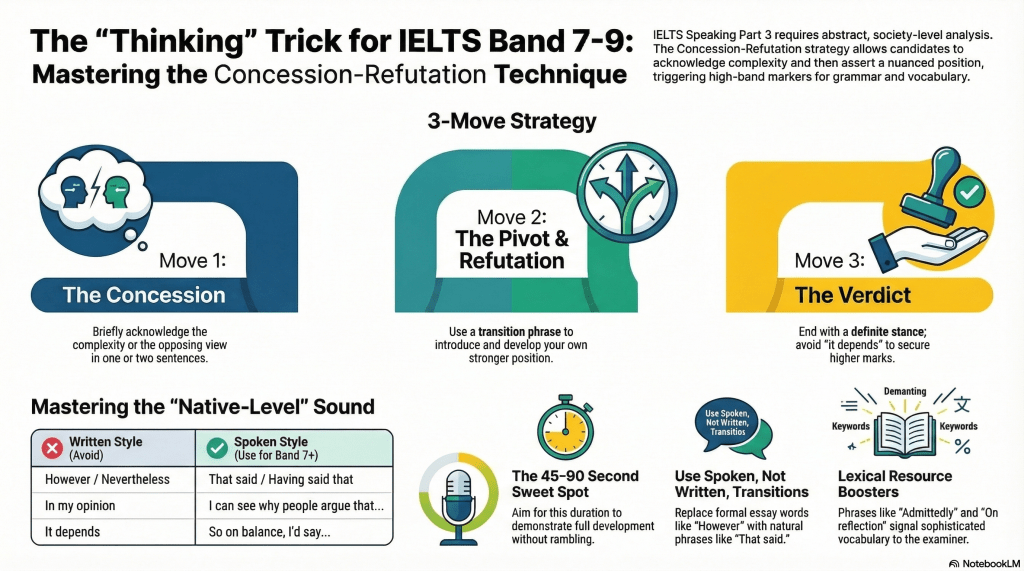
In Writing, the concession-refutation technique spans two full paragraphs. In Speaking, it lives inside a single extended answer — typically structured across three moves:
Move 1 — Concession: You acknowledge the opposing view or the complexity of the issue.
Move 2 — Refutation: You pivot and argue your own position, explaining why it is stronger.
Move 3 — Conclusion: You land on a clear personal stance, often with a brief qualification or nuance.
The whole answer might run between 45 seconds and 90 seconds — which is the sweet spot for a well-developed Part 3 response. It is long enough to demonstrate fluency and depth. It is short enough to stay focused and avoid rambling.
The Spoken Concession-Refutation Template
Here is the core template you need to memorise and practise until it feels natural:
Concession opener: I can see why people would argue that… / Admittedly, there is something to the idea that… / It’s true that… / I understand why many people feel that…
Briefly develop the conceded point: …and I think [give the strongest version of the opposing view in one or two sentences].
Pivot / Refutation signal: That said… / Having said that… / But when I think about it more carefully… / Even so… / On reflection, though… / But I’d push back on that a little…
State and develop your own position: …I actually think [your view], because [your strongest reason]. [Add a brief example, consequence, or comparison if possible.]
Concluding stance (optional but powerful): So on balance, I’d say… / Ultimately, I think… / All things considered…
This template is not a rigid script. It is a flexible framework that sounds completely natural when delivered with confidence and good connected speech. The goal is to internalise the shape of the argument so that you can apply it to any Part 3 question without freezing.
Sample Answers — Concession-Refutation in Action
Sample 1
Examiner: Do you think social media has done more harm than good to society?
Without concession-refutation (Band 5–6 response):
I think social media is bad because people spend too much time on it. It causes addiction and mental health problems. Also, there is a lot of fake news on social media. So yes, I think it is more harmful.
With concession-refutation (Band 7–8 response):
I can see why a lot of people would say social media has been damaging — and I think there’s genuine truth to that, especially when you look at the research on how platforms are designed to maximise screen time at the expense of users’ mental wellbeing. That said, when I think about it more carefully, I’d actually argue that the problem isn’t social media itself but the way it’s regulated — or rather, the way it isn’t. At its best, social media has given ordinary people a voice, connected communities across borders, and accelerated social movements that probably wouldn’t have gained traction through traditional media alone. So on balance, I think the potential is genuinely positive — but realising that potential requires much stronger oversight than we currently have.
What makes this Band 7–8:
- Opens with a concession (I can see why… and I think there’s genuine truth to that)
- Develops the conceded side briefly but fairly
- Pivots with a natural spoken signal (That said, when I think about it more carefully)
- Introduces a reframe — not just a counter-point, but a more nuanced position (regulation, not the tool)
- Ends with a qualified conclusion (the potential is genuinely positive — but)
- Sounds like a thinking person speaking, not a rehearsed script
Sample 2
Examiner: Is it more important for children to learn through play or through formal instruction?
Without concession-refutation (Band 5–6 response):
I think play is more important for young children because they enjoy it more and they can learn naturally. Formal instruction can be boring. So play-based learning is better.
With concession-refutation (Band 7–8 response):
Admittedly, there’s a strong case for formal instruction — particularly when it comes to building foundational skills like literacy and numeracy, where structured repetition and explicit teaching tend to produce more consistent results than leaving things to chance through play. Having said that, I’d argue that for younger children especially, play is actually the more powerful learning mode, because it’s through play that children develop creativity, social intelligence, and the ability to navigate failure — qualities that are increasingly difficult to teach in a formal classroom setting. I think the mistake many education systems make is treating these two approaches as mutually exclusive, when the evidence suggests that blending them produces the best outcomes. So ultimately, I wouldn’t say one is more important — I’d say the balance matters more than the choice.
What makes this Band 7–8:
- Concedes the formal instruction argument specifically and fairly (particularly when it comes to…)
- Pivots cleanly (Having said that)
- Develops the preferred view with layered reasoning (creativity, social intelligence, navigating failure)
- Introduces an additional nuance (false dichotomy) that elevates the answer
- Ends with a confident, original conclusion
Sample 3
Examiner: Some people think that older generations have little to offer young people in today’s rapidly changing world. Do you agree?
Without concession-refutation (Band 5–6 response):
No, I don’t agree. Older people have a lot of experience and wisdom. Young people should respect them and learn from them. They know many things that are useful.
With concession-refutation (Band 7–8 response):
I understand the argument — in sectors like technology, finance, and media, the pace of change has been so rapid that experience from even ten years ago can feel outdated. And I think younger people are right to be sceptical of advice that doesn’t account for how fundamentally different the current landscape is. Even so, I think writing off older generations entirely is a significant mistake. The kind of wisdom that comes from navigating long-term relationships, economic downturns, career setbacks — that doesn’t expire. If anything, I’d argue that young people today, who are dealing with enormous uncertainty and instability, need that kind of perspective more than any previous generation. So I’d push back quite firmly on the idea. The question isn’t whether older people have something to offer — it’s whether we’ve created environments where that knowledge can actually be shared across generations.
What makes this Band 7–8:
- Engages seriously with the opposing position rather than dismissing it (in sectors like technology, finance…)
- Concedes a specific, credible version of the opposing view
- Pivots with Even so — natural spoken English
- Develops the refutation with specific, concrete examples (long-term relationships, economic downturns, career setbacks)
- Ends with a reframe that is both intellectually sophisticated and conversationally natural
The Spoken Phrase Bank
Memorise these. Use them until they feel as natural as Tagalog.
Concession Openers
- I can see why people would argue that…
- Admittedly, there’s something to the idea that…
- It’s true that…
- I understand why a lot of people feel that…
- There’s definitely a case to be made for…
- I think [opposing view] has some merit — particularly when you consider…
- That’s a fair point, actually, because…
- I won’t deny that…
- To be fair to that argument,…
Pivot / Refutation Signals
- That said,…
- Having said that,…
- Even so,…
- On reflection, though,…
- But when I think about it more carefully,…
- I’d push back on that a little, though, because…
- But I think the stronger argument is…
- Where I’d disagree is…
- The part of that argument I find less convincing is…
- What that view doesn’t fully account for, though, is…
Concluding / Verdict Phrases
- So on balance, I’d say…
- Ultimately, I think…
- All things considered,…
- My overall feeling is that…
- So I’d come down on the side of…
- When I weigh it all up,…
- I think the bottom line is…
Dos and Don’ts for Speaking
✅ DOS
Do let the concession sound genuine. The examiner is not looking for a debate performance — they are listening for natural, engaged thinking. When you say “I can see why people would argue that,” it should sound like you actually considered the opposing view. Practise delivering the concession with a natural rise in intonation, as if you are genuinely acknowledging a fair point.
Do keep the concession brief. In Writing, you develop your concession across a full paragraph. In Speaking, the concession is one to three sentences — enough to show you’ve considered the other side, but not so long that it takes over your answer. If you spend more than 20 seconds on the concession, you are at risk of losing your pivot.
Do use natural spoken pivots — not written ones. In Writing you write However and Nevertheless. In speaking, these sound formal and rehearsed. The natural spoken equivalents are That said, Having said that, Even so, But when I think about it, I’d push back on that a little. These sound like a real person thinking — which is exactly what the examiner wants to hear.
Do land on a clear personal position. Part 3 questions are asking for your opinion. After your concession and refutation, you must arrive somewhere definite. “It’s really hard to say” is not a conclusion — it is a Band 5 escape hatch. Even if the issue is genuinely complex, you must commit to a position, even a qualified one: “On balance, I’d say X — though I recognise it’s not a simple issue.”
Do practise with a timer. A well-developed concession-refutation answer in Part 3 runs between 45 and 90 seconds. Shorter than that and you are not demonstrating enough development. Longer than that and you risk losing coherence or rambling. Time yourself regularly during practice.
Do connect your answer back to the question. Filipino candidates often drift during extended answers. The concession-refutation structure actually helps prevent this because it is argument-shaped — but make sure your concluding statement directly addresses what the examiner asked. If they asked “Do you think X?”, your conclusion should leave them with a clear answer to that specific question.
❌ DON’TS
Don’t open with “In my opinion” every single time. “In my opinion,” at the start of every Part 3 answer is a Band 5–6 pattern. It signals a simple opinion-statement is coming — not an analytical response. Replace it with a concession opener that shows you are thinking, not just stating.
Don’t use written English pivots in spoken answers. Avoid starting your refutation with “However,” spoken as a standalone word at the start of a sentence, in the stiff, formal way it appears in essays. It sounds rehearsed and unnatural. Use “That said,” or “Having said that,” — these are conversational, fluent, and naturally occurring in real English discussion.
Don’t over-rehearse to the point of sounding scripted. The concession-refutation technique must sound like thinking, not like a memorised template being recited. If the examiner senses you are reproducing a fixed script, it damages your Fluency and Coherence score. Practise the structure, not the exact words.
Don’t give a one-sided answer to a Part 3 question. Even if you have a strong personal opinion, a completely one-sided answer misses the complexity that Part 3 is designed to elicit. The concession-refutation technique is your tool for demonstrating that you can hold nuance — use it even when you feel certain about your position.
Don’t confuse concession with uncertainty. A concession is a rhetorical acknowledgment of the opposing view’s merits. It is a sign of intellectual confidence, not hesitation. You are not saying “I don’t know.” You are saying “I understand that view — and here is why mine is stronger.” Deliver your concession with the same confidence as your refutation.
Don’t forget to breathe and pace yourself. Extended answers require breath control and natural pausing. Filipino candidates under pressure often speed up as their answer develops. Slow down after your pivot phrase — the refutation is the most important part of your answer, and rushing through it undermines the very argument you built it to deliver.
Common Mistakes and How to Fix Them
Mistake 1: The Short, Flat Answer
What it sounds like:
I think social media is harmful. It causes mental health problems and spreads fake news. So it is bad for society.
The problem: This is a statement, not a discussion. It demonstrates no critical thinking, no awareness of complexity, and no engagement with the question’s implicit tension. Part 3 is designed to push you beyond this — and staying here signals Band 5 or below.
The fix: Before answering, identify the opposing view. Build in a concession. Then argue your own position with at least two connected reasons. Always end with a verdict.
Mistake 2: The Endless Concession
What it sounds like:
I can see why people think social media is harmful. There is a lot of evidence for this. Many studies show it damages mental health. Also, fake news is a serious problem. Politicians also misuse it. So yes, I think these are all very valid points and they are very serious concerns…
The problem: The candidate never pivots. They have been conceding for 45 seconds and never made it to their own argument. The examiner is waiting for the refutation that never comes.
The fix: Limit your concession to two or three sentences maximum. As soon as you say the concession opener and develop it briefly, hit the pivot phrase. The concession is the setup — your refutation is the payoff.
Mistake 3: Pivoting Without Refuting
What it sounds like:
I understand why people say social media is harmful. That said, I think it also has a lot of benefits. It helps people communicate. It also helps small businesses.
The problem: The candidate pivoted but did not refute. They simply listed benefits without challenging the logic of the concession. This sounds like a list, not an argument.
The fix: After your pivot, directly engage with what you just conceded. If you acknowledged that social media damages mental health, your refutation should explain why that concern is overstated, conditional, or solvable — not just pivot to a different topic entirely.
Mistake 4: Hedging Instead of Concluding
What it sounds like:
…so I think both sides have valid points and it really depends on the person and the situation. There is no simple answer to this question.
The problem: This is not a conclusion — it is a retreat. The examiner asked for your opinion. Answering with “it depends” and nothing more is a failure to complete the communicative task. It also suggests limited critical thinking.
The fix: You can acknowledge complexity while still committing to a position: “So while it genuinely depends on how these platforms are regulated, I’d ultimately come down on the side of cautious optimism — the potential is there, but we need stronger safeguards.” That is a conclusion. “It depends” alone is not.
Mistake 5: Tagalog-Influenced Pivot Structures
What it sounds like:
But even though that, I am still believing that… Even if that is true, but I think that… Yes I agree with that opinion however but my opinion is…
The problem: These are direct L1 transfer patterns from Filipino/Tagalog discourse structure, particularly the “kahit ganyan, pero…” construction. They produce grammatically inaccurate, lexically weak pivots that hurt both GRA and Lexical Resource.
The fix: Replace with: That said, I’d argue that… / Having said that, I actually think… / Even so, the stronger point for me is… — practise these until they replace the Tagalog-influenced pattern automatically.
Mistake 6: Memorising Full Answers
What it sounds like:
[Perfectly fluent for 30 seconds, then suddenly stilted and hesitant as the memorised portion runs out]
The problem: Examiners are trained to detect rehearsed answers. A sudden drop in fluency and naturalness halfway through an answer is a clear signal of memorisation. It damages your Fluency and Coherence score even if the content is good.
The fix: Memorise the structure and the phrase bank, not the content. Practise applying the concession-refutation framework to five to ten new questions every day. The goal is structural fluency — not content recall.
How to Practise This Technique Before Your Test
Step 1: Build a question bank. Collect 30 to 50 Part 3 questions across common topics — technology, education, environment, work, family, culture, government, globalisation. These are the domains IELTS draws from consistently.
Step 2: Identify the opposing view for each question. Before you answer any question, spend five seconds identifying: what is the strongest argument on the other side? That becomes your BP1 concession.
Step 3: Answer aloud — not in writing. Speaking is a spoken skill. Writing out answers and reading them does not build the fluency the examiner is measuring. Speak your answers into a voice recorder, a mirror, or to a study partner.
Step 4: Record and review. Listen back for: Did you concede? Did you pivot with a natural spoken phrase? Did you refute — not just present a second side? Did you land on a clear conclusion? If any of these are missing, the structure broke down.
Step 5: Time your answers. Aim for 45 to 90 seconds. If you finish in under 30 seconds, you did not develop the argument. If you go over 90 seconds, you are likely rambling past the point of coherence.
Step 6: Vary your vocabulary. Do not use the same concession opener and pivot phrase in every answer. Rotate through the phrase bank deliberately. Variety in cohesive devices is a Lexical Resource indicator.
Frequently Asked Questions
Q1: Should I use the concession-refutation technique for every Part 3 question?
For most opinion-based Part 3 questions — yes. It is the most reliable structure for demonstrating Band 7+ critical thinking. The only exceptions are questions asking you to compare, predict, or explain rather than evaluate: “How has X changed over time?” or “What do you think will happen to X in the future?” For purely comparative or predictive questions, a simpler structure is fine. For evaluative questions — “Do you think X is good/bad/better/more important?” — always deploy the concession-refutation technique.
Q2: Will the examiner know I’m using a technique? Does that hurt my score?
No — and this is an important point. Examiners are assessing your language, not your rhetorical strategy. A well-deployed concession-refutation sounds like a thoughtful, articulate person engaging with a complex question. That is exactly what they want to hear. The technique only sounds mechanical if you over-rehearse the exact words rather than internalising the structure.
Q3: What if I genuinely don’t have a strong opinion on the topic?
Choose a position anyway — and argue for the side you can develop most convincingly. Part 3 is not a values survey. It is a speaking test. Pick the position that gives you the most to say, commit to it, and deploy your concession-refutation structure around it. You will not be penalised for holding an unusual opinion. You will be rewarded for arguing it clearly.
Q4: How is this different from what I do in Part 2?
Part 2 is a personal narrative — you are describing your own experience, memory, or opinion about something specific. The concession-refutation technique is not appropriate for Part 2 because you are not being asked to analyse competing positions. Part 3 shifts to societal, abstract questions where analysis is explicitly expected. This is where the technique lives.
Q5: Can I use Filipino examples to support my refutation in Part 3?
Absolutely — and this is actually an underused advantage for Filipino candidates. Examples drawn from Philippine society, culture, education, government, or everyday life are completely valid and often more naturally delivered than invented international examples. If the examiner asks about public transport investment and you reference EDSA traffic or the MRT, that is a legitimate and effective example. Use what you know.
Q6: What if the examiner asks a follow-up question while I’m mid-structure?
Stop, answer the follow-up, and use the concession-refutation structure on that new question. Do not try to return to your original answer. The examiner’s follow-up is the new question — and it is an opportunity to demonstrate the same analytical depth on a slightly different angle of the same topic.
Q7: Is Band 9 possible for a Filipino candidate who uses this technique?
Yes — Band 9 Speaking does not require a native-sounding accent, and it does not require perfect grammar in every sentence. It requires fluent, coherent, natural English with wide lexical range and a flexible grammatical system. The concession-refutation technique, delivered naturally with a variety of vocabulary, complex sentence structures, and confident delivery, produces exactly the kind of spoken discourse that Band 8–9 descriptors describe. The accent is irrelevant. The thinking is everything.
Quick Reference Summary
- Part 3 rewards critical thinking out loud. The concession-refutation technique is how you demonstrate that thinking in spoken English.
- The structure is: Concede (1–3 sentences) → Pivot → Refute and develop (3–5 sentences) → Conclude (1 sentence).
- Use spoken pivots — That said, Having said that, Even so, On reflection — not written ones like However or Nevertheless standing alone.
- Keep the concession brief. It is the setup, not the answer.
- Always land on a clear personal verdict. “It depends” alone is not a conclusion.
- Practise the structure, not the script. Fluency comes from structural automaticity, not memorised content.
- Use Filipino examples freely. They are authentic, naturally delivered, and completely valid.
- Record yourself. You cannot improve what you cannot hear.
The examiner in Part 3 is not waiting for the right answer. They are waiting for the right kind of thinking — and this technique is how you show them you are capable of it.
Written for Filipino IELTS candidates aiming for Band 7–9 | IELTS Guide Phil
#IELTSGuidePhil #IELTSSpeaking #IELTSSpeakingPart3 #IELTSTips #IELTSPhilippines #IELTSBand7 #IELTSBand8 #IELTSBand9 #IELTSSpeakingTips #ConcessionRefutation #IELTSFluency #IELTSCoherence #IELTSLexicalResource #IELTSGrammar #IELTSGuidePhil #IELTSReview #IELTSPractice #LearnEnglish #EnglishSpeaking #EnglishForFilipinos #IELTSCoach #PublicSpeaking #CriticalThinking
 IELTS Guide Phil
Leave a comment