
If you have ever written a sentence like “Many governments around the world have introduced various policies to address this growing problem” — and felt quietly proud of it — this post is going to change how you write IELTS essays forever.
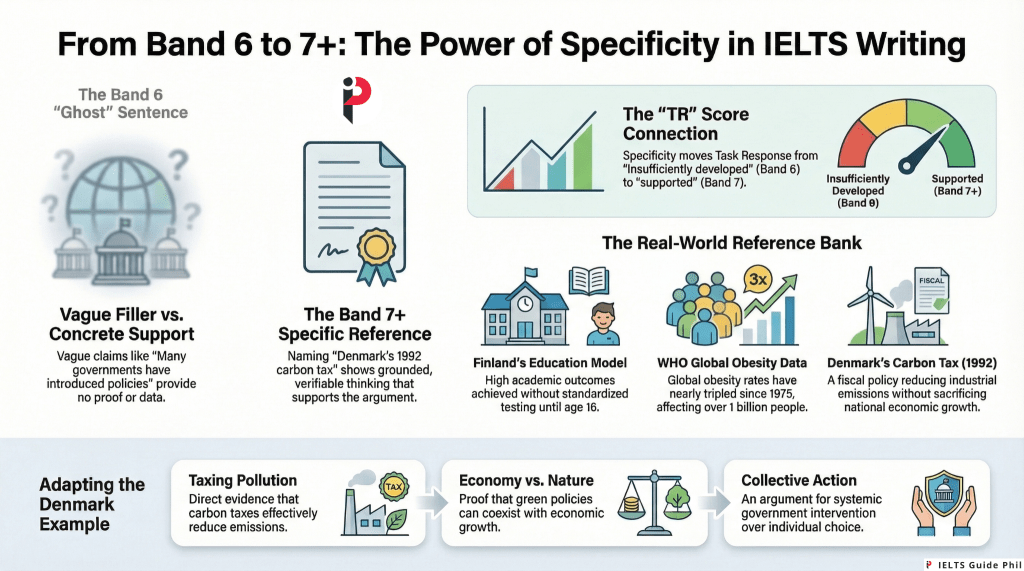
That sentence is a ghost. It looks like an example. It sounds like support. But it gives the examiner absolutely nothing to hold onto. No country. No policy. No data. No proof that you actually understand the issue you are writing about.
And it is costing you marks.
This post breaks down exactly why vague, generic examples are a Band 6 ceiling — and gives you a ready-to-use Real-World Reference Bank of 10–15 specific examples you can adapt across dozens of IELTS Task 2 topics to push your Task Response score toward Band 7, 8, and beyond.
Why Your Examples Are Holding You Back
Before we get to the bank, you need to understand what is actually happening when an examiner reads a generic example.
What Band 6 Looks Like in Practice
“For instance, many governments have introduced policies to reduce environmental pollution. This has had a positive effect on the environment.”
There is no lie here. But there is no truth either. Nothing in that sentence could be challenged, verified, or traced. It is filler dressed up as evidence.
What Band 7+ Looks Like in Practice
“Denmark’s carbon tax, introduced in 1992, is widely regarded as one of the most effective national-level climate interventions, having reduced industrial emissions significantly without collapsing economic growth.”
Now the examiner sees something. A country. A policy. A year. A measured outcome. You have demonstrated that your idea is not just an opinion — it is grounded in the real world.
The TR Score Connection: Why Specificity Is Not Optional
Task Response (TR) is one of the four IELTS Writing Band Descriptors. At Band 6, the descriptor reads: “relevant main ideas but they may be insufficiently developed.” At Band 7, it shifts to: “main ideas are extended and supported.”
That word — supported — is the gap.
Specific, real-world examples are the mechanism through which you extend and support your ideas. The examiner is not looking for a history lecture or a research paper. They are looking for evidence that your thinking is grounded, not floating in the abstract.
The good news: you do not need to memorise academic citations. You need a bank of 10–15 real-world reference points that you can adapt flexibly across multiple essay topics. Think of it less like a library and more like a toolkit.
The Real-World Reference Bank: 15 Examples You Can Use Across Multiple Topics
Each entry below includes the core fact, the essay topics it fits, and a sample sentence showing how to drop it in naturally.
🌍 Environment & Climate
1. Denmark’s Carbon Tax (1992)
- The Fact: Denmark introduced one of the world’s first national carbon taxes in 1992, pricing greenhouse gas emissions from industry and transport.
- Fits: Climate change, government policy, economic growth vs. environment, taxation
- Sample Sentence: “Denmark’s 1992 carbon tax demonstrates that governments can use fiscal policy to reduce emissions without sacrificing economic stability.”
2. The Philippines Plastic Bag Ban
- The Fact: Several Philippine cities, including Muntinlupa and Malabon, have implemented local plastic bag bans, with national legislation also being debated.
- Fits: Pollution, government regulation, individual vs. collective responsibility, consumerism
- Sample Sentence: “Local plastic bag bans in Philippine cities like Muntinlupa show that community-level policy can drive meaningful reductions in single-use plastic waste.”
3. Singapore’s Zero Waste Masterplan
- The Fact: Singapore launched its Zero Waste Masterplan in 2019, aiming to reduce waste sent to its only landfill by 30% by 2030.
- Fits: Urbanisation, sustainability, government planning, technology and environment
- Sample Sentence: “Singapore’s Zero Waste Masterplan illustrates how densely populated nations can treat sustainability as a national infrastructure priority.”
🏥 Health & Medicine
4. WHO Obesity Data
- The Fact: According to the World Health Organization, global obesity rates have nearly tripled since 1975, with over 1 billion people now classified as obese.
- Fits: Lifestyle diseases, fast food, government health campaigns, diet and exercise, media influence
- Sample Sentence: “WHO data showing that obesity has tripled globally since 1975 underscores the urgency of public health intervention beyond individual lifestyle choices.”
5. Finland’s Mental Health in Schools Programme
- The Fact: Finland integrates mental health literacy into its national school curriculum, with trained counsellors in every public school.
- Fits: Education, youth wellbeing, government responsibility, work-life balance
- Sample Sentence: “Finland’s school-based mental health programme suggests that embedding psychological education in curricula can reduce stigma and improve early intervention.”
6. The Philippines’ Universal Health Care Act (2019)
- The Fact: Republic Act 11223 mandated universal health care coverage for all Filipino citizens, automatically enrolling them in PhilHealth.
- Fits: Healthcare access, government spending, inequality, rural vs. urban divide
- Sample Sentence: “The Philippines’ 2019 Universal Health Care Act reflects a growing consensus that health coverage should be a citizen’s right, not a market commodity.”
💻 Technology & Social Media
7. The Rise of AI in the Workplace
- The Fact: A 2023 Goldman Sachs report estimated that AI could automate up to 300 million jobs globally, while also creating new categories of employment.
- Fits: Technology, employment, education and skills, future of work, economic inequality
- Sample Sentence: “Goldman Sachs projections on AI-driven job displacement highlight why education systems must prioritise adaptability over fixed technical skills.”
8. The EU’s Digital Services Act (2022)
- The Fact: The European Union passed the Digital Services Act in 2022, holding large online platforms legally responsible for harmful content hosted on their sites.
- Fits: Social media regulation, free speech vs. safety, government and technology, children and the internet
- Sample Sentence: “The EU’s Digital Services Act represents a landmark attempt to hold social media corporations accountable for the real-world harm their platforms can facilitate.”
9. Screen Time and Children — Apple’s Parental Controls
- The Fact: Apple introduced Screen Time parental controls in iOS 12 (2018) following shareholder pressure from child advocacy groups concerned about smartphone addiction in minors.
- Fits: Technology and children, parenting, mental health, corporate responsibility
- Sample Sentence: “Apple’s introduction of Screen Time tools, driven by shareholder advocacy rather than legislation, raises questions about whether corporate self-regulation is sufficient to protect young users.”
🎓 Education
10. Finland’s Education Model
- The Fact: Finland consistently ranks among the world’s top education systems despite having no standardised testing until age 16, shorter school days, and heavily play-based early learning.
- Fits: Education systems, examinations, teaching methods, government investment, childhood development
- Sample Sentence: “Finland’s high academic outcomes despite minimal standardised testing challenge the widespread assumption that frequent examinations improve student performance.”
11. South Korea’s Private Tutoring Industry (Hagwon Culture)
- The Fact: South Korea’s private tutoring sector, known as hagwons, is a multi-billion dollar industry, with students sometimes studying until midnight to gain competitive advantage.
- Fits: Academic pressure, education inequality, parenting, work-life balance, competitive culture
- Sample Sentence: “South Korea’s hagwon culture, where children study beyond midnight for academic advantage, illustrates the psychological cost of hyper-competitive education systems.”
👥 Society, Inequality & Urbanisation
12. Norway’s Gender Quota in Boardrooms
- The Fact: Norway passed a law in 2003 requiring that at least 40% of corporate board members be women — the first country in the world to mandate gender balance at that level.
- Fits: Gender equality, women in the workplace, government legislation, corporate culture
- Sample Sentence: “Norway’s 2003 boardroom gender quota law demonstrates that legislative mandates, rather than voluntary commitments, may be necessary to achieve meaningful workplace equality.”
13. Bhutan’s Gross National Happiness Index
- The Fact: Bhutan measures national progress not by GDP but by a Gross National Happiness index, factoring in psychological wellbeing, cultural preservation, and environmental sustainability.
- Fits: Economic development, happiness and success, government priorities, materialism vs. wellbeing
- Sample Sentence: “Bhutan’s decision to measure progress through happiness rather than economic output invites a fundamental rethinking of what governments owe their citizens.”
14. Tokyo’s Urban Planning and Public Transport
- The Fact: Tokyo operates the world’s most punctual and busiest mass transit system, moving over 8 million passengers daily with an average delay of under one minute.
- Fits: Urbanisation, transport, government investment, technology, overpopulation
- Sample Sentence: “Tokyo’s public transport system, widely regarded as the world’s most efficient, demonstrates that urban overcrowding can be managed through sustained government investment in infrastructure.”
🌐 Globalisation & Migration
15. The Philippines as a Top Remittance Economy
- The Fact: The Philippines consistently ranks among the world’s top five remittance-receiving countries, with Overseas Filipino Workers sending home over $30 billion annually.
- Fits: Migration, globalisation, economic development, family, brain drain
- Sample Sentence: “The Philippines’ dependence on OFW remittances — exceeding $30 billion annually — reflects both the economic opportunity globalisation creates and the social cost of long-term family separation.”
How to Adapt One Example Across Multiple Topics
Here is the power move: one real-world reference point can support multiple essay arguments depending on how you frame it.
Take Denmark’s Carbon Tax. Watch how the same fact shifts to serve different essay types:
| Essay Topic | How to Frame Denmark |
|---|---|
| Should governments tax pollution? | Direct evidence that carbon taxes work |
| Does economic growth conflict with environmentalism? | Proof they can coexist |
| Are rich nations responsible for climate change? | Example of a wealthy nation taking action |
| Is individual or collective action more effective? | Argument for systemic/government-level solutions |
| Can policy change behaviour? | Behavioural economics angle — pricing shapes choices |
One fact. Five essays. That is the value of a well-chosen reference point.
Dos and Don’ts of Using Real-World Examples in IELTS
✅ DO THIS
- Do name the country, organisation, or policy specifically. “Denmark’s carbon tax” beats “a European nation’s environmental policy” every time.
- Do connect the example to your argument. State the example, then explain what it proves. Never drop a fact and walk away.
- Do use approximate figures if you are unsure of the exact number. “Over one billion people” is fine. Rounding is not lying.
- Do adapt the same example to fit the essay question. Flexibility is the whole point of building a bank.
- Do learn 2–3 examples per major theme. Environment, health, education, technology, society. That covers 90% of IELTS topics.
❌ DON’T DO THIS
- Don’t fabricate statistics. If you are not sure of the number, drop the figure and keep the concept. Examiners will not verify your data, but obvious fabrications undermine your credibility.
- Don’t treat examples as a substitute for analysis. A Band 7+ essay explains why the example supports the argument, not just what the example is.
- Don’t memorise fixed sentences. Memorised phrases are detectable and penalised. Internalise the fact, then express it in your own words.
- Don’t use the same example twice in the same essay. Repetition signals a limited range of ideas.
- Don’t begin your essay with an example. Hook the reader with a general observation or a provocative statement first, then bring in the specific evidence in your body paragraphs.
Common Mistakes Filipino Candidates Make With Examples — And How to Fix Them
Mistake 1: The “Generic Shield”
What it looks like: “Many studies have shown that pollution is harmful to human health.”
Why it fails: No study is named. No data is offered. The sentence could have been written by anyone about anything.
The fix: “WHO data indicates that air pollution contributes to approximately 7 million premature deaths annually, making it one of the leading environmental health risks worldwide.”
Mistake 2: The Dropped Example
What it looks like: “For example, Denmark has a carbon tax. This is why the environment is important.”
Why it fails: The example is named but never explained. The link between the evidence and the argument is missing entirely.
The fix: “Denmark’s carbon tax illustrates that pricing pollution at the national level can reduce industrial emissions while maintaining economic growth — evidence that environmental protection and prosperity are not mutually exclusive.”
Mistake 3: The Local Bubble
What it looks like: Every single example is from the Philippines, regardless of the essay topic.
Why it fails: While local examples are valid and can be powerful, over-relying on them can make your essay feel narrow and your knowledge base limited.
The fix: Mix local examples (Philippines’ UHC Act, OFW remittances, plastic bag bans) with international references (Finland’s education model, Norway’s gender quotas, WHO data). This signals global awareness, which examiners associate with higher-level academic thinking.
Mistake 4: The Outdated Cliché
What it looks like: “As Albert Einstein once said, imagination is more important than knowledge.”
Why it fails: Einstein quotes in IELTS essays have become so overused they read as a red flag, not a sophisticated opener. Quotations from famous people are also notoriously difficult to verify and easy to misattribute.
The fix: Replace motivational quotations with data or policy references. They are more credible, more specific, and much harder to misuse.
Mistake 5: The Invisible Transition
What it looks like: A body paragraph that starts with an argument, drops an example, then ends — with no sentence tying the two together.
Why it fails: The examiner cannot see the logical connection you assumed was obvious.
The fix: Always close the loop. Use phrases like:
- “This demonstrates that…”
- “This suggests that…”
- “The success of this policy indicates…”
- “Such evidence supports the view that…”
Frequently Asked Questions
Q: Do I need to memorise exact statistics for IELTS Writing? No. Approximate figures work fine. “Over one billion,” “nearly tripled,” “more than $30 billion” — these are all acceptable. Examiners are assessing your language, not your data accuracy. What you should never do is invent a specific number (e.g., “72.4% of people”) that sounds fabricated.
Q: Can I use examples from the Philippines in an Academic Task 2 essay? Absolutely. Local examples are valid and can be highly effective, especially when the essay topic relates to Southeast Asia, developing nations, or health and economy. The key is not to use them exclusively. Balance local and international references.
Q: What if I forget my examples under exam pressure? This is why you build a bank of 10–15 — not 50. A smaller, deeply understood set of reference points is far more useful than a long list you half-remember. Practice writing about each example so the core facts feel natural, not recalled.
Q: Is it acceptable to paraphrase or slightly simplify real-world facts? Yes. You are not writing a research paper. Simplifying a complex policy into one or two precise sentences is exactly what academic writing requires. Just make sure the core claim remains accurate.
Q: How specific do I need to be? Is naming the country enough? Naming the country is the minimum. Naming the country plus the policy or initiative is solid Band 7 territory. Adding an approximate date or outcome pushes you toward Band 8. Think: who did what, and what happened as a result.
Q: Can I use the same reference bank for both Academic and General Training Task 2? Yes. The essay formats differ slightly in tone, but both reward specific, developed support. Your reference bank transfers across both.
Q: What if the examiner knows my example is slightly wrong? This is extremely unlikely. IELTS examiners assess language, not subject-matter expertise. A small factual imprecision will not be penalised as long as the language surrounding it is accurate and well-constructed.
Your Action Plan: Build Your Bank in One Week
Day 1–2: Choose 3 themes most relevant to your weak areas (e.g., environment, technology, education). Learn two examples per theme.
Day 3–4: Practice writing one body paragraph per example — argument, evidence, analysis, conclusion sentence.
Day 5–6: Take three past IELTS essay questions and identify which reference points from your bank could apply to each. Write the linking sentence.
Day 7: Write a full timed essay using at least two specific examples from your bank. Review your Task Response score honestly.
Final Word: The Examiner Is Not Impressed by Vagueness
When you write “many governments have introduced various policies,” you are asking the examiner to trust your argument without giving them any reason to. When you write “Denmark’s 1992 carbon tax reduced industrial emissions without collapsing economic growth,” you are showing the examiner that your thinking is anchored in the real world.
The difference between Band 6 and Band 7 is not always grammar. It is often depth. And depth begins with specificity.
Start your bank today. Ten to fifteen facts. Multiple topics. One clear framework. That is the tool that closes the gap.
#IELTSGuidePhil #IELTSWriting #IELTSBand7 #IELTSTaskResponse #IELTSTips #IELTSPhilippines #IELTSGuidePhil #IELTSExamples #FilipinoCandidates #IELTSPreparation #AcademicWriting #IELTSTask2 #RealWorldExamples #IELTSVocabulary #Band7Plus #IELTSCoach
 IELTS Guide Phil
Leave a comment