
Most IELTS candidates walk into the exam with the same plan: read the question, think really hard, hope something comes out.
That’s not brainstorming. That’s wishing.
The difference between a Band 6 response and a Band 7+ response often has nothing to do with grammar or vocabulary. It has everything to do with idea quality and idea speed — how fast you can generate relevant, developed thoughts under pressure.
This post gives you a complete brainstorming system for both IELTS Writing Task 2 and the IELTS Speaking test — with techniques, examples, common mistakes, and fixes you can apply immediately.
Why Brainstorming Is a Testable Skill in IELTS
Before the techniques, understand why this matters at the band descriptor level.
In Writing Task 2, the examiner assesses Task Response (TR) — whether your ideas are relevant, sufficiently developed, and supported. A candidate who brainstorms poorly writes vague, underdeveloped body paragraphs. That caps the score at Band 5 or 6, no matter how clean the grammar is.
In Speaking, the examiner assesses Fluency and Coherence (FC) and Lexical Resource (LR). A candidate who runs out of ideas mid-answer produces hesitation, repetition, and topic-avoidant filler language — all of which directly lower the band score.
Brainstorming is not pre-exam homework. It is a real-time cognitive skill that the examiner is indirectly evaluating every time you speak or write.
Part 1: Brainstorming for IELTS Writing Task 2
You have roughly 3–5 minutes to plan before writing. This is not optional. Candidates who skip planning almost always produce structurally weak essays with underdeveloped ideas.
Here is a set of techniques ranked by effectiveness and speed.
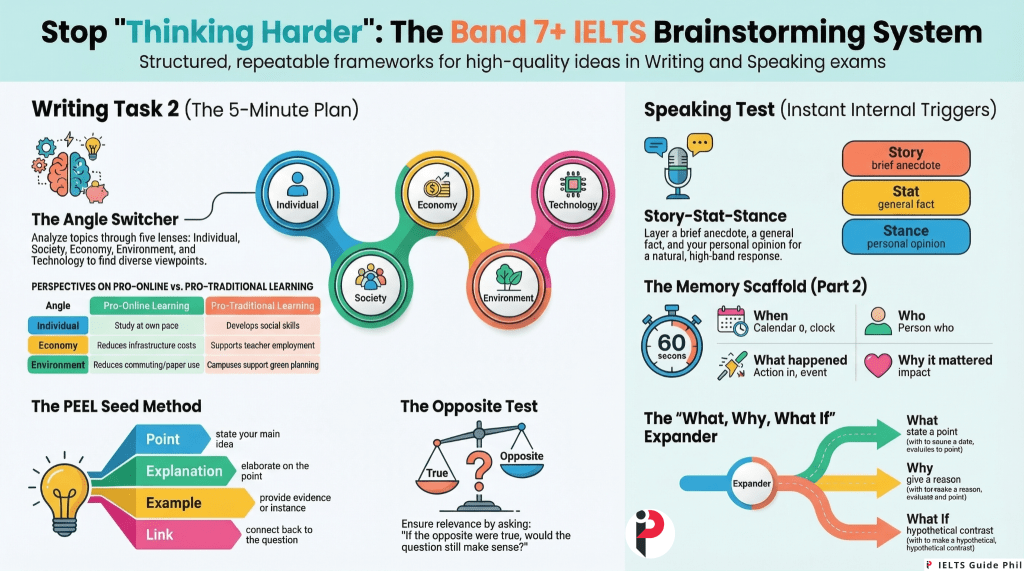
Technique 1: The PEEL Seed Method
Before you brainstorm what to say, brainstorm where each idea will go. Use the PEEL structure (Point → Explanation → Example → Link) as a seed frame.
How to use it:
- Write your main point (your brainstormed idea) in one sentence.
- Ask: Why is this true? → This becomes your Explanation.
- Ask: What real-world example proves this? → This becomes your Example.
- Ask: How does this connect back to the question? → This becomes your Link.
Example — Question: “Some people think that governments should ban fast food. To what extent do you agree or disagree?”
- Point: Fast food consumption contributes to rising rates of non-communicable diseases.
- Explanation: High levels of sodium, saturated fat, and refined sugar in fast food products are directly linked to obesity, hypertension, and type 2 diabetes.
- Example: In the Philippines, the Department of Health reported a sharp increase in obesity rates correlating with the rapid expansion of fast food chains in urban areas over the past two decades.
- Link: If governments are responsible for public health, then regulating or restricting the fast food industry is a logical extension of that responsibility.
You now have a complete paragraph idea generated from a single brainstormed point. This is what examiners mean by “fully developed ideas.”
Technique 2: The Angle Switcher
Many candidates brainstorm only from their own perspective. The Angle Switcher forces you to generate ideas from multiple viewpoints, which is especially useful for Discussion essays and Advantages/Disadvantages questions.
The five angles:
- Individual — How does this affect a single person?
- Society — How does this affect communities or groups?
- Economy — What are the financial implications?
- Environment — What are the ecological consequences?
- Technology/Future — What does this mean in a modern or long-term context?
Example — Question: “Online learning will replace traditional classroom education in the future. Discuss both views.”
| Angle | Pro-Online Learning | Pro-Traditional Learning |
|---|---|---|
| Individual | Learners study at their own pace | Face-to-face interaction builds social skills |
| Society | Access to education in rural areas | Shared learning experience builds community |
| Economy | Reduces cost of education infrastructure | Supports employment of teachers |
| Environment | Reduces commuting and paper use | Campuses support green urban planning |
| Technology | AI-personalised learning is now possible | Screen dependency is a growing health concern |
In under two minutes, you have ten potential ideas from a structured brainstorm. Now you simply select the two strongest for your body paragraphs.
Technique 3: The “Because, So, Unless” Chain
This technique is designed specifically to develop thin ideas into Band 7-worthy arguments.
When you have a raw idea, run it through this chain:
- Because → What causes or supports this?
- So → What is the consequence or implication?
- Unless → What condition would change or limit this?
Raw idea: Technology has made people less active.
- Because → Remote work, online entertainment, and food delivery apps reduce the need for physical movement.
- So → Sedentary lifestyles are becoming the norm, contributing to obesity and cardiovascular disease.
- Unless → Fitness technology (wearables, fitness apps) is actively used to counter this trend, in which case technology could be neutral or even beneficial.
The “Unless” clause is particularly powerful — it shows the examiner nuanced thinking, which is a marker of Band 7–8 writing.
Technique 4: The Real-World Hook
Examiners read hundreds of essays that use the same generic examples: “For instance, in many countries…” or “Studies have shown that…”
A Real-World Hook is a specific, grounded example tied to something you actually know — a country, a policy, a statistic, a personal observation, or a named institution.
Generic (Band 6 level): “For example, many governments have introduced environmental policies.”
Specific (Band 7+ level): “For instance, Denmark’s carbon tax policy has been cited as one of the most effective models for reducing national greenhouse gas emissions while maintaining economic growth.”
You do not need to memorise academic citations. You need a bank of 10–15 real-world reference points that you can adapt across multiple essay topics.
Suggested reference bank for Filipino IELTS candidates:
- Health: WHO obesity data; Philippine DOH public health campaigns
- Environment: Paris Agreement; plastic bag ban in the Philippines
- Education: K-12 reform in the Philippines; PISA rankings
- Technology: Rise of AI tools; social media regulation debates
- Economy: BPO industry growth in the Philippines; gig economy expansion
- Crime/Law: Restorative justice models; rehabilitation vs. punishment debates
- Transport: Metro Manila traffic; bike lane infrastructure expansion
Technique 5: The Opposite Test
This technique helps you avoid irrelevant ideas — one of the most common Task Response errors.
Before committing to an idea, ask: If the opposite were true, would the question still make sense?
Question: “The arts are just as important as the sciences in school curricula. Do you agree or disagree?”
Test idea: “Science leads to medical breakthroughs.” Opposite test: “If science did NOT lead to medical breakthroughs, would the question about arts vs. sciences in school be more or less relevant?” → This idea is about the value of science in general, not about whether arts should be equally prioritised in schools. It fails the opposite test — it is off-topic.
Relevant idea: “Arts education develops critical thinking and creativity, which are transferable skills applicable across disciplines including science.” Opposite test: “If arts did NOT develop these skills, should they still be equally prioritised?” → Now the argument directly hinges on the question. It passes the test.
This takes 30 seconds and saves you from writing an entire paragraph that the examiner marks as “not directly addressing the question.”
Part 2: Brainstorming for IELTS Speaking
Speaking brainstorming is different. You have zero time to write anything down in Parts 1 and 3, and only one minute of preparation time in Part 2. Your brainstorming must be instant and internal.
Technique 6: The Story-Stat-Stance Framework (for Part 1 and Part 3)
When an examiner asks you a question in Speaking Part 1 or Part 3, your answer needs three layers to sound natural and developed without sounding like a rehearsed monologue.
- Story — A brief personal anecdote, memory, or observation
- Stat or Fact — A general truth, trend, or real-world reference
- Stance — Your opinion or position on the matter
Question: “Do you think people spend too much time on social media?”
- Story: “Personally, I’ve noticed that I check my phone the moment I wake up — before I even get out of bed — and I don’t think I’m alone in that.”
- Stat/Fact: “There’s actually data suggesting that the average person spends close to seven hours a day on screens, which is more time than most people spend sleeping.”
- Stance: “So yes, I think social media use has genuinely crossed into compulsive territory for a lot of people, and that’s worth being concerned about.”
The answer is coherent, extended, and natural — not because the candidate memorised a script, but because they used a three-part brainstorm trigger in real time.
Technique 7: The Part 2 Memory Scaffold
In Speaking Part 2, you have one minute to prepare a 1–2 minute monologue. Most candidates waste this minute trying to “think of something good to say.” Instead, use the minute to build a Memory Scaffold — a quick mental map of four anchoring details.
The four anchors:
- When — Give a specific time reference (last year, when I was in college, during the pandemic)
- Who — Mention a person involved (a close friend, my younger sister, a former teacher)
- What happened — The specific event or situation (one brief sentence)
- Why it mattered — The significance, emotion, or lesson (this is your “development”)
Cue card: “Describe a time you helped someone. You should say: who you helped, what you did, and explain why you decided to help.”
Scaffold (built in 60 seconds):
- When: Two years ago, during the pandemic lockdowns
- Who: My neighbour, an elderly woman who lived alone
- What happened: I started buying groceries for her every week because she couldn’t go out safely
- Why it mattered: It made me realise how isolated elderly people can be, and it shifted how I see community responsibility
With four anchors in place, you can speak fluently for two minutes because you are not inventing the story in real time — you are simply narrating it from your scaffold.
Technique 8: The Topic Web for Part 3
Part 3 questions are abstract and opinion-based. They can catch candidates off guard because they don’t follow from Part 2’s personal narrative — they zoom out to society, policy, and future implications.
Train yourself to instantly web any Part 3 topic across five sub-areas:
Core topic → Web branches:
- Personal impact
- Social/cultural impact
- Government/policy angle
- Advantages and disadvantages
- Future prediction
Part 3 question: “Do you think the government should be responsible for people’s health?”
Instant web:
- Personal: People bear primary responsibility for lifestyle choices
- Social: Public health campaigns can shift cultural norms
- Government: Subsidised healthcare, food labelling regulations, sugar taxes
- Pros/Cons: Intervention vs. personal freedom debate
- Future: Preventive healthcare models are more cost-effective than treatment
You now have five angles to choose from. Pick the two most interesting, connect them logically, and you have a Band 7+ extended response.
Technique 9: The “What, Why, What If” Expander
This is a mental technique for expanding short answers in real time — especially useful in Speaking Part 1, where candidates tend to give one-sentence responses.
When you notice your answer is getting short, trigger the expander:
- What → State your point clearly.
- Why → Give the reason or cause.
- What If → Add a hypothetical, contrast, or implication.
Question: “Do you prefer to study alone or with others?”
Without the expander: “I prefer to study alone.” ← Band 5 response (too short, no development)
With the expander:
- What: “I generally prefer studying on my own.”
- Why: “I find that I retain information more effectively without interruptions — group study sessions often turn into social conversations before long.”
- What If: “That said, if I’m preparing for something that requires discussion — like this exam, for instance — working with a study partner can actually sharpen my thinking quite a bit.”
Total response: three sentences, natural flow, extended but not padded. This is exactly what examiners mark as “able to speak at length without noticeable effort.”
Part 3: Dos and Don’ts of IELTS Brainstorming
✅ DO:
Do allocate dedicated planning time. In Writing Task 2, spend 3–5 minutes planning. Candidates who plan consistently produce better-structured, more developed essays than those who dive straight into writing.
Do practise brainstorming as a timed drill. Set a two-minute timer and brainstorm six ideas for a random IELTS topic. Do this daily. Speed and quality improve with repetition.
Do choose quality over quantity. Two well-developed ideas will always outperform five shallow ones in Task Response scoring. Never list ideas in your essay that you cannot explain or support.
Do recycle your reference bank. Build a personal bank of 10–15 real-world examples and practise adapting them across different essay topics. A well-placed specific example elevates Task Response noticeably.
Do brainstorm the counterargument. Even in Opinion essays, acknowledging a counterpoint (then refuting it) signals sophisticated thinking to the examiner.
Do use physical notes during Writing Task 2. You have scrap paper available. Use it. Writing ideas down, even messily, frees up cognitive space for the actual writing.
❌ DON’T:
Don’t brainstorm only what you “believe.” IELTS essays are not personal opinion journals. They are arguments. Brainstorm what you can best support and develop, not just what you personally feel.
Don’t confuse topic familiarity with idea readiness. Just because you know a topic (e.g., climate change) doesn’t mean you have developed, exam-ready ideas about it. Practise generating structured arguments, not just associations.
Don’t use “brainstorming” as an excuse to write an outline. Some candidates spend their entire planning time writing a detailed essay outline. The outline should take 60 seconds. The brainstorming — generating and evaluating ideas — comes first.
Don’t borrow the question’s exact wording as your idea. If the question asks whether technology is harmful, your brainstormed idea should not be “technology is harmful” — that’s just a paraphrase of the question. Drill down to why and how.
Don’t skip Part 2 preparation time in Speaking. One minute feels short, but it is enough to build a Memory Scaffold. Candidates who don’t use it run out of things to say within 45 seconds.
Don’t aim for the “perfect” idea. In a timed exam, a good idea fully developed is worth far more than a perfect idea half-expressed. Commit to your idea and develop it thoroughly.
Common Mistakes and Fixes
Mistake 1: Generating ideas that are all the same type
“Brainstormed ideas for ‘Is technology good for society?’: It helps communication. It helps education. It helps healthcare. It helps business.”
This is not brainstorming — it’s listing synonyms for “helps.” All four points have the same structure and the same logical weight.
Fix: Use the Angle Switcher (individual, society, economy, environment, technology/future) to force variety in perspective and scope.
Mistake 2: Brainstorming without considering the question type
A Discussion essay requires ideas for both sides. An Opinion essay requires ideas that support one position. A Problem-Solution essay requires brainstorming causes and remedies, not just opinions.
Fix: Before brainstorming a single idea, identify the essay type and brainstorm toward the structure the question is asking for.
Mistake 3: Ideas that are too abstract to develop
“Brainstormed idea: Society will suffer if the government doesn’t act.”
This is an outcome, not an idea. You cannot write a paragraph about it because it has no specific content.
Fix: Push every abstract idea through the PEEL Seed trigger. Ask: What specifically? Why specifically? What example proves this? If you can’t answer, the idea is too thin to use.
Mistake 4: In Speaking, brainstorming “big” instead of brainstorming “personal”
Many candidates, especially for Part 2, try to think of an impressive story instead of a real and specific one. This leads to vague, invented-sounding answers that lack natural detail.
Fix: The best Part 2 answers are ordinary experiences told with vivid, specific detail. Use the Memory Scaffold and anchor to a real memory, even a simple one. Authenticity sounds more fluent than performance.
Mistake 5: Treating brainstorming as a one-time pre-exam activity
Some candidates practise brainstorming once during review, then rely on instinct during the actual exam.
Fix: Brainstorming is a muscle. It needs daily exercise. Use real IELTS past questions (from Cambridge IELTS books or official resources) and drill the techniques above until they become automatic responses to a question prompt.
Mistake 6: Filipino-specific — defaulting to Filipinisms as “examples”
Some Filipino candidates brainstorm examples that are culturally hyper-specific and may confuse the examiner, or worse, they produce examples that are not universally recognisable.
Fix: Your personal Filipino context is actually a strength — when it is explained, not assumed. “In the Philippines, particularly in Metro Manila, the lack of reliable public transport has forced millions of workers to rely on private vehicles, worsening both traffic congestion and air pollution” is a strong, specific example. “Like in our country” without any context is not.
Frequently Asked Questions
Q: How many ideas should I brainstorm for Writing Task 2?
Aim for 4–6 raw ideas in your initial brainstorm, then select the 2 strongest for your body paragraphs. You do not need more than two main ideas — you need two ideas that are fully developed. A common mistake is choosing three ideas and developing none of them adequately.
Q: What if I genuinely don’t know anything about the essay topic?
This is rare in IELTS because the topics are deliberately accessible — they do not require specialist knowledge. If you feel stuck, use the Angle Switcher and ask yourself: How does this topic affect a person? A family? A country? The economy? The future? One of these angles will always yield a usable idea.
Q: Is it acceptable to use made-up statistics or examples?
Yes — IELTS Writing Task 2 does not require cited sources, and examiners do not fact-check your examples. You can write “research suggests that…” or “studies have indicated that…” without attribution. However, the example must be plausible and relevant. Implausible figures (“99% of people prefer online learning”) will read as unnatural and may undermine the credibility of your argument.
Q: In Speaking, what do I do if I’m asked a question I have absolutely no idea about?
Use a “thinking aloud” opener to buy yourself 3–5 seconds of real-time brainstorming: “That’s an interesting question — I haven’t really thought about it from that angle before, but I suppose…” This is natural, fluent behaviour. It is not a penalty. What is a penalty is silence, visible panic, or a completely off-topic answer.
Q: Should I always agree with the statement in an Opinion essay to make brainstorming easier?
Not necessarily. Choose the position you can better support and develop, not the one you personally agree with more. If you can immediately think of three strong reasons to disagree with the statement and only one weak reason to agree, write the disagreement essay. IELTS does not reward moral alignment — it rewards argument quality.
Q: How do I know if my brainstormed idea is relevant enough?
Use the Opposite Test. Ask: If the opposite of my idea were true, would it change the answer to the question? If yes, the idea is relevant. If not, it may be tangential — and tangential ideas cost you Task Response marks.
Q: Can I practise brainstorming without a study partner?
Absolutely. In fact, solo timed drills are more effective for building speed. Set a two-minute timer, write down a random IELTS topic, and generate as many structured ideas as you can. Evaluate them afterward using the Opposite Test and PEEL Seed check. Do this daily for two weeks and you will notice a measurable improvement in idea generation speed.
Q: Is there a difference in how I brainstorm for Academic and General Training Task 2?
The brainstorming techniques are identical — the essay formats and assessment criteria are the same for both modules in Task 2. The difference is only in Task 1.
Final Word: The Exam Doesn’t Test What You Know — It Tests How Quickly You Can Think
Brainstorming is the invisible skill in IELTS. No examiner will write “excellent brainstorming” on your scoresheet. But every band descriptor for Task Response, Fluency and Coherence, and even Lexical Resource is indirectly measuring the quality of what you generated before you ever wrote or spoke your first sentence.
The candidates who consistently hit Band 7 and above are not necessarily more intelligent or more grammatically advanced than Band 6 candidates. They are faster, more structured thinkers under pressure — and that is a trainable skill.
Train it.
#IELTSGuidePhil #IELTSWriting #IELTSSpeaking #IELTSBrainstorming #IELTSTips #IELTSBand7 #IELTSPreparation #IELTSPhilippines #IELTSTask2 #IELTSSpeakingTips #IELTSWritingTask2 #IELTSGuidePhil #IELTSCoach #IELTSFilipino #BandScore7 #IELTSPractice #EnglishForIELTS #IELTSIdeas #IELTSExamTips #IELTSStrategy #IELTSOnline
 IELTS Guide Phil
Leave a comment