
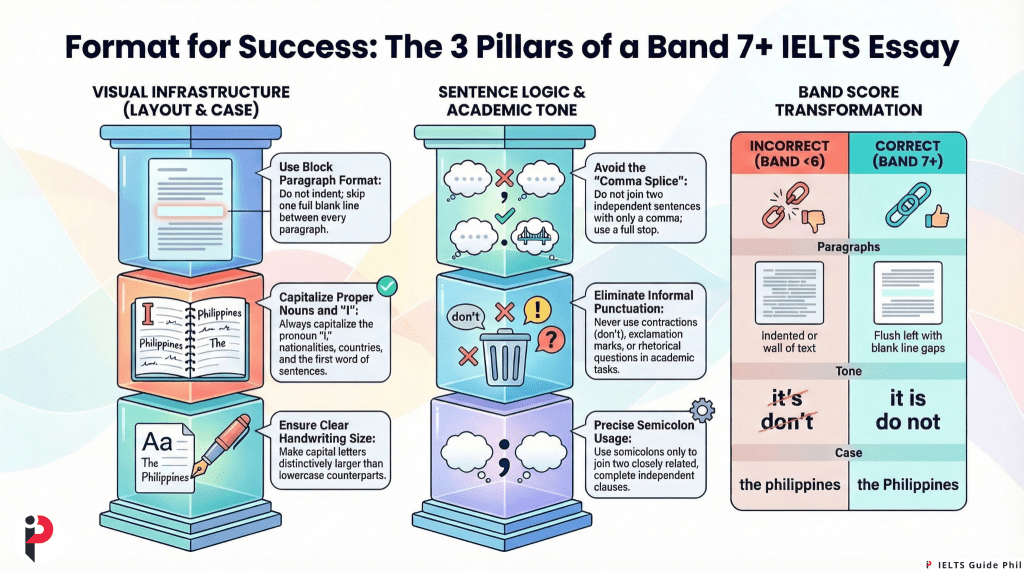
Most IELTS candidates obsess over vocabulary and grammar — and ignore the one thing examiners see before they read a single word: how the writing looks on the page.
Whether you are typing on a computer or writing by hand, your formatting sends an immediate signal about your level of education, your awareness of written English conventions, and your ability to organize ideas. A messy, inconsistently formatted essay whispers “this writer is not confident” before the examiner even reaches your thesis statement.
This post covers three interconnected elements that are simpler than grammar but just as consequential: block paragraphs, capitalization, and punctuation. Master all three and your writing instantly looks — and reads — like Band 7+.
PART 1: BLOCK PARAGRAPHS — The Modern Standard for IELTS Writing
What Is a Block Paragraph Format?
A block paragraph (also called block format) is the default style for formal written English today. It has two defining features:
- No indentation at the start of a paragraph
- A blank line (line skip) between each paragraph
This is the format used in academic journals, professional reports, business letters, and — critically — IELTS answer sheets.
Block format looks like this:
The rise of remote work has transformed urban economies worldwide. Cities that once depended on daily commuter traffic are now experiencing significant changes in commercial real estate demand and public transport usage.
(blank line)
Governments must respond to these shifts by redesigning city infrastructure. Investing in residential amenities rather than office-centric development could prove a more sustainable long-term strategy.
Indented format (what you should NOT do in IELTS) looks like this:
The rise of remote work has transformed urban economies worldwide. Cities that once depended on daily commuter traffic are now experiencing significant changes.
Governments must respond to these shifts by redesigning city infrastructure. Investing in residential amenities could prove a more sustainable strategy.
The indented version looks like a personal diary entry or a school essay from the 1980s. The block version looks like a published academic document.
Why Does This Matter for Your IELTS Band Score?
Block paragraphs directly support Coherence and Cohesion (CC), which accounts for 25% of your Writing score.
The CC descriptor specifically looks at whether your writing is “logically organized” and whether “each central topic is clear.” When paragraphs are visually separated, the examiner’s eye can immediately locate each section, each topic shift, and each supporting argument.
A well-blocked essay:
- Makes your structure instantly visible
- Reduces the cognitive load on the examiner
- Demonstrates awareness of academic writing conventions
- Allows your topic sentences to stand out at the start of each block
An unblocked, unindented essay with no visible paragraph breaks is one of the most common and most damaging formatting errors Filipino IELTS candidates make — particularly in handwritten tests.
Block Paragraphs in Typed vs. Handwritten IELTS Tests
For typed tests (computer-delivered IELTS):
The text editor provided on screen does not automatically insert indentations. Pressing Enter once moves to the next line. Pressing Enter twice creates the blank line between paragraphs. This makes block format extremely easy to apply — you simply press Enter twice at the end of each paragraph.
Common typed-test error: Pressing Enter only once and then pressing the Tab key or spacebar multiple times to simulate an indent. This creates visual inconsistency and wastes precious seconds.
For handwritten tests (paper-based IELTS):
You must physically skip one line between paragraphs. On standard IELTS answer paper, this means after finishing the last line of a paragraph, you leave the very next ruled line blank, then begin the next paragraph on the line after that.
Common handwritten-test error: Starting a new paragraph with a slight leftward push of the pen (an unclear, inconsistent indent) without leaving a blank line — so the examiner cannot tell where one paragraph ends and the next begins.
The golden rule for both formats: If the examiner has to look twice to find your paragraph breaks, you have already lost CC marks.
✅ DOS — Block Paragraph Format
- Do press Enter twice between paragraphs in the computer-delivered test
- Do skip one full ruled line between paragraphs in the handwritten test
- Do start every paragraph flush with the left margin (no indent, no tab, no extra spaces)
- Do treat your introduction, each body paragraph, and your conclusion as visually distinct, separated blocks
- Do keep each block focused on one central idea — one paragraph, one main point
- Do aim for paragraphs of roughly 4–7 sentences, making each block substantial enough to be seen as a developed unit of thought
❌ DON’TS — Block Paragraph Format
- Don’t indent the first line of any paragraph in IELTS Writing Tasks 1 or 2
- Don’t use only a single Enter/line break between paragraphs in the typed test (this makes it look like one continuous paragraph)
- Don’t write in one continuous block with no paragraph breaks at all — this is catastrophic for CC
- Don’t use extra-large gaps (three or four blank lines) between paragraphs — it wastes space and looks amateurish
- Don’t inconsistently mix formats (some paragraphs indented, some not, some with blank lines, some without)
- Don’t write a two-sentence paragraph — it signals underdevelopment and drags down Task Achievement
Common Mistakes and Fixes — Block Paragraphs
Mistake 1: The Invisible Paragraph Break The candidate writes everything as a wall of text — no indentation, no blank lines. On the answer sheet, the examiner sees one unbroken mass of writing. Fix: Before you begin writing, mark a light mental checkpoint: “Every time I shift to a new idea, I leave a blank line.”
Mistake 2: The Phantom Indent (Handwritten) The candidate starts each paragraph by beginning slightly to the right of the margin — an indent so small and inconsistent that it reads as a margin mistake rather than a paragraph signal. Fix: Commit fully. Either indent (5–7 character spaces, consistent) OR block format (no indent + blank line). IELTS convention is block format. Do not half-do it.
Mistake 3: The Tab Key Trap (Typed) The candidate presses Tab before each paragraph to indent it, then does not press Enter twice — so there is an indent but no blank line separation. Fix: Delete the habit of pressing Tab entirely. Use double Enter only.
Mistake 4: The Three-Paragraph Essay Introduction + one giant body paragraph + conclusion. The candidate avoided the block format problem by essentially never needing it. Fix: IELTS Task 2 requires at minimum four paragraphs. Block format makes each one visible.
Mistake 5: Mini-Paragraphs The candidate correctly uses blank lines between paragraphs but each block is only one or two sentences. The format is right but the content is thin. Fix: Each body paragraph should have a topic sentence, an explanation, an example, and a concluding link — at minimum three to four sentences.
PART 2: CAPITALIZATION — The Signal That You Know Written English
The Non-Negotiable Rules of Capitalization in IELTS Writing
Capitalization is not optional. In English academic writing, it is a grammatical rule, not a stylistic preference. Every error in capitalization is technically a Grammatical Range and Accuracy (GRA) issue — the descriptor that accounts for 25% of your score.
Here are the rules every IELTS candidate must know cold:
Rule 1: The First Word of Every Sentence
This is the most fundamental rule of English punctuation. Always capitalize the first word of a sentence — regardless of what word it is.
✅ The results were inconclusive.
❌ the results were inconclusive.
Filipino learners sometimes make this error in handwriting when they rush and produce letters that are technically lowercase in form but medium in size — the examiner cannot tell if capitalization was intended.
Fix: Make your capital letters clearly, distinctively larger than their lowercase counterparts. This is especially critical for: a/A, c/C, o/O, s/S, u/U, v/V, w/W, x/X, z/Z — the letters most commonly ambiguous in fast handwriting.
Rule 2: The Pronoun “I”
The first-person singular pronoun is always capitalized in English — always, everywhere, every time, no exceptions.
✅ I believe this policy is ineffective.
❌ i believe this policy is ineffective.
This is a shockingly common error in Filipino IELTS candidates’ handwritten answers, where a small “i” can disappear into the page.
Rule 3: Proper Nouns
Proper nouns — specific names of people, places, organizations, nationalities, languages, religions, days, months — are always capitalized.
✅ the Philippines, Filipino workers, the United Nations, English, Monday, January, Islam, the Pacific Ocean
❌ the philippines, filipino workers, the united nations
IELTS-specific application: Many Task 1 Academic questions involve graphs about specific countries, organizations, or time periods. Failing to capitalize these is a GRA error repeated potentially dozens of times in a single response.
Rule 4: The Title of the Essay (If You Write One)
IELTS does not require you to write a title, and most examiners advise against it as it wastes time. But if you do write one, capitalize it using title case:
✅ The Impact of Technology on Modern Education
❌ The impact of technology on modern education (sentence case for a title — acceptable in some contexts but inconsistent if mixed)
Advice: Do not write a title. Begin directly with your introduction. Titles are not assessed and consume valuable writing time.
Rule 5: Do NOT Over-Capitalize
Over-capitalization is also a GRA error — and it reveals a misunderstanding of English grammar.
Do not capitalize:
- Common nouns that are not being used as proper nouns
- Concepts, ideas, or topics just because they seem important
- The word after a colon (unless it begins a full new sentence in some styles)
- Seasons: spring, summer, autumn, winter
❌ The Government should invest in Education and Healthcare.
✅ The government should invest in education and healthcare.
❌ Many Students struggle with Academic Writing.
✅ Many students struggle with academic writing.
Filipino IELTS candidates frequently over-capitalize nouns that feel “important” — influenced partly by Filipino conventions and partly by the instinct that big ideas deserve big letters. In English academic writing, they do not.
✅ DOS — Capitalization
- Do capitalize the first letter of every sentence without exception
- Do always capitalize the pronoun “I”
- Do capitalize all proper nouns: specific people, places, countries, nationalities, languages, organizations, days, and months
- Do make your capital letters visibly and consistently larger in handwriting
- Do double-check names of countries and organizations in Task 1 — these appear repeatedly
❌ DON’TS — Capitalization
- Don’t capitalize common nouns just because they feel significant or important
- Don’t write seasons, subjects (unless specific course names), or general concepts in capitals
- Don’t write “internet” in capitals — it is now accepted as lowercase in contemporary English style
- Don’t write “Government,” “Economy,” or “Society” with capitals when used generically
- Don’t confuse title case with sentence case — choose one style and stick to it for headers (if you use any)
Common Mistakes and Fixes — Capitalization
Mistake 1: The Lowercase Opening “many researchers argue that…” Fix: “Many researchers argue that…” — Capital M, always.
Mistake 2: Random Important-Word Capitals “The rise of Social Media has affected Mental Health among Youth.” Fix: “The rise of social media has affected mental health among youth.” — None of those are proper nouns.
Mistake 3: Country Adjective Errors “the filipino community” / “an american study” Fix: “the Filipino community” / “an American study” — Nationality adjectives derived from proper nouns are always capitalized.
Mistake 4: The Ambiguous Handwritten Capital The candidate intends to write “The” but produces a letter that could be “t” or “T” depending on the examiner’s generosity. Fix: Practice writing your capital letters with obvious, deliberate size differentiation before your test date.
PART 3: PUNCTUATION — The Architecture of Meaning
Punctuation is not decoration. It is the structural scaffolding of a sentence. Every punctuation mark tells the reader something: where to pause, where to stop, what is subordinate, what is a list, what is being introduced. In IELTS, punctuation errors fall under GRA and affect how clearly your ideas are communicated.
The Essential Punctuation Marks for IELTS Writing
1. The Full Stop / Period (.)
Used to end a declarative sentence. Simple, non-negotiable.
✅ The population grew significantly over the decade.
IELTS error: Run-on sentences — two complete sentences joined with only a comma or no punctuation at all.
❌ The population grew significantly, this was due to improved healthcare.
✅ The population grew significantly. This was due to improved healthcare.
✅ The population grew significantly, which was due to improved healthcare. (subordinate clause — correct)
2. The Comma (,)
The most misused punctuation mark in IELTS essays. It has specific, rule-governed uses:
a) Before a coordinating conjunction joining two independent clauses (FANBOYS: for, and, nor, but, or, yet, so)
✅ The government invested heavily in infrastructure, but the results were disappointing.
b) After an introductory phrase or clause
✅ Despite the challenges, researchers managed to achieve significant results. ✅ In recent decades, urbanization has accelerated dramatically.
c) To separate items in a list
✅ The report examined housing, employment, education, and healthcare.
d) Around non-restrictive (non-essential) clauses
✅ The study, which was conducted over five years, yielded surprising results.
What the comma cannot do:
❌ It cannot join two independent clauses alone — this is a comma splice, one of the most penalized errors in GRA.
❌ The economy improved, the unemployment rate dropped.
✅ The economy improved, and the unemployment rate dropped.
✅ The economy improved; the unemployment rate dropped.
3. The Semicolon (;)
Used to join two closely related independent clauses without a conjunction. A mark of sophistication when used correctly — and a mark of confusion when misused.
✅ Urban areas experienced rapid growth; rural communities, by contrast, continued to decline.
Rule: Both sides of the semicolon must be able to stand as complete sentences.
❌ The city grew rapidly; because of migration. (Second part is not an independent clause)
✅ The city grew rapidly because of migration. (Use a comma before the subordinating conjunction, not a semicolon)
Used sparingly and correctly, a semicolon signals to the examiner that you have a sophisticated understanding of English sentence structure — a direct pathway to GRA Band 7+.
4. The Colon (:)
Used to introduce a list, an explanation, or a quotation.
✅ There are three main causes of urban poverty: unemployment, lack of education, and inadequate housing.
✅ The conclusion was clear: further research was needed.
Common error: Using a colon after an incomplete sentence.
❌ The three causes are: poverty, disease, and conflict. (The phrase before the colon must be a complete independent clause)
✅ There are three main causes: poverty, disease, and conflict.
5. The Apostrophe (‘)
Used for contractions and possession. In formal IELTS academic writing, contractions are inappropriate. The apostrophe’s only legitimate use in IELTS Writing is for possession.
✅ The government’s response was inadequate.
✅ The children’s education was prioritized.
❌ don’t, can’t, it’s, they’re, isn’t — These are informal contractions. Do not use them in IELTS Writing Tasks 1 or 2.
The it’s / its confusion:
- it’s = it is (a contraction — avoid in IELTS)
- its = belonging to it (possessive — acceptable)
✅ The policy has its limitations.
❌ It’s a growing problem. → Write: It is a growing problem.
6. The Question Mark (?)
Used only in direct questions. In IELTS Writing Task 2, you are writing academic arguments — not asking questions. Rhetorical questions are informal and should be avoided.
❌ But what can we do about this problem?
✅ The question of what can be done about this problem deserves careful examination.
✅ DOS — Punctuation
- Do end every sentence with a full stop
- Do use commas after introductory phrases and before coordinating conjunctions linking independent clauses
- Do use semicolons to join two closely related complete sentences — sparingly and correctly
- Do use colons to introduce lists or explanations — after a complete sentence only
- Do use apostrophes for possession (the government’s policy, the city’s infrastructure)
- Do spell out contractions in full (do not, cannot, it is, they are)
❌ DON’TS — Punctuation
- Don’t use comma splices — a comma between two independent clauses with no conjunction
- Don’t use contractions (don’t, can’t, won’t, isn’t) in formal IELTS writing
- Don’t place a semicolon before a subordinating clause (because, although, since, while)
- Don’t use exclamation marks — they are informal and have no place in academic IELTS writing
- Don’t use ellipses (…) — also informal and vague
- Don’t use dashes (—) as casual connectors — they are informal in running prose; use conjunctions or semicolons instead
- Don’t write rhetorical questions in Task 2
Common Mistakes and Fixes — Punctuation
Mistake 1: The Comma Splice
❌ Social media is widely used, it has many negative effects.
✅ Social media is widely used, and it has many negative effects.
✅ Social media is widely used; it has many negative effects.
✅ Social media is widely used. It has many negative effects.
Mistake 2: The Missing Comma After Introductory Phrase
❌ Furthermore the data suggests a clear trend.
✅ Furthermore, the data suggests a clear trend.
Mistake 3: The Apostrophe in Plurals
❌ The government’s introduced new policies. (Apostrophe where only a plural is needed)
✅ The governments introduced new policies. (Multiple governments, no apostrophe)
Mistake 4: Contractions in Formal Writing
❌ It’s clear that the policy didn’t work.
✅ It is clear that the policy did not work.
Mistake 5: Semicolon Before a Subordinate Clause
❌ The results were promising; although further testing was required.
✅ The results were promising, although further testing was required.
Mistake 6: Overusing Commas
❌ Many students, in the Philippines, struggle with, academic writing, because of, L1 interference.
✅ Many students in the Philippines struggle with academic writing because of L1 interference.
THE BIG PICTURE: How All Three Work Together
Block paragraphs, capitalization, and punctuation are not three separate concerns — they are one integrated system of written clarity.
Think of it this way:
- Block paragraphs = the architecture of your response (macro-structure)
- Capitalization = the grammar of individual words and sentence boundaries (micro-grammar)
- Punctuation = the logic and rhythm within and between sentences (sentence-level grammar)
When all three are correct and consistent, your essay does something remarkable: it becomes invisible infrastructure. The examiner stops noticing the formatting and focuses entirely on your ideas — which is exactly what you want.
When any one of them breaks down, the examiner’s attention is pulled away from your argument and toward the error. Every moment spent decoding your formatting is a moment spent not appreciating your ideas.
Putting It All Together: A Formatted Sample Paragraph
Before (Common IELTS candidate errors):
one of the main reason why urbanization is increasing is the lack of economic opportunity in rural area’s. many young people, especially in developing countries like the philippines, they move to Cities to find better Jobs. this pattern isn’t unique to Southeast asia; it can be seen across the developing world, the consequences however are complex
After (Block format, correct capitalization, correct punctuation):
One of the main reasons why urbanization is increasing is the lack of economic opportunity in rural areas. Many young people, especially in developing countries like the Philippines, move to cities to find better jobs. This pattern is not unique to Southeast Asia; it can be seen across the developing world. The consequences, however, are complex.
Same ideas. Same vocabulary level. Dramatically different impression.
Frequently Asked Questions
Q1: Will I lose marks specifically for not using block paragraphs?
Not directly — the IELTS band descriptors do not have a checkbox for “block paragraphs.” However, failure to visually separate paragraphs makes your essay look disorganized, which directly impacts your Coherence and Cohesion score. Examiners assess how clearly information is organized and sequenced. An essay with no visible paragraph breaks reads as a structureless block of text — and will be assessed accordingly.
Q2: Should I indent or use block format for IELTS handwritten essays?
Use block format: no indentation + one blank line between paragraphs. This is the current standard for academic and professional writing in English. Indentation is an older convention associated with literary and personal writing. Some handbooks still teach it, but block format is universally accepted for IELTS and is safer, clearer, and more consistent to produce under exam conditions.
Q3: Does capitalization really affect my GRA score?
Yes. Every capitalization error is a grammatical error. If you are writing “the philippines” or “i believe” or “Many Students” repeatedly throughout your essay, those errors accumulate and lower your GRA score — which is 25% of your total Writing band. Consistent capitalization errors signal a lack of control over English conventions, which is a GRA concern by definition.
Q4: I was taught to use rhetorical questions to engage the examiner. Is this wrong for IELTS?
For IELTS Academic Writing Task 2, yes — rhetorical questions are informal and should be avoided. IELTS Writing is assessed as academic writing, not persuasive speech or editorial commentary. The examiner is not your audience in the journalistic sense. Replace rhetorical questions with academic reformulations: instead of “Is this really the solution we need?” write “Whether this constitutes an adequate solution remains a matter of debate.”
Q5: Can I use dashes (—) in my IELTS essay?
Occasional, careful use of the em dash for parenthetical information is not catastrophically penalized, but it leans informal. In academic writing, parenthetical information is better handled with commas or brackets. Avoid dashes as connectors between ideas (replacing conjunctions or semicolons) — that usage signals informal register.
Q6: What about bullet points or numbered lists in IELTS Writing?
Never use bullet points or numbered lists in IELTS Writing Tasks 1 or 2. These are not academic prose formats. Everything must be written in full sentences within properly formatted paragraphs. Task 1 graph descriptions and Task 2 essays are both continuous prose documents.
Q7: I have bad handwriting. Can I still score well on a paper-based test?
Yes — the examiner assesses your language, not your artistic penmanship. However, legibility is an implicit requirement: if the examiner cannot read your writing, they cannot assess it. Focus on writing slowly enough to be legible, keep letter sizes consistent, make capitals clearly distinct, and keep spacing between words even. Legibility is not a band descriptor, but illegibility is effectively a zero across all four criteria.
Q8: Is it acceptable to start a sentence with “And,” “But,” or “So” in IELTS?
In contemporary English, starting a sentence with a coordinating conjunction is grammatically accepted. However, in formal academic writing — which IELTS Task 2 is — it is stylistically better to use conjunctive adverbs instead: Furthermore, Moreover, Nevertheless, However, Therefore. Starting sentences with And or But reads as conversational rather than academic. So as a sentence opener is informal — replace it with Therefore or Consequently.
Quick Reference Checklist (Paste Into Your IELTS Prep Notes)
Block Paragraphs ☐ Every paragraph starts flush with the left margin (no indent) ☐ One blank line between every paragraph ☐ Minimum four paragraphs for Task 2 ☐ Each paragraph is 4–7 sentences minimum ☐ One central idea per paragraph
Capitalization ☐ First word of every sentence capitalized ☐ Pronoun “I” always capitalized ☐ All proper nouns capitalized (countries, nationalities, organizations, days, months) ☐ No over-capitalization of common nouns ☐ Handwritten capitals visually distinct from lowercase
Punctuation ☐ Every sentence ends with a full stop ☐ Commas used correctly after introductory phrases, before conjunctions, in lists ☐ No comma splices ☐ No contractions (do not, cannot, it is — not don’t, can’t, it’s) ☐ No exclamation marks, ellipses, or rhetorical questions ☐ Apostrophes used only for possession, not plurals ☐ Semicolons only between two complete, related sentences
The best IELTS essays are not the ones that dazzle with rare vocabulary. They are the ones that communicate clearly, precisely, and professionally — from the very first glance at the page.
Word count: approximately 3,400 words
Target reader: IELTS candidates aiming for Band 7–9; Filipino learners in the paper-based and computer-delivered test formats; IELTS educators building formatting awareness into their curriculum
#IELTSGuidePhil #IELTSWriting #IELTSBand7 #IELTSPhilippines #IELTSPrep #BlockParagraphs #IELTSFormatting #IELTSGrammar #IELTSPunctuation #IELTSCapitalization #WritingTask2 #WritingTask1 #IELTSTips #FilipinasForIELTS #IELTSGuidePhil #CoherenceAndCohesion #GrammaticalRangeAndAccuracy #HandwrittenIELTS #ComputerDeliveredIELTS #IELTSCoach #AcademicWriting
 IELTS Guide Phil
Leave a comment