
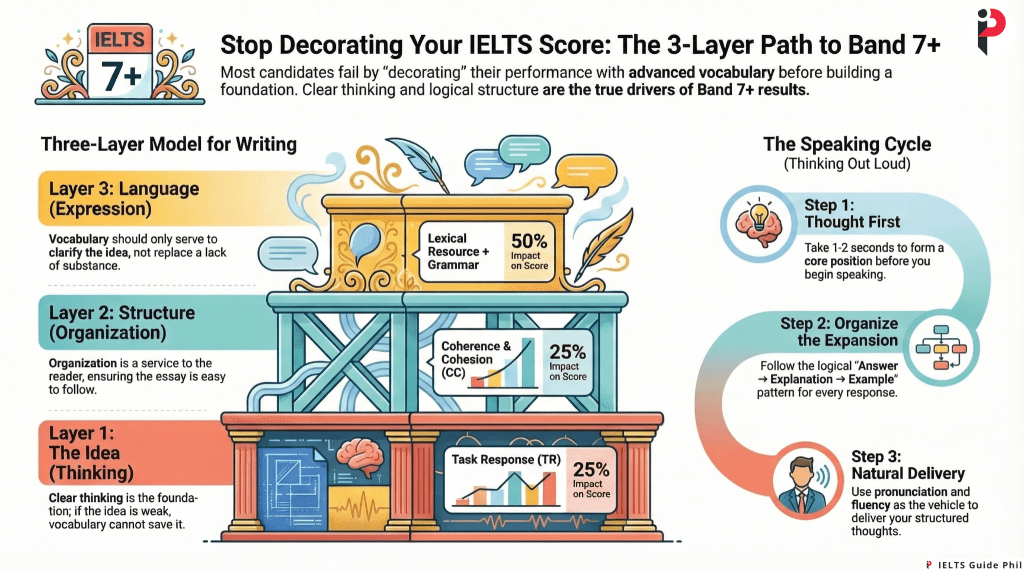
The Two Signature Frameworks That Separate Band 5 Thinking from Band 7+ Performance
Most IELTS candidates spend months memorizing “advanced vocabulary lists,” downloading essay templates, and practicing tongue twisters for pronunciation. Then they sit the exam — and get a Band 6 again.
Not because they lack words.
Because they’re fixing the wrong layer.
This post introduces two original frameworks developed for IELTS Guide Phil’s approach to preparation: The Three-Layer Model for IELTS Writing and The Speaking Cycle. These aren’t tricks. They’re systems of thinking — and once you understand them, you’ll never approach IELTS the same way again.
PART ONE: THE THREE-LAYER MODEL FOR IELTS WRITING
Idea → Structure → Language
Here’s the uncomfortable truth most IELTS courses won’t tell you:
Vocabulary is the last thing that matters in an IELTS essay.
Not because vocabulary doesn’t matter — it does. But because it sits on top of two more fundamental layers that most students skip entirely.
Think of it like building a house. You wouldn’t install chandeliers before you’ve laid the foundation. Yet that’s exactly what most candidates do when they memorize impressive phrases for an essay that has no clear argument.
The Three-Layer Model maps every element of IELTS Writing to one of three levels:
Layer 1: Idea (Thinking)
This is the foundation of everything.
If your idea is weak, no vocabulary on earth will save your essay. Examiners are trained to evaluate the quality of your thinking — not just the quality of your words. This is what the Task Response (TR) criterion measures, and it carries the same weight as Lexical Resource and Grammar combined.
A strong idea answers four questions:
- Is my argument clear?
- Does my point directly respond to the question?
- Is my explanation logical and complete?
- Does my example actually support my point?
Compare these two opening ideas for the prompt: “Technology has brought more harm than good. To what extent do you agree?”
Weak idea:
Technology is very important for modern society and has many benefits.
Strong idea:
While technology has undeniably improved access to information and communication, its most significant harm lies in the erosion of deep human attention — a cost that may outweigh its convenience.
The difference isn’t vocabulary. The first idea has no direction. The second creates a clear intellectual position the examiner can follow, evaluate, and award.
The principle: Good writing begins with good thinking.
If you can’t explain your idea in plain Filipino to a friend, you can’t write it in English for an examiner.
Layer 2: Structure (Organization)
Once the idea exists, it must be organized.
IELTS examiners reward essays that feel easy to follow. When an examiner has to work hard to understand what you’re saying, your Coherence and Cohesion (CC) score drops — regardless of how sophisticated your vocabulary is.
Structure answers these questions:
- What comes first, and why?
- How does this paragraph connect to the next?
- Is the explanation complete before I move on?
- Does the reader always know where they are in my argument?
A basic IELTS structure most students know:
Introduction → Body 1 → Body 2 → Conclusion
But the deeper structure inside each paragraph is where most candidates fall apart:
Weak paragraph structure:
Technology is useful. Many people use it every day. For example, smartphones. It helps communication and also education. In conclusion, technology has many uses.
Everything is there — an idea, an example, a conclusion. But it’s scattered. The reader has to assemble it themselves.
Strong paragraph structure:
Topic sentence: Technology has fundamentally transformed how people access education. Explanation: Unlike previous generations who depended on physical libraries and scheduled classes, today’s learners can access world-class courses on demand, removing barriers of geography and cost. Example: In the Philippines, for instance, students in remote provinces can now study through platforms like Coursera or Khan Academy, which would have been unimaginable twenty years ago. Mini-conclusion: This suggests that technology’s impact on education is not merely convenient — it is democratizing.
Same general idea. Completely different readability. The structure guides the reader’s thinking so the examiner doesn’t have to.
The principle: Structure is not a format. It is a service to your reader.
Layer 3: Language (Expression)
Only after the first two layers are solid does language begin to matter.
This includes vocabulary, grammar, collocations, and sentence variety — everything that falls under Lexical Resource (LR) and Grammatical Range and Accuracy (GRA). These are real criteria and they genuinely affect your score.
But here’s the critical distinction: language should serve the idea, not replace it.
Weak sentence (language covering for an empty idea):
There are a myriad of multifaceted benefits associated with the proliferation of technological advancements in contemporary society.
This sentence uses impressive-sounding words to say almost nothing. Examiners recognize this pattern immediately — and it signals panic, not proficiency.
Strong sentence (language expressing a clear idea):
Technology reduces the cost of communication by enabling instant, borderless contact between individuals who would otherwise be separated by geography and expense.
Here, the vocabulary clarifies the idea. Every word earns its place.
The key insight: Vocabulary cannot compensate for weak ideas or poor structure. But when ideas and structure are strong, even moderately sophisticated language produces a Band 7 essay.
Why the Three-Layer Model Works: The Scoring Alignment
Here is what makes this framework genuinely powerful — it maps directly onto the IELTS Writing marking criteria:
| Layer | IELTS Criterion |
|---|---|
| Idea | Task Response (TR) |
| Structure | Coherence & Cohesion (CC) |
| Language | Lexical Resource (LR) + Grammatical Range & Accuracy (GRA) |
Each criterion carries 25% of your Writing score. Notice that Language — the thing most candidates obsess over — only accounts for 50% of the total. The other 50% lives in the two layers most students ignore.
High scores don’t come from excelling at one layer. They come from all three working together.
The Three-Layer Model: Dos and Don’ts
DOs:
- Before writing a single sentence, ask: What is my actual position on this question?
- Write your topic sentence first, then check if your explanation actually supports it
- Read your paragraph back and ask: Does this feel easy to follow?
- Let your vocabulary grow from your ideas — not the other way around
- Practice “naked drafts” — write ideas in plain simple English first, then elevate the language
DON’Ts:
- Don’t open a template and fill it in with your ideas — this reverses the natural process
- Don’t use complex vocabulary to disguise an argument you haven’t fully formed
- Don’t confuse long sentences with good sentences — clarity always wins
- Don’t skip the mini-conclusion in your body paragraphs
- Don’t add examples that don’t directly prove your topic sentence
Common Mistakes and Fixes
Mistake #1: The Band 5 Trap — Writing Before Thinking
What it looks like: The candidate begins writing within thirty seconds of reading the prompt. The essay wanders, contradicts itself, or fails to take a clear position.
Fix: Spend two to three minutes in “Idea Mode” before writing. Ask: What is my one-sentence answer to this question? Write it down. Everything else must support that sentence.
Mistake #2: The Vocabulary Disguise
What it looks like: Sentences like “the plethora of ubiquitous technological innovations precipitate a multitude of societal ramifications” — which sounds impressive but means nothing specific.
Fix: Read your sentence back and ask: What exactly am I saying? If you can’t paraphrase it in plain language, the sentence has no idea inside it. Rewrite the idea first. Then dress it in better language.
Mistake #3: Paragraph Soup
What it looks like: Multiple ideas crammed into one paragraph with no clear organization — a topic sentence that promises one thing but delivers another, or an example that doesn’t connect to the explanation.
Fix: Use the four-part paragraph structure: Topic Sentence → Explanation → Example → Mini-Conclusion. Check each part separately. If any part is missing or misaligned, the whole paragraph collapses.
Mistake #4: The Structure Without a Soul
What it looks like: A technically formatted essay — introduction, two body paragraphs, conclusion — but each paragraph feels disconnected from the others. The essay has shape but no argument.
Fix: Write a one-sentence “spine” for the whole essay: My essay argues that ______, because ______ and ______. Every paragraph should trace back to that spine.
Mistake #5: Saving the Best for Last
What it looks like: The strongest idea or example is buried in the conclusion, rather than developed in the body.
Fix: The conclusion should conclude, not introduce. If you find yourself starting a new argument in the final paragraph, move it to the body and let the conclusion summarize and close.
PART TWO: THE SPEAKING CYCLE
Thought → Organization → Delivery
Now let’s apply the same logic to Speaking.
Most IELTS candidates believe that good Speaking performance is about confidence, fluency, and advanced vocabulary. These matter — but they are, again, the surface layer of a process that begins much earlier.
The Speaking Cycle captures what actually happens in the mind of a strong speaker — and what’s missing in the mind of a weak one.
Step 1: Thought
Before the mouth opens, the brain must produce a clear idea.
This sounds obvious. But it is exactly where most candidates fail.
When the examiner asks a question, the instinctive response of a nervous candidate is to start talking immediately — out of a fear that silence suggests weakness. So they begin with filler: “Well, I think… um… this is quite an interesting question because…”
The examiner hears noise before content. Fluency and Coherence drops.
A strong speaker takes one to two seconds to produce a core idea:
Examiner’s question: “Do you think people spend too much time on their phones?”
Weak response (no thought):
“Um, yes, I think… phones are very popular now and people… they use it every day for many things like social media and messaging and also for work so…”
Strong response (thought first):
“Yes, I think so — especially among young people who use social media for entertainment more than genuine connection.”
The second answer began with a clear position. Everything that follows will feel more coherent because the idea came first.
The principle: Speaking is thinking out loud. If the thinking is unclear, the speaking will be too.
Step 2: Organization
Once the idea exists, the speaker must expand it logically.
The most natural and examiner-friendly structure for Part 1 and Part 2 answers follows this pattern:
Answer → Explanation → Example
This is the speaking equivalent of Layer 2 in the Writing model — it gives the answer shape and direction.
Using the same question:
Answer: Yes, I think people definitely spend too much time on their phones. Explanation: The problem isn’t the phone itself — it’s how passive the usage has become. Most people scroll through content rather than creating, learning, or connecting meaningfully. Example: I notice it in my own family. During meals, everyone defaults to their phone within a few minutes — not because they need information, but because the habit is automatic.
This answer is organized. The examiner can follow it. It feels complete.
For Part 2 (Long Turn), the same principle expands: the 1-minute preparation time should be used to generate one clear central idea and two to three supporting points — not to write full sentences.
The principle: Organization turns a thought into an answer. Without it, good ideas collapse into rambling.
Step 3: Delivery
Only after thought and organization does delivery carry full meaning.
Delivery includes:
- Pronunciation — not accent, but clarity and word stress
- Fluency — natural pace, minimal unnatural pausing
- Intonation — rising and falling patterns that signal meaning
- Pacing — varying speed to emphasize key ideas
These are real criteria. Pronunciation carries 25% of the Speaking score. Fluency and Coherence, another 25%. They matter enormously.
But delivery without content sounds like this:
“Well, I strongly believe that — with great confidence — technology is, in many ways, quite significantly impacting the daily lifestyle of modern individuals in quite a profound manner.”
Smooth. Empty.
Delivery with strong thought and organization sounds like:
“I think smartphones have genuinely shortened our attention spans — not because of the technology itself, but because of how the apps are deliberately designed to keep us scrolling.”
This answer is less “impressive” in its delivery. But it is far more coherent, credible, and scoreable.
The principle: Delivery is the vehicle. Thought and organization are the destination. A beautiful vehicle with no destination impresses no one.
The Speaking Cycle: Scoring Alignment
| Step | IELTS Criterion |
|---|---|
| Thought | Fluency & Coherence (FC) — coherence dimension |
| Organization | Fluency & Coherence (FC) — fluency dimension |
| Delivery | Pronunciation (P) + Lexical Resource (LR) + GRA |
Again: the layer most students focus on — Delivery — accounts for roughly 75% of the score in isolation, but it depends on the earlier steps to be meaningful. A candidate with strong thought and organization but average pronunciation will score higher than a candidate with perfect intonation but no clear ideas.
The Speaking Cycle: Dos and Don’ts
DOs:
- Use the 1-2 seconds between question and answer to find your core idea
- Practice the Answer → Explanation → Example pattern on every Part 1 question
- Use your 1-minute prep time in Part 2 to identify one main point and supporting details
- Speak at a natural pace — not rushing to demonstrate fluency
- Allow natural intonation to carry emphasis, rather than forcing it
DON’Ts:
- Don’t start speaking before you’ve formed an idea
- Don’t use filler phrases (“As far as I know, this is a very interesting topic…”) to hide the fact that you’re still thinking
- Don’t memorize scripted answers — examiners are trained to detect them
- Don’t confuse speed with fluency — rushing produces more errors, not more marks
- Don’t neglect the Explanation step — an answer with no explanation is always incomplete
Common Mistakes and Fixes
Mistake #1: The Empty Launch
What it looks like: Candidate starts speaking immediately but produces filler: “Well, I think this is quite an interesting question because there are many aspects to consider…”
Fix: Take one second. Find the idea. Begin with the answer. “Yes, I think so — because…”
Mistake #2: The One-Sentence Trap
What it looks like: Candidate answers the question but stops immediately: “Yes, I like music.” Then waits for the examiner to follow up.
Fix: Never stop at the Answer step. Move to Explanation → Example. Every answer should be three to five sentences minimum in Part 1, much longer in Part 2.
Mistake #3: The Pronunciation Obsession
What it looks like: Candidate has practiced rolling their R’s and softening Filipino vowels, but struggles to produce complete, coherent answers under pressure.
Fix: Pronunciation practice is valuable, but it should come after you’ve practiced generating and organizing ideas quickly. Think first. Pronounce second.
Mistake #4: Rehearsed Answers That Don’t Fit
What it looks like: Examiner asks “Do you prefer reading books or watching films?” and the candidate delivers a pre-memorized answer about the importance of education.
Fix: Flexibility matters more than polish. Practice generating fresh ideas quickly rather than storing polished ones. The Speaking test rewards spontaneous, natural communication — not performance.
Mistake #5: Trailing Off in Part 2
What it looks like: Candidate speaks confidently for thirty seconds, then loses track of the structure and repeats earlier points or slows dramatically.
Fix: During your 1-minute preparation, write down three separate points — not sentences, just keywords. In the Long Turn, treat each point as a mini-cycle: Thought → Organization → Delivery.
Bringing Both Frameworks Together
Here is the deeper insight:
Writing = thinking clearly on paper. Speaking = thinking clearly out loud.
Both frameworks share the same foundational structure:
Ideas come first. Organization comes second. Language comes last.
This is the core principle of the IELTS Guide Phil approach — and it is the exact opposite of what most candidates are doing when they buy vocabulary books and template packs.
The Three-Layer Model and The Speaking Cycle don’t just help students score higher on IELTS. They develop the actual communication skills that IELTS was designed to measure in the first place. That’s why they work.
Frequently Asked Questions
Q1: My vocabulary is weak. Shouldn’t I focus on that first?
Only if your ideas and structure are already strong. For most candidates below Band 7, the limiting factor isn’t vocabulary — it’s unclear arguments and disorganized paragraphs. Fix Layers 1 and 2 first. Vocabulary improvement will also feel more meaningful when you have strong ideas to express.
Q2: How do I practice “thinking before speaking” in the Speaking test without looking nervous or slow?
The pause between question and answer doesn’t need to be silent. You can say “That’s a great question — let me think for a moment” or simply nod briefly. One to two seconds of silent thinking looks composed, not confused. Practice this in mock tests until it becomes natural.
Q3: Doesn’t using a paragraph structure like Topic Sentence → Explanation → Example → Mini-Conclusion make the essay sound formulaic?
Only if the ideas inside are weak. The structure itself is invisible to the reader — what they experience is clarity. A formulaic idea (“Technology is good because it helps people”) sounds mechanical. A powerful idea expressed through the same structure sounds authoritative.
Q4: Can I use the Answer → Explanation → Example structure for all three parts of the Speaking test?
It works most naturally in Parts 1 and 3. For Part 2 (Long Turn), it serves as the internal structure for each sub-point, not the overall answer. For Part 3, where questions are more abstract, you may want to extend the structure to: Answer → Explanation → Example → Counter-consideration, which demonstrates the nuanced thinking examiners reward at Band 7+.
Q5: My Writing Task 2 essays always feel incomplete even when I finish on time. What layer is the problem?
Almost certainly Layer 1 — the Idea layer. When the central argument isn’t clear from the beginning, candidates write around the topic rather than into it, which creates essays that feel padded but incomplete. Before your next practice essay, write one sentence: “My argument is that ______.” Every paragraph should connect directly to that sentence.
Q6: How do these frameworks apply to Task 1 Writing (Academic)?
In Task 1, “Idea” becomes selection and interpretation — choosing which data is significant and what it means. “Structure” becomes grouping and sequencing — organizing features logically rather than describing every data point. “Language” then becomes the precise vocabulary for trends, comparisons, and approximation. The hierarchy is identical.
Q7: I’ve been studying IELTS for two years. Why does my score stay at 6?
Two years of practicing the wrong layer will produce the same result every time. Band 6 candidates almost always have sufficient vocabulary and basic grammar control. What keeps them at 6 is insufficient task response and coherence — Layers 1 and 2. Redirecting your next month of study entirely toward idea generation and paragraph organization will produce faster improvement than another vocabulary list.
Summary: The Two Frameworks at a Glance
The Three-Layer Model for Writing:
Layer 1 — Idea (Thinking) → Task Response
Layer 2 — Structure (Organization) → Coherence & Cohesion
Layer 3 — Language (Expression) → Lexical Resource + GRA
The Speaking Cycle:
Step 1 — Thought → Clear position before speaking
Step 2 — Organization → Answer → Explanation → Example
Step 3 — Delivery → Pronunciation, fluency, intonation
The Core Principle of Both: Ideas come first. Organization comes second. Language comes last.
Stop decorating a building that hasn’t been built yet.
Written for IELTS candidates targeting Band 7–9 and for IELTS educators developing a thinking-first approach to preparation.
#IELTS #IELTSTips #IELTSWriting #IELTSSpeaking #IELTSBand7 #IELTSBand8 #IELTSPreparation #IELTSGuidePhil #IELTSPhilippines #IELTSCoach #IELTSFramework #IELTSStrategy #IELTSStudy #IELTSExam #EnglishWriting #EnglishSpeaking #ThinkingSkills #AcademicWriting #IELTS2026 #FilipinasIELTS
 IELTS Guide Phil
Leave a comment