
Why the most successful IELTS candidates stop memorizing and start thinking
The Big Idea
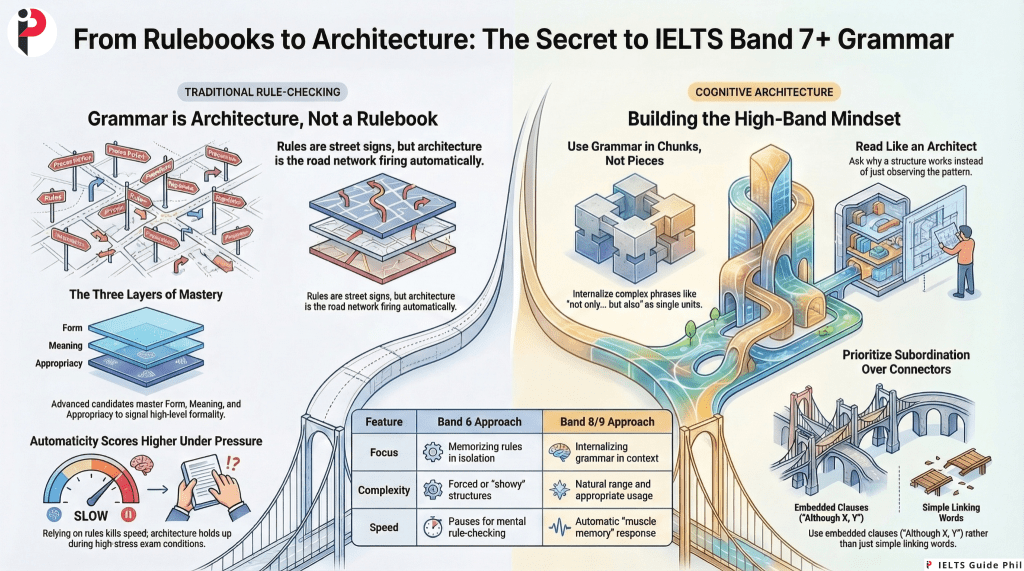
Most IELTS students approach grammar the same way they approach a driving test — memorize the rulebook, pass the exam, then forget everything. But here’s what linguists and cognitive scientists have known for decades: grammar is not a rulebook. It’s architecture.
When you learn that “the past perfect is formed with had + past participle,” you’re reading a description of grammar — like reading a blueprint of a building you’ve never entered. Real grammar mastery is knowing the building so well you could navigate it blindfolded.
This distinction is everything for IELTS Band 7, 8, and 9 performance.
What “Cognitive Architecture” Actually Means
Think of your brain as a city. Rules are street signs. Cognitive architecture is the road network itself — the highways, junctions, one-way streets, and shortcuts that exist whether signs are posted or not.
When a native English speaker says “If I had known, I would have told you,” they’re not consulting a mental rulebook for third conditional formation. The structure fires automatically, like muscle memory. That automaticity is cognitive architecture at work.
For IELTS, this matters because:
- Writing Task 2 rewards grammatical structures that feel natural and varied — not textbook-correct but stilted
- Speaking rewards fluency and spontaneity — you cannot pause to recall rules mid-sentence
- Reading and Listening reward pattern recognition — your brain needs to process structure instantly, not consciously decode it
The 3 Layers of Grammar as Architecture
Layer 1 — Form is what most students study: subject-verb agreement, tense endings, article usage. This is the surface layer. Necessary, but nowhere near sufficient.
Layer 2 — Meaning is where grammar carries information. The difference between “She has been working” and “She worked” isn’t just tense — it’s a different cognitive frame: ongoing relevance vs. completed and closed. IELTS examiners notice when candidates feel this difference versus when they’re guessing.
Layer 3 — Appropriacy is the deepest level: knowing which structure fits which context, register, and rhetorical purpose. A Band 9 candidate writes “Rarely has such a policy generated such controversy” not because they memorized fronting rules, but because they’ve internalized that inversion signals emphasis and formality simultaneously.
✅ DOS: Building Architecture, Not Memorizing Rules
Do read like an architect. When you encounter a sentence structure that strikes you as powerful or elegant, stop. Ask: Why does this work? What is this structure doing that a simpler version couldn’t? This is how you internalize, not just observe.
Do use grammar in chunks, not pieces. The phrase “not only… but also” should live in your head as a single cognitive unit — a prefabricated structure you deploy, not a formula you assemble from parts.
Do notice grammar in context. Watch English-language TED Talks or documentaries and pay attention to how complex structures arise naturally in real communication. This rewires your pattern recognition.
Do write one paragraph daily using one target structure. Not a textbook exercise — your actual opinion on something real. Repeated, meaningful use is how architecture gets built.
Do think in English during the exam. Translation between languages forces you back to rule-checking mode, which kills both speed and naturalness.
❌ DON’TS: Habits That Keep Grammar Superficial
Don’t learn grammar structures in isolation. Memorizing “passive voice = to be + past participle” without knowing why and when English uses passive voice is like memorizing the shape of a key without knowing what door it opens.
Don’t correct yourself out loud in Speaking. Self-correction signals lack of automaticity to the examiner. Build the structure correctly in practice so it fires correctly in the exam.
Don’t overuse complex structures just to show off. Forced complexity is a Band 6 trap. Architecture means knowing when a simple sentence is the right tool. “Climate change is serious” is sometimes more powerful than a contorted attempt at inversion.
Don’t skip the “why.” If your grammar book says “use would to express hypothetical situations,” that’s fine — but ask why English uses this form. The answer (distance from reality maps onto linguistic distance from present tense) builds architecture. The rule alone builds dependency.
Don’t study grammar passively. Reading explanations without producing language is like watching someone build a house and believing you’ve learned construction.
Common Mistakes & How to Fix Them
Mistake 1: Treating articles as random Wrong: “I want to discuss importance of education.” Right: “I want to discuss the importance of education.” The fix: Articles aren’t decorative — they signal whether a noun is already identified in your listener’s mind. Build this concept, don’t memorize lists of exceptions.
Mistake 2: Subject-verb agreement collapse under pressure Wrong: “The number of students who attend university have increased.” Right: “The number of students who attend university has increased.” The fix: Practice identifying the true subject before the verb, especially in sentences with long relative clauses. Make this a reflex.
Mistake 3: Tense inconsistency in essays Wrong: Switching between present and past tense in a discursive argument without reason. Right: Establish a tense logic and stay inside it unless shifting deliberately (e.g., citing past research then returning to present discussion). The fix: Read your essays back aloud. Your ear will catch tense jumps your eye misses.
Mistake 4: Overcomplicating relative clauses Wrong: “The policy which it was introduced in 2010 and which many people have criticized has been abolished.” Right: “The policy introduced in 2010, which many people have criticized, has been abolished.” The fix: Reduced relative clauses are not “simpler” — they’re often more sophisticated. Build comfort with participial phrases.
Mistake 5: Confusing connectors with grammar Wrong: Using “however” and “furthermore” to appear grammatically sophisticated. Right: Using subordination — “Although X, Y” — which is actual grammatical complexity. The fix: IELTS examiners specifically reward a mix of simple, compound, and complex sentences. Connectors between short simple sentences don’t score as highly as embedded subordinate clauses.
Frequently Asked Questions
Q: I know all the grammar rules but keep making mistakes in the exam. Why? A: Because you’re operating at Layer 1 (form) but the exam exposes Layer 3 (automaticity under pressure). Knowledge and architecture are different things. Shift your practice from exercises to production — write and speak grammar into your nervous system.
Q: How long does it take to build genuine grammatical architecture? A: Research in second language acquisition suggests that consistent, meaningful exposure and production over 3–6 months creates noticeable automaticity. There are no shortcuts, but there are efficient paths: comprehensible input slightly above your level, daily output, and noticing (conscious attention to structure in context).
Q: Do IELTS examiners actually notice the difference between “real” grammar and memorized grammar? A: Yes — more than most candidates realize. Examiners are trained to assess “range and accuracy” together. A candidate who attempts advanced structures and fails scores lower than a candidate who uses mid-range structures accurately and fluently. But a candidate who uses advanced structures naturally — that’s Band 8 and 9.
Q: Should I target specific structures for IELTS Writing? A: Yes, but strategically. High-value architectural structures include: fronting and inversion (“Rarely do we see…”), nominalization (“the deterioration of” instead of “things got worse”), conditional variety (mixed, inverted), and participial phrases. Learn these as tools with purposes, not formulas to insert.
Q: My speaking grammar is fine when I practice at home but falls apart in the exam. What’s happening? A: Anxiety loads your working memory, which pushes you back to conscious rule-checking — exactly the mode where automatic architecture breaks down. The solution is high-pressure practice: record yourself, practice with strangers, simulate exam conditions. Architecture must hold under stress, not just comfort.
Q: Is it okay to use simple grammar in IELTS if I’m accurate? A: For a Band 6, yes. For Band 7+, no. The descriptors explicitly require a “variety of complex structures.” Accuracy alone is insufficient at higher bands — range is equally weighted.
The Bottom Line
Grammar rules are a map. Cognitive architecture is knowing the territory. For IELTS success — especially at Band 7 and above — you need to move from reading the map to inhabiting the land. That means producing language, noticing patterns in real texts, building structures as chunks, and trusting that consistent meaningful practice rewires your brain in ways that no grammar drill ever can.
Stop asking “what is the rule?” Start asking “what is this structure doing, and how can I make it mine?”
#IELTSGuidePhil #IELTS #IELTSWriting #IELTSSpeaking #IELTSGrammar #Band7 #Band8 #Band9 #EnglishGrammar #CognitiveLinguistics #IELTSPreparation #LearnEnglish #IELTSTips #AcademicEnglish #GrammarInContext #SecondLanguageAcquisition #IELTSBand9 #EnglishFluency #IELTSSuccess
 IELTS Guide Phil
Leave a comment