
Introduction: When “a coffee” and “some coffee” are both correct
Imagine ordering at a café. You say “Two coffees, please” — and the barista nods. Then your grammar-obsessed friend says “Coffee is uncountable — you can’t say ‘two coffees’!” — and they’re technically wrong. Or are they?
Welcome to one of the most overlooked, frequently misunderstood corners of English grammar: dual-nature nouns — words that can be either countable or uncountable depending on context. These aren’t exceptions or mistakes. They follow a perfectly logical system, once you see it. But until you do, they can trip up even advanced learners and native speakers alike.
This post breaks it all down: what dual-nature nouns are, why they exist, how to use them correctly, and what to do when you’re not sure.
What Are Countable and Uncountable Nouns? (A Quick Refresher)
Before diving in, let’s align on definitions.
Countable nouns refer to discrete, individual items you can count: a chair, two chairs, three apples. They take the indefinite article a/an, can be pluralized, and work with numbers.
Uncountable nouns (also called mass nouns) refer to substances, concepts, or masses treated as a whole: water, advice, music, air. They don’t typically take a/an, don’t pluralize, and pair with quantifiers like some, much, a little.
The twist? English has a large class of words that belong to both categories, depending on what meaning is being expressed.
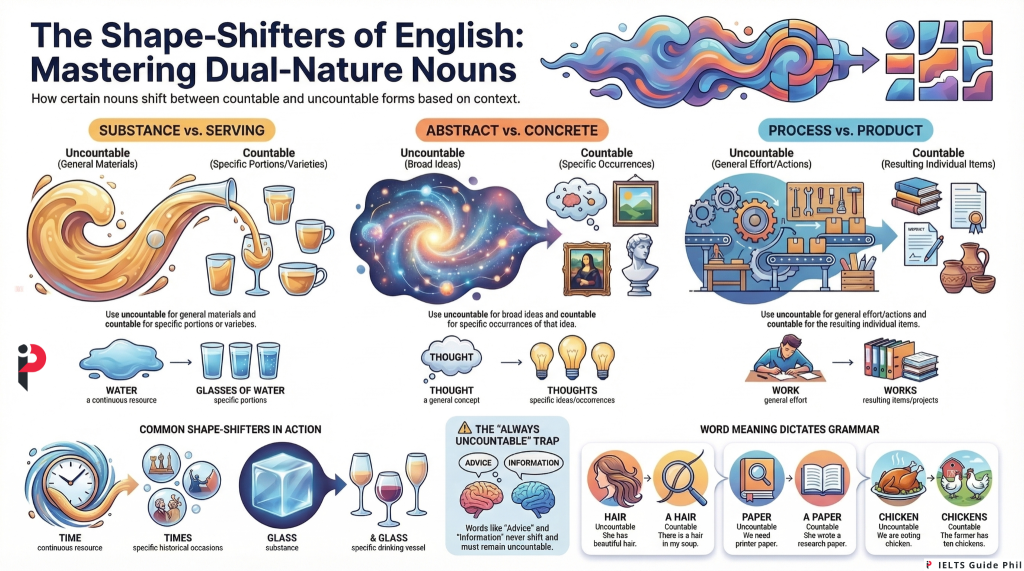
Why Do Some Nouns Shift Between Countable and Uncountable?
The shift isn’t random — it follows three core patterns:
1. General substance vs. specific serving/type When you refer to something as a general material or concept, it’s uncountable. When you refer to a specific portion, instance, or variety, it becomes countable.
2. Abstract concept vs. concrete example An abstract idea is uncountable; a specific occurrence of it is countable.
3. Process vs. product The act of something (uncountable) vs. the result or instance of that act (countable).
Once you internalize these patterns, most dual-nature nouns make perfect sense.
The Most Important Dual-Nature Nouns — With Full Examples
1. Experience
- Uncountable: “She has a lot of experience in marketing.” (general knowledge/skill)
- Countable: “Traveling alone was an experience I’ll never forget.” (a specific event)
- Countable plural: “His experiences in the army changed him.”
2. Coffee / Tea / Beer / Wine
- Uncountable: “I drink coffee every morning.” (the substance)
- Countable: “Can I get two coffees?” (two cups/servings)
- Countable: “They serve twelve beers on tap.” (twelve varieties)
This pattern applies broadly to drinks and foods: wine, tea, juice, cake, chocolate, cheese, bread.
3. Light
- Uncountable: “The room was filled with natural light.” (illumination as a substance)
- Countable: “Turn off the lights before you leave.” (individual light fixtures)
- Countable: “There’s a light at the end of the tunnel.” (a specific source)
4. Hair
- Uncountable: “She has beautiful hair.” (hair as a mass on someone’s head)
- Countable: “There’s a hair in my soup.” (a single strand)
- Countable plural: “A few hairs were left on the pillow.”
5. Paper
- Uncountable: “We’ve run out of paper for the printer.” (the material)
- Countable: “She wrote a paper on climate change.” (an academic document)
- Countable plural: “Sign these papers, please.” (documents)
6. Time
- Uncountable: “I don’t have enough time to finish this.” (time as a continuous resource)
- Countable: “I’ve told you three times already.” (instances/occasions)
- Countable: “We had a wonderful time at the party.” (an experience)
7. Room
- Uncountable: “Is there room for one more person?” (space)
- Countable: “We need to book a room for the night.” (a physical room)
8. Work
- Uncountable: “I have a lot of work to do today.” (tasks/effort in general)
- Countable: “Shakespeare wrote 37 works.” (individual creations/pieces)
- Countable: “This sculpture is a brilliant work of art.” (a specific piece)
9. Life
- Uncountable: “Life is full of surprises.” (existence in the abstract)
- Countable: “She lived a long life.” (one person’s lifetime)
- Countable plural: “Nine lives — that’s what cats supposedly have.”
10. Noise
- Uncountable: “There’s too much noise in here.” (sound as a mass)
- Countable: “I heard a strange noise last night.” (a specific sound event)
11. Glass
- Uncountable: “The table is made of glass.” (the material)
- Countable: “He dropped a glass on the floor.” (a drinking vessel)
- Countable plural: “She wears glasses.” (eyewear)
12. Iron
- Uncountable: “The gate is made of iron.” (the metal)
- Countable: “Use an iron to remove the creases.” (a clothes iron)
13. Chicken
- Uncountable: “We’re having chicken for dinner.” (the meat)
- Countable: “The farmer has twenty chickens.” (the animals)
14. Difficulty
- Uncountable: “She completed the task with some difficulty.” (the abstract quality)
- Countable plural: “They faced many difficulties during the project.” (specific problems)
15. Beauty
- Uncountable: “The beauty of the landscape was breathtaking.” (an abstract quality)
- Countable: “She was considered a great beauty in her era.” (a beautiful person)
Dos and Don’ts
✅ DO
- Do consider what meaning you’re conveying before choosing countable or uncountable usage. Ask yourself: am I talking about the substance/concept in general, or a specific instance, serving, or type?
- Do use a/an and plurals when referring to a specific instance or variety: a noise, two coffees, three works of art.
- Do use quantifiers like some, much, a little, a lot of when using the uncountable form: some paper, not much room, a little time.
- Do check whether the context makes the meaning clear. A good test: can you replace the word with “an instance/type/portion of [noun]”? If yes, go countable.
- Do use the uncountable form for general truths or philosophical statements: Life is short. Beauty fades. Time heals all wounds.
❌ DON’T
- Don’t assume that because a noun is “usually” uncountable, it can never be countable. Context determines everything.
- Don’t over-apply the countable form in formal writing when the general concept is meant: ❌ “I need an advice” (advice is always uncountable — a common overgeneralization).
- Don’t confuse the shift with incorrect grammar. “Two beers, please” is completely standard English — not a mistake.
- Don’t use the uncountable form when referring to physical, countable objects: ❌ “She has beautiful hair in her soup” — when you mean a strand, use a hair.
- Don’t forget that some words look like they should shift but don’t. Advice, furniture, luggage, information are always uncountable — no exceptions.
Common Mistakes and How to Fix Them
Mistake 1: “I need an experience to put on my résumé.” This is almost always wrong in a professional context. “Experience” meaning general skill and exposure is uncountable.
✅ Fix: “I need experience to put on my résumé.” (Exception: “That internship was a great experience” is fine — referring to a specific event.)
Mistake 2: “There are too many noises in this city.” While technically possible if referring to distinct individual noise events, it sounds unnatural in this context.
✅ Fix: “There is too much noise in this city.” Reserve the countable form for specific, distinct sounds: “I heard three strange noises.”
Mistake 3: “She has many beautiful hairs.” In English, “hair” as a mass (the hair on your head) is uncountable.
✅ Fix: “She has beautiful hair.” Use countable only for individual strands: “There are a few hairs on the seat.”
Mistake 4: “We don’t have many room for the guests.” “Room” meaning space is uncountable — it doesn’t take “many.”
✅ Fix: “We don’t have much room for the guests.”
Mistake 5: Treating “time” as always uncountable Learners often avoid the countable form of “time” out of habit.
❌ “I have told you much time to be careful.”
✅ Fix: “I have told you many times to be careful.” (Instances and occasions = countable.)
Mistake 6: “Please give me an information about the flight.” “Information” is a false friend for learners of Romance languages (informations in French/Italian/Spanish). It is always uncountable in English.
✅ Fix: “Please give me some information about the flight.” Or: “Please give me a piece of information about the flight.”
Frequently Asked Questions
Q: How do I know if a noun is a dual-nature noun or just always uncountable? A: The best approach is to look it up in a reliable dictionary like Oxford or Cambridge, which mark nouns as [C] (countable), [U] (uncountable), or [C/U] (both). Over time, you’ll internalize the patterns. Some permanently uncountable nouns to memorize: advice, furniture, luggage, equipment, information, news, progress, homework, knowledge.
Q: Is it wrong to say “two coffees” in a formal report? A: In formal written English, you might prefer “two cups of coffee,” but “two coffees” is widely accepted even in semi-formal contexts. It’s not grammatically incorrect — it’s a recognized countable use referring to servings or types.
Q: Can I say “a work” when talking about someone’s creative output? A: Yes. “This painting is a significant work.” or “She produced several major works.” However, “I have a lot of work to do” uses the uncountable form, referring to tasks or effort.
Q: Why does “chicken” shift but “beef” doesn’t pluralize the same way? A: “Chicken” refers to both the animal (countable) and the meat (uncountable). “Beef” only refers to the meat, so it stays uncountable. The animal it comes from (cattle/cows) is a different word. English isn’t always consistent here — pork, lamb, and veal are also meat-only uncountable nouns, while “duck” and “turkey” behave like “chicken” and can be either.
Q: What about “a beer” vs. “some beer”? A: Both are correct. “Some beer” refers to the beverage as a substance. “A beer” or “three beers” refers to servings (glasses/bottles) or varieties (types of beer). Context makes the meaning clear.
Q: Are these shifts the same across all varieties of English (UK, US, Australian)? A: Mostly yes, though some regional differences exist. For instance, “I play sport” (British) vs. “I play sports” (American). These differences are minor and unlikely to cause misunderstanding.
Q: How do I teach this concept to language learners? A: Start with concrete, tangible examples like food and drink — “coffee,” “chicken,” “cake” — where the switch between substance and serving/type is intuitive. Then progress to more abstract shifts like “experience,” “beauty,” and “work.” Use real-world examples and don’t rush to abstract rules before establishing the concrete pattern.
Quick Reference Cheat Sheet
| Word | Uncountable Use | Countable Use |
|---|---|---|
| coffee | I drink coffee daily | Two coffees, please |
| experience | She has experience | It was a great experience |
| hair | She has red hair | There’s a hair in my food |
| time | I need more time | She called three times |
| room | There’s no room left | Book a hotel room |
| paper | Print on paper | Write a research paper |
| work | I have work to do | Shakespeare’s works |
| glass | The vase is glass | He dropped a glass |
| light | Let in more light | Turn off the lights |
| noise | Too much noise | A strange noise |
| life | Life is beautiful | She lived a long life |
| chicken | Grilled chicken | Five chickens in the yard |
| beauty | The beauty of nature | She was a beauty |
| iron | An iron fence | Pass me the iron |
Final Thought: Embrace the Fluidity
English nouns are not rigidly countable or uncountable — they’re context-sensitive. The same word can shift meaning and grammatical behavior depending on whether you’re talking about a concept or an instance, a substance or a serving, an idea or its embodiment. This fluidity isn’t a flaw in the language; it’s a feature that allows for precision and nuance.
The key is to ask, every time: What do I mean right now — the general thing, or a specific instance of it? Answer that, and the grammar will follow naturally.
#IELTSGuidePhil #EnglishGrammar #LearnEnglish #ESL #EFL #EnglishTeaching #GrammarTips #CountableNouns #UncountableNouns #MassNouns #EnglishLanguage #GrammarNerd #EnglishLearners #TEFL #TESOL #LanguageLearning #EnglishVocabulary #GrammarHelp #WritingTips #BusinessEnglish #AcademicEnglish #EnglishTeacher #LanguageTeaching #GrammarRules #WordUsage #EnglishFluency
 IELTS Guide Phil
Leave a comment