
If you have ever written a sentence like “The implementation of the utilisation of renewable resources requires the consideration of environmental factors” and felt oddly proud of how academic it sounded — this post is an intervention.
Nominalisation is one of the most misunderstood tools in academic writing. IELTS candidates either avoid it entirely (missing out on Band 7+ vocabulary range) or weaponise it indiscriminately (turning perfectly clear ideas into verbal quicksand). Today, we untangle exactly when to use it, when to kill it, and how to tell the difference.
What Even Is Nominalisation?
Nominalisation is the process of converting a verb, adjective, or other word class into a noun (or noun phrase).
Examples of the transformation:
- decide → decision
- grow → growth
- significant → significance
- pollute → pollution
- fail → failure
- investigate → investigation
So instead of writing “Scientists investigated the effects,” you might write “The investigation of the effects revealed…”
Simple enough. The danger is in when you make that swap.
When Nominalisation IMPROVES Clarity ✅
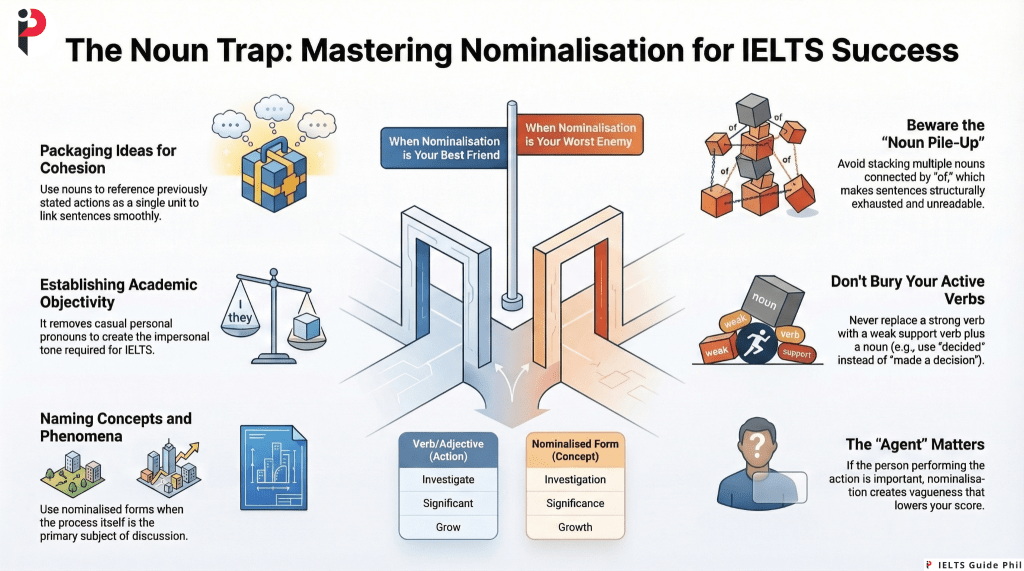
1. When You Need to Reference a Previously Stated Action as a Topic
This is nominalisation at its finest. It allows you to package a complex idea and then discuss it as a single unit.
Example:
“Many cities have begun restricting car usage in urban centres. This restriction has proven controversial among commuters.”
Without nominalisation, you would write the clumsy: “This restricting cars has proven controversial,” which sounds awkward and loses academic register instantly.
The IELTS payoff: This technique helps you create cohesion — one of the four marking criteria — by linking sentences and paragraphs smoothly.
2. When the Process or Concept Itself Is the Subject of Discussion
Sometimes the action is not what matters — the phenomenon is.
Example:
“Urbanisation has accelerated dramatically over the past five decades.”
You are not discussing who is urbanising or how. You are discussing urbanisation as a force. The nominalised form is not just acceptable here — it is the correct choice.
3. When You Want to Sound Objective or Impersonal (Academic Tone)
Academic writing often requires you to discuss processes without attributing them to specific actors — particularly in Task 1 when describing graphs or in Task 2 when discussing societal trends.
Weaker (too personal/journalistic):
“People consume more energy because they use more devices.”
Stronger (academic register):
“Increased consumption of energy reflects growing dependence on electronic devices.”
The nominalised version removes the casual people…they construction and raises the register considerably — exactly what Band 7–9 demands.
4. When Condensing a Complex Clause Into a Concise Subject
Wordy version:
“That the government failed to invest in public transport led to serious congestion problems.”
Nominalised, cleaner version:
“The government’s failure to invest in public transport led to serious congestion problems.”
One nominalisation trimmed that sentence meaningfully without losing any information.
When Nominalisation KILLS Readability ❌
1. When It Buries the Real Verb
Every sentence needs a strong, active verb as its engine. When you nominalise the main action and replace it with a weak support verb (make, give, have, do, conduct, carry out), your sentence loses all its energy.
Nominalisation overkill:
“The committee made a recommendation for the implementation of stricter regulations.”
What it should say:
“The committee recommended stricter regulations.”
Nine words instead of fifteen, and dramatically clearer. The examiner does not admire length — they admire precision.
2. When It Creates Chains of Nouns (Noun Pile-Ups)
This is the most common IELTS mistake related to nominalisation. Candidates stack noun after noun, connected by of, creating sentences that resemble legal disclaimers.
The noun pile-up:
“The consideration of the implementation of the privatisation of water supply management requires careful examination.”
No human being has ever enjoyed reading that sentence. There is no verb doing real work. The sentence is structurally exhausted before it reaches its point.
Unpacked and readable:
“Privatising water supplies requires careful thought about how the process would be managed.”
3. When the Agent (Who Does the Action) Matters
If it is important to know who did something, nominalisation hides that information and creates vagueness — which lowers your score for task achievement and coherence.
Vague:
“The implementation of educational reforms caused widespread debate.”
Clear:
“When the government implemented educational reforms, teachers and parents debated the changes widely.”
The second sentence is more informative, more human, and easier to read.
4. When You Are Writing Straightforward Narrative or Argument
In the introduction and conclusion of a Task 2 essay, you want directness and impact. Over-nominalised opening sentences create distance between your argument and the reader.
Off-putting opening:
“The consideration of the advantages and disadvantages of the usage of technology in educational environments requires thorough examination.”
Engaging opening:
“Technology is transforming education, but whether this transformation benefits students more than it harms them remains a genuinely contested question.”
The Golden Rule (Save This)
Nominalise the concept. Keep the action verbal.
In other words: use nouns to name things (phenomena, trends, processes), and use strong verbs to describe what happens. Never nominalise your main verb just to sound academic.
Dos and Don’ts at a Glance
DO use nominalisation to package a previously mentioned idea for cohesion (“This growth suggests…”).
DO nominalise when the phenomenon itself is the topic (urbanisation, globalisation, inflation).
DO use it to achieve an appropriately impersonal academic tone in Task 1 and Task 2.
DO nominalise when it genuinely shortens and sharpens a sentence.
DON’T chain more than two nominalisations together in a single clause.
DON’T replace a strong verb with a nominalisation + weak verb (made a decision instead of decided).
DON’T use nominalisation when the actor performing the action is important to your argument.
DON’T treat nominalisation as a synonym for “sounding smart.” Clarity is the real intelligence.
Common Mistakes and How to Fix Them
Mistake 1: Nominalising everything in a panic “There was a significant improvement in the achievement of students following the implementation of new teaching methods.” Fix: “Students achieved significantly more after teachers introduced new methods.”
Mistake 2: Confusing formality with complexity Many candidates think that more nominalisations = higher band score. The IELTS marking rubric rewards appropriate complexity, not maximum complexity. Fix: Read your sentence aloud. If you stumble, restructure it.
Mistake 3: Forgetting articles with nominalisations Because nominalisations create abstract nouns, candidates often drop articles incorrectly. Wrong: “Implementation of policy is difficult.” Correct: “The implementation of this policy is difficult.” or “Implementing the policy is difficult.”
Mistake 4: Using nominalisation in place of a conjunction Wrong: “There was an increase in demand. This resulted in a rise in prices.” (two choppy sentences) Better: “Rising demand drove prices upward.” or “As demand increased, prices rose.”
Frequently Asked Questions
Q: Will using nominalisation automatically give me a higher band score? Not automatically, no. Nominalisation contributes to your Lexical Resource and Grammatical Range scores — but only when used correctly. Incorrect or excessive use actively harms your Coherence and Cohesion score and makes your Task Achievement harder to assess. The examiner is looking for control, not quantity.
Q: How many nominalisations should I aim for per paragraph? There is no magic number, but a useful benchmark is one or two per paragraph — used purposefully. If you find four or five in a single paragraph, read it critically and ask whether each one genuinely serves the reader or just serves your anxiety about sounding academic.
Q: Is nominalisation more important for Task 1 or Task 2? Both tasks reward it, but for different reasons. In Task 1, nominalisation helps you describe trends objectively (growth, decline, fluctuation, stabilisation). In Task 2, it helps you discuss ideas with appropriate abstraction (inequality, marginalisation, globalisation). The trap of over-nominalisation is more common in Task 2, where candidates feel pressure to sound argumentative and intellectual.
Q: My teacher told me to avoid passive voice. Is nominalisation different? Yes, they are distinct techniques, though both can create impersonal tone. Passive voice changes the verb structure (was investigated). Nominalisation changes the word class entirely (investigation). Both have legitimate uses in academic writing, and both can become problematic when overused. The advice to avoid passive voice is often overstated — what your teacher likely meant was do not hide behind passives when you need to make a clear argument.
Q: How do I know if my nominalisation is helping or hurting a sentence? Apply the verb test: find the nominalisation and ask — is there a stronger verb hiding inside it? If the implementation of could simply be implementing, and the sentence is clearer with the verb, make the swap. If the nominalised form allows you to make the sentence more concise and connected, keep it.
Q: Can I practise nominalisation recognition? Absolutely. Take any newspaper editorial or quality magazine article and highlight every abstract noun ending in -tion, -ment, -ance, -ence, -ity, -ism, -al. Then ask, for each one: is the author using this because the concept needs naming, or because an action needs describing? That distinction will sharpen your instinct faster than any grammar drill.
A Final Thought
The most sophisticated IELTS writers are not the ones who use nominalisation most — they are the ones who know precisely when to stop. An essay that alternates between vivid, active verbs and well-placed abstract nouns reads with rhythm and intelligence. An essay that nominalises relentlessly reads like a policy document nobody asked for.
Use nominalisation as a scalpel, not a sledgehammer.
#IELTSGuidePhil #IELTS #IELTSWriting #IELTSTask2 #IELTSTask1 #Nominalisation #AcademicWriting #IELTSBand7 #IELTSBand8 #IELTSBand9 #LexicalResource #EnglishGrammar #IELTSTips #WritingSkills #AcademicEnglish #IELTSPreparation #EnglishWriting #GrammarTips #IELTSCoaching #HighBandScore #EnglishLearning
 IELTS Guide Phil
Leave a comment