
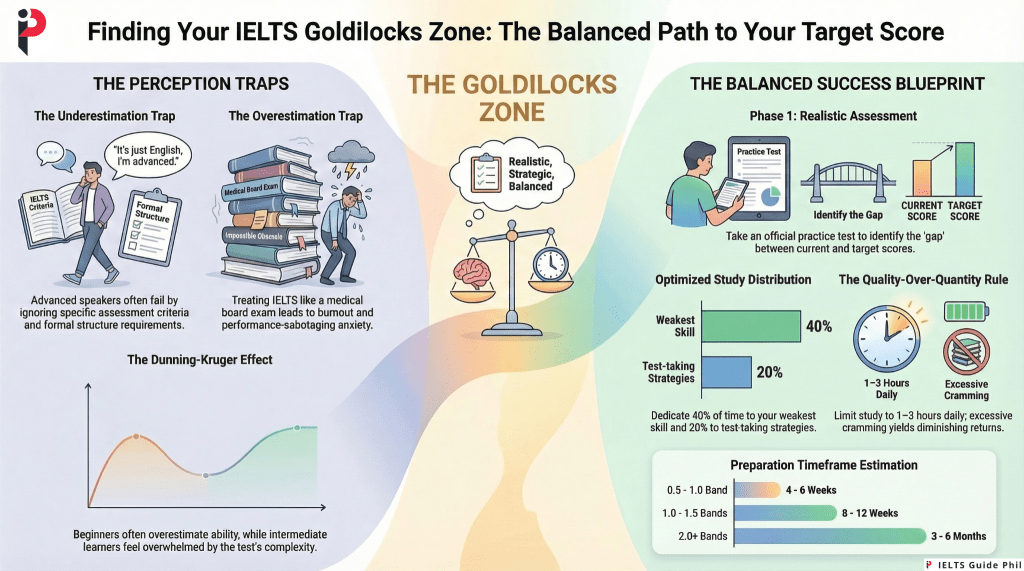
If you’re preparing for IELTS, you’ve probably experienced both extremes: panic-scrolling through horror stories of people failing despite months of preparation, then swinging to overconfidence after acing a few practice tests. The truth? IELTS is neither the impossible monster nor the easy walkthrough that test-takers often imagine. Finding the balance between underestimation and overestimation isn’t just helpful—it’s essential for achieving your target score.
Understanding the Two-Sided Coin of IELTS Perception
The Underestimation Trap: “It’s Just English, Right?”
Many test-takers, particularly native speakers or those with advanced English skills, walk into IELTS thinking it’s a casual conversation about the weather. They assume that years of speaking English automatically translate to a Band 8 or 9. This dangerous mindset ignores a critical reality: IELTS doesn’t just test your English—it tests your ability to perform specific academic and communicative tasks under strict conditions.
Real-world example: Sarah, a Canadian who moved to the UK, needed IELTS for her nursing registration. As a native speaker, she booked her test without preparation, confident she’d score 7.5+ easily. Her result? Band 6.5 overall, with a devastating 6.0 in Writing. Why? She didn’t understand the assessment criteria, wrote informally, and failed to structure her Task 2 essay properly. She had to retake the test (£200+ lost) and delay her career plans by three months.
The Overestimation Trap: “I Need Two Years and Fifty Practice Books”
On the flip side, some candidates treat IELTS like it’s the Bar exam or medical boards. They invest enormous amounts of time, money, and emotional energy, often burning out before test day. They memorize thousands of vocabulary words they’ll never use, complete hundreds of practice tests, and develop test-day anxiety that sabotages their actual performance.
Real-world example: Raj spent 18 months preparing for IELTS, completing every Cambridge book available and taking weekly classes. He could recite collocations in his sleep and had memorized templates for every possible question type. On test day, his anxiety was so overwhelming that he blanked during Speaking Part 2 and rushed through his Writing tasks. His score: 6.5—exactly what he’d been getting in practice tests six months earlier. The extra year of “preparation” had actually decreased his confidence.
Why Balance Matters: The Science of Optimal Preparation
Research in educational psychology shows that both underpreparation and overpreparation lead to suboptimal performance. The sweet spot—what psychologists call “optimal arousal”—occurs when you’re adequately prepared, realistically confident, and appropriately focused.
The Dunning-Kruger Effect in IELTS
The Dunning-Kruger effect explains why beginners often overestimate their abilities while those with intermediate knowledge underestimate theirs. In IELTS terms:
- Low English level: Often unaware of how much they don’t know
- Intermediate level: Suddenly aware of the complexity, may feel overwhelmed
- Advanced level: Better able to assess abilities realistically
Understanding where you fall on this curve helps calibrate your preparation timeline and expectations.
The Realities of IELTS: What It Actually Tests
What IELTS IS:
- A standardized assessment of four English skills with specific criteria
- Predictable in format but variable in content
- Achievable for most with 4-12 weeks of focused preparation (depending on current level)
- Skills-based, meaning you can learn and improve test-taking strategies
- Fair but strict in its marking standards
What IELTS IS NOT:
- A measure of intelligence or your worth as a person
- Impossible even for non-native speakers (millions achieve 7.0+ annually)
- Purely about vocabulary or grammar knowledge
- The same as conversational fluency or academic English ability
- A test you can “hack” without genuine language skills
The Balanced Approach: Your IELTS Preparation Strategy
Phase 1: Realistic Assessment (Week 1)
Do This:
- Take one complete official practice test under timed conditions
- Get Writing and Speaking tasks evaluated by a qualified tutor or official marking service
- Identify your actual band score in each section
- Calculate the gap between current score and target score
Don’t Do This:
- Guess your level based on “feeling” or classroom performance
- Compare yourself to friends or online stories
- Skip the assessment and jump into random practice
- Use non-official materials for your diagnostic test
Phase 2: Strategic Planning (Week 1-2)
Calculate Your Timeline:
- Need 0.5-1.0 band increase: 4-6 weeks of focused preparation
- Need 1.0-1.5 band increase: 8-12 weeks of structured study
- Need 2.0+ band increase: 3-6 months plus possible coursework
Build Your Study Plan:
- Daily commitment: 1-2 hours for working professionals, 3-4 hours for full-time students
- Skills distribution: 40% on weakest skill, 20% each on other skills, 20% on test strategies
- Practice test frequency: Weekly in early stages, twice weekly in final two weeks
Phase 3: Skill Development (Bulk of Preparation)
For Each Skill:
Listening:
- Reality check: You don’t need to understand every word; you need to identify key information
- Underestimators miss: The variety of accents and the need to practice specific question types
- Overestimators waste time on: Listening to random podcasts without targeted practice
- Balanced approach: 30 minutes daily of official IELTS practice + accent exposure through TED Talks/BBC
Reading:
- Reality check: It’s not about reading speed; it’s about scanning and skimming strategically
- Underestimators miss: The academic vocabulary and complex sentence structures
- Overestimators waste time on: Memorizing obscure vocabulary instead of practicing techniques
- Balanced approach: Three passages weekly, focusing on question type strategies and time management
Writing:
- Reality check: This is where most people score lower than expected
- Underestimators miss: The strict assessment criteria (Task Achievement, Coherence, Lexical Resource, Grammatical Range)
- Overestimators waste time on: Memorizing essays and learning fancy vocabulary they can’t use naturally
- Balanced approach: Two Task 1s and two Task 2s weekly, with professional feedback on at least 4 essays total
Speaking:
- Reality check: It’s a conversation with structure, not a memorized speech contest
- Underestimators miss: The need to extend answers and use specific discourse markers
- Overestimators waste time on: Learning scripts that sound robotic and preparing for every possible topic
- Balanced approach: Daily 15-minute practice with focus on fluency, using a speaking app or language partner
Common Mistakes and How to Fix Them
Mistake #1: “I’ll just wing it—I speak English every day”
The Problem: Daily English and test English require different skills. IELTS Writing demands formal register and specific structures. IELTS Speaking requires you to speak for 2 minutes without notes.
The Fix:
- Spend 2-3 weeks minimum learning test format and requirements
- Practice timed tasks even if your English is advanced
- Get familiar with assessment criteria
Mistake #2: “I need to score 9.0 in everything”
The Problem: Even native speakers rarely score 9.0 across all sections. Aiming for perfection creates unnecessary pressure and wastes time on marginal gains.
The Fix:
- Identify your required overall and section scores
- Allocate energy proportionally (e.g., if you need 7.0 overall but 6.5 in each skill is sufficient, don’t kill yourself trying for 8.0s)
- Accept that Band 7.0-8.0 is excellent and achieves most goals
Mistake #3: “I’ll study 8 hours a day for three months”
The Problem: IELTS preparation has diminishing returns. Excessive study leads to burnout, anxiety, and actually worse performance.
The Fix:
- Study 1-3 hours daily maximum
- Include rest days in your schedule
- Focus on quality practice with feedback, not quantity
- Maintain normal life activities to reduce stress
Mistake #4: “Practice tests are enough”
The Problem: Taking tests without analyzing mistakes or learning strategies is like running on a treadmill—lots of effort, no progress.
The Fix:
- Review every practice test thoroughly
- Identify patterns in your mistakes
- Learn specific strategies for each question type
- Get expert feedback on productive skills (Writing and Speaking)
Mistake #5: “I scored Band 8 in practice, so I’ll definitely get that on test day”
The Problem: Practice test conditions differ from real tests. Nerves, unfamiliar topics, and stricter timing can affect performance.
The Fix:
- Expect your real score to be 0.5 bands lower than consistent practice scores
- Simulate real test conditions (including stress) in your practice
- Book your test only when you’re consistently scoring 0.5-1.0 above your target
Mistake #6: “I failed once, so I’m terrible at English”
The Problem: IELTS scores fluctuate based on many factors. One score doesn’t define your ability.
The Fix:
- Analyze what went wrong specifically
- Address those gaps in a focused retake preparation (usually 3-4 weeks)
- Remember that many successful test-takers needed 2-3 attempts
The Perfect Preparation Timeline: A Balanced Example
8-Week Plan for Intermediate to Upper-Intermediate Level (Current Band 5.5-6.5, Target 7.0)
Weeks 1-2: Foundation and Reality Check
- Take official practice test
- Learn test format and assessment criteria
- Identify weakest skills
- Start daily skill-building activities
Weeks 3-5: Intensive Skill Development
- Focused practice on each skill with technique learning
- Weekly mini-practice tests for each section
- First batch of Writing feedback (2-3 essays)
- Speaking practice 4-5 times per week
Weeks 6-7: Test Simulation and Refinement
- Two full practice tests under real conditions
- Final Writing feedback (2-3 essays)
- Mock Speaking tests with timer
- Review all past mistakes systematically
Week 8: Confidence Building and Maintenance
- Light practice only (one section per day)
- Review strategies and common mistakes
- Rest adequately before test day
- Prepare logistics (documents, location, equipment)
Dos and Don’ts: Your Quick Reference Guide
The Golden DOs:
✅ DO take at least one official practice test before starting preparation
✅ DO get professional feedback on Writing and Speaking (minimum 2-3 times)
✅ DO learn the specific assessment criteria for each section
✅ DO practice under timed, realistic conditions
✅ DO focus extra time on your weakest skill
✅ DO prepare 4-12 weeks depending on your score gap
✅ DO maintain normal life balance and sleep schedule
✅ DO arrive at the test center early and well-rested
✅ DO use official Cambridge IELTS materials for practice
✅ DO expect some nervousness—it’s normal and manageable
The Critical DON’Ts:
❌ DON’T book your test without knowing your current level
❌ DON’T rely solely on free YouTube videos and apps
❌ DON’T memorize essays or speaking answers
❌ DON’T study for more than 3-4 hours daily (diminishing returns)
❌ DON’T compare your preparation to others—everyone’s different
❌ DON’T use practice test scores as gospel—they’re estimates
❌ DON’T ignore Speaking and Writing while focusing only on Listening/Reading
❌ DON’T cram the day before—you’ll just increase anxiety
❌ DON’T give up after one unsuccessful attempt
❌ DON’T pay for expensive “guaranteed score” courses (they don’t exist)
Test Day: The Reality Check
What to Actually Expect:
The Environment:
- May be noisier or quieter than expected
- Temperature might be uncomfortable
- Other test-takers will finish at different times
- Equipment (headphones for Listening) varies by center
Your Performance:
- You might feel it went terribly (most people do)
- One section might go worse than others (completely normal)
- You may not remember all your answers (that’s fine)
- The Speaking examiner’s demeanor doesn’t reflect your score
The Aftermath:
- You’ll obsess over what you said/wrote (everyone does)
- You’ll think you failed (most people feel this way)
- Your actual score often surprises you (hopefully positively)
- Results take 3-13 days depending on test format
Frequently Asked Questions
Q1: “I’m a native English speaker. Do I still need to prepare?”
A: Yes, but differently. You need 1-2 weeks to learn test format, understand assessment criteria, and practice Writing task types. Native speakers often struggle with Writing because they write conversationally instead of academically. Don’t skip preparation—learn what the test wants.
Q2: “How much should I spend on IELTS preparation?”
A: Balanced approach:
- Minimum: £50-100 for official Cambridge books and one Writing evaluation
- Moderate: £200-400 for books + 4-6 tutor sessions for feedback
- Maximum: £500-800 for a structured course (only if you need significant improvement)
Don’t spend thousands—it’s unnecessary. The test costs £150-250; your prep shouldn’t cost five times that unless you’re improving by 2+ bands.
Q3: “How many practice tests should I complete?”
A: 6-10 complete tests is optimal. More than 15 is overkill unless you’re reviewing them thoroughly. Quality over quantity—one test properly analyzed is worth five tests rushed through.
Q4: “My practice scores are Band 7.5 but I need 8.0. Should I take the test?”
A: Yes. If you consistently score 7.5 in practice, you have a good chance of getting 7.5-8.0 on test day. The 0.5 band gap accounts for test-day variables. However, if you consistently score 6.5 and need 8.0, wait and prepare more.
Q5: “I failed my first attempt. How long should I wait to retake?”
A: Depends on the gap:
- Got 6.0, need 6.5: Retake in 3-4 weeks with focused practice
- Got 6.0, need 7.5: Wait 8-12 weeks and address fundamental gaps
- Got 5.0, need 7.0: Consider 3-6 months or even formal English coursework
Don’t retake immediately without addressing specific weaknesses—you’ll likely get the same score.
Q6: “Should I do IELTS Academic or General Training?”
A: This isn’t about which is easier (they’re scored identically). Check your requirement:
- Academic: University admission, professional registration requiring academic English
- General Training: Immigration, work experience, secondary school
Taking the wrong one means your score is invalid for your purpose. Double-check before booking.
Q7: “Can I improve my score by 2 bands in one month?”
A: Unlikely unless you’re currently underperforming significantly due to lack of test familiarity. Realistic expectations:
- 1 month: 0.5-1.0 band improvement possible
- 2-3 months: 1.0-1.5 band improvement realistic
- 6 months: 2.0+ band improvement achievable with consistent work
Miracles don’t happen, but strategic improvement does.
Q8: “Is British English or American English better for IELTS?”
A: Both are equally accepted. Use whichever you’re most comfortable with, but be consistent. Don’t mix spellings (colour vs color) within the same essay. The examiners are trained to accept all major English variants.
Q9: “What’s a realistic score for someone with intermediate English?”
A: If you’re truly intermediate (can hold conversations, understand most daily content, write basic texts):
- Current level: Band 5.0-6.0
- With 2-3 months preparation: Band 6.5-7.0 realistic
- Band 8.0+: Requires advanced proficiency, achievable with 6-12 months dedicated study
Q10: “Should I take computer-delivered or paper-based IELTS?”
A: Personal preference, not difficulty:
- Computer-delivered: Faster results (3-5 days), easier editing in Writing, good for fast typists
- Paper-based: Better for those who think while physically writing, results in 13 days
Your score will be the same. Choose based on your comfort level with typing vs handwriting under pressure.
The Mindset That Gets Results
Confidence Without Arrogance
The most successful IELTS candidates maintain what psychologists call “realistic optimism”:
- They believe they can achieve their target with proper preparation
- They acknowledge the challenge without being intimidated by it
- They prepare strategically without obsessing
- They perform calmly because they trust their preparation
From Sarah’s Redemption Story:
Remember Sarah, the Canadian nurse who scored 6.5 on her first attempt? She retook the test after three weeks of focused Writing practice, learning assessment criteria, and completing six timed essays with feedback. Second attempt: Band 7.5 overall, 7.0 in Writing. She didn’t transform her English—she learned what the test wanted and delivered it.
From Raj’s Balance Story:
Raj, after his anxiety-filled first attempt, took a different approach. He worked with a psychologist on test anxiety, reduced his study time to 90 minutes daily, and focused on simulating test conditions. Second attempt (three months later): Band 7.5 overall. Less preparation time, better results. Why? He found his Goldilocks Zone.
Your Action Plan: Starting Today
This Week:
- Take one official practice test (Cambridge IELTS 14-19)
- Calculate your current band scores realistically
- Identify the gap to your target score
- Book your real test 6-12 weeks from now (creates healthy pressure)
This Month:
- Learn assessment criteria for all four skills
- Complete skill-building exercises daily (1-2 hours)
- Get feedback on 2-3 Writing tasks
- Practice Speaking 4-5 times per week
Before Test Day:
- Complete 6-10 full practice tests
- Review all mistakes systematically
- Simulate test conditions (noise, time pressure, sitting duration)
- Rest adequately the day before
Final Thoughts: Finding Your Goldilocks Zone
IELTS is neither a walk in the park nor climbing Mount Everest. It’s a manageable challenge that rewards strategic preparation, realistic self-assessment, and balanced confidence. The test-takers who succeed aren’t necessarily those with the best English or those who study the longest—they’re the ones who find that perfect middle ground.
You don’t need to be perfect. You don’t need to memorize dictionaries. You don’t need to study until you burn out. You need to understand what the test measures, practice those specific skills, and show up prepared but not paralyzed by anxiety.
Your English is probably better than you think when you’re feeling discouraged, and not quite as test-ready as you assume when you’re feeling confident. That’s the paradox of IELTS preparation—and understanding this paradox is the first step to acing the test.
Remember: IELTS is not a reflection of your intelligence, your worth, or even your “real” English ability. It’s a standardized test with specific requirements. Learn them, practice them, and perform them. That’s the secret—and it’s simpler than you think, yet requires more specific preparation than you might assume.
Find your Goldilocks Zone. Not too hot, not too cold—just right.
#IELTS #IELTSGuidePhil #IELTSPreparation #IELTSTips #IELTSWriting #IELTSSpeaking #IELTSReading #IELTSListening #IELTSExam #IELTSTest #EnglishTest #StudyAbroad #IELTSScore #Band7 #Band8 #IELTSHelp #IELTSAdvice #TestPreparation #EnglishLearning #ESL #TESOL #ImmigrationTest #UniversityAdmission #IELTSAcademic #IELTSGeneralTraining #TestTakingStrategies #StudyTips #IELTSSuccess #IELTSMotivation #LearnEnglish #EnglishExam #IELTSStudy #LanguageLearning #IELTSCoaching #TestDay #IELTSGoals #AchieveYourGoals #IELTSCommunity
About This Guide: This comprehensive blog post draws on educational psychology research, standardized testing principles, and real experiences from thousands of IELTS test-takers. While every candidate’s journey is unique, the balanced approach outlined here has helped countless students achieve their target scores without unnecessary stress or wasted time.
Remember: Your IELTS journey is personal. Take what resonates, adapt to your situation, and most importantly—trust the process while staying realistic about both the challenge and your capabilities.
Good luck, and may you find your perfect Goldilocks Zone!
 IELTS Guide Phil
Leave a comment