
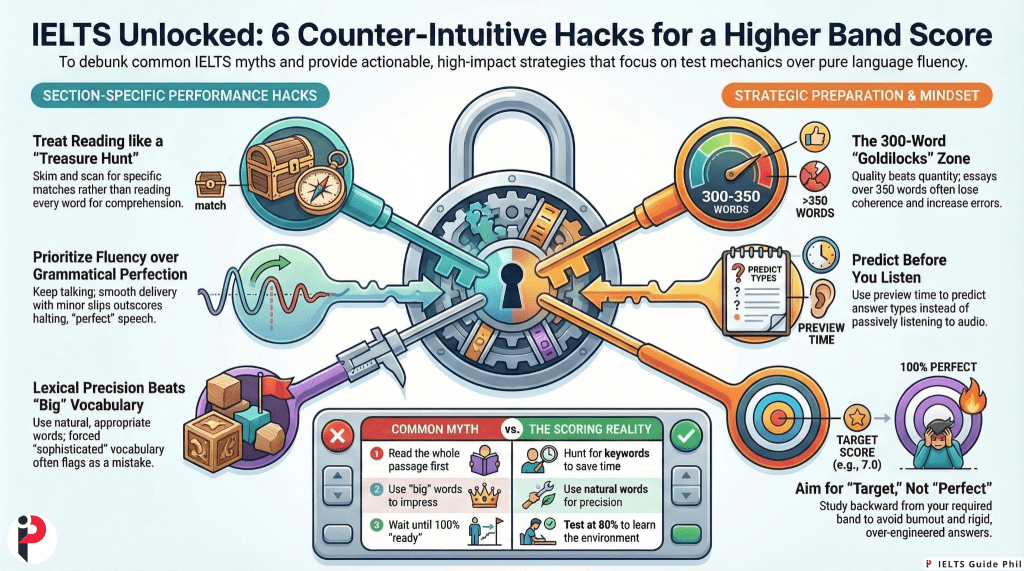
The conventional wisdom around IELTS prep is full of well-meaning myths. Here’s the uncomfortable truth that high-scorers figured out — often too late.
1. Don’t Aim for a Perfect Score
Sounds wrong because: More ambition = better results, right?
Why it actually makes sense: Aiming for 9.0 across all bands makes you rigid and anxious. Most universities require 6.5 or 7.0. When you chase perfection, you over-engineer your answers, second-guess natural phrasing, and waste time on diminishing returns. Instead, set a realistic target band and study backward from it. Precision beats perfectionism every time.
✅ Do this: Know your exact required band per section. A 6.0 in Listening and 7.5 in Writing might be perfectly acceptable — and that changes your study plan entirely.
❌ Not this: Spending three weeks perfecting your Band 9 essay structure when your target university asks for 6.5.
2. Reading More English Doesn’t Directly Improve Your Reading Score
Sounds wrong because: More reading = better reading, obviously.
Why it actually makes sense: The IELTS Reading test isn’t a comprehension exam — it’s a location and matching exam. Candidates who read every passage carefully and thoroughly routinely run out of time. The skill being tested is skimming, scanning, and ruthless prioritisation, not deep literary appreciation.
✅ Do this: Practice skimming a passage in 60 seconds, then answer questions without re-reading from the top. Train your eyes to hunt, not absorb.
❌ Not this: Reading every word of every paragraph before touching a single question.
Common mistake: Thinking that because your English is fluent, the Reading test will be easy. Plenty of native English speakers struggle with IELTS Reading because it requires a specific test-taking technique, not just language ability.
Fix: Treat it like a treasure hunt. The answer is in there somewhere — your job is to find it fast.
3. Using Big Vocabulary Can Actually Lower Your Writing Score
Sounds wrong because: Sophisticated language = high band, surely?
Why it actually makes sense: Examiners are specifically trained to identify “forced” vocabulary — words crammed in to impress rather than communicate. The Lexical Resource criterion rewards precision and appropriateness, not complexity. Using “ameliorate” when “improve” fits better is a red flag, not a green one. Worse, one wrong usage of a complex word can actively damage your score.
✅ Do this: Use advanced vocabulary only when it’s the most natural word for the context. Collocations matter enormously — “make a decision” scores better than “conduct a decision” regardless of how advanced both words sound.
❌ Not this: Keeping a list of 50 “impressive” words and forcing them into every essay.
Common mistake: Writing “utilize” instead of “use” everywhere, or “commence” instead of “start,” thinking this signals sophistication.
Fix: Ask yourself — would a highly educated native speaker naturally choose this word here? If you’re not sure, use the simpler option.
4. In Speaking, Being Fluent Matters More Than Being Correct
Sounds wrong because: Grammar is grammar. Mistakes are mistakes.
Why it actually makes sense: The Speaking test has four criteria: Fluency & Coherence, Lexical Resource, Grammatical Range & Accuracy, and Pronunciation. Fluency is listed first for a reason. A candidate who speaks smoothly with occasional grammatical slips will outscore a candidate who speaks haltingly but “correctly.” Pausing to mentally check every sentence destroys your fluency score.
✅ Do this: Keep talking. Use fillers strategically (“That’s an interesting point, actually…”) to buy yourself a second. Recover from mistakes mid-sentence rather than stopping and restarting.
❌ Not this: Pausing for 4–5 seconds after every question to mentally draft a perfect sentence.
FAQ: But won’t my grammar mistakes bring my score down? Yes — but less than you think if your fluency is strong. A Band 7 requires only “frequent error-free sentences,” not perfection. Fluency disruption, however, can drop you from 7 to 5 very quickly.
5. Writing Longer Essays Doesn’t Mean a Higher Writing Score
Sounds wrong because: More content = more ideas = more marks.
Why it actually makes sense: There is a minimum word count (150 for Task 1, 250 for Task 2) but no maximum that helps you. Essays over 350 words in Task 2 tend to introduce new, half-developed arguments, lose coherence, and give examiners more text to find errors in. Quality of argument development, not quantity of words, drives your Task Response and Coherence scores.
✅ Do this: Aim for 270–300 words for Task 2. Every sentence should earn its place. One well-developed argument with a clear example beats three underdeveloped ones.
❌ Not this: Writing 380 words and congratulating yourself on effort.
Common mistake: Repeating the same point in different words to hit a word count, which examiners immediately recognise and penalise under Task Response.
6. Listening to English Podcasts Won’t Prepare You for the Listening Test
Sounds wrong because: More listening practice = better listening skills.
Why it actually makes sense: Podcasts train your general comprehension. IELTS Listening tests something more specific: reading a question, predicting an answer type, listening for one specific piece of information, writing it correctly, and moving on — all simultaneously, all at pace. These are cognitive multitasking skills that casual listening never builds.
✅ Do this: Practice with official IELTS audio specifically. Before each section plays, spend every second of the preview time reading ahead and predicting answer types (a number? a name? a place?).
❌ Not this: Listening to a true crime podcast and calling it “IELTS prep.”
Pro tip: If you miss an answer, let it go immediately. The next question has already started playing. This is one of the hardest psychological adjustments IELTS Listening demands.
7. In Speaking Part 2, Don’t Try to Answer the Question Perfectly
Sounds wrong because: Answering the question well is the whole point.
Why it actually makes sense: Speaking Part 2 asks you to speak for 1–2 minutes on a cue card topic. The examiner is not grading your content — they don’t care whether your described “memorable journey” was real, interesting, or even particularly related to the exact prompt. They are grading your language. A confident, fluent monologue about a loosely related topic will outscore a stilted, accurate answer.
✅ Do this: Prepare 3–4 flexible “template stories” before your exam — a childhood memory, a person you admire, a place you visited, a challenge you overcame. With minor adaptation, these fit most Part 2 prompts.
❌ Not this: Panicking because the prompt mentions a “traditional food” and you can’t think of one. Just adapt your food story.
Common mistake: Stopping before two minutes because you feel you’ve “finished” the answer.
Fix: Keep expanding. Add how it made you feel. Speculate about what you’d do differently. Compare it to another experience. Examiners want to hear you speak, not just receive your answer.
8. Studying Grammar Rules Intensively Late in Prep Is a Waste of Time
Sounds wrong because: Surely fixing your grammar weaknesses improves your score?
Why it actually makes sense: Grammar internalised through drilling rules 2 weeks before an exam does not transfer to spontaneous speaking or writing under pressure. In fact, candidates who cram grammar rules often over-apply them awkwardly. Grammar improves through massive, spaced exposure and production — not memorisation of rules. Two weeks out, your time is far better spent on test technique, timing practice, and consolidating what you already know.
✅ Do this: In the final two weeks, do one full timed practice test per day, review your specific errors, and focus purely on test strategy.
❌ Not this: Spending the final week rereading a grammar textbook and hoping passive reading becomes active skill.
9. Taking the Test Before You’re “Ready” Is Often the Best Move
Sounds wrong because: Why pay and fail when you could study more and pass?
Why it actually makes sense: The IELTS testing environment — the noise, the invigilator, the clock, the acoustic headphones, the physical writing by hand — cannot be simulated at home. Many candidates who wait until they’re “fully ready” discover their first real test is so experientially different that they underperform anyway. An early “test run” at the actual cost is worth it for the irreplaceable experience, especially if your target institution allows multiple score submissions or takes your best sitting.
✅ Do this: Book your first test when you’re at roughly 80% of your target band in practice. The experience itself will close the remaining gap faster than more home study.
❌ Not this: Waiting 6 months for perfect readiness, then discovering test-day conditions rattle you completely.
FAQ: What if I get a low score and it goes on my record? IELTS scores are only valid for two years and institutions only see the scores you choose to submit (depending on test type and institution policy). One early sitting rarely damages anything and often accelerates your preparation significantly.
Frequently Asked Questions
Q: Should I memorise essay templates? Templates for structure are fine and useful. Templates for phrases and sentences are dangerous — examiners are trained to spot them and will penalise memorised chunks under Lexical Resource.
Q: Is British spelling better than American spelling? Neither is penalised. Consistency is what matters. Pick one and use it throughout.
Q: Can I ask the examiner to repeat a question in Speaking? Yes, once — and it won’t affect your score. Saying “Could you repeat the question, please?” is far better than answering the wrong question for two minutes.
Q: Does handwriting affect Writing scores? Officially, no. Practically, illegible handwriting makes it harder for the examiner to assess your language, which can indirectly reduce your score. Write clearly and reasonably sized.
Q: How many times can I take IELTS? Unlimited. There is no waiting period between sittings.
The candidates who score highest on IELTS are rarely the ones who studied the hardest in isolation — they’re the ones who understood what the test was actually measuring and trained for that specifically. Counter-intuitive? Yes. Effective? Absolutely.
#IELTSGuidePhil #IELTS #IELTSTips #IELTSPreparation #IELTSWriting #IELTSSpeaking #IELTSReading #IELTSListening #EnglishLearning #StudyAbroad #IELTSBand7 #IELTSBand8 #EnglishProficiency #IELTSExam #TestPrep #IELTSCoaching #LearnEnglish #AcademicEnglish #IELTSAdvice #StudyTips #LanguageLearning
 IELTS Guide Phil
Leave a comment