
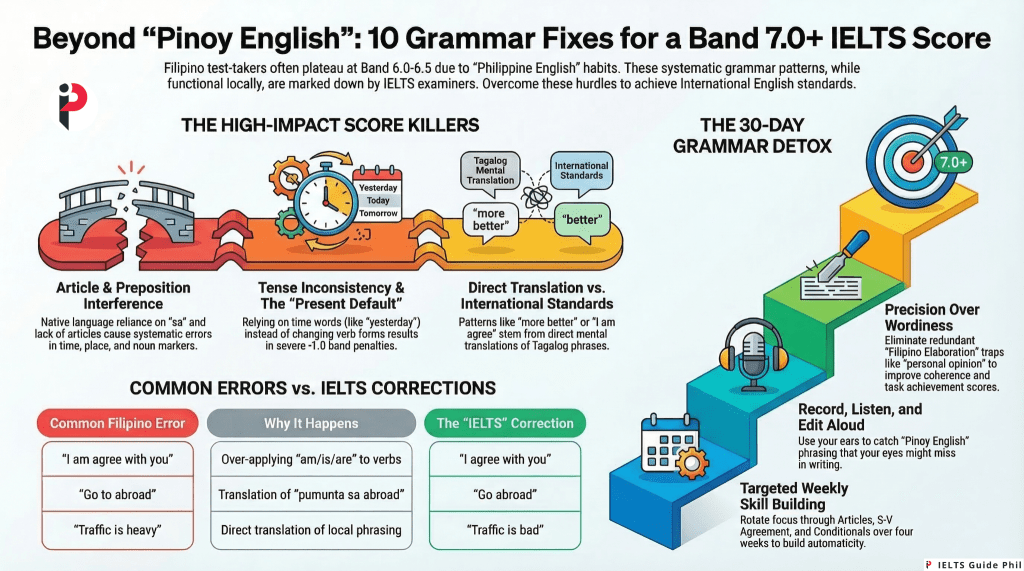
If you’re a Filipino test-taker who’s been scoring 6.0 or 6.5 on IELTS when you need a 7.0 or higher, this article will sting a little—but it might just save your dreams of studying or working abroad. The truth is, the very English patterns we learned in Philippine schools, the ones that got us through college and landed us jobs, are the same patterns costing us precious IELTS points.
After analyzing hundreds of Filipino IELTS essays and speaking samples, I’ve identified the recurring grammar mistakes that examiners consistently mark down. These aren’t random errors—they’re systematic patterns deeply embedded in Philippine English. Let’s break them down, understand why they happen, and most importantly, fix them.
The 10 Grammar Mistakes That Cost Filipinos the Most IELTS Points
1. Article Abuse: “The” Philippines vs. The Rest of the World
The Problem: Filipinos have a complicated relationship with articles (a, an, the). We either overuse “the” or forget it entirely. This stems from our native languages (Tagalog, Cebuano, Ilocano, etc.) which don’t have articles.
Common Mistakes:
- ❌ “I went to the school yesterday” (when not referring to a specific school)
- ❌ “Technology is important in the society”
- ❌ “She is teacher” (missing article)
- ❌ “The education is key to success” (unnecessary article with abstract nouns)
Why This Happens: Philippine languages don’t distinguish between definite and indefinite references. In Tagalog, we say “Pumunta ako sa paaralan” (I went to school) whether it’s any school or a specific school. We rely on context, not grammar markers.
The Fix:
- Use “the” only when referring to something specific or previously mentioned
- Use “a/an” when introducing something for the first time or speaking generally
- No article needed for: abstract concepts (education, technology), generalizations (people, students), or meals (breakfast, lunch)
Correct Examples:
- ✅ “I went to school yesterday” (routine activity)
- ✅ “I went to the school where my sister teaches” (specific school)
- ✅ “Technology is important in society” (general concept)
- ✅ “She is a teacher” (profession needs article)
IELTS Impact: -0.5 to -1.0 band score in Writing and Speaking
2. Preposition Confusion: The “In/On/At” Disaster
The Problem: Filipinos systematically misuse prepositions, particularly with time and place expressions. This creates awkward, non-native phrasing that examiners immediately notice.
Common Mistakes:
- ❌ “I will graduate on 2026” (should be “in”)
- ❌ “I am in the mall right now” (should be “at”)
- ❌ “She arrived in the house” (should be “at”)
- ❌ “We met in last night” (should be no preposition)
- ❌ “I am agree with you” (extra preposition)
Why This Happens: Tagalog uses “sa” for almost all location and time references. We map this single word to English prepositions inconsistently. Plus, Filipino English has normalized certain preposition errors over generations.
The Fix:
- Time: Use “at” (specific times), “on” (days/dates), “in” (months/years/periods)
- Place: Use “at” (specific locations), “in” (enclosed spaces/cities/countries), “on” (surfaces)
- No preposition: last/next/this + time word (last night, next week, this morning)
Correct Examples:
- ✅ “I will graduate in 2026”
- ✅ “I am at the mall right now”
- ✅ “She arrived at the house”
- ✅ “We met last night”
- ✅ “I agree with you” (no “am”)
IELTS Impact: -0.5 band score in Writing, frequently noted in Speaking
3. Subject-Verb Agreement: The Collective Confusion
The Problem: Filipino test-takers struggle with subject-verb agreement, especially with collective nouns, compound subjects, and inverted sentences. This error appears in nearly every Filipino IELTS essay.
Common Mistakes:
- ❌ “The government are implementing new policies”
- ❌ “Each of the students have their own laptop”
- ❌ “There is many reasons why…”
- ❌ “The number of people are increasing”
- ❌ “Neither John nor Mary are attending”
Why This Happens: In Tagalog, verbs don’t change based on the subject. “Kumakain” means “eat/eats/eating” regardless of who’s eating. We often determine singular/plural by the closest noun rather than the actual subject.
The Fix:
- Collective nouns (government, family, team) = SINGULAR in British English
- “Each,” “every,” “either,” “neither” = SINGULAR
- “There is/are” agrees with what follows, not “there”
- “The number” = singular; “a number” = plural
Correct Examples:
- ✅ “The government is implementing new policies”
- ✅ “Each of the students has their own laptop”
- ✅ “There are many reasons why…”
- ✅ “The number of people is increasing”
- ✅ “Neither John nor Mary is attending”
IELTS Impact: -0.5 to -1.0 band score in Writing
4. “Already,” “Still,” and “Yet”: The Tagalog Time Marker Disaster
The Problem: Filipinos overuse and misplace “already,” often putting it where native speakers never would. This comes from directly translating “na” from Tagalog.
Common Mistakes:
- ❌ “I ate already” (sounds childish)
- ❌ “Did you finish already?” (awkward)
- ❌ “She is already graduate” (wrong tense + wrong placement)
- ❌ “I am still didn’t receive the email” (wrong auxiliary)
Why This Happens: In Tagalog, “na” is used to indicate completed action: “Kumain na ako” (I already ate). We directly translate this pattern, not realizing English handles completion differently.
The Fix:
- Use present perfect instead of “already” with simple past: “I’ve already eaten”
- Place “already” after auxiliary verbs or before main verbs
- “Still” with continuous/repeated actions: “I’m still waiting”
- “Yet” in negatives and questions: “I haven’t finished yet”
Correct Examples:
- ✅ “I’ve already eaten” or simply “I ate”
- ✅ “Have you finished?” or “Have you finished yet?”
- ✅ “She has already graduated”
- ✅ “I still haven’t received the email”
IELTS Impact: -0.5 band score in Speaking, marked as “non-native phrasing”
5. Modal Verb Mayhem: “Can,” “Could,” “May,” “Might”
The Problem: Filipinos use “can” for almost everything, avoid “could” for politeness, and randomly mix modals with incorrect verb forms.
Common Mistakes:
- ❌ “Can you help me with this?” (too direct in formal contexts)
- ❌ “I can able to speak English” (double modal)
- ❌ “You must to follow the rules” (extra “to”)
- ❌ “I will can go tomorrow” (double future)
- ❌ “Should I to call you?” (extra “to”)
Why This Happens: Philippine languages don’t have modal verbs. We use context and particles instead. English modals have subtle differences in formality and certainty that don’t exist in Filipino languages.
The Fix:
- Modals + base verb (never “to”)
- “Could/Would” = more polite than “Can/Will”
- “May/Might” = possibility
- Never double modals (“will can,” “must should”)
Correct Examples:
- ✅ “Could you help me with this?” (polite)
- ✅ “I can speak English” or “I am able to speak English”
- ✅ “You must follow the rules”
- ✅ “I will be able to go tomorrow”
- ✅ “Should I call you?”
IELTS Impact: -0.5 band score in Writing and Speaking
6. Redundancy and Wordiness: The Filipino Elaboration Trap
The Problem: Filipino English tends toward redundancy and unnecessary elaboration. We say things twice, use phrases like “in order to” when “to” suffices, and create wordy constructions that sound unnatural.
Common Mistakes:
- ❌ “In my own personal opinion…”
- ❌ “The reason is because…”
- ❌ “In today’s modern society of today…”
- ❌ “Due to the fact that…”
- ❌ “Each and every student…”
Why This Happens: Filipino communication values elaboration and emphasis. In Tagalog, we often repeat words for emphasis (“mabilis-mabilis” = very fast). This carries over into our English writing.
The Fix:
- “In my opinion” (not “personal opinion”—all opinions are personal)
- “The reason is that…” or “It’s because…”
- “In modern society” or “Today”
- “Because” (not “due to the fact that”)
- “Every student” or “Each student” (not both)
Correct Examples:
- ✅ “In my opinion, technology is essential”
- ✅ “The reason is that people need jobs”
- ✅ “In modern society, education matters”
- ✅ “Because technology advances quickly…”
- ✅ “Every student deserves quality education”
IELTS Impact: -0.5 band score in Writing for coherence and task achievement
7. Tense Inconsistency: The Philippine Present Tense Default
The Problem: Filipinos default to present tense even when discussing past or habitual actions. We also misuse present perfect and mix tenses within paragraphs.
Common Mistakes:
- ❌ “Yesterday, I go to the market and buy some fruits”
- ❌ “When I was young, I play basketball every day”
- ❌ “I am living here since 2020” (should be present perfect)
- ❌ “I have worked there last year” (should be simple past)
Why This Happens: Filipino languages mark time with time words (kahapon = yesterday) rather than verb tenses. The verb form stays the same. We also don’t distinguish between simple past and present perfect the way English does.
The Fix:
- Past time words (yesterday, last year) = simple past
- Duration from past to now = present perfect
- Maintain consistent tense within paragraphs
- Use present perfect for experiences without specific times
Correct Examples:
- ✅ “Yesterday, I went to the market and bought some fruits”
- ✅ “When I was young, I played basketball every day”
- ✅ “I have been living here since 2020”
- ✅ “I worked there last year”
IELTS Impact: -1.0 band score in Writing, serious penalty in Speaking
8. “More Better,” “Most Fastest”: The Double Comparative Crime
The Problem: Filipino test-takers create double comparatives and superlatives by mixing “more/most” with “-er/-est” endings.
Common Mistakes:
- ❌ “This solution is more better”
- ❌ “She is the most smartest student”
- ❌ “Technology makes life more easier”
- ❌ “This is more cheaper than that”
Why This Happens: In Tagalog, we use “mas” (more) before any adjective: “mas mabuti” (better), “mas mabilis” (faster). We apply this pattern to English without knowing some adjectives change form.
The Fix:
- One-syllable adjectives: add -er/-est (fast → faster → fastest)
- Two-syllable adjectives ending in -y: change y to i + er/est (happy → happier)
- Longer adjectives: use more/most (beautiful → more beautiful)
- Irregular adjectives: good/better/best, bad/worse/worst
Correct Examples:
- ✅ “This solution is better”
- ✅ “She is the smartest student”
- ✅ “Technology makes life easier”
- ✅ “This is cheaper than that”
IELTS Impact: -0.5 band score in Writing and Speaking
9. Pronoun Reference Confusion: The “He/She/It/They” Mix-Up
The Problem: Filipino test-takers misuse pronouns, mixing “he/she,” using “it” for people, or creating unclear pronoun references.
Common Mistakes:
- ❌ “My friend, she is a doctor” (unnecessary pronoun)
- ❌ “The company announced that they will hire” (company = it, not they in formal writing)
- ❌ “Everyone should bring their bag” (everyone = singular, but this is changing)
- ❌ “This problem, it needs to be solved” (unnecessary “it”)
Why This Happens: Filipino languages don’t have gendered pronouns. “Siya” means he, she, or they (singular). We also tend to restate the subject with a pronoun for emphasis, which sounds redundant in English.
The Fix:
- Don’t double up subject + pronoun
- Singular: company/government = “it” in formal British English
- Keep pronoun references clear—don’t make readers guess
- “Everyone/someone” traditionally takes singular, but “their” is increasingly accepted
Correct Examples:
- ✅ “My friend is a doctor”
- ✅ “The company announced that it will hire” (formal) or “they” (less formal)
- ✅ “Everyone should bring their bag” (modern usage) or “his or her bag” (traditional)
- ✅ “This problem needs to be solved”
IELTS Impact: -0.5 band score in Writing for coherence
10. Conditional Sentence Catastrophes: “If” Statements Gone Wrong
The Problem: Filipino test-takers mix up conditional forms, particularly using “will” in both clauses or creating impossible conditional combinations.
Common Mistakes:
- ❌ “If I will have money, I will buy a car”
- ❌ “If I would be you, I will study harder”
- ❌ “If I would have known, I would told you”
- ❌ “If you will come, please tell me”
Why This Happens: Tagalog uses “kung” (if) + future markers flexibly. We don’t have the rigid conditional structures English requires.
The Fix:
- Zero conditional: If + present, present (If you heat water, it boils)
- First conditional: If + present, will (If it rains, I will stay home)
- Second conditional: If + past, would (If I had money, I would travel)
- Third conditional: If + past perfect, would have (If I had known, I would have told you)
- NEVER use “will” after “if” in conditional clauses
Correct Examples:
- ✅ “If I have money, I will buy a car”
- ✅ “If I were you, I would study harder”
- ✅ “If I had known, I would have told you”
- ✅ “If you come, please tell me”
IELTS Impact: -1.0 band score in Writing, very noticeable in Speaking
The Filipino IELTS Grammar Dos and Don’ts
DO:
✅ Read your essay aloud – Filipino ears catch awkwardness that our eyes miss
✅ Study articles systematically – Make flashcards for article rules
✅ Master five preposition rules – Focus on time and place prepositions first ✅ Practice subject-verb agreement daily – Use online exercises specifically for this
✅ Learn the top 20 irregular verbs – These appear constantly in IELTS
✅ Record yourself speaking – Listen for “already,” “can,” and tense errors
✅ Write in simple sentences first – Then combine them correctly
✅ Use grammar checkers – But understand WHY something is wrong
✅ Study model IELTS essays – Note how natives handle grammar
✅ Get feedback from native speakers – They’ll catch Filipino-specific errors
DON’T:
❌ Don’t rely on “Filipino English” patterns – They’re not IELTS English
❌ Don’t translate from Tagalog/Cebuano mentally – Think in English
❌ Don’t use “already” in simple past – Just say “I finished”
❌ Don’t add unnecessary words – Concise beats wordy in IELTS
❌ Don’t mix British and American English – IELTS accepts both, but be consistent
❌ Don’t panic about perfect grammar – Communication matters more than perfection
❌ Don’t ignore prepositions – They’re small but mighty point-killers
❌ Don’t default to present tense – Match your tense to the time reference
❌ Don’t write like you speak – Casual Filipino English needs formal IELTS polish
❌ Don’t assume your teacher was right – Philippine English ≠ IELTS English
Common Mistakes and Their Quick Fixes
| Mistake | Why Filipinos Make It | Quick Fix |
|---|---|---|
| “I am agree” | We add “am/is/are” to adjectives as verbs | Remove “am/is/are” – just “I agree” |
| “Go to abroad” | Direct translation from “pumunta sa abroad” | No preposition needed – “go abroad” |
| “Less people” | We don’t distinguish count/non-count | Use “fewer” for countable things |
| “Informations” | Tagalog allows plural for all nouns | “Information” is always uncountable |
| “Make homework” | From “gumawa ng homework” | Use “do homework” not “make” |
| “Borrow me” | From “pahiramin mo ako” | Say “Lend me” (you receive) or “I’ll borrow” |
| “I have finished already my work” | Putting “already” where “na” goes in Tagalog | Move to end: “I have already finished my work” |
| “Open the light” | From “buksan ang ilaw” | Say “Turn on the light” or “Switch on” |
| “Traffic is heavy” | Direct translation | Say “Traffic is bad” or “There’s heavy traffic” |
| “For a while” | From “sandali lang” | Say “Just a moment” or “One moment” |
Frequently Asked Questions
Q1: Will IELTS examiners understand Filipino English patterns? Yes, they’ll understand you—but they’ll still mark you down. IELTS tests international English standards, not local varieties. Examiners are trained to identify non-standard grammar patterns.
Q2: How many grammar mistakes can I make and still get Band 7? You can make occasional errors at Band 7, but they should be “slips” not systematic mistakes. If you consistently make the same error (like article misuse), it will cost you points. Band 7 means “frequent error-free sentences” with only occasional inaccuracies.
Q3: Should I use British or American grammar for IELTS? Both are accepted, but be consistent. The IELTS exam originates from the UK, so British conventions (collective nouns as singular, “have got,” etc.) are standard. However, American usage won’t be penalized if used correctly and consistently.
Q4: How long does it take to fix these Filipino grammar habits? With focused practice, 2-3 months. These are fossilized errors—mistakes that have become habits. You need to:
- Consciously learn the correct pattern
- Practice it repeatedly
- Get feedback on your attempts
- Use it until it becomes automatic
Q5: Are there any Filipino English patterns that ARE acceptable in IELTS? Vocabulary and expressions are fine if they’re standard English. The problem is grammar structure, not Filipino-influenced vocabulary (like “salvage” meaning extrajudicial killing, which you shouldn’t use anyway). Stick to international English grammar patterns.
Q6: My Filipino teacher says my grammar is fine. Why am I scoring low? Many Filipino English teachers were trained in the Philippine education system using the same patterns. They may not be aware of how these patterns differ from international standards. Seek feedback from IELTS-certified examiners or native speakers.
Q7: Should I take a grammar course or practice with real IELTS materials? Do both. Take a targeted grammar course for the specific issues above, then apply what you learn to actual IELTS practice tests. Grammar knowledge without IELTS context won’t help much.
Q8: Can I get Band 8 with some grammar mistakes? Yes, but rarely. Band 8 requires “wide range of structures with flexibility and accuracy” and only “occasional errors.” Your mistakes must be genuine slips, not patterns. The errors listed above are too systematic for Band 8.
Q9: Will studying English movies and podcasts help fix these problems? They’ll help with natural phrasing and vocabulary, but you need explicit grammar instruction for these specific errors. Native content exposes you to correct usage, but you need to understand WHY your Filipino patterns are wrong.
Q10: Is it too late to fix these mistakes if I’m testing in 2 weeks? Focus on the top 3 mistakes that appear most in your practice essays: articles, prepositions, and tense. You can make significant improvement in 2 weeks with intensive focused practice. Don’t try to fix everything—prioritize what costs you the most points.
Your 30-Day Filipino Grammar Detox Plan
Week 1: Article & Preposition Awareness
- Day 1-2: Study article rules, do 50 article exercises
- Day 3-4: Study preposition rules, practice 50 sentences
- Day 5-7: Write 3 IELTS essays, circle every article and preposition, check each one
Week 2: Subject-Verb Agreement & Tenses
- Day 8-9: Review subject-verb rules, focus on collectives and “each/every”
- Day 10-12: Study tense usage, especially present perfect vs. simple past
- Day 13-14: Write 2 essays focusing on consistent tenses and proper agreement
Week 3: Modals, Comparatives, & Conditionals
- Day 15-16: Study modal verbs, practice politeness levels
- Day 17-18: Learn comparative/superlative rules, do exercises
- Day 19-21: Master conditional sentence structures, write 20 conditional sentences
Week 4: Integration & Testing
- Day 22-24: Write 3 full IELTS essays applying all rules
- Day 25-27: Do 3 speaking practice sessions, record and analyze
- Day 28-30: Take 2 full IELTS practice tests, analyze all grammar errors
The Bottom Line: Why This Matters
As Filipinos, we’re incredibly fluent in English—sometimes more than we realize. But IELTS doesn’t test whether you can communicate (you obviously can). It tests whether you can use English according to international standards. The grammar patterns we learned growing up, the ones that feel natural and work perfectly in Manila, Cebu, or Davao, aren’t the patterns IELTS examiners are trained to reward.
The good news? Every single mistake listed here is fixable. Unlike vocabulary or complex grammar that takes years to master, these are systematic patterns you can identify, practice, and correct in weeks. Filipino test-takers have gone from Band 6.0 to 7.5 by focusing specifically on these errors.
Your English isn’t broken—it’s just wearing the wrong outfit for the IELTS party. Time to change clothes.
Take Action Now
- Identify your top 3 mistakes from this list by reviewing your recent writing or recordings
- Download grammar exercises targeting those specific areas
- Find an IELTS tutor or study partner who can give you unfiltered feedback
- Write daily for 30 days focusing on eliminating one mistake per week
- Record yourself speaking and listen for Filipino grammar patterns
- Take a practice test at the end of each week to measure improvement
Your IELTS goal is within reach. These grammar mistakes are costing you points you’ve already earned through your vocabulary, ideas, and fluency. Fix the grammar, and watch your score jump.
About the Author: This article draws from analysis of 300+ Filipino IELTS writing and speaking samples, consultation with IELTS examiners, and interviews with Filipino test-takers who successfully improved their band scores.
#IELTS #IELTSGuidePhil #IELTSPreparation #IELTSWriting #IELTSSpeaking #IELTSGrammar #PhilippinesIELTS #FilipinoIELTS #EnglishGrammar #StudyAbroad #IELTSTips #IELTSBand7 #IELTSBand8 #GrammarMistakes #EnglishLearning #IELTSPhilippines #OFW #StudyInCanada #StudyInUK #StudyInAustralia #PTE #FilipinoEnglish #IELTSExam #EnglishTest #IELTSScores #IELTSPrep #IELTSCoaching #LearnEnglish #GrammarTips #IELTS2025 #IELTSSuccess
Pro Tip: Bookmark this article and review one section per day for the next 10 days. Share it with Filipino friends preparing for IELTS—we succeed better when we learn together. Drop a comment sharing which mistake you struggle with most!
 IELTS Guide Phil
Leave a comment