
Here’s a scene I witness at least once a week: A confident candidate walks into the IELTS Speaking test armed with an arsenal of debate techniques. They’re ready to argue, to persuade, to demolish counterarguments, to prove their intellectual superiority. They’ve practiced their strongest opinions on controversial topics. They’ve memorized devastating rebuttals. They’ve sharpened their rhetorical weapons.
Then they walk out confused, deflated, certain they aced it but somehow feeling like something went wrong.
Two weeks later: Band 6.0.
Meanwhile, another candidate approaches the test like a pleasant coffee shop conversation with a friendly acquaintance. They’re relaxed, natural, willing to say “I’m not entirely sure, but I think…” They laugh at themselves when they can’t remember a word. They meander through their thoughts conversationally, occasionally changing direction mid-sentence.
Their score? Band 7.5.
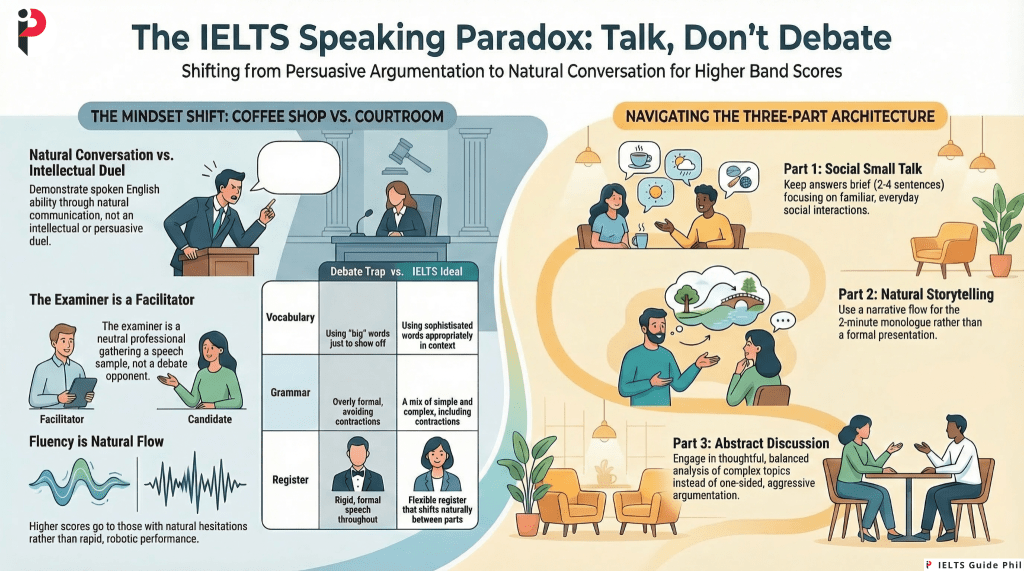
What happened? The first candidate misunderstood the fundamental nature of IELTS Speaking. They treated it like a debate, a courtroom argument, or an intellectual duel. The second candidate understood an uncomfortable truth: IELTS Speaking rewards natural conversation, not persuasive argumentation.
But here’s where it gets complicated—and where most preparation goes wrong: it’s a natural conversation with three distinct parts, each testing completely different skills, performed in an artificially structured format, assessed against specific criteria.
Welcome to the paradox at the heart of IELTS Speaking.
What IELTS Speaking Actually Is (And Isn’t)
Let’s start by clearing up the most dangerous misconceptions:
IELTS Speaking is NOT:
- A debate where you defend a position against opposition
- A legal proceeding where you present evidence
- An intellectual competition where you demonstrate superior reasoning
- A persuasive speech where you convince someone to agree with you
- A job interview where you sell yourself
- A lecture where you demonstrate expertise
- A performance where you entertain
IELTS Speaking IS:
- A structured sample of your spoken English ability
- A demonstration of how well you can communicate ideas conversationally
- An assessment of your fluency, vocabulary range, grammatical accuracy, and pronunciation
- A test of how naturally you can speak English across different discourse modes
The examiner isn’t your debate opponent. They’re not judging your opinions. They’re not evaluating whether you’re right or wrong, smart or foolish, interesting or boring. They’re listening to how you speak, not what you say.
This distinction changes everything.
The Three-Part Architecture: Why Each Part Requires Different Skills
The genius—and the trap—of IELTS Speaking is its three-part structure. Most candidates prepare as if it’s one continuous conversation. It’s not. Each part tests different speaking skills and requires different approaches.
Part 1: Social Conversation (4-5 minutes)
What it tests: Your ability to answer familiar questions about yourself and everyday topics naturally and fluently.
The skill required: Small talk competence.
Think about conversations at parties, first days of class, meeting colleagues—situations where you exchange basic information pleasantly without depth or complexity. That’s Part 1.
The topics are deliberately familiar: your home, your work, your hobbies, your family, your daily routines. The questions are straightforward: “Where are you from?” “Do you enjoy cooking?” “What do you like about your hometown?”
The trap: Many candidates, especially those with debate training, over-answer Part 1 questions. They hear “Do you like reading?” and launch into a five-minute discourse on the societal importance of literacy, the decline of reading among youth, and their personal journey with literature.
The examiner wanted: “Yes, I enjoy reading, especially in the evenings. I find it relaxing after work, and it helps me learn new things. Recently I’ve been reading more non-fiction than novels.”
That’s it. A natural, brief answer that a normal person would give in normal conversation. Two or three sentences, maybe four if you’re extending naturally.
What candidates get wrong: They treat Part 1 like it’s testing their intellectual depth. It’s not. It’s testing whether you can engage in basic social interaction in English. Can you answer simple questions without long pauses? Can you speak naturally about familiar topics? Can you maintain a conversational flow?
The candidate who gives a PhD-level analysis of reading habits in response to “Do you like reading?” has misunderstood the task. They’re playing concert pianist when the test wants pleasant background music.
Part 2: Extended Speaking (3-4 minutes total, including 2-minute monologue)
What it tests: Your ability to speak at length on a topic with minimal support, organizing your thoughts coherently.
The skill required: Descriptive storytelling or explanation.
You receive a card with a topic (describe a memorable journey, talk about a skill you learned, explain a time you helped someone) and four prompt points. You have one minute to prepare, then must speak for 1-2 minutes without interruption.
This is the part that most closely resembles a planned speech or presentation, but it’s still not a debate or argument. You’re describing, narrating, or explaining—not persuading.
The key difference: In a debate, you’d build an argument with thesis, evidence, counterarguments, and conclusion. In Part 2, you’re telling a story or describing an experience with natural narrative flow.
The trap: Candidates often prepare Part 2 like a formal presentation with introduction, three main points, and conclusion. This creates stiff, unnatural speech that sounds memorized.
Compare these approaches to “Describe a time you overcame a challenge”:
Debate/formal approach (sounds unnatural): “Good afternoon. Today I shall describe a significant challenge I overcame, which demonstrates perseverance and problem-solving. Firstly, the challenge was academic in nature. Secondly, it required strategic planning. Thirdly, the outcome proved beneficial for my development. In conclusion, this experience taught me valuable lessons about persistence.”
Natural storytelling approach (what IELTS wants): “Well, I’d like to talk about when I struggled with mathematics in my first year of university. I’d always been decent at math in high school, but university-level calculus was completely different—much more abstract and theoretical. At first, I was really frustrated because I couldn’t understand the concepts no matter how many times I read the textbook. So I decided to change my approach. Instead of just reading, I started going to every tutorial session, forming a study group with classmates, and watching online videos that explained things differently…”
Notice the difference? The second version sounds like a person talking. It has natural hesitations (“Well”), conversational phrases (“I’d like to talk about”), realistic details (“every tutorial session”), and a storytelling flow that unfolds naturally rather than following a formal structure.
What candidates get wrong: They memorize rigid frameworks and deliver them like speeches. The examiner can tell. Or they focus so much on impressive vocabulary that they lose the natural narrative thread. Or they argue about why the challenge was important rather than simply describing what happened.
Part 3: Abstract Discussion (4-5 minutes)
What it tests: Your ability to discuss abstract ideas, express and justify opinions, and engage in more complex, conceptual conversation.
The skill required: Thoughtful discussion, not aggressive debate.
This is where the debate misconception causes the most damage. Part 3 asks questions related to the Part 2 topic but at a more abstract, societal level.
If Part 2 was about a skill you learned, Part 3 might ask: “How has education changed in your country?” “Do you think practical skills or academic knowledge is more important?” “What role should parents play in their children’s education?”
These questions invite opinion and analysis. That’s where candidates mistakenly shift into debate mode.
Here’s the critical distinction: The examiner isn’t challenging your views. They’re not playing devil’s advocate to test your argumentation. They’re prompting you to speak about complex topics so they can assess your ability to express and explain ideas in English.
The debate trap in action:
Examiner: “Some people think university education should be free. What’s your opinion?”
Debate approach (wrong): “I completely disagree with that position, and I’ll tell you why. Firstly, free education is economically unsustainable—look at the evidence from countries that have tried it. Secondly, people don’t value what they don’t pay for, leading to lower graduation rates. Thirdly, the taxpayer burden would be enormous. Those who argue for free education ignore these basic economic realities. The data clearly shows…”
This candidate is arguing against an opponent who doesn’t exist. They’re marshaling evidence, attacking contrary positions, and trying to “win” the argument.
Discussion approach (right): “That’s an interesting question, and I think there are good arguments on both sides. Free education would certainly make university accessible to more people, especially those from lower-income families, which could be really beneficial for society. On the other hand, I can see how it might be difficult to fund, and there’s a question of whether students would value it as much if they weren’t paying. In my view, maybe a middle ground would work better—like reduced fees or more scholarships rather than completely free education. But honestly, it’s a complex issue, and I’m sure there are aspects I haven’t fully considered.”
This sounds like a thoughtful person discussing an idea, acknowledging complexity, considering different perspectives, and offering a nuanced view. It’s conversational, not confrontational.
What candidates get wrong: They think strength of opinion and aggressive argumentation demonstrate language ability. They don’t. They demonstrate misunderstanding of the speaking context. IELTS values balanced, thoughtful discussion over one-sided argumentation.
Why Natural Conversation Scores Higher Than Debate Performance
The Fluency Factor
In natural conversation, people:
- Sometimes pause to think
- Occasionally restart sentences
- Use fillers naturally (“well,” “you know,” “I mean”)
- Speak at a comfortable, variable pace
- Self-correct without anxiety
In debates or formal speeches, people:
- Minimize pauses (seeing them as weakness)
- Deliver prepared points without deviation
- Avoid fillers (seeing them as unprofessional)
- Maintain consistent, often rapid pace
- Rarely self-correct (it undermines authority)
IELTS rewards the natural conversation patterns. Fluency isn’t about speaking quickly without pausing. It’s about maintaining natural flow with appropriate pausing, self-correction, and hesitation that doesn’t impede communication.
I’ve seen candidates who spoke rapidly with no pauses score Band 6 for fluency because they sounded like they were performing memorized content, not conversing naturally. Meanwhile, candidates who paused to think but maintained genuine conversational flow scored Band 7-8.
The key: Natural pauses while searching for the right word or organizing thoughts are fine. Awkward silences because you don’t understand or have nothing to say are problematic. The difference is in the quality of the pause, not its existence.
The Vocabulary Paradox
Debaters use sophisticated vocabulary to impress and persuade. Every word is chosen for maximum impact. Precision and formality signal expertise.
Natural speakers use appropriate vocabulary for genuine communication. They occasionally struggle to find words, use simpler alternatives when complex ones don’t come naturally, and mix formal and informal language based on context.
Example scenario – Question about environmental problems:
Debate vocabulary (often sounds unnatural): “The ramifications of anthropogenic climate change are catastrophic. We must implement comprehensive mitigation strategies to ameliorate the deleterious effects of carbon emissions. The perpetuation of fossil fuel dependence will inevitably precipitate ecological devastation.”
This candidate is showing off vocabulary, but it sounds scripted and unnatural. Are those words wrong? No. Would a natural speaker string them together like that in conversation? Absolutely not.
Natural vocabulary with range (what IELTS prefers): “Climate change is definitely one of the biggest environmental challenges we face. The effects are already pretty serious—more extreme weather, rising sea levels, that kind of thing. I think we need to reduce our carbon emissions significantly, which means moving away from fossil fuels to renewable energy. It’s not going to be easy, but if we don’t take action now, the consequences could be really severe for future generations.”
This demonstrates good vocabulary range (“emissions,” “renewable energy,” “consequences”) while maintaining natural speech patterns. The language is appropriate for serious discussion but still conversational.
What IELTS wants: You using somewhat sophisticated vocabulary naturally and appropriately, not you demonstrating every advanced word you know regardless of whether it fits conversationally.
The Grammar Reality
Debate-trained speakers often focus on grammatical perfection, using complex structures to demonstrate sophistication. They avoid contractions, use passive voice extensively, and construct elaborate sentences.
Natural speakers use a mix of simple and complex grammar, contract words naturally (I’m, don’t, can’t), and structure sentences for clarity rather than complexity.
Overly formal (sounds unnatural): “Were I to consider the question thoroughly, I would be compelled to argue that it is essential we do not underestimate the significance of this issue. It must not be forgotten that…”
Naturally varied (what IELTS prefers): “If I think about it carefully, I’d say this issue is really important and we shouldn’t underestimate it. We need to remember that…”
Both sentences are grammatically correct. The second one scores better because it demonstrates natural grammar use, including contractions and the ability to mix structures appropriately.
Common Mistakes That Come From Debate/Formal Thinking
Mistake 1: Treating the Examiner as an Opponent
The Problem: Candidates argue against positions the examiner hasn’t taken, try to preemptively counter objections, or become defensive about their views.
Why It Fails: The examiner isn’t disagreeing with you. They’re facilitating conversation to elicit a speech sample. When you argue against phantom opponents, you create an awkward dynamic and waste time on unnecessary justification.
The Fix: Respond to questions as if a friendly acquaintance asked them over coffee. Share your thoughts without feeling the need to defend against attack.
Mistake 2: One-Sided Argumentation
The Problem: Candidates present only one perspective forcefully, listing reasons why their view is correct and opposing views are wrong.
Why It Fails: This sounds argumentative rather than conversational. IELTS values balanced, thoughtful responses that acknowledge complexity. Part 3 especially rewards candidates who can discuss different perspectives.
The Fix: For complex topics, acknowledge different viewpoints even if you have a preference: “Some people think X because of Y, while others believe Z because of W. Personally, I lean toward X, but I can understand why…”
Mistake 3: Formal Speech Register Throughout
The Problem: Candidates maintain formal, speech-like register across all three parts, avoiding contractions, using complex syntax consistently, and sounding like they’re giving a presentation.
Why It Fails: Natural conversation includes variation in formality. Part 1 should be relatively informal (like chatting with someone new), Part 2 somewhat more organized but still natural (like telling a story to friends), and Part 3 more formal but still conversational (like a thoughtful discussion with a colleague).
The Fix: Allow your formality to flex naturally. Use contractions in Parts 1 and 2. Speak like a human having a conversation, not a robot executing a program.
Mistake 4: Avoiding Uncertainty
The Problem: Debaters are trained never to show weakness or uncertainty. Candidates feel they must have strong, definitive opinions on every topic and present them confidently.
Why It Fails: Natural speakers express uncertainty appropriately. Pretending to know things you don’t or having firm opinions on topics you’ve never considered sounds insincere and unnatural.
The Fix: It’s perfectly acceptable to say “I’m not entirely sure, but I think…” or “I haven’t thought about this much before, but off the top of my head…” or “That’s a difficult question, and I can see both sides…” This sounds natural and honest, which is what IELTS values.
Mistake 5: Prioritizing Being Right Over Being Communicative
The Problem: Candidates focus on expressing the “correct” opinion or providing factually accurate information, sometimes at the expense of clear communication.
Why It Fails: IELTS isn’t fact-checking your opinions or evaluating their merit. The examiner doesn’t care if your views on education reform are sound. They care whether you can express ideas clearly in English.
The Fix: Prioritize clear communication over perfect accuracy. If you can’t remember specific statistics, use approximations (“I think it’s around 30% or maybe a bit higher”). If you’re unsure about a topic, speak in general terms based on your impressions rather than trying to recall precise facts.
Mistake 6: Memorizing and Reciting
The Problem: Candidates memorize answers or frameworks and deliver them verbatim, especially in Part 2.
Why It Fails: Examiners are trained to recognize memorized content, and it’s penalized. Memorized speech lacks the natural hesitations, self-corrections, and spontaneity of genuine conversation.
The Fix: Prepare ideas and vocabulary, not complete answers. Know what you might talk about and have relevant vocabulary ready, but generate the actual sentences spontaneously during the test.
The Dos and Don’ts of IELTS Speaking
Do:
Sound like yourself talking. Your natural speech patterns, appropriately adapted for the formality level of each part, should come through. If you’re naturally thoughtful and measured, be that. If you’re naturally enthusiastic and expressive, be that. Don’t adopt a persona.
Use discourse markers naturally. Words like “well,” “actually,” “I mean,” “you know,” “basically” are part of natural speech. Don’t overuse them, but don’t eliminate them entirely either. They help create conversational flow.
Extend your answers appropriately. In Part 1, two to four sentences usually suffice. In Part 2, fill the 1-2 minutes naturally without rushing or dragging. In Part 3, aim for extended responses (30-60 seconds) that develop ideas without monologuing excessively.
Self-correct naturally. If you start a sentence and realize you want to rephrase, do so naturally: “I went to… actually, I visited Spain last year.” This shows monitoring and control, not weakness.
Ask for clarification if needed. If you genuinely don’t understand a question, politely ask: “Sorry, could you repeat that?” or “Do you mean…?” This is natural conversation behavior.
Show engagement with the topic. React naturally to questions. If something interests you, let your tone reflect that. If you find a question difficult, it’s okay to say “That’s a tough question” before answering.
Use a mix of simple and complex sentences. Natural speech isn’t uniformly complex. You might say “I love reading” (simple) followed by “It’s something I’ve enjoyed since childhood, probably because my parents always encouraged us to read before bed” (complex).
Don’t:
Don’t give yes/no answers without extension. Even in Part 1, “yes” or “no” alone is insufficient. Always add explanation or detail: “Yes, I do. I find it helps me relax after a busy day.”
Don’t speak in a monotone. Natural conversation has intonation variation, emphasis, and rhythm. If you sound like you’re reading from a script or speaking in a flat tone throughout, it signals unnaturalness.
Don’t use overly academic or technical language inappropriately. Unless the topic specifically calls for it, speaking like you’re writing a research paper sounds unnatural. Match your language to conversational contexts.
Don’t argue with or challenge the examiner. They’re facilitating, not debating. If a question seems to assume something you disagree with, don’t correct the premise—just answer the question as posed or gently offer an alternative view.
Don’t speak too quickly to demonstrate fluency. Rapid speech with errors scores lower than moderate-paced speech with accuracy and clarity. Fluency is about flow and natural pace, not speed.
Don’t give overly long answers in Part 1 or Part 3. Part 1 should be brief exchanges. Part 3 should be extended but not endless. If you’re speaking for 2-3 minutes on a single Part 3 question, you’ve probably gone too long and prevented the examiner from asking other questions to assess your range.
Don’t panic about perfect grammar. Native speakers make grammatical errors in casual speech. Minor errors that don’t impede communication won’t destroy your score. Aim for general accuracy while maintaining natural flow.
Understanding the Examiner’s Role
This is crucial: The examiner is not your adversary, your debate opponent, your judge (in the verdict sense), or even really your conversation partner.
The examiner is:
- A trained assessor gathering a speech sample
- Following a script they must adhere to
- Assessing you against specific criteria
- Prohibited from expressing personal opinions or engaging in genuine debate
- Trying to facilitate the best possible speech sample from you
What this means practically:
When the examiner asks “Do you think children should have mobile phones?” they’re not asking because they care about your opinion on child phone ownership. They’re asking because it’s a question designed to elicit a speech sample that demonstrates your ability to express and justify opinions.
When they follow up with “Why do you think that?” they’re not challenging you—they’re following the script to get you to extend your response and demonstrate elaboration skills.
When they seem neutral or don’t react to your answers, they’re not bored or disapproving—they’re maintaining professional assessment distance.
Understanding this removes the adversarial dynamic that debate-minded candidates create. You’re not trying to convince the examiner or impress them with your views. You’re providing them with the speech samples they need to assess your English.
The Three Parts Working Together
Here’s what many candidates miss: the three parts aren’t random. They work together to assess your full range of speaking abilities.
Part 1 shows you can handle everyday social interaction—the foundation of communication.
Part 2 shows you can organize and deliver extended speech—demonstrating coherence and the ability to sustain speaking.
Part 3 shows you can discuss abstract ideas and complex topics—the highest level of spoken communication.
A candidate who treats all three parts as debates loses this progression. They sound combative in Part 1 when they should sound friendly, scripted in Part 2 when they should sound narrative, and argumentative in Part 3 when they should sound thoughtful.
The progression should be:
- Part 1: Pleasant and natural
- Part 2: Organized but still natural narrative
- Part 3: Thoughtful, balanced discussion
Think of it as:
- Part 1: Meeting someone at a party
- Part 2: Telling friends a story about your weekend
- Part 3: Discussing an interesting topic with colleagues over lunch
None of these scenarios involve debate. All involve natural conversation at different levels of complexity.
Frequently Asked Questions
Q: If I have strong opinions, should I moderate them to sound more balanced?
A: You don’t need to change your actual opinions, but consider how you express them. Instead of “People who think X are completely wrong,” try “I personally believe Y, though I understand some people think X because…” You can have strong views while expressing them in a balanced, conversational way.
Q: What if the examiner seems to disagree with me? Should I defend my position more strongly?
A: The examiner almost certainly isn’t disagreeing with you—they’re following a script. If they ask follow-up questions, they’re trying to get you to elaborate, not challenging your view. Never shift into defensive debate mode. Just continue explaining your thinking naturally.
Q: How do I show confidence without sounding like I’m giving a speech or debate?
A: Confidence in IELTS Speaking means speaking clearly and naturally, not hesitating excessively due to anxiety, and expressing ideas without apologizing unnecessarily. It doesn’t mean formal delivery or aggressive argumentation. Confident conversation is different from confident debate.
Q: Should I agree with what I think the examiner wants to hear?
A: Examiners don’t want to hear anything specific. They’re assessing language, not opinions. Be genuine. False agreement sounds as unnatural as aggressive disagreement. Just express your actual thoughts naturally and clearly.
Q: Can I use debate techniques like “on the one hand… on the other hand”?
A: These phrases can work in Part 3 if used naturally to present balanced views: “On the one hand, technology makes life easier, but on the other hand, we might be losing some important skills.” Just don’t overuse them or sound like you’re delivering a formal debate statement.
Q: What if I don’t know much about the topic? Should I admit it or try to sound knowledgeable?
A: Brief honesty is fine and natural: “I haven’t really thought about this much, but I’d say…” Then share whatever thoughts you have. Pretending expertise on topics you know nothing about often leads to vague, unconvincing responses. Natural admission of limited knowledge followed by thoughtful speculation sounds more genuine.
Q: How formal should my language be in each part?
A: Part 1: Relatively informal, like talking to someone you’ve just met socially. Contractions, simpler vocabulary, relaxed grammar. Part 2: Moderately formal, like telling a story at work or school. Still natural but slightly more organized. Part 3: More formal, like discussing a serious topic with educated friends or colleagues. But all three should still sound conversational, not like speeches or presentations.
Q: If I’m naturally argumentative or debate-oriented in my personality, how do I adjust?
A: Recognize that IELTS Speaking is a performance of conversational English, not a showcase of your personality. Channel your analytical thinking into thoughtful discussion rather than aggressive argumentation. Instead of arguing FOR a position, discuss ideas ABOUT a topic. It’s a subtle but important shift.
Q: Should I try to make the examiner laugh or engage them personally?
A: Natural moments of light humor are fine if they emerge organically, but don’t try to entertain the examiner. They’re professionally neutral and won’t respond the way friends would. Focus on clear communication, not on creating a personal connection. This isn’t a job interview or a first date—it’s a standardized assessment.
Q: How can I practice conversational speaking rather than debate-style speaking?
A: Record yourself answering IELTS questions and listen back. Do you sound like you’re arguing a case in court or discussing ideas with a friend? Practice with: “Tell me about…” prompts (not “Argue for…”), time yourself giving balanced views (not one-sided arguments), and speak as if explaining ideas to someone unfamiliar with the topic (not defending against criticism).
The Bottom Line: Conversation Beats Confrontation
The single most important thing to understand about IELTS Speaking is this: it’s a conversation sample, not a persuasion exercise.
Your job is to demonstrate that you can:
- Engage in everyday social conversation (Part 1)
- Organize and deliver extended descriptive or narrative speech (Part 2)
- Discuss abstract ideas thoughtfully (Part 3)
Your job is NOT to:
- Win arguments
- Prove you’re right
- Convince anyone of anything
- Demonstrate superior reasoning
- Defend positions against attack
- Present yourself as an expert
Every minute you spend preparing debate techniques or memorizing strong arguments is a minute wasted. Every time you practice arguing forcefully for positions is practice in the wrong skill.
What you should practice instead:
- Answering questions naturally and conversationally
- Extending responses appropriately without monologuing
- Expressing uncertainty honestly when relevant
- Discussing different perspectives on complex topics
- Maintaining natural speech patterns under pressure
- Using appropriate formality for each part
The paradox of IELTS Speaking is that it’s a highly structured, artificially constructed test that rewards natural, unstudied-seeming conversation. You need to prepare thoroughly to sound unprepared. You need to practice intensively to sound spontaneous.
But you definitely don’t need to debate.
Think of the examiner as someone who’s genuinely interested in your thoughts and experiences, not as someone you need to convince or defeat. Approach the test as three related conversations—small talk, storytelling, and thoughtful discussion—not as a three-round debate competition.
The candidates who score highest in IELTS Speaking aren’t the ones with the strongest arguments or the most impressive rhetorical techniques. They’re the ones who sound most like competent, educated people having natural conversations in English.
Be interesting if it comes naturally, but prioritize being clear. Be thoughtful in your responses, but don’t agonize over being right. Be confident in your communication, but don’t be combative in your style.
Above all, remember: the examiner isn’t your opponent to defeat, your audience to wow, or your judge to convince. They’re simply the facilitator of a conversation designed to assess your English speaking ability.
Give them what they need: natural, clear, appropriately extended English conversation across three different discourse modes.
Save your debate skills for actual debates. For IELTS, just talk.
#IELTS #IELTSGuidePhil #IELTSSpeaking #IELTSPreparation #IELTSTips #SpeakingTest #IELTSExam #IELTSSuccess #BandScore #IELTSStrategy #EnglishSpeaking #IELTSPart1 #IELTSPart2 #IELTSPart3 #FluencyAndCoherence #IELTSAdvice #TestPrep #EnglishConversation #NaturalEnglish #Band7 #Band8 #IELTSGuide #SpeakingSkills #ConversationalEnglish #IELTSInterview #StudyAbroad #EnglishTest
 IELTS Guide Phil
Leave a comment