
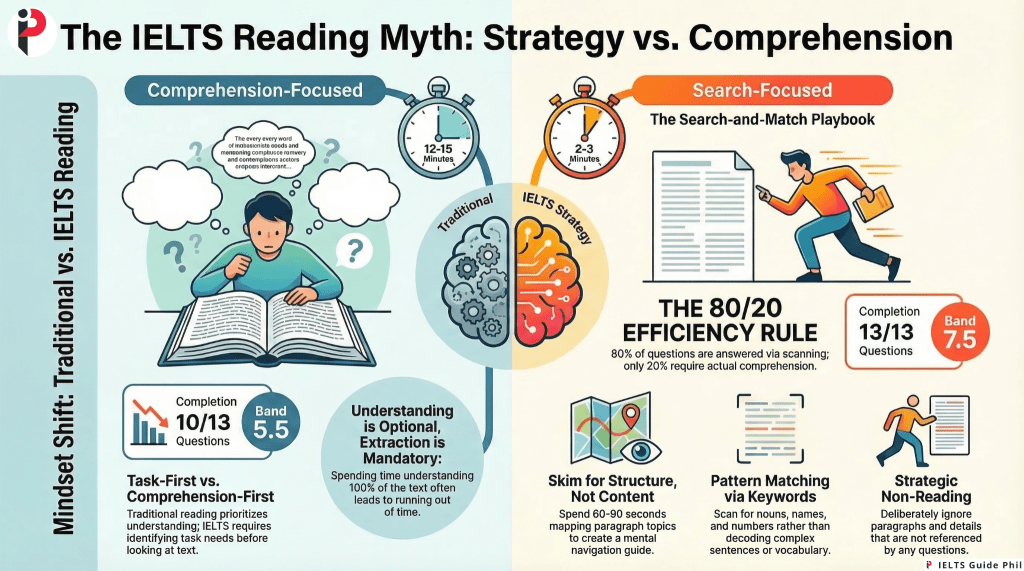
Picture this: You’re sitting in the IELTS Reading test with 60 minutes on the clock. You encounter a 900-word passage about the biochemical processes of photosynthesis in deep-sea algae. It’s dense, technical, filled with terminology you’ve never seen. You read it carefully once. Then again. Then a third time, determined to understand every sentence, every concept, every relationship.
Twenty-five minutes later, you finally feel you understand the passage. You’ve grasped the science. You could explain photosynthesis at a dinner party. You’re ready to answer questions.
Except you have 13 questions to answer and only 10 minutes left before you need to move to the next passage. You panic, rush through the questions, guess on half of them, and run out of time before completing the entire Reading section.
Final score: Band 5.5.
Meanwhile, another candidate approaches the same passage differently. They skim it in 90 seconds, barely understanding 40% of the content. They don’t know what “phycobilin pigments” are and don’t care. They can’t explain the photosynthetic process and wouldn’t try. But they can locate where the passage discusses pigments, identify which paragraph talks about process efficiency, and match headings to sections based on keywords and structure.
They answer all 13 questions in 18 minutes with 80% accuracy, despite understanding maybe half of what they read.
Their score: Band 7.5.
This scenario repeats itself thousands of times in every IELTS test administration. Candidates who prioritize comprehension over task completion struggle. Candidates who treat Reading as a strategic search-and-match exercise succeed.
Here’s the uncomfortable truth that most IELTS candidates resist accepting: IELTS Reading isn’t primarily testing your ability to understand texts. It’s testing your ability to locate, match, and extract specific information from texts under severe time pressure.
Understanding is optional. Finding answers is mandatory.
The Fundamental Misunderstanding About IELTS Reading
Most people approach IELTS Reading with assumptions formed by years of academic reading:
Traditional Reading Assumption: Read the text carefully, understand it thoroughly, then answer questions based on your comprehension.
IELTS Reading Reality: Identify what information the questions need, scan the text to locate that information, extract the answers, move on.
The difference is profound:
Traditional reading is comprehension-first: Understand → Then apply understanding to tasks
IELTS reading is task-first: Identify task requirements → Locate relevant information → Extract answers
In traditional academic contexts, you read to learn, to understand, to synthesize information for later use. You’re building knowledge. Understanding the entire text matters because you’ll be tested on concepts, asked to apply ideas, or required to integrate information across sources.
In IELTS Reading, you read to find answers to specific questions within a time limit. You’re not building knowledge; you’re extracting data. Understanding 100% of the text often means you’re wasting time understanding things you’ll never be asked about.
The strategic candidate asks: “What specific information do these questions require, and where in the text can I find it?”
The struggling candidate asks: “What is this entire passage about, and what does the author want me to understand?”
The first question leads to Band 7-8. The second question leads to running out of time.
Why Full Comprehension Is Actually Counterproductive
Let me be radically clear about something that will offend English teachers everywhere: Trying to fully understand IELTS Reading passages is often the worst strategy you can employ.
Here’s why:
Time Is Your Enemy, Not Difficulty
You have 60 minutes to read approximately 2,700 words across three passages and answer 40 questions. That’s about 1.5 minutes per question, including reading time.
If you spend 10 minutes carefully reading and understanding a 900-word passage, you have approximately 50 seconds per question. That’s barely enough time to locate the answer, let alone consider it carefully.
If you spend 3 minutes skimming for general structure and then work question-by-question, scanning for specific information as needed, you have substantially more time per question.
The math is brutal: Comprehension time + Question time = Not enough time
The winning equation: Minimal initial reading time + Extended question-focused scanning time = All questions completed
Most of the Passage Is Irrelevant to Most Questions
Here’s a truth that becomes obvious once you analyze IELTS Reading systematically: Typically, 40-60% of any passage is never tested.
The passage might contain 12 paragraphs. The questions might only reference information from 7 of them. If you spent equal time understanding all 12 paragraphs, you wasted time on 5 paragraphs that contribute nothing to your score.
Some sentences are purely transitional or provide background context. Some paragraphs elaborate on minor points. Some sections contain interesting details that no question addresses.
Reading for complete comprehension means investing cognitive energy in information that will never appear in any question. It’s like studying every page of a textbook when you know the exam only covers specific chapters.
Strategic readers identify which parts of the text the questions target and focus there.
Completionist readers understand everything equally and run out of time.
Complex Passages With Simple Questions
IELTS frequently pairs complex, technical passages with relatively straightforward questions. The passage might discuss quantum mechanics or medieval economics using sophisticated academic language, but the questions might only ask:
- “What year did X occur?” (Simple fact location)
- “Which paragraph contains information about Y?” (Simple scanning)
- “Does the text say A, B, or C?” (Simple matching)
If you spend 15 minutes wrestling with quantum mechanics concepts you barely grasp, only to discover the questions just want dates and names you could have found in 30 seconds each, you’ve been deceived by the passage’s complexity into over-investing in comprehension.
The passage’s difficulty is often a red herring. It looks intimidating, so you think you need to understand it deeply. But the questions might only require surface-level information extraction.
Understanding Doesn’t Equal Finding
Even if you comprehend a passage thoroughly, you still need to locate where specific information appears to answer questions. Comprehension and location are separate skills.
I’ve watched candidates who genuinely understood passages—they could discuss the main ideas intelligently—still struggle to answer True/False/Not Given questions because they couldn’t remember or relocate where specific claims appeared.
Meanwhile, candidates who barely grasped the passage’s thesis could systematically scan for keywords and answer the same questions accurately.
Understanding without efficient location = Time wasted twice (comprehension time + relocation time)
Strategic location without full understanding = Direct path to answers
The Question Types That Prove IELTS Is About Search, Not Understanding
Different question types reveal the search-oriented nature of IELTS Reading. Let’s examine how:
Matching Headings to Paragraphs
What it supposedly tests: Your understanding of main ideas
What it actually tests: Your ability to identify keywords and topic sentences quickly
You don’t need to understand every sentence in a paragraph to match it with a heading. You need to:
- Identify the topic sentence (usually first or last sentence)
- Scan for keywords that match heading concepts
- Confirm the paragraph’s focus matches the heading
A candidate who carefully reads and understands every word in every paragraph uses 15-20 minutes on this task. A candidate who reads topic sentences, scans for keywords, and strategically confirms spends 6-8 minutes and achieves the same or better accuracy.
Example: Paragraph discusses “various factors contributing to urban heat islands including concrete surfaces, lack of vegetation, and vehicle emissions.”
Heading options include: “Causes of temperature increase in cities”
You don’t need to understand thermal dynamics or urban planning theory. You need to recognize that “factors contributing to” = causes, and “urban heat islands” = temperature increase in cities. Match made in 20 seconds.
True/False/Not Given
What it supposedly tests: Your comprehension of the author’s claims
What it actually tests: Your ability to locate specific statements and compare them to question claims
These questions are scanning exercises. You:
- Identify the key concept in the question
- Scan the text for where that concept is discussed
- Compare the question’s claim to the text’s statement
- Determine if they match (True), contradict (False), or if the text doesn’t address it (Not Given)
Understanding the broader context of the passage is often irrelevant. You need to locate and compare specific statements.
Example: Question: “The majority of birds migrate south during winter.” Text location: “While many bird species travel to warmer climates in winter, significant populations of northern species remain year-round.”
You don’t need to understand ornithology or bird behavior comprehensively. You need to recognize that “many” ≠ “majority” and “significant populations remain” contradicts the universal claim. Answer: False.
This is pattern matching, not deep comprehension.
Sentence Completion
What it supposedly tests: Your understanding of information
What it actually tests: Your ability to locate parallel information and extract specific words
The questions usually follow the passage order. You:
- Read the incomplete sentence
- Scan for the section discussing that topic
- Find the parallel information
- Extract the word(s) that complete the sentence grammatically
You often don’t need to understand the surrounding paragraphs or the passage’s overall argument. You need to locate and extract.
Example: Question: “The ancient Egyptians used _____ to preserve bodies.” You scan for “preserve bodies” or “preservation,” locate “mummification required the use of natron, a naturally occurring salt,” extract “natron,” confirm it fits grammatically, move on.
Total time: 30-45 seconds. Total comprehension required: minimal.
Multiple Choice
Even multiple choice questions—which seem to require comprehension—often reward strategic scanning over deep understanding.
What it supposedly tests: Your understanding of detailed information or inferences
What it actually tests: Your ability to locate the relevant section and match it against options
The technique:
- Identify the topic/concept the question asks about
- Scan to locate where the passage discusses this
- Read that section carefully (maybe 2-3 sentences)
- Eliminate options that contradict or aren’t mentioned
- Select the option that matches
You don’t read the entire passage deeply. You read the relevant 50-100 words carefully.
Summary Completion
What it supposedly tests: Understanding of passage structure and main points
What it actually tests: Ability to identify paragraph topics and extract key terms
Summaries typically follow passage order. You:
- Read the summary sentence
- Identify which paragraph it summarizes
- Scan that paragraph for the missing information
- Extract the appropriate word(s)
Again, systematic scanning with targeted reading, not comprehensive understanding.
The Search Strategies That Actually Work
Strategy 1: Question-First Reading
Traditional approach: Read passage → Answer questions
Effective approach: Skim passage for structure → Read questions → Locate answers in passage
Start by spending 60-90 seconds skimming the passage to understand:
- How many paragraphs
- General topic of each paragraph (first sentences)
- Any obvious structural divisions
Then read the questions carefully and work through them, scanning back to the passage for each specific answer.
This inverts the traditional model but aligns with the task-focused nature of IELTS.
Strategy 2: Keyword Scanning
Every question contains keywords that signal where in the passage to find the answer. Train yourself to:
- Identify the keywords (usually nouns, names, numbers, unique concepts)
- Scan the passage for those exact words or synonyms
- Read carefully only around those keywords
Question: “What challenge did researchers face when studying deep-sea organisms?”
Keywords: researchers, challenge, studying, deep-sea organisms
Scanning target: Look for “researchers” or “scientists” or “study” near “deep-sea” or “organisms” near “problem” or “difficulty” or “challenge”
You’re not reading for understanding. You’re pattern matching.
Strategy 3: Paragraph Purpose Identification
Instead of understanding every detail of every paragraph, quickly identify each paragraph’s purpose:
- Is it introducing the topic?
- Is it explaining a process?
- Is it providing an example?
- Is it presenting a problem?
- Is it offering a solution?
- Is it comparing two things?
- Is it concluding?
This gives you a mental map without requiring deep comprehension. When a question asks about “the solution proposed,” you scan for the “solution paragraph,” not re-read everything.
Strategy 4: Strategic Non-Reading
This is the most controversial but often most effective strategy: Deliberately don’t read parts of the passage.
If you’re working through questions sequentially and realize questions 5-8 all reference paragraphs C, D, and E, why read paragraphs A, B, F, and G carefully unless questions specifically require them?
Many candidates waste time reading the conclusion paragraph thoroughly when no questions reference it. Or they carefully read introductory paragraphs that just provide general context.
Read only what you need to read to answer questions that exist.
Everything else is optional. If you have time at the end, great. If not, you’ve lost nothing because those sections weren’t tested.
Strategy 5: Time-Boxing
Allocate strict time per passage:
- Passage 1: 18 minutes maximum
- Passage 2: 20 minutes maximum
- Passage 3: 22 minutes maximum
Passages get progressively harder, so this increasing allocation makes sense. But the key is moving on regardless of whether you’ve understood everything or answered everything perfectly.
Better to attempt all 40 questions (even if some are educated guesses) than to perfectly understand two passages and never reach the third.
Common Mistakes Comprehension-Focused Readers Make
Mistake 1: Reading Linearly From Start to Finish
The Problem: Candidates read passages from first word to last word before looking at questions.
Why It Fails: You’re reading information you may never need, using time you don’t have, and then forgetting where information appeared by the time you reach the questions.
The Fix: Skim for structure, then work question-by-question, reading targeted sections as needed.
Mistake 2: Looking Up Unknown Vocabulary
The Problem: Candidates pause when encountering unknown words, trying to deduce meanings from context or worrying they won’t understand without knowing the word.
Why It Fails: Most unknown words are irrelevant to questions. The time spent decoding vocabulary you’ll never be tested on is time stolen from answering questions.
The Fix: Skip unknown words unless they appear in questions or answer locations. If a question asks about “phytoremediation” and you don’t know it, that’s when you use context. Otherwise, ignore and move on.
Mistake 3: Re-Reading for Comprehension
The Problem: When a paragraph doesn’t make sense, candidates re-read it repeatedly until they understand.
Why It Fails: Some academic passages contain genuinely difficult concepts that take educated native speakers multiple readings to grasp. You don’t have time for this, and you probably don’t need to understand those concepts anyway.
The Fix: Read once, extract what you can understand, move forward. If a question specifically requires understanding that paragraph, you can revisit it with the question’s guidance about what you’re looking for.
Mistake 4: Answering Questions From Memory
The Problem: After reading the passage, candidates answer questions based on what they remember reading.
Why It Fails: Memory is unreliable under pressure. You’ll confuse details, misremember specifics, and make subtle errors. True/False/Not Given questions especially punish memory-based answering.
The Fix: Always scan back to the relevant section to verify your answer, even if you think you remember. This takes 10-15 seconds but dramatically improves accuracy.
Mistake 5: Trying to Understand Technical Content
The Problem: Candidates encounter technical passages about science, technology, history, or specialized fields and attempt to fully grasp the concepts.
Why It Fails: IELTS deliberately includes passages on topics most candidates know nothing about. You’re not expected to learn genetics or medieval architecture in 20 minutes. You’re expected to extract information.
The Fix: Accept that you won’t understand everything. Focus on surface-level information extraction. If the passage discusses “how mitochondria generate ATP through oxidative phosphorylation,” you don’t need to understand cellular biology. You need to locate and extract facts when questions ask about them.
Mistake 6: Reading Every Word Equally
The Problem: Candidates give equal attention to every sentence, reading topic sentences, supporting details, examples, and transitions with the same careful focus.
Why It Fails: Not all sentences are created equal. Topic sentences contain main ideas. Supporting details may or may not be tested. Examples often illustrate points already stated. Transitions just connect ideas.
The Fix: Vary your reading speed and attention. Slow down for topic sentences and sentences containing keywords from questions. Speed through or skip everything else.
The Dos and Don’ts of IELTS Reading
Do:
Skim passages quickly first. 60-90 seconds to understand structure and paragraph topics. This creates a mental map you’ll use to navigate when answering questions.
Read questions carefully. Questions deserve more careful reading than passages. Every word in a question matters. A single word difference (“some” vs. “all,” “mainly” vs. “partly”) changes the answer.
Scan actively for keywords. Train your eyes to move quickly down the page looking for specific words or concepts. This is a learnable skill that improves with practice.
Use question order as a guide. Most question types follow passage order (though not always). If question 5 references paragraph C and question 7 references paragraph E, question 6 probably references paragraph D.
Write clearly on the answer sheet. All IELTS Reading answers are machine-scanned or human-marked from your answer sheet, not your question booklet. Unclear answers or answers recorded incorrectly cost you marks even if you found the right information.
Attempt every question. There’s no penalty for wrong answers. Blank answers guarantee zero marks. Guesses might be correct. Always fill in something.
Move on decisively. If a question is consuming too much time, make your best guess and move forward. One difficult question isn’t worth sacrificing three easy questions you never reach.
Don’t:
Don’t read every passage completely before starting questions. This wastes time and tests memory rather than location skills.
Don’t worry about understanding everything. Partial understanding is sufficient if you can locate and extract answers. Perfect understanding that leaves no time for questions is worthless.
Don’t spend time on interesting but irrelevant information. The passage might contain fascinating facts you’d love to learn about. Ignore them unless questions ask about them.
Don’t re-read difficult sections multiple times trying to understand. Diminishing returns set in quickly. Move forward and return only if a question requires that section.
Don’t ignore question word limits. “NO MORE THAN TWO WORDS” means exactly that. “Computer system” is acceptable; “computer operating system” is wrong even if the information is correct. Follow instructions precisely.
Don’t change answers without strong reason. Your first instinct, when based on located information rather than guessing, is usually correct. Change answers only if you find clear contradicting evidence.
Don’t use outside knowledge. Answer only based on passage content. If you know something about the topic from personal knowledge but the passage doesn’t state it, the answer is “Not Given,” not “True” or “False.”
When Understanding Does Matter (The 20% Exception)
I’ve argued that full comprehension is often counterproductive, but there are specific situations where understanding does matter:
Inference Questions
Some questions ask you to infer something not explicitly stated. These require understanding the logical implications of what you’ve read, not just locating stated facts.
Example: “What can be inferred about the author’s opinion on…”
For these, you do need to understand the surrounding context and read between the lines. But even here, you’re understanding a specific section relevant to the question, not the entire passage.
Main Idea Questions
Questions like “What is the main purpose of paragraph 4?” or “Which heading best summarizes the passage?” require understanding core messages, not just fact location.
But notice: you’re understanding the main idea, not every supporting detail. You can identify a paragraph’s purpose without understanding every example it contains.
Matching Features
When matching statements to people, theories, or time periods mentioned in the passage, you need enough comprehension to understand who said what or when things occurred.
But again, you’re comprehending specific relationships mentioned in the text, not deeply understanding the theories themselves or the biographical details of the people.
The 80/20 Rule
Roughly 80% of IELTS Reading questions can be answered through strategic scanning and surface-level extraction. About 20% require some degree of actual comprehension.
The successful strategy is:
- Treat everything as search-first
- Upgrade to comprehension only when search doesn’t yield answers
- Comprehend strategically (only what’s needed), never comprehensively
Practical Example: How Two Candidates Approach the Same Passage
The Passage: 900 words about the history and impact of the printing press in Europe (actual common IELTS topic)
Comprehension-Focused Candidate:
Minutes 0-12: Reads the entire passage carefully, taking in information about Gutenberg’s invention, the timeline of printing press development, social impacts on literacy, effects on religious reformation, economic changes in the book trade, and technological improvements over centuries. Pauses on complex words like “incunabula” and “moveable type.” Re-reads a paragraph about religious implications to fully understand the connection between printing and Protestant Reformation.
Minutes 12-13: Reads all questions.
Minutes 13-20: Attempts to answer questions from memory, scanning back occasionally when unsure. Realizes they can’t remember where specific dates appeared. Searches frantically for information about a question on economic impacts. Runs out of time with 3 questions unanswered.
Questions answered: 10/13 Time used: 20 minutes Time remaining for other passages: Already behind
Search-Focused Candidate:
Minutes 0-2: Skims passage, notes it has 6 paragraphs covering: introduction to printing press, Gutenberg’s invention, spread across Europe, impact on literacy, religious effects, economic changes. Doesn’t try to understand details, just maps structure.
Minutes 2-3: Reads all questions carefully, noting they ask about: specific dates (fact location), main idea of paragraph 3 (topic sentence identification), True/False/Not Given about literacy claims (statement comparison), matching headings (keyword scanning).
Minutes 3-17: Works through questions systematically:
- Date question: Scans for numbers, finds “1440” near “Gutenberg,” confirms context, answers in 30 seconds
- Main idea: Reads first and last sentences of paragraph 3, identifies it’s about spread across Europe, answers in 45 seconds
- True/False/Not Given: Scans for “literacy” discussions, locates relevant paragraph, compares specific claims to text, answers carefully in 2 minutes for 3 questions
- Matching headings: Reads topic sentences of each paragraph, matches to heading keywords, double-checks, completes in 4 minutes
- Continues through remaining questions using scanning and targeted reading
Minute 17: All questions answered with 3 minutes to spare, which candidate uses to double-check two answers they’re uncertain about.
Questions answered: 13/13 Time used: 17 minutes Time remaining for other passages: Ahead of schedule
The comprehension-focused candidate “understood” the passage better and could probably discuss the printing press’s historical impact at a dinner party. They scored worse.
The search-focused candidate couldn’t explain the connection between printing and religious reformation and might not remember anything about the passage tomorrow. They scored better.
IELTS doesn’t care about tomorrow. It cares about the next 60 minutes.
Frequently Asked Questions
Q: Doesn’t this approach make me a bad reader? Shouldn’t I always try to understand what I read?
A: In real academic or professional contexts, yes, full comprehension is usually the goal. But IELTS Reading isn’t real reading—it’s a test of specific skills under time pressure. Using test-appropriate strategies doesn’t make you a bad reader any more than sprinting makes you bad at marathon running. Different contexts require different approaches. After you pass IELTS, return to reading for deep understanding in your actual studies or work.
Q: What if I encounter a passage on a topic I know a lot about? Shouldn’t I use my background knowledge?
A: Use background knowledge to understand the passage more quickly if it helps, but answer questions ONLY based on what the passage states. Your outside knowledge might contradict the passage or include information the passage doesn’t mention. If the passage says something you know is factually wrong, ignore your knowledge and use what the passage says. IELTS tests reading comprehension, not subject knowledge.
Q: How can I improve my scanning speed?
A: Practice scanning specifically. Take an IELTS passage and random words, then time yourself locating those words in the text. Train your eyes to move quickly down the page without reading every word. Practice identifying keywords in questions and finding them (or synonyms) in passages. This is a physical skill that improves with deliberate practice, like typing speed.
Q: What if I can’t find the answer after scanning?
A: First, ensure you’re looking for the right thing—reread the question carefully and identify synonyms the passage might use instead of the question’s exact words. Second, use the question order as a guide—if you found question 6’s answer in paragraph B and question 8’s answer in paragraph D, question 7’s answer is probably in paragraph C. Third, if you genuinely can’t locate it after reasonable effort, make your best guess and move on. Don’t let one question consume five minutes.
Q: Should I read questions before the passage or passage before questions?
A: Read questions before deep reading of the passage. A quick skim of the passage for structure comes first, then careful reading of questions, then targeted scanning of the passage to locate answers. This ensures you’re searching for specific information rather than trying to remember everything.
Q: How do I know which parts of the passage are important if I don’t read carefully?
A: The questions tell you what’s important. A paragraph not referenced by any question isn’t important for your score, regardless of how interesting or central it seems to the passage’s overall argument. Let the questions guide where you invest your attention.
Q: What about passages where the questions are all scattered and don’t follow passage order?
A: Some question types (especially matching headings and True/False/Not Given) don’t always follow passage order. This makes the search strategy even more important—you need to scan efficiently rather than reading linearly. Use paragraph structure and keywords to navigate quickly to relevant sections.
Q: Can I really get a good score without understanding the passages?
A: Yes. Candidates regularly achieve Band 7-8 in Reading while understanding perhaps 60-70% of the actual content. What matters is whether you can locate and extract the specific information questions require. Full understanding is neither necessary nor sufficient for a high score. Strategic information extraction is both necessary and usually sufficient.
Q: How much should I skim versus scan versus read carefully?
A: Skim initially (60-90 seconds per passage) to map structure. Scan constantly (throughout the question-answering process) to locate relevant sections. Read carefully selectively (only the 2-4 sentences surrounding each answer location). The ratio is roughly: 5% skim, 40% scan, 30% targeted careful reading, 25% extracting/writing answers.
Q: What if I finish with time remaining? Should I re-read passages to understand them better?
A: No. Use extra time to: double-check answers you were uncertain about, verify that you’ve transferred all answers to the answer sheet correctly, review that you haven’t exceeded word limits, and ensure you’ve attempted every question. Understanding passages better won’t improve your score once questions are answered; correcting careless errors will.
The Bottom Line: Search Strategy Over Comprehension Strategy
The fundamental shift required for IELTS Reading success is understanding that you’re being tested on information retrieval skills, not reading comprehension in the traditional academic sense.
Traditional reading comprehension: Read → Understand → Remember → Apply knowledge
IELTS Reading: Identify information needed → Locate in text → Extract accurately → Move on
Your score is determined by how many answers you get right, not how much you understand. A candidate who understands 100% of three passages but only completes 30 questions will score lower than a candidate who understands 50% of three passages but completes all 40 questions accurately.
This isn’t an argument for ignoring comprehension entirely. Understanding helps with navigation, speeds up scanning, and enables you to answer inference questions. But understanding is a means to the end of answering questions, not an end in itself.
The successful IELTS Reading approach:
- Accept you won’t understand everything (and don’t need to)
- Skim for structure, not comprehension
- Let questions guide what you read carefully
- Scan actively for keywords and specific information
- Read targeted sections carefully
- Extract answers precisely
- Move on without looking back
The unsuccessful IELTS Reading approach:
- Try to understand everything before answering questions
- Read linearly from start to finish
- Re-read difficult sections until they make sense
- Answer questions from memory after reading
- Worry about unknown vocabulary
- Spend equal time on all parts of the passage
- Run out of time
The test is called “IELTS Reading,” but it might be more accurately titled “IELTS Information Location and Extraction Under Time Pressure.” The reading is just the vehicle for testing search and retrieval skills.
Master the search, and you master the test—even if you never fully understand what photosynthesis in deep-sea algae actually involves.
Your university professors will expect comprehensive reading and deep understanding. IELTS just expects you to find answers quickly.
Give each test what it wants.
#IELTS #IELTSGuidePhil #IELTSReading #IELTSPreparation #IELTSTips #ReadingTest #IELTSExam #IELTSStrategy #IELTSSuccess #BandScore #ReadingSkills #TestPrep #IELTSAdvice #ScanningTechniques #TimeManagement #Band7 #Band8 #IELTSGuide #AcademicReading #IELTSTechniques #TestTakingStrategies #StudyAbroad #EnglishTest #ReadingComprehension #IELTSAcademic #QuestionTypes #PassageAnalysis
 IELTS Guide Phil
Leave a comment