
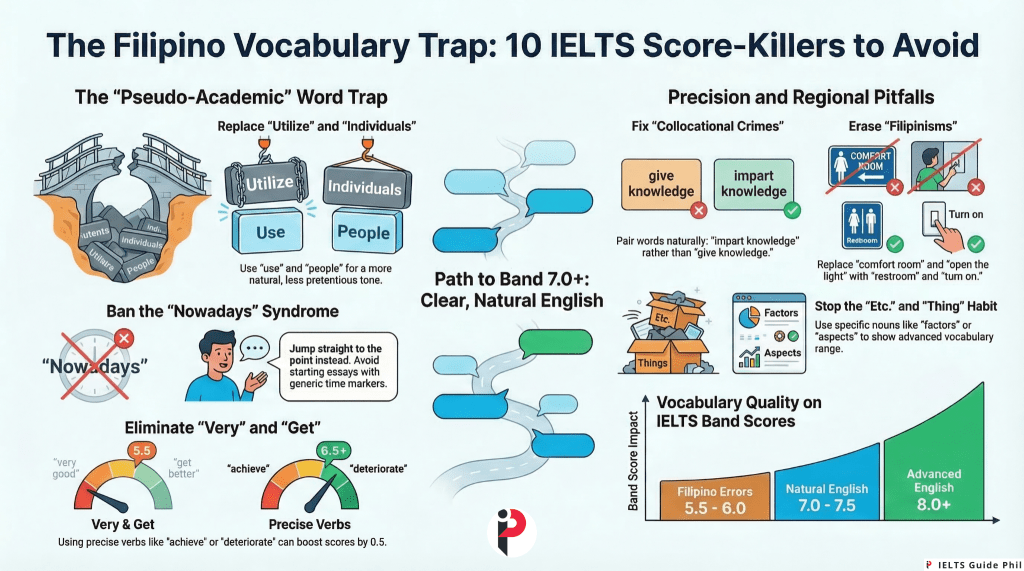
You know that sinking feeling when you get your IELTS results back and the score is lower than expected? You used impressive vocabulary. You threw in words like “utilize,” “individuals,” and “in this modern era.” You avoided simple words and tried to sound academic.
And that’s exactly why you lost points.
Here’s the brutal truth that no one tells Filipino IELTS test-takers: The vocabulary you think makes you sound intelligent is actually screaming “I memorized a word list without understanding how native speakers actually use these words.”
IELTS examiners can spot “memorized vocabulary” within seconds. They see the same patterns from Filipino test-takers over and over again—awkward collocations, unnatural word choices, and phrases that native speakers would never use. These vocabulary mistakes don’t just sound odd; they actively cost you band scores in both Lexical Resource (Writing) and Vocabulary Range (Speaking).
After analyzing thousands of Filipino IELTS responses, I’ve identified the 10 most common vocabulary mistakes that consistently cost Filipino test-takers 0.5 to 1.0 band scores. These aren’t uncommon words you don’t know—they’re common words you’re using WRONG, or “impressive” words you’re overusing unnaturally.
Let’s expose these vocabulary killers and learn what IELTS examiners actually want to see.
MISTAKE #1: “Nowadays” Syndrome – The Filipino Obsession with Time Markers
The Problem
Filipino test-takers are addicted to starting essays with:
❌ “Nowadays, technology is very important…”
❌ “In this modern era, people use smartphones…”
❌ “In today’s society, education is essential…”
❌ “At present, social media affects everyone…”
❌ “In the present time, many people work from home…”
If I had a peso for every Filipino IELTS essay that starts with “nowadays,” I could retire tomorrow. This word appears in approximately 80% of Filipino IELTS Writing Task 2 essays—often multiple times.
Why This Is Wrong
“Nowadays” isn’t grammatically incorrect, but:
- It’s repetitive – When examiners read 50 essays that all start with “nowadays,” yours immediately sounds generic
- It’s often unnecessary – If you’re discussing current issues, the present tense already signals “now”
- It sounds dated – Native speakers rarely use “nowadays” in formal academic writing
- It wastes words – IELTS values concise, direct communication
What Native Speakers Actually Say
Instead of starting with time markers, native speakers typically:
✅ Jump straight to the point: “Technology has transformed education” (no time marker needed)
✅ Use “today” if timing matters: “Today, many people work remotely” (simpler, more natural)
✅ Use “currently” or “at present” sparingly: “Currently, unemployment rates are rising” (formal, but don’t overuse)
✅ Use present perfect for recent changes: “Social media has become an integral part of daily life” (shows recent development)
The IELTS Context
Overused Filipino Openings:
❌ “Nowadays, in this modern era of technology, people in today’s society use computers for many purposes.” (Three time markers in one sentence! Redundant and awkward)
Natural Academic Openings:
✅ “Technology has fundamentally changed how people communicate and work.” (Direct, clear, no unnecessary time markers)
❌ “Nowadays, education plays a vital role in our life”
✅ “Education plays a vital role in personal and societal development”
❌ “In this modern society, many Filipinos go abroad”
✅ “Many Filipinos seek opportunities abroad for better employment”
Alternatives to “Nowadays”
When you DO need to reference current times:
- Today (most natural)
- Currently (formal, use occasionally)
- In recent years (when discussing trends)
- In the 21st century (when emphasizing modernity)
- Increasingly (when showing a trend: “People are increasingly working from home”)
- Present perfect tense (Often the best solution: “has become,” “have started”)
The Fix: Practice Exercise
Rewrite these sentences without “nowadays”:
- Nowadays, technology is everywhere in our daily lives.
- In today’s modern world, education is very important for success.
- Nowadays, at the present time, many people prefer online shopping.
Better versions:
- Technology permeates daily life. / Technology has become ubiquitous in daily life.
- Education is essential for professional and personal success. / Education has become increasingly crucial for success.
- Many consumers now prefer online shopping to traditional retail. / Online shopping has gained widespread popularity.
IELTS Impact: Using “nowadays” 3-4 times in one essay signals memorized phrases rather than natural language use. Cost: -0.5 band score in Lexical Resource.
MISTAKE #2: “Utilize” Instead of “Use” – The False Sophistication Trap
The Problem
Filipinos love replacing simple words with “fancier” equivalents:
❌ “Students should utilize technology in learning”
❌ “We can utilize public transportation”
❌ “Teachers utilize various methods”
❌ “People utilize smartphones for communication”
Filipino test-takers think: “Use” sounds too simple, so I’ll say “utilize” to sound more academic.
Wrong strategy.
Why This Is Wrong
“Utilize” and “use” are NOT interchangeable synonyms:
Use = employ something for a purpose (general)
Utilize = make practical or effective use of something, especially something not originally intended for that purpose
Examples where “utilize” is appropriate:
✅ “The company utilized waste materials to create new products” (repurposing)
✅ “During the war, they utilized old buildings as hospitals” (using something for an unintended purpose)
Examples where “utilize” sounds pretentious:
❌ “I utilize my phone to call my mother” (Just say “use”)
❌ “Students utilize books for studying” (Obviously, that’s what books are for)
What Native Speakers Do
Native speakers default to “USE” in 95% of situations. They only use “utilize” when:
- Making something serve a purpose it wasn’t designed for
- Making effective or practical use of resources
- Writing highly technical or bureaucratic documents
In IELTS essays about education, technology, environment, or society? Almost always use “USE.”
The IELTS Context
❌ “Students should utilize the internet for research”
✅ “Students should use the internet for research”
❌ “We can utilize solar power to reduce pollution”
✅ “We can use solar power to reduce pollution” OR
✅ “We can harness solar power to reduce pollution” (more sophisticated, more natural)
❌ “Teachers utilize technology in the classroom”
✅ “Teachers use technology in the classroom” OR
✅ “Teachers integrate technology into classroom instruction” (more precise)
Better Alternatives Than “Utilize”
Instead of trying to make “use” sound fancy:
- Use employ: “Employers employ various strategies…”
- Use leverage: “Companies leverage technology to improve efficiency”
- Use harness: “Countries should harness renewable energy”
- Use exploit: “We must exploit opportunities” (neutral in this context)
- Use apply: “Students apply knowledge in practical situations”
- Use implement: “Schools implement new policies”
The Real Sophistication
Sophistication in IELTS vocabulary means:
- Precision (choosing the exact right word)
- Collocations (natural word partnerships)
- Flexibility (paraphrasing effectively)
NOT just using longer words.
IELTS Impact: Overusing “utilize” signals memorized vocabulary rather than natural usage. It makes you sound like you’re trying too hard. Cost: -0.25 to -0.5 band score in Lexical Resource.
MISTAKE #3: “Individuals” Instead of “People” – The Academic Pretender
The Problem
❌ “Many individuals believe that education is important”
❌ “Individuals should take responsibility for their health”
❌ “Young individuals spend too much time on social media”
❌ “Successful individuals work hard”
Filipinos replace “people” with “individuals” thinking it sounds more academic. It doesn’t—it sounds unnatural.
Why This Is Wrong
“Individuals” is not a fancy synonym for “people.”
People = human beings in general (plural)
Individual = a single person, emphasizing their separateness or uniqueness (singular concept)
“Individuals” should be used when emphasizing:
- Personal uniqueness
- Separation from the group
- Individual rights/responsibilities as distinct from collective ones
When to Actually Use “Individual(s)”
✅ “Each individual has unique talents” (emphasizing personal uniqueness)
✅ “Individual rights must be protected” (legal/philosophical context)
✅ “We must consider individual differences in learning styles” (education context, emphasizing personal variation)
✅ “The policy affects individuals differently” (emphasizing separate effects)
When to Use “People”
✅ “Many people believe that education is important” (general statement)
✅ “People should take responsibility for their health” (general advice)
✅ “Young people spend too much time on social media” (demographic group)
The IELTS Context
❌ “Successful individuals work hard to achieve their goals”
✅ “Successful people work hard to achieve their goals”
❌ “Many individuals in society face financial problems”
✅ “Many people in society face financial problems”
❌ “Young individuals need proper guidance”
✅ “Young people need proper guidance”
But these are correct:
✅ “Society must balance individual freedom with collective responsibility”
✅ “The education system should cater to individual learning needs”
Alternative Ways to Say “People”
If you want variety (because repeating “people” gets dull):
- Citizens (in political contexts)
- Consumers (in economic contexts)
- Workers/employees (in employment contexts)
- Students/learners (in education contexts)
- Residents (in local contexts)
- The public (general population)
- Members of society
- Community members
Or use specific demographics:
- Teenagers, young adults, professionals, parents, elderly people, etc.
The Key Principle
Choose words based on PRECISION and NATURAL USAGE, not perceived formality.
IELTS Impact: Overusing “individuals” signals memorized vocabulary lists rather than natural English. Cost: -0.25 band score in Lexical Resource.
MISTAKE #4: “Give Knowledge” – The Collocational Crime
The Problem: Filipino False Collocations
Filipinos create word combinations that sound logical but aren’t how native speakers pair words:
❌ “Teachers give knowledge to students”
❌ “Books give us information”
❌ “Parents should give proper education to children”
❌ “The internet gives many advantages”
❌ “Exercise gives good health”
These aren’t grammatically wrong—they’re COLLOCATIONAL errors. Native speakers don’t pair these words together.
What Are Collocations?
Collocations are words that naturally go together in English. Native speakers learn these through exposure, but Filipino learners often create logical combinations that sound unnatural.
Filipino thinking: “If I can ‘give’ a gift, I can ‘give’ knowledge, right?” Native speaker thinking: “No, you ‘give’ tangible things, but you ‘impart’ knowledge.”
The Correct Collocations
Knowledge:
❌ Give knowledge
✅ Impart knowledge (formal)
✅ Share knowledge
✅ Acquire knowledge (as the receiver)
✅ Gain knowledge (as the receiver)
Information:
❌ Give information
✅ Provide information
✅ Supply information
✅ Convey information
✅ Share information
Education:
❌ Give education
✅ Provide education
✅ Offer education
✅ Receive education (as the receiver)
Advantages:
❌ Give advantages
✅ Offer advantages
✅ Provide advantages
✅ Bring advantages
Health:
❌ Give health
✅ Improve health
✅ Promote health
✅ Benefit health
✅ Maintain health
More Filipino Collocational Mistakes
❌ “Make exercise” → ✅ “Do exercise” or “Exercise”
❌ “Make a research” → ✅ “Do research” or “Conduct research”
❌ “Make homework” → ✅ “Do homework”
❌ “Create problems” → ✅ “Cause problems” (create = intentionally design; cause = bring about)
❌ “Take advantages” → ✅ “Take advantage” (singular) or “Enjoy advantages”
❌ “Do damage” → ✅ “Cause damage”
❌ “Give impact” → ✅ “Have an impact” or “Make an impact”
❌ “Make influence” → ✅ “Have influence” or “Exert influence”
Common Verb-Noun Collocations Filipino Test-Takers Need
With “MAKE”:
- Make a decision, make a mistake, make progress, make an effort, make changes, make a contribution, make a difference
With “DO”:
- Do homework, do research, do business, do damage (actually correct!), do harm, do your best, do a favor
With “TAKE”:
- Take responsibility, take action, take advantage (singular!), take measures, take steps, take precautions
With “HAVE”:
- Have an impact, have influence, have an effect, have consequences, have benefits
With “CAUSE”:
- Cause problems, cause damage, cause harm, cause pollution, cause concern
With “POSE”:
- Pose a threat, pose a risk, pose a challenge, pose a danger
The IELTS Context
❌ “The government should give proper education to all citizens”
✅ “The government should provide quality education to all citizens”
❌ “Technology gives many advantages to society”
✅ “Technology offers numerous advantages to society” OR
✅ “Technology brings many benefits to society”
❌ “Regular exercise gives good health”
✅ “Regular exercise promotes good health” OR
✅ “Regular exercise improves health”
❌ “This policy will create serious problems”
✅ “This policy will cause serious problems” OR
✅ “This policy will pose serious problems”
How to Learn Collocations
- Read extensively – Note which words appear together
- Use a collocation dictionary – Oxford Collocations Dictionary
- Learn chunks, not individual words – “take responsibility,” “pose a threat,” etc.
- Notice patterns in IELTS model essays – How do native writers pair words?
IELTS Impact: Collocational errors make your writing sound unnatural and non-native, even when grammar is correct. Multiple collocational errors: -0.5 to -1.0 band score in Lexical Resource.
MISTAKE #5: “Very + Adjective” Overload – The Intensity Trap
The Problem
❌ “Technology is very important in very modern society”
❌ “Education is very very essential for success”
❌ “This is a very big problem that is very serious”
❌ “Social media is very popular and very useful”
Filipino test-takers overuse “very” because:
- It’s the first intensifier we learned
- We think repetition adds emphasis
- We don’t know more sophisticated alternatives
Why This Is Wrong
Using “very” repeatedly:
- Sounds childish and repetitive
- Wastes words (especially problematic in Speaking where you need to show range)
- Misses opportunities to use precise, strong vocabulary
- Signals limited vocabulary range
The Solution: Strong Adjectives
Instead of “very + basic adjective,” use a single strong adjective:
Replace “very important”:
- Crucial, vital, essential, critical, paramount, fundamental, pivotal
Replace “very big”:
- Huge, enormous, massive, substantial, considerable, significant
Replace “very small”:
- Tiny, minute, minuscule, negligible, insignificant
Replace “very good”:
- Excellent, outstanding, exceptional, superb, remarkable, impressive
Replace “very bad”:
- Terrible, awful, dreadful, appalling, abysmal, dire
Replace “very difficult”:
- Challenging, demanding, arduous, formidable, daunting
Replace “very easy”:
- Simple, straightforward, effortless, uncomplicated
Replace “very interesting”:
- Fascinating, captivating, compelling, intriguing, engaging
Replace “very tired”:
- Exhausted, fatigued, drained, worn out
Replace “very angry”:
- Furious, enraged, livid, infuriated
Replace “very happy”:
- Delighted, thrilled, ecstatic, elated, overjoyed
Replace “very sad”:
- Devastated, heartbroken, miserable, despondent
Replace “very sure”:
- Certain, confident, convinced, positive
Replace “very scared”:
- Terrified, petrified, frightened
Alternative Intensifiers
When you DO want to intensify an adjective, vary your intensifiers:
- Extremely (stronger than very)
- Exceptionally (for positive qualities)
- Remarkably (surprisingly so)
- Particularly (in this specific case)
- Especially (more than others)
- Incredibly (hard to believe)
- Utterly (completely, often for negative)
- Highly (commonly used in formal writing: “highly effective”)
The IELTS Context
❌ “Climate change is a very big and very serious problem that is very difficult to solve”
✅ “Climate change is a massive and critical problem that is extremely challenging to address” OR even better:
✅ “Climate change poses a formidable challenge that requires urgent global action”
❌ “Education is very very important for young people”
✅ “Education is crucial for young people’s development”
❌ “This is a very good solution”
✅ “This is an excellent solution” OR
✅ “This is a highly effective solution”
Advanced Technique: Avoid Intensifiers Entirely
Sometimes the strongest writing uses no intensifier at all:
❌ “Technology is very important in education”
✅ “Technology plays a vital role in education” (The verb phrase “plays a vital role” is stronger than “is very important”)
❌ “This is a very big problem”
✅ “This poses a significant challenge”
✅ “This represents a major obstacle”
Practice Exercise
Replace “very” with stronger vocabulary:
- Pollution is a very serious problem in Manila.
- The internet is very useful for students.
- Learning English is very difficult for many Filipinos.
- Social media has become very popular among teenagers.
- This solution is very good for the environment.
Better versions:
- Pollution is a critical problem in Manila. / Pollution poses a severe threat to Manila’s environment.
- The internet is invaluable for students. / The internet serves as an essential tool for students.
- Learning English is challenging for many Filipinos. / Many Filipinos find English acquisition daunting.
- Social media has become ubiquitous among teenagers. / Social media dominates teenage social interaction.
- This solution is environmentally friendly. / This solution benefits the environment substantially.
IELTS Impact: Overusing “very” signals limited vocabulary range. Cost: -0.5 band score in Lexical Resource (Writing) and Vocabulary Range (Speaking).
MISTAKE #6: “In order to” – The Unnecessary Wordiness Disease
The Problem
❌ “People work hard in order to earn money”
❌ “Students study in order to pass exams”
❌ “The government should invest in education in order to improve society”
❌ “We need to protect the environment in order to save it for future generations”
Filipino test-takers love “in order to” because it sounds formal and academic. But it’s unnecessarily wordy.
Why This Is Wrong
In 90% of cases, “in order to” can be replaced with just “to.”
“In order to” is not wrong, but:
- It wastes words (3 words instead of 1)
- It makes writing less concise
- Native speakers prefer “to” in most contexts
The Rule
Use “TO” in most cases (simpler, more natural)
Use “IN ORDER TO” only when you want to emphasize purpose or prevent ambiguity
When “In Order To” Is Actually Better
Use “in order to” when:
- Emphasizing purpose:
✅ “The government implemented strict laws in order to combat corruption” (Emphasizes that this was the deliberate purpose) - Preventing ambiguity:
✅ “She stopped to talk to him” (She stopped so that she could talk)
✅ “She stopped in order to talk to him” (Makes purpose clearer) - At the start of a sentence:
✅ “In order to succeed, you must work hard” (More natural than “To succeed…”)
The IELTS Context
Most of the time, Filipinos use “in order to” unnecessarily:
❌ “Students study hard in order to get good grades”
✅ “Students study hard to get good grades”
❌ “We should exercise regularly in order to stay healthy”
✅ “We should exercise regularly to stay healthy”
❌ “Companies invest in technology in order to improve efficiency”
✅ “Companies invest in technology to improve efficiency”
When it IS appropriate:
✅ “In order to address climate change, governments must cooperate internationally” (Sentence-initial position, emphasizing the purpose)
✅ “The company restructured its operations in order to remain competitive” (Emphasizing deliberate purpose)
Other Wordy Phrases Filipinos Overuse
Similar wordiness problems:
❌ “Due to the fact that” → ✅ “Because” or “Since”
❌ “In spite of the fact that” → ✅ “Although” or “Despite”
❌ “At this point in time” → ✅ “Now” or “Currently”
❌ “For the purpose of” → ✅ “For” or “To”
❌ “In the event that” → ✅ “If”
❌ “On the grounds that” → ✅ “Because”
❌ “With regard to” → ✅ “Regarding” or “About”
❌ “In the near future” → ✅ “Soon”
❌ “A large number of” → ✅ “Many”
❌ “A small number of” → ✅ “Few”
The Key Principle: Concision
IELTS values:
- Clarity
- Concision
- Precision
Don’t use 5 words when 1 word works just as well.
Practice Exercise
Simplify these sentences:
- Students need to work hard in order to achieve their goals.
- Due to the fact that technology is advancing, education is changing.
- In order to solve this problem, we need better policies.
- For the purpose of improving health, people should exercise.
- In spite of the fact that education is expensive, it is important.
Better versions:
- Students need to work hard to achieve their goals.
- Because technology is advancing, education is changing. / As technology advances, education changes.
- To solve this problem, we need better policies. / Solving this problem requires better policies.
- To improve health, people should exercise. / People should exercise to maintain health.
- Although education is expensive, it is important. / Despite its cost, education remains important.
IELTS Impact: Wordiness doesn’t increase your score—it actually reduces it by making your writing less efficient. Cost: -0.25 band score in Task Achievement/Response due to lack of concision.
MISTAKE #7: “Etc.” Abuse – The Lazy Listing Habit
The Problem
❌ “People use social media like Facebook, Instagram, Twitter, etc.”
❌ “Students need books, pens, notebooks, etc. for school”
❌ “Healthy foods include fruits, vegetables, fish, etc.”
❌ “Technology affects education, business, healthcare, etc. etc.”
Filipino test-takers end lists with “etc.” constantly, thinking it sounds complete and academic.
Why This Is Wrong
Using “etc.” in IELTS:
- Sounds informal – Too casual for academic writing
- Sounds lazy – Suggests you can’t think of more examples
- Reduces specificity – IELTS values precise, detailed examples
- “Etc. etc.” is especially bad – Never double it; this looks very unprofessional
What Native Speakers Do
Native speakers in formal academic writing:
- Give specific examples without “etc.”:
✅ “Social media platforms such as Facebook, Instagram, and Twitter have transformed communication” - Use “and other” + noun:
✅ “Social media platforms and other digital communication tools” - Use “and similar” + noun:
✅ “Facebook, Twitter, and similar platforms” - Use “among others”:
✅ “Social media influences politics, business, and education, among others” - Use “and so on” (slightly more formal than “etc.”):
✅ “Students need textbooks, writing materials, and so on” (Still not great, but better than “etc.”) - Simply list 2-3 examples without ending marker:
✅ “Technology affects education, healthcare, and business” (No need for anything after—the list is complete)
The IELTS Context
❌ “Renewable energy sources include solar, wind, hydro, etc.”
✅ “Renewable energy sources include solar, wind, and hydroelectric power” OR
✅ “Renewable energy sources such as solar and wind power offer sustainable alternatives”
❌ “Students face problems like stress, financial difficulties, etc.”
✅ “Students face problems such as stress, financial difficulties, and time management challenges” OR
✅ “Students face various challenges including academic stress and financial constraints”
❌ “Cities offer better opportunities for jobs, education, healthcare, etc.”
✅ “Cities offer better opportunities for employment, education, and healthcare” OR
✅ “Cities provide superior access to employment, education, and medical services”
Advanced Technique: Use Parallel Structure
Instead of listing items with “etc.,” create parallel structures:
❌ “Technology provides benefits like faster communication, more information, entertainment, etc.”
✅ “Technology facilitates faster communication, broader access to information, and diverse entertainment options”
When “Etc.” Might Be Acceptable
“Etc.” is acceptable in:
- Informal notes or lists
- Speaking (casual conversation, though still try to avoid)
- Parenthetical additions: “(books, pens, etc.)”
But in IELTS Writing and formal Speaking responses: avoid it entirely.
Practice Exercise
Remove “etc.” and improve these sentences:
- Air pollution causes health problems like asthma, lung disease, etc.
- Students use technology for research, communication, entertainment, etc.
- Successful people have qualities like determination, hard work, patience, etc.
Better versions:
- Air pollution causes serious health problems including asthma, chronic lung disease, and cardiovascular issues.
- Students use technology for research, communication, and entertainment purposes. / Students rely on technology for academic research, peer communication, and leisure activities.
- Successful people exhibit qualities such as determination, diligence, and patience. / Success requires determination, hard work, and patience.
IELTS Impact: Using “etc.” makes your vocabulary seem limited and lazy. Cost: -0.25 band score in Lexical Resource.
MISTAKE #8: “Get” Overuse – The Informal Infiltrator
The Problem
❌ “People get stressed from work”
❌ “Students get good grades if they study”
❌ “We should get better education”
❌ “The environment is getting worse”
❌ “Many people get sick from pollution”
Filipino test-takers overuse “get” because:
- It’s versatile (has many meanings)
- It’s the first verb we learn for many concepts
- We don’t know more specific alternatives
Why This Is Wrong
“Get” isn’t grammatically wrong, but:
- Too informal for IELTS academic writing
- Too vague – doesn’t show precise vocabulary
- Too repetitive – if you use “get” 10 times in an essay, you’re showing limited range
“Get” is acceptable in IELTS Speaking (natural conversation) but should be minimized in Writing Task 2.
Replacing “Get” with Precise Verbs
“Get” as BECOME:
❌ “People get stressed”
✅ “People become stressed” OR better:
✅ “People experience stress”
❌ “The situation gets worse”
✅ “The situation deteriorates” or “worsens”
❌ “He got angry”
✅ “He became angry” or “He grew angry”
“Get” as RECEIVE:
❌ “Students get good grades”
✅ “Students receive good grades” OR better:
✅ “Students achieve good grades” or “earn high grades”
❌ “People get salaries”
✅ “People receive salaries” or “earn income”
“Get” as OBTAIN:
❌ “We should get better education”
✅ “We should obtain better education” OR better:
✅ “We should access quality education” or “pursue better education”
❌ “People get jobs”
✅ “People obtain jobs” or “secure employment”
“Get” as ACQUIRE:
❌ “Students get knowledge from books”
✅ “Students acquire knowledge from books” OR better:
✅ “Students gain knowledge through reading”
“Get” as DEVELOP:
❌ “People get diseases”
✅ “People develop diseases” or “contract illnesses”
❌ “He got cancer”
✅ “He developed cancer” or “was diagnosed with cancer”
“Get” as UNDERSTAND:
❌ “I don’t get this concept”
✅ “I don’t understand this concept” OR:
✅ “I don’t grasp this concept” or “comprehend this idea”
“Get” as ARRIVE:
❌ “I got home at 6pm”
✅ “I arrived home at 6pm” OR:
✅ “I reached home at 6pm”
Phrasal Verbs with “Get”
Some phrasal verbs with “get” are acceptable even in formal writing:
✅ “Get rid of” (eliminate)
✅ “Get along with” (have good relations)
✅ “Get over” (recover from)
But in formal IELTS Writing, consider alternatives:
- “Get rid of” → “eliminate,” “remove”
- “Get along with” → “maintain harmonious relationships with”
- “Get over” → “recover from,” “overcome”
The IELTS Context
❌ “Many people get health problems because of pollution”
✅ “Many people develop health problems due to pollution”
❌ “Students need to get good education to get better jobs”
✅ “Students need to receive quality education to secure better employment”
❌ “The economy is getting better”
✅ “The economy is improving” or “The economy is recovering”
❌ “People get information from the internet”
✅ “People obtain information from the internet” OR better:
✅ “People access information via the internet”
When “Get” Is Acceptable in IELTS
In Speaking (natural conversation):
✅ “I got my degree last year”
✅ “People get stressed easily nowadays”
In Writing Task 1 (describing processes):
✅ “The water gets heated” (passive voice in process description)
In informal phrasal verbs (even Writing Task 2, occasionally):
✅ “Governments should get rid of corruption”
Practice Exercise
Replace “get” with more precise verbs:
- Many people get sick from unhealthy lifestyles.
- Students should get good education for success.
- The environment is getting worse every year.
- People get stressed from too much work.
- Children get knowledge from their parents.
Better versions:
- Many people develop illnesses from unhealthy lifestyles. / Unhealthy lifestyles cause people to become ill.
- Students should receive quality education to ensure success. / Students require quality education for future success.
- The environment deteriorates annually. / Environmental conditions worsen each year.
- People experience stress from excessive workloads. / Excessive work causes stress.
- Children acquire knowledge from their parents. / Parents impart knowledge to their children.
IELTS Impact: Overusing “get” signals informal, repetitive vocabulary. Cost: -0.5 band score in Lexical Resource (especially in Writing).
MISTAKE #9: “Thing(s)” – The Vague Vocabulary Killer
The Problem
❌ “Technology is a good thing for society”
❌ “There are many things that affect education”
❌ “The most important thing is health”
❌ “One thing that people need is money”
❌ “These things are essential for success”
“Thing” is the laziest word in English—it means nothing specific and signals vocabulary poverty.
Why This Is Wrong
Using “thing(s)”:
- Shows imprecision – What specific thing are you referring to?
- Sounds childish – Elementary-level vocabulary
- Misses opportunities – Every “thing” could be replaced with a more impressive word
- Indicates limited vocabulary – You can’t think of the specific word
Replacing “Thing” with Specific Nouns
“Thing” as CONCEPT:
❌ “Freedom is an important thing”
✅ “Freedom is an important concept” or “value” or “principle”
“Thing” as FACTOR:
❌ “One thing that affects success is hard work”
✅ “One factor that affects success is hard work” OR better:
✅ “Hard work significantly influences success”
“Thing” as ASPECT:
❌ “The most important thing in life is health”
✅ “The most important aspect of life is health” OR better:
✅ “Health is life’s most crucial element”
“Thing” as ELEMENT/COMPONENT:
❌ “These things are necessary for success”
✅ “These elements are necessary for success” OR:
✅ “These components are essential for success”
“Thing” as ISSUE/MATTER:
❌ “The thing we need to discuss is education”
✅ “The issue we need to discuss is education” OR:
✅ “The matter requiring discussion is education”
“Thing” as PHENOMENON:
❌ “Social media is a modern thing”
✅ “Social media is a modern phenomenon”
“Thing” as DEVELOPMENT/INNOVATION:
❌ “Technology is a good thing”
✅ “Technology is a beneficial development” OR:
✅ “Technological innovation benefits society”
The IELTS Context
❌ “There are many things that students need to consider”
✅ “There are many factors that students need to consider” OR better:
✅ “Students must consider numerous factors”
❌ “Money is not the most important thing in life”
✅ “Money is not life’s most important element” OR better:
✅ “Financial wealth does not constitute life’s primary value”
❌ “One thing that affects health is diet”
✅ “One factor that affects health is diet” OR better:
✅ “Diet significantly influences health”
❌ “Technology brings many good things to society”
✅ “Technology brings many benefits to society”
Advanced Technique: Be More Specific
Instead of “thing,” identify WHAT you actually mean:
❌ “Students need many things for success” What things? → Resources, skills, opportunities, support…
✅ “Students need adequate resources, support, and opportunities to succeed”
❌ “Climate change is a serious thing” Serious what? → Problem, threat, challenge, concern…
✅ “Climate change poses a serious threat to humanity”
Practice Exercise
Replace “thing(s)” with specific words:
- Education is the most important thing for development.
- There are several things that cause poverty.
- Technology has changed many things in our lives.
- The main thing students need is motivation.
- These things are essential for a healthy lifestyle.
Better versions:
- Education is the most crucial factor in development. / Education constitutes the foundation of societal development.
- Several factors contribute to poverty. / Poverty results from multiple causes.
- Technology has transformed many aspects of daily life. / Technological advances have revolutionized modern living.
- Students primarily require motivation to succeed. / Motivation serves as the key element in student success.
- These elements are essential for a healthy lifestyle. / A healthy lifestyle requires these fundamental components.
IELTS Impact: Overusing “thing” signals elementary vocabulary. Cost: -0.5 to -1.0 band score in Lexical Resource.
MISTAKE #10: False Friends from Tagalog – “Salvage,” “Comfort Room,” “Open/Close the Light”
The Problem
Filipino English has unique expressions that don’t exist in international English:
❌ “Salvage the victim” (In Philippine English: extrajudicial killing)
❌ “Where is the comfort room?” (In Philippine English: bathroom/toilet)
❌ “Can you open the light?” (In Philippine English: turn on the light)
❌ “Please close the aircon” (In Philippine English: turn off the air conditioner) ❌ “I will just xerox this document” (In Philippine English: photocopy)
❌ “Traffic is very heavy today” (Philippine phrasing)
❌ “I will take my rest now” (Philippine phrasing)
❌ “For a while” meaning “just a moment” (Philippine meaning)
Why This Is Wrong
These are Filipinisms—English words or phrases used with meanings specific to the Philippines. IELTS examiners (usually British, Australian, or Canadian) will:
- Not understand what you mean
- Mark it as an error in vocabulary usage
- Recognize it as non-standard English
Dangerous Filipinisms to Avoid
“Salvage”
❌ Philippine meaning: extrajudicial killing
✅ International meaning: rescue, save, recover
In IELTS Writing, if you write:
❌ “The journalist was salvaged by unknown assailants” An international examiner thinks: “rescued by unknown helpers” (opposite of what you mean!)
Correct usage:
✅ “Rescue workers salvaged valuables from the wreckage”
✅ “The company tried to salvage its reputation”
If you mean extrajudicial killing (inappropriate topic for IELTS anyway):
✅ “The journalist was murdered” or “killed”
“Comfort Room” (CR)
❌ “Where is the comfort room?”
✅ “Where is the restroom?” (American)
✅ “Where is the toilet?” (British, direct)
✅ “Where are the facilities?” (British, polite)
✅ “Where is the bathroom?” (American, though technically a room with a bath)
“Open/Close” the light/aircon/TV
❌ “Can you open the light?”
✅ “Can you turn on the light?”
✅ “Can you switch on the light?”
❌ “Please close the aircon”
✅ “Please turn off the air conditioning”
✅ “Please switch off the AC”
This error comes from Tagalog:
- “Buksan ang ilaw” (literally: open the light)
- “Isara ang aircon” (literally: close the aircon)
“Xerox” as a verb
❌ “I will xerox this document”
✅ “I will photocopy this document”
✅ “I will make a copy of this document”
(Xerox is a brand name, not a verb in standard English)
“Traffic is heavy”
❌ “Traffic is very heavy today”
✅ “Traffic is bad today”
✅ “There is heavy traffic today” (grammatically acceptable but awkward)
✅ “The traffic is terrible today”
Note: In standard English, “traffic” (the condition) is bad/terrible/awful, while “there is heavy traffic” (description of density) is acceptable.
“Take my rest”
❌ “I will take my rest now”
✅ “I will rest now”
✅ “I am going to rest”
✅ “I need to get some rest”
“For a while” vs. “A while ago”
❌ “Wait for me for a while” (meaning: wait just a moment)
✅ “Wait for me for a moment”
✅ “Wait for me for a minute”
✅ “Give me a moment”
In standard English, “for a while” means “for some period of time” (possibly longer), not “briefly.”
“Ref” (refrigerator)
❌ “Put it in the ref”
✅ “Put it in the refrigerator”
✅ “Put it in the fridge” (informal but international)
“Blowout”
❌ “He gave us a blowout after his promotion” (Philippine meaning: treat/party)
✅ “He treated us after his promotion”
✅ “He took us out to celebrate his promotion”
In standard English, “blowout” means:
- A tire bursting
- A big party (informal)
- A decisive victory
But NOT “treating friends to food.”
“High Blood”
❌ “My father has high blood”
✅ “My father has high blood pressure”
✅ “My father has hypertension”
In standard English, “high blood” means nothing without “pressure.”
“Admit in hospital”
❌ “He was admitted in the hospital”
✅ “He was admitted to the hospital” (American)
✅ “He was admitted to hospital” (British, no “the”)
“Borrow vs. Lend” confusion
❌ “Can you borrow me your pen?” (mixing Tagalog “pahiram”)
✅ “Can you lend me your pen?” (you’re asking them to give)
✅ “Can I borrow your pen?” (you’re receiving)
More Filipinisms to Watch Out For
- ❌ “Colorum” → ✅ “Illegal/unlicensed” (transport)
- ❌ “Hold-upper” → ✅ “Robber/mugger”
- ❌ “Styrofoam” (for food container) → ✅ “Takeout container” or “foam container”
- ❌ “Carnap” → ✅ “Car theft/carjacking”
- ❌ “Brownout” → ✅ “Power outage” or “blackout”
- ❌ “Grabe” (used in English sentences) → ✅ “Extreme/incredible/intense”
- ❌ “Plastic” (person being fake) → ✅ “Two-faced/insincere”
The IELTS Context
Because IELTS is an international test, you must use international standard English, not Philippine English variants.
In Speaking, if you accidentally use a Filipinism, the examiner may:
- Ask you to clarify
- Not understand at all
- Mark it as inappropriate vocabulary
In Writing, Filipinisms will be marked as errors because they’re not recognized internationally.
How to Avoid Filipinisms
- Be aware they exist – Many Filipinos don’t realize these are Philippine-specific
- Read international English materials – British and American newspapers, not just Philippine media
- Watch international English media – BBC, CNN, not just local news
- Think: “Would an American or British person say this?”
- When in doubt, use the most literal standard expression
Practice Exercise
Correct these Filipinisms:
- Can you open the aircon? It’s very hot.
- Wait for me for a while, I’ll just go to the comfort room.
- Traffic is so heavy today that I was late.
- I need to xerox these documents before the meeting.
- My mother has high blood and needs medication.
Corrected versions:
- Can you turn on the air conditioning? It’s very hot.
- Wait for me a moment, I just need to use the restroom/toilet.
- Traffic was so bad today that I arrived late. / There was such heavy traffic that I was late.
- I need to photocopy these documents before the meeting.
- My mother has high blood pressure (or hypertension) and needs medication.
IELTS Impact: Using Filipinisms confuses examiners and signals non-standard English. Cost: -0.5 to -1.0 band score in Lexical Resource, as examiners may not understand what you mean.
How These Vocabulary Mistakes Compound Your Score Loss
Let’s look at a typical Filipino IELTS essay paragraph with all these mistakes:
❌ BEFORE (Filipino vocabulary errors):
“Nowadays, in this modern era, technology is a very very important thing in our society. Many individuals utilize smartphones for various things like communication, information, entertainment, etc. Students should study hard in order to get good education. Teachers give knowledge to students so they can get good grades. This is one of the reason why education is very essential. Technology gives many advantages to people, and they get benefits from it.”
Errors count:
- “Nowadays, in this modern era” (redundant time markers)
- “very very important thing” (double “very” + vague “thing”)
- “individuals” (unnatural for “people”)
- “utilize” (pretentious substitute for “use”)
- “things like… etc.” (lazy listing)
- “in order to get” (wordiness + informal “get”)
- “get good education” (wrong collocation + “get”)
- “give knowledge” (wrong collocation)
- “get good grades” (“get” overuse)
- “one of the reason” (covered in previous blog post, but shows pattern)
- “very essential” (redundancy – essential already means very necessary)
- “gives many advantages” (wrong collocation)
- “get benefits” (wrong collocation + “get”)
Errors in vocabulary alone: 13+ mistakes in 7 sentences
✅ AFTER (Corrected international English):
“Technology plays a crucial role in contemporary society. Most people use smartphones for communication, accessing information, and entertainment. Students must pursue quality education to achieve academic success. Teachers impart knowledge to students, enabling them to excel academically. Education remains essential for personal and professional development. Technology offers numerous advantages, providing substantial benefits to users worldwide.”
Improvements:
- Removed redundant time markers
- Replaced “thing” with specific nouns
- Used “people” instead of “individuals”
- Changed “utilize” to “use”
- Eliminated “etc.”
- Removed “in order to”
- Replaced all instances of “get” with precise verbs
- Fixed collocations (impart knowledge, pursue education, offer advantages)
- Removed “very” with strong adjectives
Result: From Band 5.5-6.0 vocabulary to Band 7.0-7.5 vocabulary
Band score impact: Vocabulary mistakes alone in the “before” version would cost 1.0-1.5 band scores in Lexical Resource.
The 30-Day Filipino Vocabulary Detox Program
Week 1: Awareness and Elimination
Day 1-2: Time Markers
- Review your last 5 practice essays
- Circle every “nowadays,” “in this modern era,” “in today’s society”
- Rewrite openings without time markers
Day 3-4: “Utilize” and “Individuals”
- Find and replace every “utilize” with “use” or better alternatives
- Replace “individuals” with “people” or specific groups
Day 5-7: Collocations
- Study 30 common verb-noun collocations
- Practice: Write 20 sentences using correct collocations
- Focus on: give/provide/offer/cause/make/do combinations
Week 2: Precision and Variety
Day 8-10: “Very” Elimination
- List 20 strong adjectives to replace “very + adjective”
- Rewrite 5 paragraphs eliminating all instances of “very”
Day 11-13: “Get” Replacement
- Study 15 precise verbs to replace “get”
- Write 30 sentences using: receive, obtain, achieve, develop, experience, etc.
Day 14: “Thing” Banishment
- Identify what you actually mean: factor, aspect, element, issue, phenomenon
- Rewrite 3 essays replacing every “thing” with specific nouns
Week 3: Concision and Naturalization
Day 15-17: Wordiness Reduction
- Learn 10 wordy phrases and their concise alternatives
- Practice using “to” instead of “in order to”
- Eliminate “etc.” from all lists
Day 18-21: Filipinism Awareness
- Study the list of Filipinisms
- Check your speaking recordings for Philippine-specific expressions
- Practice international alternatives
Week 4: Integration and Testing
Day 22-24: Writing Practice
- Write 3 full IELTS Task 2 essays
- Self-check for all 10 vocabulary mistakes
- Get feedback from a tutor on vocabulary specifically
Day 25-27: Speaking Practice
- Record 3 full IELTS Speaking mock tests
- Listen specifically for vocabulary errors
- Practice self-correction mid-response
Day 28-30: Final Assessment
- Take 2 full IELTS practice tests
- Have someone score your Lexical Resource specifically
- Create your personal “watch list” of mistakes you still make
Examiner Insights: What They’re Really Looking For
Band 5-6 Vocabulary (Filipino problem areas):
- Limited range, repetitive vocabulary
- Errors in word choice and collocation
- Overuse of simple words like “very,” “get,” “thing”
- Inappropriate formality level
Band 7 Vocabulary (Target level):
- Sufficient range with some flexibility and precision
- Awareness of style and collocation
- Occasional errors in word choice
- Natural phrasing most of the time
Band 8+ Vocabulary:
- Wide range with natural, sophisticated control
- Precise meanings in all contexts
- Rare errors only as “slips”
- Effective use of less common vocabulary
The key difference for Filipino test-takers: Moving from 6.0 to 7.0 is often NOT about learning more difficult words—it’s about using common words MORE NATURALLY and AVOIDING these 10 systematic mistakes.
Real Success Stories
Maria, 26, Nurse (Canada Immigration)
- Before: Band 6.5 (6.0 Lexical Resource)
- After: Band 7.5 (7.5 Lexical Resource)
- Key change: Eliminated “nowadays,” “utilize,” “individuals,” and “very” + learned proper collocations
- Timeline: 5 weeks
Joseph, 29, Engineer (UK Work Visa)
- Before: Band 6.0 overall (5.5 Lexical Resource – vocabulary limiting him)
- After: Band 7.0 overall (7.0 Lexical Resource)
- Key change: Stopped using “get,” “thing,” “etc.” and learned to write concisely
- Timeline: 8 weeks
Patricia, 24, Graduate School
- Before: Band 6.5 Writing (vocabulary was biggest weakness)
- After: Band 7.5 Writing
- Key change: Fixed all collocational errors, eliminated Filipinisms, varied vocabulary naturally
- Timeline: 6 weeks
Your Vocabulary Checklist: Print and Review Before Every Test
Before you submit your IELTS Writing, check:
□ Did I start with “nowadays”? (Remove or replace) □ Did I use “utilize” anywhere? (Change to “use” or better) □ Did I write “individuals” for “people”? (Replace) □ Did I use wrong collocations? (give knowledge, make research, etc.) □ Did I use “very” more than once? (Replace with strong adjectives) □ Did I use “in order to”? (Usually replace with “to”) □ Did I end any lists with “etc.”? (Remove and complete the list) □ Did I use “get” more than twice? (Replace with precise verbs) □ Did I use “thing” or “things”? (Replace with specific nouns) □ Did I use any Filipinisms? (Replace with international English)
If you checked any box: GO BACK AND FIX IT.
Final Thoughts: The Filipino Advantage Unleashed
Filipino test-takers have tremendous advantages:
- Strong English foundation
- Confidence in speaking
- Rich vocabulary from education
- Critical thinking skills
The problem isn’t lack of English ability—it’s fossilized vocabulary habits from Philippine English education.
Once you eliminate these 10 vocabulary mistakes:
- Your writing sounds more natural
- Examiners recognize you as a high-level user
- Your Lexical Resource score jumps 0.5-1.0 bands
- Your overall IELTS score follows
Remember: IELTS doesn’t want you to use the “fanciest” words. It wants you to use appropriate, precise, natural vocabulary that communicates clearly.
Stop trying to impress with “utilize” and “individuals.” Start impressing with natural, appropriate word choice and proper collocations.
Your 7.0 or 7.5 is waiting. These 10 vocabulary mistakes are the only things standing between you and your target score.
Now go eliminate them.
Self-Assessment: Your Vocabulary Error Profile
Review your last 3 IELTS practice essays or speaking recordings. Count how many times you made each error:
- “Nowadays” overuse: _____ times
- “Utilize” for “use”: _____ times
- “Individuals” for “people”: _____ times
- Wrong collocations: _____ times
- “Very” overuse: _____ times
- “In order to” wordiness: _____ times
- “Etc.” usage: _____ times
- “Get” overuse: _____ times
- “Thing/things” usage: _____ times
- Filipinisms: _____ times
Your highest numbers = your priority focus areas
Set a goal: Zero instances of your top 3 errors within 2 weeks.
Share this article with your IELTS study group. Filipino test-takers improve faster when we help each other recognize these patterns.
Comment below: Which of these 10 vocabulary mistakes do you struggle with most? Let’s support each other in eliminating these score-killers!
Hashtags
#IELTSGuidePhil #IELTSPhilippines #IELTSVocabulary #FilipinoIELTS #IELTSWriting #IELTSSpeaking #VocabularyMistakes #IELTSPreparation #IELTSTips #PhilippineEnglish #IELTSBand7 #IELTSBand8 #EnglishVocabulary #IELTS2025 #StudyAbroad #IELTSTest #IELTSExam #LearnEnglish #FilipinoEnglish #LexicalResource #IELTSCoaching #Collocations #IELTSSuccess #IELTSScores #VocabularyRange #EnglishLearning #IELTSStudy #FilipinoStudents #OFW #StudyInCanada #StudyInUK
BONUS RESOURCE: Create flashcards for:
- 30 correct collocations (provide information, cause problems, etc.)
- 20 strong adjectives (to replace “very + adjective”)
- 15 verbs to replace “get”
- 10 specific nouns to replace “thing”
Review these daily until they become automatic!
 IELTS Guide Phil
Leave a comment