
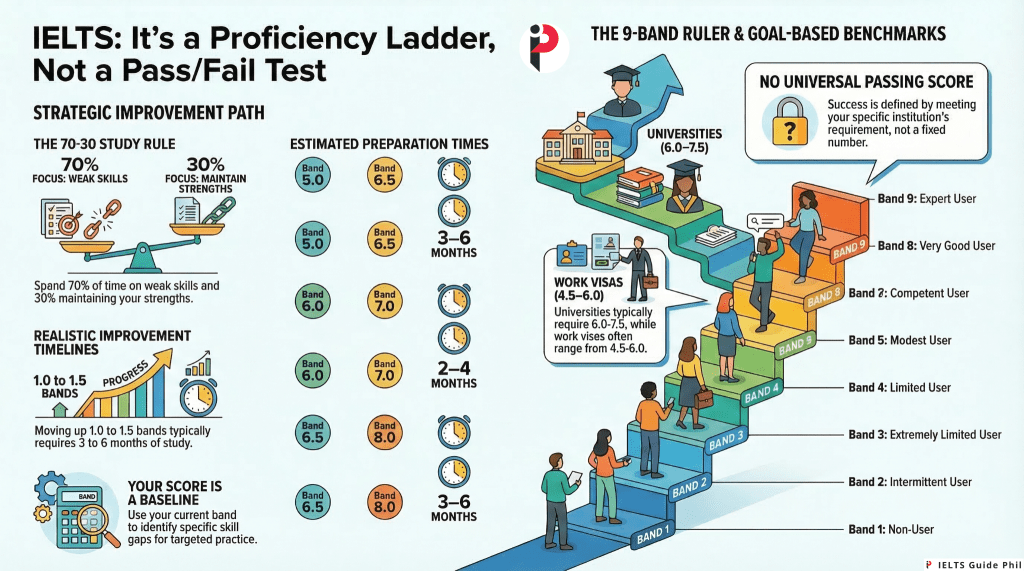
If you’ve been stressing about “passing” the IELTS exam, take a deep breath. Here’s the truth that will change your entire perspective: IELTS isn’t something you pass or fail. It’s a proficiency placement exam that measures where you currently stand on the English language spectrum.
Understanding this fundamental difference can transform your preparation strategy, reduce test anxiety, and help you set realistic, achievable goals. Let’s dive deep into what IELTS really is and how to approach it effectively.
What IELTS Actually Measures
The International English Language Testing System (IELTS) is designed to assess your English language ability across four key skills: Listening, Reading, Writing, and Speaking. Rather than giving you a simple “pass” or “fail” verdict, IELTS places you on a 9-band scale that reflects your current proficiency level.
Think of it like a ruler measuring your height. The ruler doesn’t pass or fail you—it simply tells you how tall you are. Similarly, IELTS doesn’t judge whether your English is “good enough” in absolute terms. Instead, it provides an accurate snapshot of your current language abilities.
The 9-Band Scale Explained
- Band 9: Expert user – Full operational command of the language
- Band 8: Very good user – Fully operational command with occasional inaccuracies
- Band 7: Good user – Operational command with occasional inaccuracies or misunderstandings
- Band 6: Competent user – Generally effective command despite inaccuracies
- Band 5: Modest user – Partial command, coping with overall meaning in most situations
- Band 4: Limited user – Basic competence limited to familiar situations
- Band 3: Extremely limited user – Conveys only general meaning in very familiar situations
- Band 2: Intermittent user – Great difficulty understanding spoken and written English
- Band 1: Non-user – Essentially no ability to use the language
- Band 0: Did not attempt the test
Each institution or organization sets its own required band score based on their needs, which is why there’s no universal “passing score.”
Why This Distinction Matters
Understanding that IELTS is a placement exam rather than a pass/fail test has several important implications:
1. Your Score Reflects Your Current Level
Your IELTS score is a honest assessment of where your English stands today. A Band 5 doesn’t mean you’ve failed—it means you’re at a modest user level. This information is valuable because it shows you exactly what you need to work on.
2. Different Goals Require Different Scores
A university might require Band 7.0 for admission, while a visa application might only need Band 5.5. Neither score is inherently “passing” or “failing”—they’re simply different proficiency requirements for different purposes.
3. You Can Retake Without Stigma
Since there’s no concept of failure, retaking IELTS isn’t about “failing and trying again.” It’s about improving your proficiency and demonstrating that improvement. Many successful candidates take the test multiple times.
Real-World Examples
Example 1: Maria’s Journey Maria scored Band 6.0 on her first IELTS attempt. Her target university required Band 7.0. Did she fail? No. She identified her weaknesses (primarily in Writing and Speaking), worked on them for three months, and achieved Band 7.5 on her second attempt. Her first score wasn’t a failure—it was a baseline measurement.
Example 2: Ahmed’s Success Ahmed needed Band 5.5 for a skilled worker visa. He scored Band 6.0 on his first attempt. Did he “over-pass”? No—he simply demonstrated a higher proficiency than the minimum required, which strengthened his application.
Example 3: Lin’s Strategy Lin scored Band 5.0 but needed Band 7.0 for her master’s program. Rather than feeling defeated, she used her score report to identify that her Listening (Band 6.5) and Reading (Band 6.0) were stronger than her Writing (Band 4.0) and Speaking (Band 4.5). She focused her six-month preparation on the weaker skills and eventually achieved her target.
Common Mistakes and How to Fix Them
Mistake 1: Treating All Sections Equally When You Have Specific Weaknesses
The Problem: Spending equal time on all four skills when your score report clearly shows some are much weaker than others.
The Fix: Analyze your practice test results or previous IELTS scores. If Reading is already at Band 7.0 but Writing is at Band 5.5, allocate more time to Writing. Use the 70-30 rule: spend 70% of your time on weak areas and 30% maintaining strong areas.
Mistake 2: Aiming for Band 9.0 When You Need Band 6.5
The Problem: Setting unrealistic goals that lead to burnout and disappointment.
The Fix: Identify your actual required score and aim for 0.5-1.0 band higher as a buffer. If you need Band 6.5, target Band 7.0-7.5. This gives you room for test-day nerves while keeping your goal achievable.
Mistake 3: Giving Up After a “Low” Score
The Problem: Viewing your first score as a failure rather than a starting point.
The Fix: Remember that improvement is always possible. Break down your score by section, identify patterns in your mistakes, and create a targeted study plan. Many test-takers improve by 1.5-2.0 bands with focused preparation.
Mistake 4: Not Understanding the Band Descriptors
The Problem: Preparing without knowing what examiners are actually looking for at your target band level.
The Fix: Study the official IELTS band descriptors for each skill. Understand the specific criteria for your target band. For example, Band 7 Writing requires “a clear progression throughout,” “a range of complex structures,” and “good control of grammar and punctuation.”
Mistake 5: Comparing Your Score to Others
The Problem: Feeling inadequate because someone else scored higher, without considering different requirements.
The Fix: Focus on your personal requirements. Your friend’s Band 8.0 is impressive, but if you only need Band 6.0 and achieved it, you’ve met YOUR goal. IELTS is not a competition—it’s a personal benchmark.
The Do’s and Don’ts of IELTS Preparation
DO’s:
Do Understand Your Target Score: Research the exact requirements for your purpose (university admission, visa, professional registration). Different institutions and immigration programs have different requirements.
Do Take a Diagnostic Test Early: Before investing months in preparation, take a full practice test under exam conditions. This gives you a realistic baseline and helps you allocate your study time effectively.
Do Focus on Your Weakest Skills: If your Reading is Band 7.0 but your Writing is Band 5.0, you know where to concentrate your efforts. Strategic preparation is more effective than generic studying.
Do Learn the Test Format: Familiarity with question types, timing, and instructions reduces anxiety and prevents silly mistakes. You want to showcase your English, not struggle with unfamiliar formats.
Do Practice Under Timed Conditions: Knowing the material is different from performing under pressure. Regular timed practice builds stamina and helps you develop time-management strategies.
Do Review Band Descriptors Regularly: Keep the assessment criteria in mind as you practice. This helps you self-evaluate and understand what improvements will actually impact your score.
Do Seek Feedback: Whether from teachers, tutors, or study partners, external feedback helps you identify blind spots in your performance.
Do Build Vocabulary Systematically: IELTS values range and precision in vocabulary. Learn words in context, practice using them, and review regularly.
DON’Ts:
Don’t Memorize Essays or Answers: Examiners are trained to spot memorized responses. This can actually lower your score. Focus on developing flexible language skills instead.
Don’t Ignore Any Section: Even if you only need an overall Band 6.5, a very low score in one section might drag down your average. Aim for balanced development.
Don’t Study Without a Plan: Random practice without structure rarely leads to improvement. Create a schedule that addresses your specific weaknesses and stick to it.
Don’t Rely Solely on Practice Tests: While practice tests are valuable for familiarization and timing, they don’t teach you new skills. Combine them with active learning—studying grammar, expanding vocabulary, and developing strategies.
Don’t Use Informal Language in Writing: IELTS Academic Writing requires formal, academic English. Avoid contractions, casual expressions, and overly personal language.
Don’t Rush the Speaking Test: Speaking too quickly often leads to errors and reduces clarity. Natural pace with clear pronunciation is more important than speed.
Don’t Neglect Your Stronger Skills: While focusing on weaknesses, maintain your strengths. A skill can decline without practice.
Don’t Take the Test Too Soon: Be realistic about preparation time. If you’re currently at Band 5.0 and need Band 7.0, you’ll likely need 4-6 months of consistent study. Rushing leads to disappointment and wasted test fees.
Setting Realistic Goals and Timelines
Your current level and target score determine your preparation timeline:
From Band 4.0 to Band 5.5: Approximately 3-4 months of consistent study From Band 5.0 to Band 6.5: Approximately 3-6 months of focused preparation
From Band 6.0 to Band 7.0: Approximately 2-4 months of targeted practice From Band 6.5 to Band 7.5-8.0: Approximately 3-6 months of advanced study
These are general guidelines. Your actual timeline depends on study intensity, learning style, language background, and how strategically you prepare.
Understanding Score Requirements
Different purposes require different IELTS scores. Here’s a general overview:
University Undergraduate Programs: Typically Band 6.0-6.5 University Postgraduate Programs: Usually Band 6.5-7.5 (some competitive programs require 7.5-8.0) Professional Registration (nurses, doctors, engineers): Often Band 7.0-7.5 Skilled Migration Visas: Commonly Band 6.0-7.0 depending on the country Student Visas: Typically Band 5.5-6.0 Work Visas: Generally Band 4.5-6.0 depending on occupation
Always check the specific requirements for your purpose, as these vary significantly.
Frequently Asked Questions
Q1: Can I fail the IELTS test?
No, you cannot fail IELTS. Every test-taker receives a band score from 1-9 (or 0 if you don’t attempt the test). The question is whether your score meets the requirements of the institution or organization you’re applying to. You might not achieve your target score, but that’s not the same as failing.
Q2: What’s considered a “good” IELTS score?
This depends entirely on your purpose. Band 6.5 is excellent if you only need Band 6.0, but insufficient if you need Band 7.5. There’s no universally “good” or “bad” score—only scores that meet or don’t meet specific requirements. However, statistically, Band 7.0+ is generally considered strong proficiency, and Band 8.0+ indicates very high proficiency.
Q3: How many times can I take IELTS?
You can take IELTS as many times as you want. There’s no limit. However, you must wait for your results before booking another test at the same center, and practically, you should allow time between tests to actually improve your English rather than simply retesting.
Q4: Will multiple attempts look bad on my application?
No. Most institutions only care about your final score, not how many attempts it took. They understand that English proficiency develops over time. Taking the test multiple times shows determination and commitment to meeting their requirements.
Q5: Should I take IELTS Academic or General Training?
This depends on your purpose. Academic is required for university admissions and professional registration in most cases. General Training is typically for immigration, work visas, and secondary education. Check your specific requirements before booking.
Q6: How long is my IELTS score valid?
IELTS scores are generally valid for two years from the test date. However, some organizations may have different validity periods, so always check specific requirements.
Q7: Can I improve my score in just one section on a retake?
Unfortunately, no. You must take the entire test again. Your scores are reported from the most recent test date. However, some immigration programs allow you to combine scores from two tests taken within six months—check if this applies to your situation.
Q8: What if I’m just 0.5 bands short of my requirement?
Being 0.5 bands short is frustrating but very achievable to overcome. This typically represents fixable issues in technique or specific skill areas. With targeted preparation focusing on your exact weaknesses (which your score report reveals), most people can gain 0.5-1.0 bands in 4-8 weeks.
Q9: Does IELTS test British or American English?
IELTS accepts all major English varieties (British, American, Australian, Canadian). You won’t be penalized for using American spellings or vocabulary versus British, as long as you’re consistent and accurate within the variety you choose.
Q10: What’s the difference between overall band score and individual section scores?
Your overall band score is the average of your four section scores (Listening, Reading, Writing, Speaking), rounded to the nearest 0.5. Some institutions require specific minimums in individual sections as well as an overall score. For example, a university might require “Overall 7.0 with no section below 6.5.”
Q11: Can I use a pen or pencil in the test?
For paper-based IELTS, you must use a pencil for Listening and Reading, but you can use either pencil or pen for Writing (though pencil is recommended so you can erase). For computer-delivered IELTS, you type your answers for Listening, Reading, and Writing.
Q12: What happens if I don’t finish a section?
Unanswered questions are marked as incorrect. There’s no penalty for guessing, so always fill in an answer for every question, even if you’re not sure. Managing your time effectively is a crucial skill for IELTS success.
Your Path Forward
Remember, IELTS is simply a measurement tool. Your score tells you where you are today—not where you can be tomorrow. Whether you score Band 5.0 or Band 8.0, that number represents your current proficiency, not your potential or worth.
If your score doesn’t meet your requirements, you haven’t failed. You’ve gained valuable information about where to focus your improvement efforts. With strategic preparation, clear understanding of the assessment criteria, and consistent practice, improvement is not just possible—it’s probable.
The journey to English proficiency is personal. Your timeline, your challenges, and your goals are unique. Embrace the process, celebrate small improvements, and remember that every point earned represents real growth in your English abilities.
Final Thoughts
Shifting your mindset from “pass/fail” to “proficiency measurement” removes unnecessary pressure and allows you to approach IELTS more strategically. You’re not battling against the test—you’re using it as a tool to demonstrate your English skills.
Set realistic goals, prepare strategically, understand what’s being assessed, and remember that your IELTS score is just one moment in time. It reflects where you are now, not where you’re capable of reaching.
Your English journey doesn’t end with IELTS—it’s simply one milestone along the way. Whether you achieve your target score on your first attempt or your fifth, what matters is that you’re continuously developing a skill that will serve you throughout your academic, professional, and personal life.
#IELTS #IELTSGuidePhil #IELTSPreparation #IELTSTips #EnglishProficiency #IELTSExam #LearnEnglish #EnglishTest #IELTSWriting #IELTSSpeaking #IELTSReading #IELTSListening #StudyAbroad #EnglishLearning #TestPreparation #IELTSScore #LanguageLearning #EnglishLanguage #IELTSSuccess #IELTSStrategy #EducationAbroad #InternationalStudents #IELTSAcademic #IELTSGeneralTraining #BandScore #EnglishFluency #LanguageTest #ImmigrationTest #StudyOverseas #IELTSMotivation #EnglishGoals
Remember: Your IELTS score is a starting point, not a verdict. Every band represents real proficiency, and every improvement reflects genuine growth. Approach the test with strategy, preparation, and confidence in your ability to develop your English skills.
 IELTS Guide Phil
Leave a comment