
If you’ve been preparing for the IELTS exam, you might have encountered a puzzling phenomenon: despite speaking English fluently in daily life, your practice test scores don’t reflect your abilities. Or perhaps you’ve wondered why your eloquent, natural-sounding essays receive lower marks than expected. The truth is, there’s a significant distinction between being proficient in English and being proficient in IELTS English.
Understanding this difference is crucial for test success. While “good English” reflects your ability to communicate effectively in real-world situations, “good IELTS English” demonstrates your ability to meet specific assessment criteria within a structured testing framework. Let’s explore what sets them apart and how you can bridge the gap.
What Is “Good English”?
Good English means communicating effectively in real-life contexts. It’s about making yourself understood, connecting with others, and navigating various social and professional situations with ease. Someone with good English can hold conversations, write emails, understand movies, read novels, and function comfortably in English-speaking environments.
Key characteristics of good English include natural fluency, appropriate vocabulary for context, the ability to understand and be understood, cultural awareness in communication, and grammatical accuracy that doesn’t impede comprehension. You might occasionally make minor errors, but your overall communication remains clear and effective.
What Is “Good IELTS English”?
Good IELTS English, on the other hand, is a more specific skill set. It requires demonstrating proficiency according to standardized assessment criteria across four components: Listening, Reading, Writing, and Speaking. The exam evaluates specific linguistic features including lexical resource (vocabulary range and accuracy), grammatical range and accuracy, coherence and cohesion, task achievement (Writing) or task response (Speaking), and pronunciation (Speaking).
IELTS English demands that you showcase these elements explicitly within time constraints and specific task formats. It’s not just about communicating effectively but about demonstrating the full range of your English capabilities in measurable ways.
The Critical Differences
Structure and Organization
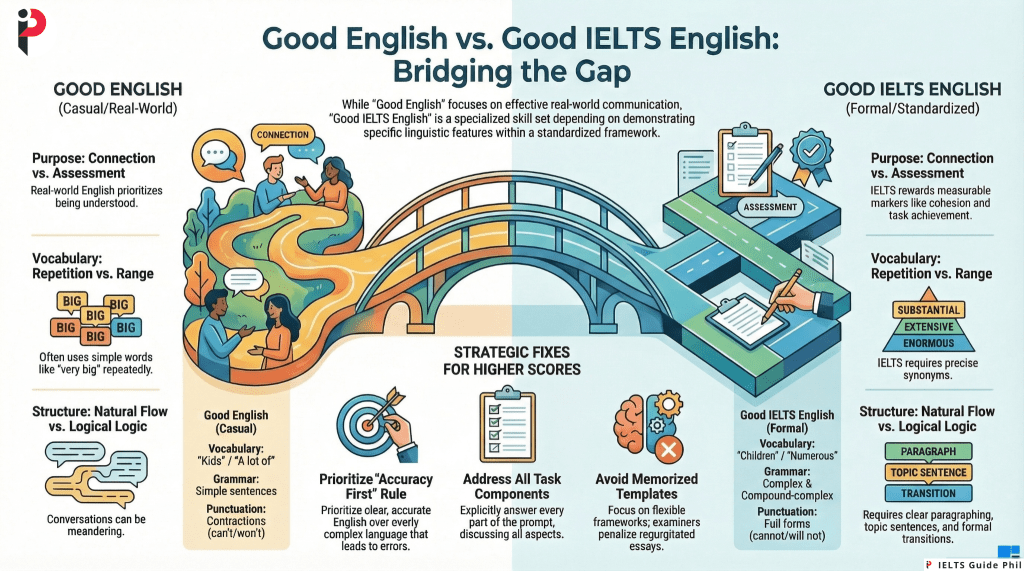
In everyday English, conversations and writing can meander naturally. You might start discussing weekend plans, digress into a funny story about your dog, and eventually circle back to making dinner arrangements. This natural flow works perfectly well in real life.
In IELTS Writing, however, you need clear paragraph structures with topic sentences, supporting details organized logically, smooth transitions between ideas, and a coherent flow from introduction to conclusion. An IELTS essay about whether pets benefit children requires a clear position, well-organized arguments, specific examples, and a logical progression that an examiner can follow easily.
Vocabulary Expectations
Good English allows you to use simple, repetitive vocabulary if it gets your message across. You might say “very big” multiple times in a conversation without anyone noticing or caring. In IELTS English, you’re expected to demonstrate vocabulary range by using synonyms and paraphrasing, employ less common lexical items appropriately, show precision in word choice, and use topic-specific vocabulary. Instead of repeatedly saying “very big,” IELTS rewards vocabulary like enormous, substantial, considerable, extensive, or significant, used appropriately in context.
Grammar Complexity
Everyday English often relies on simple sentence structures. Phrases like “I went to the store, and I bought milk, and then I came home” are perfectly acceptable in casual conversation. IELTS English requires you to demonstrate grammatical range through complex sentences (with subordinate clauses), varied sentence structures (simple, compound, complex, compound-complex), appropriate use of passive voice, conditional structures, and relative clauses. An IELTS-appropriate version might be: “After visiting the store where I purchased milk, I returned home.”
Task Completion
In real life, you can answer questions however you like. If someone asks your opinion about technology, you could share a personal anecdote, mention something you read, or simply say “I’m not sure.” In IELTS, particularly in Writing Task 2 and Speaking Part 3, you must directly address all parts of the question, provide a clear position or perspective, support your views with explanations and examples, and develop your response adequately. Avoiding the question or giving vague responses will cost you marks, even if your English is otherwise excellent.
Time Pressure and Format
Good English develops naturally over time without specific constraints. IELTS English must be demonstrated under strict time limits: 60 minutes for Writing Task 1 and 2 combined, 11-14 minutes for the Speaking test, and immediate comprehension required for Listening. You must also work within specific formats, such as 150 words minimum for Writing Task 1, 250 words minimum for Writing Task 2, and particular question types in each section.
Common Mistakes: When “Good English” Fails the IELTS Test
Mistake 1: Being Too Casual
Many fluent speakers write or speak too informally for IELTS. Using contractions excessively (can’t, won’t, shouldn’t), employing colloquialisms and slang (“kids,” “a lot of,” “stuff”), or starting sentences with “So,” “Well,” or “And” might work in conversation but can lower your score in Writing and formal Speaking responses.
The Fix: Practice using formal alternatives. Write “children” instead of “kids,” “numerous” or “many” instead of “a lot of,” and “matters” or “issues” instead of “stuff.” Avoid contractions in Writing entirely.
Mistake 2: Repeating Vocabulary
In normal conversation, repetition helps emphasize points and maintain clarity. However, in IELTS, repeating the same words signals limited vocabulary. If you use “important” five times in a 250-word essay, examiners notice.
The Fix: Build synonym clusters for common words. For “important,” alternatives include crucial, vital, essential, significant, paramount, or key. Practice paraphrasing questions using different vocabulary in your introduction.
Mistake 3: Ignoring Essay Structure
Some test-takers write stream-of-consciousness responses, similar to how they might text a friend or journal privately. This results in ideas scattered throughout the essay, no clear introduction or conclusion, and paragraphs of wildly different lengths.
The Fix: Learn and practice standard IELTS essay structures. A typical structure includes an introduction with a clear thesis, two or three body paragraphs with topic sentences and supporting details, and a conclusion that summarizes without introducing new ideas. Use each body paragraph to develop one main idea thoroughly.
Mistake 4: Simple Sentence Overload
Using only simple sentences makes your writing sound choppy and immature, even if technically correct: “I like reading. Reading is fun. It helps me relax. I read every day.”
The Fix: Combine ideas using conjunctions, relative clauses, and subordination: “I enjoy reading because it helps me relax, which is why I make time for it daily.” Practice creating complex sentences that show relationships between ideas.
Mistake 5: Not Answering the Full Question
In conversation, partial responses are acceptable. In IELTS Writing Task 2, if the question asks “Do the advantages outweigh the disadvantages?” you must discuss both advantages AND disadvantages, then clearly state your position. Discussing only one side fails to complete the task.
The Fix: Underline or highlight all parts of the question. Before you start writing, make brief notes addressing each component. Review your essay to ensure you’ve covered everything requested.
Mistake 6: Memorizing and Regurgitating
Some test-takers memorize entire essays or long phrases and try to insert them regardless of relevance. Examiners are trained to spot this, and it can seriously harm your score.
The Fix: Instead of memorizing essays, memorize flexible frameworks and useful phrases that can be adapted to different topics. Focus on understanding how to construct arguments rather than predetermined content.
Mistake 7: Overcomplicating to Impress
Some candidates try to use overly complex vocabulary or convoluted sentence structures they don’t fully understand, resulting in errors and confusion. Writing “The methodology of pedagogical enhancement necessitates comprehensive infrastructure” when you mean “Better teaching needs good resources” often backfires.
The Fix: Aim for accuracy first, complexity second. Use sophisticated vocabulary and structures only when you’re confident you’re using them correctly. Clear, accurate English always scores better than ambitious but error-filled attempts.
Dos and Don’ts for IELTS Success
DO:
- Practice within time limits regularly to develop appropriate pacing for each section
- Learn topic-specific vocabulary for common IELTS themes like education, environment, technology, health, and society
- Study model answers to understand what high-scoring responses look like and identify patterns in structure and language use
- Record yourself speaking and listen critically to identify areas for improvement in pronunciation, fluency, and grammar
- Learn common synonyms and practice paraphrasing to demonstrate lexical range
- Use a variety of grammatical structures deliberately to showcase your range
- Address every part of the question explicitly to ensure complete task achievement
- Plan your Writing responses before you begin to ensure logical organization
- Review authentic IELTS criteria to understand exactly what examiners are assessing
DON’T:
- Assume your conversational English skills will automatically translate to a high IELTS score without specific preparation
- Use informal language, slang, or contractions in Writing tasks or formal Speaking responses
- Repeat the same vocabulary when synonyms or paraphrasing would be more appropriate
- Write without a clear structure or skip the planning stage due to time pressure
- Ignore parts of the question or provide off-topic responses that don’t address what’s asked
- Memorize entire essays or long chunks of language to reproduce in the exam
- Panic about minor mistakes; even Band 9 responses can contain occasional small errors
- Use overly complex language you don’t fully understand just to appear more sophisticated
- Compare your natural conversational ability directly to IELTS requirements; they assess different things
How to Bridge the Gap
The good news is that if you already have good English, you’re halfway there. You have the foundation; you just need to learn how to demonstrate it in IELTS-specific ways.
Start by familiarizing yourself with the test format through official IELTS practice materials. Understanding exactly what each section requires helps you target your preparation effectively. Take practice tests under timed conditions to identify where you need improvement and to build stamina for test day.
Focus on your weak areas strategically. If your Speaking is strong but Writing needs work, allocate more preparation time accordingly. Work on expanding your vocabulary range systematically by learning topic-specific vocabulary sets, studying collocations (words that naturally go together), and practicing paraphrasing skills.
Develop your grammatical range by learning to use complex sentences naturally, practicing conditionals and passive structures, and studying how to combine clauses effectively. Get feedback from qualified IELTS instructors or experienced tutors who can identify specific areas for improvement and provide targeted guidance.
Study high-scoring sample responses to understand what examiners are looking for, but focus on the approach and structure rather than memorizing content. Practice organizing your thoughts quickly, especially for Writing and Speaking tasks where planning time is limited.
Frequently Asked Questions
Q: If I can communicate well in English at work or university, what band score can I expect?
A: Functional English proficiency doesn’t directly correlate to a specific band score. You might communicate effectively in daily contexts but score 5.5-6.5 without IELTS-specific preparation because you haven’t practiced demonstrating your range explicitly, working within time constraints, or organizing responses according to test criteria.
Q: How long does it take to improve from “good English” to “good IELTS English”?
A: This varies considerably depending on your starting level and target score. Someone with solid English skills might need 4-8 weeks of focused IELTS preparation to improve one band level (for example, from 6.5 to 7.0). Higher scores typically require more time because the improvements become more nuanced.
Q: Can I use informal English in the IELTS Speaking test?
A: The Speaking test has varying formality levels. Part 1 (personal questions) allows somewhat casual language, though still grammatically correct. Parts 2 and 3 require more formal, academic-style English. However, you should avoid slang, very casual expressions, and overly colloquial language throughout.
Q: Do I need to use British English or American English?
A: Either is acceptable, and mixing them won’t be penalized as long as you’re consistent and accurate. However, avoid mixing spelling conventions in Writing (for example, don’t write “colour” and “favor” in the same essay).
Q: Is it better to use simple English correctly or complex English with some mistakes?
A: Accuracy matters, but so does range. The key is finding the right balance by using a variety of structures and vocabulary that you can handle accurately. If you attempt complex language and make minor errors, you’ll likely score higher than using only simple language perfectly, as long as your errors don’t impede understanding.
Q: Will my accent affect my Speaking score?
A: Accent itself doesn’t matter; pronunciation does. Examiners assess whether you can be easily understood, not whether you sound British, American, or maintain your native accent. Focus on clear articulation, appropriate word stress, and sentence-level intonation rather than trying to adopt a native-speaker accent.
Q: Can I score Band 8 or 9 as a non-native speaker?
A: Absolutely. Many non-native speakers achieve very high band scores. These bands assess proficiency, not whether English is your first language. With thorough preparation, understanding of assessment criteria, and strong English skills, Band 8-9 is achievable.
Q: Should I take IELTS Academic or General Training?
A: This depends on your purpose. Academic is for university study or professional registration in English-speaking countries. General Training is typically for immigration, work experience, or training programs. The Speaking and Listening tests are identical; Reading and Writing differ in content and style, with Academic being more formal and specialized.
Final Thoughts
The distinction between good English and good IELTS English isn’t about one being superior to the other; they serve different purposes. Your conversational fluency, ability to understand complex texts, and real-world communication skills are valuable achievements. IELTS simply requires you to demonstrate those skills within a specific framework.
Think of IELTS preparation as learning to showcase your existing abilities in a particular format, much like a skilled musician learning to perform for an audition rather than just for pleasure. The underlying talent is already there; you’re simply learning how to present it effectively under assessment conditions.
With targeted preparation that addresses the specific requirements of each IELTS section, understanding of assessment criteria, and practice in organizing and expressing your thoughts within test constraints, you can successfully bridge the gap between your good English and the good IELTS English that will help you achieve your target score.
Remember that IELTS is ultimately a tool for demonstrating your English proficiency for academic or immigration purposes. Once you’ve achieved your required score and moved forward with your goals, you’ll return to using your natural, effective English in real-world contexts where communication, not assessment criteria, is the primary focus.
#IELTSGuidePhil #IELTS #IELTSPreparation #IELTSTips #EnglishLanguageLearning #IELTSWriting #IELTSSpeaking #EnglishExam #StudyAbroad #IELTSSuccess #EnglishProficiency #TestPreparation #LearnEnglish #IELTSExam #AcademicEnglish #LanguageLearning #IELTSStudy #EnglishTest #IELTSBandScore #HigherEducation #InternationalStudents
 IELTS Guide Phil
Leave a comment