
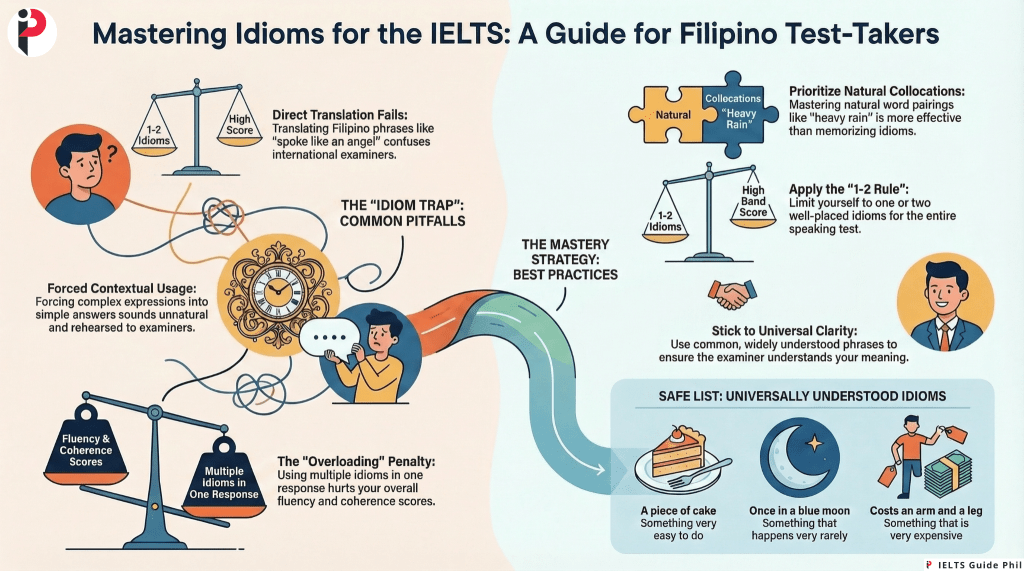
If you’re a Filipino preparing for the IELTS Speaking test, you’ve probably heard this advice: “Use idioms to sound more natural and boost your score!” While idioms can indeed enhance your speaking performance, misusing them is one of the fastest ways to confuse examiners and actually lower your band score.
As someone familiar with the Filipino English landscape, I’ve noticed that many test-takers fall into the idiom trap, thinking that cramming obscure expressions the night before will impress examiners. The reality? Forcing idioms into your speech often backfires spectacularly.
Let’s explore why Filipino IELTS candidates struggle with idioms, what mistakes to avoid, and how to use these expressions effectively and naturally.
Why Filipino Test-Takers Struggle with Idioms
Filipino English has its own beautiful flavor. We say “traffic is bad” instead of “heavy traffic,” we “open the light” instead of “turn on the light,” and we have our own set of expressions that make perfect sense locally but don’t translate to international English. This unique linguistic background creates specific challenges when learning British and American idioms for IELTS.
Many Filipinos also learn idioms from memorization lists without understanding their cultural context, frequency of use, or appropriate situations. The result? Awkward moments during the Speaking test that make examiners wince rather than award higher scores.
Understanding What Idioms Actually Are
Before we dive into mistakes, let’s clarify what idioms are. An idiom is a phrase whose meaning cannot be understood from the individual words alone. For example, “it’s raining cats and dogs” doesn’t mean animals are falling from the sky; it means it’s raining heavily.
Idioms are different from:
- Collocations: Word combinations that naturally go together (like “strong coffee,” not “powerful coffee”)
- Phrasal verbs: Verbs combined with prepositions that create new meanings (like “look after,” “give up”)
- Common expressions: Standard phrases that aren’t necessarily figurative (like “in my opinion”)
For IELTS, examiners want to see that you can use English naturally and appropriately. This includes knowing when to use idioms and, more importantly, when NOT to use them.
The Most Common Mistakes Filipino IELTS Candidates Make with Idioms
Mistake #1: Using Idioms in the Wrong Context
The Problem: Many test-takers memorize idioms but don’t understand when they’re appropriate.
Real Example from IELTS Speaking:
- Examiner: “What did you do last weekend?”
- Candidate: “I stayed home because it was raining cats and dogs, so I decided to kill two birds with one stone by studying and cooking dinner.”
Why It’s Wrong: While both idioms are used correctly in terms of grammar, they sound forced and unnatural for such a simple question. The second idiom doesn’t even make logical sense here (killing two birds with one stone means accomplishing two things with one action, but studying and cooking aren’t related actions that save time or effort).
The Fix: Keep your answer natural and straightforward. “I stayed home because of the heavy rain, so I spent time studying and prepared a nice dinner.”
Mistake #2: Mixing Up Similar-Sounding Idioms
The Problem: Filipino test-takers often confuse idioms that sound alike or have similar structures.
Common Confusions:
- “A blessing in the skies” ✗ → “A blessing in disguise” ✓
- “Nip it in the butt” ✗ → “Nip it in the bud” ✓
- “For all intensive purposes” ✗ → “For all intents and purposes” ✓
- “I could care less” ✗ → “I couldn’t care less” ✓
Real Example:
- Candidate: “When I failed my first exam, I thought it was terrible, but it turned out to be a blessing in the skies because it motivated me to study harder.”
The Fix: Learn the correct version and understand its origin. “A blessing in disguise” means something that seems bad at first but turns out to be good. Practice using it in different contexts until it feels natural.
Mistake #3: Using Outdated or Regional Idioms Examiners Won’t Recognize
The Problem: Not all idioms are universally known. Some are old-fashioned, region-specific, or simply not commonly used.
Problematic Idioms for IELTS:
- “Bob’s your uncle” (British, confusing for non-British speakers)
- “Dressed to the nines” (outdated)
- “The bee’s knees” (very old-fashioned)
- “Gone pear-shaped” (regional)
Real Example:
- Candidate: “My presentation went pear-shaped when the projector stopped working.”
Why It’s Problematic: While technically correct, this British idiom might confuse examiners from other English-speaking countries and sounds forced from a non-native speaker.
The Fix: Use more universally understood expressions. “My presentation didn’t go as planned when the projector stopped working.”
Mistake #4: Overloading Speech with Too Many Idioms
The Problem: Some candidates believe that using multiple idioms in one response will impress examiners. Instead, it makes speech sound rehearsed and unnatural.
Real Example:
- Candidate: “Speaking English is not a piece of cake, but I always try to go the extra mile. At the end of the day, practice makes perfect, so I hit the books every single day. It’s better late than never, right?”
Why It’s Wrong: No native speaker talks like this. It sounds like you memorized a list and are desperately trying to show it off. This actually hurts your fluency and coherence scores.
The Fix: Use one idiom naturally, if appropriate, and speak normally for the rest. “Speaking English isn’t easy, but I make an effort to practice daily. I believe consistent practice is the key to improvement.”
Mistake #5: Using Idioms with Incorrect Grammar or Structure
The Problem: Idioms have fixed forms. Changing the words, tenses, or structure makes them incorrect.
Common Errors:
- “Let’s not beat around the bushes” ✗ → “Let’s not beat around the bush” ✓ (no plural)
- “It was a breeze of cake” ✗ → “It was a piece of cake” ✓ (wrong idiom mixing)
- “I will cross that bridge when I will get there” ✗ → “I’ll cross that bridge when I get there” ✓ (no future tense in the ‘when’ clause)
The Fix: Learn idioms as complete, unchangeable phrases. Don’t try to modify them creatively.
Mistake #6: Translating Filipino Idioms Directly to English
The Problem: Filipino idioms don’t translate word-for-word into English.
Examples of Direct Translation Fails:
- “Nakakahiya sa bituka” (shameful to the intestines) – doesn’t work in English
- “Bahala na si Batman” (Batman will take care of it) – culturally specific
- “Nagdilang anghel ka yata” (you spoke like an angel/your prediction came true) – no English equivalent
Real Example:
- Candidate: “I was having a hard time finding a job, but then my friend spoke like an angel and introduced me to his company. Now I work there!”
Why It’s Wrong: The examiner has no idea what “spoke like an angel” means in this context.
The Fix: Use the actual meaning. “My friend’s suggestion turned out to be perfect. He introduced me to his company, and now I work there.”
Mistake #7: Using Idioms in Overly Formal or Academic Responses
The Problem: Some parts of the IELTS Speaking test require more formal language, especially Part 3. Casual idioms can sound inappropriate.
Real Example:
- Examiner: “What role does government play in environmental protection?”
- Candidate: “Well, I think the government needs to get its act together and stop dragging its feet on climate change.”
Why It’s Problematic: While these idioms are correct, they’re too informal for this serious, academic question. They make the response sound flippant rather than thoughtful.
The Fix: Match your language to the formality of the question. “I believe the government needs to take more decisive action and implement environmental policies more quickly.”
Mistake #8: Mispronouncing Idioms
The Problem: Even if you use an idiom correctly, mispronunciation can confuse examiners or make you sound less confident.
Common Mispronunciations:
- “Piece of cake” pronounced with hard ‘k’ sound at the end (should be softer)
- “Blessing in disguise” with wrong stress pattern
- “Under the weather” rushing through words
The Fix: Practice idioms out loud before the test. Record yourself and compare with native speaker recordings. Pay attention to stress patterns, linking, and natural rhythm.
The Dos and Don’ts of Using Idioms in IELTS Speaking
DO:
Use idioms you’re completely comfortable with. If you’ve heard it multiple times in context, understand its meaning deeply, and have practiced using it naturally, go ahead.
Stick to common, universally understood idioms. Examples: “piece of cake,” “costs an arm and a leg,” “once in a blue moon,” “the last straw.”
Use idioms naturally in Part 1 and Part 2. These sections are more conversational, so casual language fits better.
Learn idioms in context. Watch English shows, listen to podcasts, and note when and how native speakers use expressions. Don’t just memorize lists.
Practice with a speaking partner. Try using idioms in real conversations before the test. If they feel natural and your partner understands, you’re on the right track.
Focus on one or two idioms per test. Quality over quantity. Using one idiom perfectly is better than using five awkwardly.
DON’T:
Don’t force idioms into every response. Many high-scoring IELTS responses contain zero idioms. Clarity and fluency matter more.
Don’t use idioms you learned the day before the test. They’ll sound unnatural and rehearsed. Examiners can tell when expressions aren’t part of your natural vocabulary.
Don’t use multiple idioms in one response. This sounds like you’re showing off rather than communicating naturally.
Don’t try to impress with obscure or complicated idioms. Simple, common expressions used well score better than complex ones used awkwardly.
Don’t assume idioms automatically increase your score. The IELTS Speaking band descriptors reward “less common vocabulary” and “idiomatic language,” but only when used appropriately and naturally.
Don’t panic if you can’t think of an idiom. Clear, accurate, fluent speech without idioms scores better than awkward speech with forced expressions.
Don’t use slang or offensive idioms. Keep everything appropriate for a professional setting.
Better Alternatives: What to Focus On Instead
Rather than obsessing over idioms, Filipino IELTS candidates should focus on these aspects of natural English:
Collocations: These are word partnerships that native speakers use naturally. Instead of “strong rain,” say “heavy rain.” Instead of “do homework,” say “do the homework” or “complete homework.” Proper collocations sound more natural than random idioms and are easier to use correctly.
Phrasal verbs: Master common phrasal verbs like “look after,” “give up,” “come across,” “figure out.” These are essential for natural-sounding English and are less risky than idioms.
Discourse markers: Use expressions like “actually,” “to be honest,” “as a matter of fact,” “speaking of which” to connect ideas naturally. These make your speech flow better without the risk of misusing idioms.
Paraphrasing skills: Instead of searching for the perfect idiom, practice explaining ideas in different ways. This demonstrates language flexibility.
Natural expressions: Simple expressions like “I’d say,” “from my experience,” “in my view” sound professional without being risky.
A Safe Idiom List for Filipino IELTS Test-Takers
If you want to include idioms, here are universally understood expressions that are relatively safe for IELTS:
For Difficulty:
- A piece of cake (very easy)
- Not rocket science (not very complicated)
- Easier said than done (harder to do than to talk about)
For Cost:
- Costs an arm and a leg (very expensive)
- Won’t break the bank (affordable)
For Frequency:
- Once in a blue moon (very rarely)
- Every now and then (occasionally)
For Decisions:
- On the fence (undecided)
- Weigh the pros and cons (consider advantages and disadvantages)
For Opportunities:
- A golden opportunity (an excellent chance)
- Miss the boat (miss an opportunity)
For Problems:
- The last straw (the final problem that makes you give up)
- A blessing in disguise (something bad that turns out to be good)
For Time:
- Better late than never (it’s better to do something late than not at all)
- In the nick of time (just in time)
How IELTS Examiners Actually Score Vocabulary and Idioms
Understanding the IELTS Speaking band descriptors helps clarify how examiners view idioms:
For Band 6 (competent user), you need to use “vocabulary resource sufficient to discuss topics at length” and make “attempts to use paraphrase.” Idioms aren’t required.
For Band 7 (good user), you should use “vocabulary resource flexibly to discuss a variety of topics” and use “some less common and idiomatic vocabulary.” Note the word “some,” not “constantly.”
For Band 8 (very good user), you need “wide vocabulary resource readily and flexibly to convey precise meaning” and “skilful use of uncommon and idiomatic items.” The key word is “skilful,” which means appropriate and natural.
The pattern is clear: idioms can help, but only if used skillfully. Misused idioms will lower your score because they demonstrate a lack of precision and appropriateness.
Common Mistakes Summary and Quick Fixes
| Mistake | Quick Fix |
|---|---|
| Using too many idioms | Limit yourself to 1-2 idioms for the entire test |
| Forcing idioms in formal contexts | Save idioms for casual questions in Part 1 and 2 |
| Mixing up similar idioms | Learn each idiom’s exact form and practice repeatedly |
| Using outdated expressions | Stick to common, modern idioms everyone knows |
| Translating Filipino idioms | Express the meaning directly in clear English |
| Poor pronunciation | Practice idioms out loud with proper stress and rhythm |
| Using idioms you just memorized | Only use expressions you’re completely comfortable with |
| Assuming idioms guarantee higher scores | Focus on overall fluency, coherence, and accuracy first |
Real Success Stories: The Right Way to Use Idioms
Let me share examples of Filipino IELTS candidates who used idioms effectively:
Example 1 – Appropriate Use:
- Examiner: “Do you enjoy cooking?”
- Candidate: “Yes, I do. Actually, cooking relaxes me after a long day at work. My friends say I make really good adobo, but honestly, it’s a piece of cake once you know the basic recipe.”
Why It Works: The idiom is common, fits naturally into the conversation, and the candidate sounds comfortable using it. It doesn’t dominate the response.
Example 2 – Better Without an Idiom:
- Examiner: “What are the benefits of learning a foreign language?”
- Candidate: “Learning a foreign language opens up many opportunities. It allows you to communicate with people from different cultures, improves your career prospects, and even enhances cognitive abilities. I think these benefits make the effort worthwhile.”
Why It Works: No idioms, but the answer is clear, well-structured, and uses good vocabulary. This would score well.
Frequently Asked Questions
Q: Do I need to use idioms to get a Band 7 or higher?
No, you don’t need idioms to score well. Many candidates achieve Band 7, 8, or even 9 without using a single idiom. Examiners prioritize fluency, coherence, grammatical accuracy, and appropriate vocabulary. Idioms are just one small aspect of “less common vocabulary.” Clear, accurate, natural speech is much more important.
Q: How many idioms should I use in the IELTS Speaking test?
If you’re comfortable with idioms, one or two throughout the entire 11-15 minute test is plenty. Using more than three idioms often sounds forced and unnatural. Remember, quality always beats quantity.
Q: What if I start using an idiom and realize mid-sentence it’s not quite right?
Don’t panic. Self-correction is actually viewed positively by examiners because it shows you’re monitoring your language. Simply pause, say “I mean,” or “rather,” and rephrase in simpler terms. For example: “It was a blessing in the… I mean, it turned out to be a good thing even though it seemed bad at first.”
Q: Are American idioms okay, or should I use British ones?
IELTS accepts all standard varieties of English (British, American, Australian, etc.). Use whichever idioms you’re most familiar with, as long as they’re widely understood. Avoid regional expressions that might confuse examiners from other English-speaking countries.
Q: Can I lose points for using idioms incorrectly?
Yes, absolutely. Misused idioms count as vocabulary errors and hurt your Lexical Resource score. They also damage your coherence if the examiner can’t understand what you mean. It’s much safer to use clear, simple language than to risk using an idiom incorrectly.
Q: I’ve been told to sound more “native-like” by using lots of idioms. Is this true?
This is a common misconception. Native speakers don’t actually use idioms as frequently as people think, especially in formal or professional contexts. In fact, overusing idioms can make you sound theatrical or unnatural, even to native speakers. Focus on sounding clear and fluent rather than trying to sound like a native speaker.
Q: What’s the difference between idioms and collocations for IELTS?
Idioms are figurative expressions whose meaning isn’t literal (like “break the ice”). Collocations are word combinations that naturally go together (like “heavy rain” or “make a decision”). For IELTS, mastering collocations is actually more important than knowing idioms because they’re used more frequently and are easier to use correctly.
Q: Where can I learn idioms in context?
Watch English movies and TV shows (with English subtitles), listen to English podcasts, read conversational English blogs, and pay attention to when and how idioms are used. Avoid just memorizing lists. Apps like Netflix, YouTube channels like BBC Learning English, and podcasts on topics you enjoy are excellent resources.
Q: What should I do if the examiner uses an idiom I don’t understand?
It’s perfectly acceptable to say, “I’m sorry, could you rephrase that?” or “I’m not sure I understand. Could you say that another way?” Examiners are trained to adjust their language if needed, and asking for clarification shows good communication skills.
Q: Is it better to use no idioms at all than to risk using them incorrectly?
Yes, absolutely. Clear, accurate communication without idioms will always score better than speech with misused expressions. Don’t feel pressured to include idioms. Many successful candidates achieve high band scores by focusing on fluency, good grammar, and appropriate vocabulary without using any idioms at all.
Final Thoughts: Communicate First, Impress Later
As a Filipino preparing for IELTS, your goal should be clear communication, not impressing the examiner with fancy expressions. Your natural speaking ability, combined with good grammar and appropriate vocabulary, matters far more than sprinkling idioms throughout your responses.
Remember that English is a tool for communication, not a performance. The IELTS Speaking test evaluates your ability to express ideas clearly and discuss various topics comfortably. Idioms are like salt in cooking: a little bit enhances the flavor, but too much ruins the dish.
Focus on these priorities instead:
- Speak fluently without too many pauses or hesitations
- Answer the question fully and develop your ideas
- Use appropriate vocabulary accurately
- Demonstrate good grammar control
- Pronounce words clearly
- If comfortable, add one or two idioms naturally
Trust in your English ability, practice speaking regularly, and don’t let the pressure of idioms distract you from what really matters: being understood and communicating your ideas effectively.
You’ve got this. Just speak naturally, confidently, and clearly, and the band score will follow.
About the Author: This guide was created to help Filipino IELTS candidates avoid common pitfalls and achieve their target band scores through smart, strategic preparation.
Need more IELTS Speaking tips? Practice with a speaking partner, record yourself regularly, and focus on building confidence rather than memorizing expressions. Good luck with your test!
#IELTSSpeaking #IELTSPreparation #IELTSTips #FilipinoIELTS #IELTSPhilippines #EnglishIdioms #LearnEnglish #IELTSBand7 #IELTSBand8 #IELTSMistakes #EnglishLearning #IELTSExam #IELTSTest #StudyAbroad #EnglishFluency #IELTSVocabulary #SpeakingTest #IELTSAdvice #PinoyIELTS #IELTSHelp #EnglishTips #IELTSSuccess #TestPreparation #EnglishForFilipinos #IELTSCoach
 IELTS Guide Phil
Leave a comment