
For Filipino Overseas Workers Ready to Make Their Dreams Happen
Are you dreaming of working abroad but confused about what IELTS score you actually need? You’re not alone. Thousands of OFWs face the same question every day: “What score do I need to work in Canada? Australia? New Zealand?”
Here’s the truth: getting the wrong score can delay your dreams by months or even years. But getting the RIGHT score? That’s your golden ticket to a better life for you and your family.
This comprehensive guide breaks down exactly what you need to know about IELTS requirements for OFWs, country by country, profession by profession.
📊 Understanding IELTS Scores: The Basics
Before we dive into country-specific requirements, let’s make sure you understand the IELTS scoring system.
IELTS scores range from 1-9 (band scores):
- Band 9: Expert user
- Band 8: Very good user
- Band 7: Good user
- Band 6: Competent user
- Band 5: Modest user
- Band 4: Limited user
- Bands 1-3: Extremely limited to non-user
Your overall score is the average of four components:
- Listening
- Reading
- Writing
- Speaking
Most immigration and professional registration bodies require minimum scores in EACH component, not just the overall score. This is where many OFWs make their first mistake.
🌏 IELTS Score Targets by Country
🇨🇦 CANADA
Why OFWs Love Canada: High salaries, excellent healthcare, strong Filipino community, pathway to permanent residence
Minimum Score Requirements:
For Express Entry (Skilled Worker Program):
- CLB 7 (Canadian Language Benchmark) = IELTS Overall 6.0
- Listening: 6.0
- Reading: 6.0
- Writing: 6.0
- Speaking: 6.0
For Higher Points (Competitive Scores):
- CLB 9 = IELTS Overall 7.0-8.0
- Listening: 8.0
- Reading: 7.0
- Writing: 7.0
- Speaking: 7.0
For Healthcare Professionals (Nurses, Caregivers):
- IELTS Academic: Overall 6.5-7.0
- All components: 6.0-7.0 minimum
- Provincial requirements vary (Ontario vs. Alberta vs. British Columbia)
For Caregivers (Home Child Care Provider & Home Support Worker):
- CLB 5 minimum = IELTS Overall 5.0
- Speaking: 5.0
- Listening: 5.0
- Reading: 4.0
- Writing: 5.0
Target Score for OFWs: Aim for IELTS 7.0 overall with no component below 6.5 to be competitive.
🇦🇺 AUSTRALIA
Why OFWs Love Australia: Strong economy, high demand for skilled workers, excellent work-life balance, multicultural
Minimum Score Requirements:
For Skilled Migration (Subclass 189, 190, 491):
- Competent English = IELTS Overall 6.0
- All components: 6.0 minimum
- Proficient English (10 points) = IELTS Overall 7.0
- All components: 7.0 minimum
- Superior English (20 points) = IELTS Overall 8.0
- All components: 8.0 minimum
For Healthcare Professionals:
- Nurses (AHPRA Registration): IELTS Overall 7.0
- All components: 7.0 minimum
- Doctors: IELTS Overall 7.0
- All components: 7.0 minimum (some specialties require 7.5)
For Tradespeople:
- TRA (Trades Recognition Australia): IELTS Overall 6.0
- Speaking: 6.0
- Listening: 6.0
- Reading: 5.0
- Writing: 5.0
For Temporary Work Visas (482/494):
- IELTS Overall 5.0
- All components: 5.0 minimum (for occupations requiring certification)
Target Score for OFWs: Aim for IELTS 7.0 overall (all components 7.0) to maximize points and opportunities.
🇳🇿 NEW ZEALAND
Why OFWs Love New Zealand: Beautiful country, welcoming immigration policies, strong demand for skilled workers
Minimum Score Requirements:
For Skilled Migrant Category:
- IELTS Overall 6.5
- All components: 6.0 minimum
For Healthcare Professionals:
- Nurses (Nursing Council): IELTS Academic Overall 7.0
- All components: 7.0 minimum
- Alternative: Pass OET (Occupational English Test)
For Teachers:
- Teaching Council: IELTS Academic Overall 7.0
- Speaking: 7.0
- Listening: 7.0
- Reading: 7.0
- Writing: 7.0
For Essential Skills Work Visa:
- Varies by skill level:
- Higher-skilled (ANZSCO 1-3): IELTS Overall 5.0
- Mid-skilled (ANZSCO 4-5): IELTS Overall 4.0
Target Score for OFWs: Aim for IELTS 6.5-7.0 overall depending on your occupation.
🇬🇧 UNITED KINGDOM
Why OFWs Love UK: Historic ties, English-speaking, diverse job market, gateway to Europe
Minimum Score Requirements:
For Skilled Worker Visa:
- CEFR Level B1 = IELTS Overall 4.0
- All components: 4.0 minimum
For Healthcare Professionals (NHS):
- Nurses & Midwives (NMC): IELTS Academic Overall 7.0
- All components: 7.0 minimum (with option for 6.5 in one component with retake)
- Doctors (GMC): IELTS Academic Overall 7.5
- Speaking: 7.0
- Other components: 7.5 minimum
For Settlement (Indefinite Leave to Remain):
- CEFR Level B1 = IELTS Overall 4.0 (Life Skills)
Target Score for OFWs: Healthcare professionals should aim for IELTS 7.0-7.5; other professions IELTS 4.0-6.0.
🇸🇬 SINGAPORE
Why OFWs Choose Singapore: Close to Philippines, high salaries, tax benefits, modern infrastructure
Minimum Score Requirements:
Singapore doesn’t have standardized IELTS requirements for all work visas. Requirements depend on:
- Employment Pass (EP): Usually no IELTS requirement (university degree from English-speaking institution may suffice)
- S Pass: No specific IELTS requirement
- Work Permit: No IELTS requirement
However, professional certifications may require:
- Nurses (Singapore Nursing Board): IELTS Overall 6.5 or TOEFL equivalent
- Some specialized roles: IELTS 6.0-7.0
Target Score for OFWs: If applying for professional registration, aim for IELTS 6.5-7.0.
🇦🇪 UAE (Dubai, Abu Dhabi)
Why OFWs Love UAE: Tax-free income, large Filipino community, diverse job opportunities
Minimum Score Requirements:
UAE generally does NOT require IELTS for work visas. However:
- Healthcare professionals: IELTS may be required for licensing
- Nurses (DHA/HAAD): IELTS Overall 6.0-6.5
- Doctors: IELTS Overall 6.5-7.0
- Teaching positions: IELTS 6.0-7.0 (varies by institution)
- Some corporate positions: IELTS 6.0-6.5 (employer-specific)
Target Score for OFWs: If required, aim for IELTS 6.5 overall.
🇺🇸 UNITED STATES
Why OFWs Dream of USA: Highest salaries, large Filipino-American community, career opportunities
Minimum Score Requirements:
IELTS is NOT the primary English proficiency test for US immigration. However:
For Healthcare Professionals:
- NCLEX-RN (Nurses): IELTS not required, but TOEFL or English testing through CGFNS
- USMLE (Doctors): No IELTS requirement
For Academic/Work Visas:
- Generally, TOEFL is preferred over IELTS
- If accepted: IELTS Overall 6.0-7.0 (institution/employer-dependent)
For EB-3 (Employment-Based Immigration):
- No specific IELTS requirement
- Employer may require proof of English proficiency
Target Score for OFWs: Focus on TOEFL instead. If IELTS accepted, aim for 6.5-7.0.
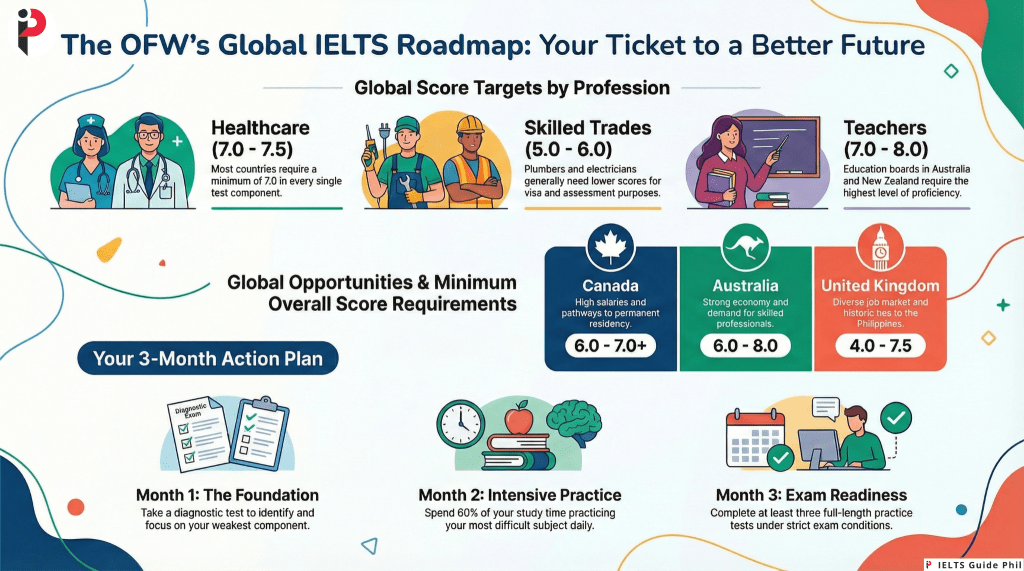
📋 Score Requirements by Profession
🏥 Healthcare Professionals
Nurses:
- Canada: 6.5-7.0 (all components 6.0-7.0)
- Australia: 7.0 (all components 7.0)
- New Zealand: 7.0 (all components 7.0)
- UK: 7.0 (all components 7.0, one component may be 6.5)
- UAE: 6.0-6.5
- Singapore: 6.5
Caregivers:
- Canada: 5.0 (CLB 5) for Home Support Workers
- Australia: 5.5-6.0
- New Zealand: 5.0-6.0
Doctors:
- UK: 7.5 overall (Speaking 7.0, others 7.5)
- Australia: 7.0 (all components 7.0)
- Canada: 7.0 (all components 7.0)
Dentists/Allied Health:
- Generally: 7.0 overall (all components 7.0)
👷 Skilled Trades (Electricians, Plumbers, Mechanics, Welders)
Australia:
- TRA Assessment: 6.0 overall (S/L: 6.0, R/W: 5.0)
Canada:
- Express Entry: 6.0 overall (CLB 7) for competitive applications
- Provincial Nominee: 5.0-6.0 (varies by province)
New Zealand:
- 5.0-6.5 depending on skill level
👨🏫 Teachers
Requirements are HIGHER for teachers:
- New Zealand: 7.0 (all components 7.0)
- Australia: 7.5 overall (Reading/Writing 7.0, Speaking/Listening 8.0) for registration
- Canada: 7.0-8.0 (varies by province)
- UK: 6.5-7.0
💼 IT Professionals & Engineers
Generally more flexible:
- Canada: 6.0-7.0 (higher scores = more points)
- Australia: 6.0-7.0 (higher scores = more points)
- New Zealand: 6.5
- UK: 4.0-6.0 (depending on employer)
🍳 Hospitality Workers (Chefs, Hotel Staff)
Lower requirements:
- Canada: 5.0-6.0 (depending on position)
- Australia: 5.0-6.0
- New Zealand: 4.0-5.0
- UK: 4.0-5.0
✅ DOS: Best Practices for IELTS Success
DO Understand Your Target Score
Why: Different countries and professions have different requirements. Knowing your target prevents wasted time and money.
Action: Research the EXACT requirements for your destination country AND profession. Check with:
- Immigration authorities (IRCC for Canada, Home Affairs for Australia)
- Professional registration bodies (AHPRA, NCLEX, NMC)
- Your recruitment agency
DO Take IELTS Academic vs. General Training Accordingly
Why: Some countries/professions require Academic, others accept General Training.
Action:
- IELTS Academic: Required for healthcare professionals (nurses, doctors), teachers, engineers in most countries
- IELTS General Training: Accepted for skilled migration, trades, general employment in Canada, Australia, New Zealand
DO Focus on Your Weakest Component
Why: You need minimum scores in ALL components, not just overall.
Action:
- Take a practice test to identify your weakest area
- Allocate 60% of study time to your weakest component
- Many OFWs struggle with Writing—practice daily
DO Prepare for At Least 3 Months
Why: Rushing leads to lower scores and retakes cost money (₱11,000+ per attempt).
Action:
- Month 1: Familiarize with test format, take diagnostic test
- Month 2: Intensive practice on weak areas
- Month 3: Full practice tests, timing, review
DO Use Official IELTS Practice Materials
Why: Free online materials may not reflect actual test difficulty.
Action:
- Buy “The Official Cambridge Guide to IELTS”
- Use IELTS.org official practice tests
- Take at least 3 full practice tests under exam conditions
DO Consider Your Test Date Strategically
Why: You need time to receive results and apply for jobs/visas.
Action:
- Book your test 4-6 months before your target application date
- Results take 13 days (paper-based) or 3-5 days (computer-based)
- Allow time for retakes if needed
DO Take Computer-Based IELTS
Why: Faster results, easier typing than handwriting, more test dates.
Action:
- Choose computer-based unless you strongly prefer handwriting
- Practice typing essays within time limits
DO Join OFW IELTS Study Groups
Why: Free practice partners, shared resources, moral support.
Action:
- Join Facebook groups: “IELTS for OFWs,” “Pinoy IELTS Review”
- Find study partners in your city
- Share tips and resources
❌ DON’TS: Common Mistakes to Avoid
DON’T Rely on Your Existing English Skills Alone
Why: Even fluent English speakers can score poorly without test preparation.
Reality Check: Many Filipino nurses who speak English daily score 6.0-6.5 without preparation. With proper preparation, they score 7.0-8.0.
DON’T Ignore the Speaking Test Format
Why: The IELTS Speaking test has a specific structure many Filipinos aren’t familiar with.
Mistake: Treating it like casual conversation.
Fix:
- Part 1: Short answers (4-5 minutes)
- Part 2: 2-minute speech with 1 minute prep
- Part 3: Discussion/abstract questions
Practice the format, not just English conversation.
DON’T Use Memorized Answers
Why: Examiners are trained to detect memorized responses and will mark you down.
Mistake: Memorizing “template answers” from YouTube or review centers.
Fix: Learn flexible frameworks, not fixed answers. Practice adapting answers to different questions.
DON’T Assume General Training is “Easier”
Why: Different content, not necessarily easier.
Reality: Reading passages in General Training can be tricky with advertisements and workplace documents. Academic has more straightforward academic texts.
DON’T Skip Practice Tests
Why: Time management is crucial and can only be learned through practice.
Mistake: Studying content without timing yourself.
Fix: Take at least 3 full-length practice tests (all 4 components) under exam conditions before your actual test.
DON’T Ignore Component Requirements
Why: You can have a high overall score but fail to meet component minimums.
Example: You score L:8.0, R:7.5, W:6.0, S:7.0 = Overall 7.125
- Canada (CLB 9): ❌ FAIL (Writing below 7.0)
- Australia (Proficient): ❌ FAIL (Writing below 7.0)
Fix: Check component requirements, not just overall score.
DON’T Book Your Test Too Early
Why: Insufficient preparation leads to retakes.
Mistake: Booking a test next month when you haven’t started studying.
Fix: Study first, book test when you’re consistently scoring at target in practice tests.
DON’T Apply to the Wrong Test Location
Why: Some countries don’t accept results from certain locations (rare but happens).
Fix: Take IELTS in the Philippines or your current location. Verify with your immigration consultant.
🚨 Common Mistakes and How to Fix Them
Mistake #1: “I scored Band 6.5 but still can’t proceed with my application”
Problem: You met the overall requirement but one component was below the minimum.
Example:
- Target: Canada Nurse (IELTS 7.0 all components)
- Your score: L:7.5, R:7.0, W:6.5, S:7.0 (Overall: 7.0)
- Result: ❌ Writing is below 7.0
Fix:
- Retake the IELTS focusing ONLY on improving Writing
- For Canada nurses: Consider CELBAN (Canadian English Language Benchmark Assessment for Nurses) as an alternative
- Practice IELTS Writing Task 1 and Task 2 extensively
- Get feedback on practice essays
Mistake #2: “I spent ₱50,000 on review centers but still failed”
Problem: Review centers don’t guarantee results; active practice does.
Fix:
- Invest in quality self-study materials (₱5,000-10,000)
- Join free online study groups
- Practice daily (2-3 hours)
- Focus on YOUR weak areas, not generic lessons
- Take mock tests every week
Mistake #3: “I used IELTS General for my nursing application”
Problem: Healthcare professionals need IELTS Academic.
Fix:
- Always verify which version is required
- IELTS Academic: Healthcare, teaching, engineering registration
- IELTS General: Skilled migration, trades, general employment
- When in doubt, take Academic (more widely accepted)
Mistake #4: “My score expired before I could use it”
Problem: IELTS scores are valid for only 2 years.
Fix:
- Plan your timeline: Test → Results → Application → Processing
- Don’t take IELTS too early
- If scores are expiring, retake 6 months before expiry
Mistake #5: “I assumed my college English class was enough”
Problem: IELTS tests specific skills in a specific format.
Reality: Even English teachers need to prepare for IELTS format.
Fix:
- Understand the test format thoroughly
- Practice IELTS-specific skills (skimming, scanning, paraphrasing)
- Learn what examiners are looking for
Mistake #6: “I only practiced Reading and Listening online”
Problem: Writing and Speaking need human feedback.
Fix:
- Writing: Get essays corrected by qualified teachers or use IELTS marking services
- Speaking: Practice with partners or record yourself for self-evaluation
- Use online platforms like iTalki for Speaking practice with certified tutors
💡 Pro Tips for Filipino OFWs
Tip #1: Use Your Philippines Advantage
Filipinos are naturally good at English, but we have specific weaknesses:
- Common problem: Filipino accent in Speaking (not wrong, but clarity matters)
- Solution: Watch British Council IELTS Speaking samples on YouTube
- Common problem: Direct translation from Filipino to English in Writing
- Solution: Think in English, read English newspapers daily
Tip #2: Budget Wisely
IELTS Costs in Philippines:
- Test fee: ₱11,000-14,000
- Review materials: ₱3,000-10,000
- Optional review center: ₱15,000-50,000
Smart budgeting:
- Invest in official materials: ₱5,000
- Free online resources: ₱0
- Study group: ₱0
- One quality practice test book: ₱2,000
- Total: ₱7,000-8,000 vs. ₱30,000+ for review centers
Tip #3: Time Your Test Strategically
Best times to take IELTS:
- Avoid: December (busy with holidays, less focus)
- Good: January-March (New Year motivation, before summer jobs)
- Good: July-August (after summer, before Christmas rush)
Tip #4: Choose Your Test Center Wisely
Popular test centers in Philippines:
- British Council (Manila, Makati, Baguio, Cebu, Davao)
- IDP Education (Manila, Cebu, Davao)
Considerations:
- Computer-based: More dates, faster results
- Paper-based: If you prefer handwriting
- Location: Choose a convenient, familiar area to reduce test-day stress
Tip #5: Have a Backup Plan
What if you don’t get your target score?
- Option 1: Retake IELTS (no limit on attempts)
- Option 2: Consider alternative tests (CELPIP for Canada, OET for healthcare)
- Option 3: Take a bridging English course (some countries accept this)
- Option 4: Apply to countries with lower requirements first, upskill later
🎯 Your Action Plan: 3-Month IELTS Preparation Timeline
Month 1: Foundation (Weeks 1-4)
Week 1: Assessment
- Take a full diagnostic test
- Identify target score and current score gap
- Identify weakest component
- Create study schedule (2-3 hours daily)
Week 2: Listening
- Learn different question types
- Practice note-taking skills
- Listen to BBC, TED Talks, podcasts
- Practice 2 Listening tests
Week 3: Reading
- Learn skimming and scanning techniques
- Practice True/False/Not Given questions
- Time yourself (60 minutes for 3 passages)
- Practice 2 Reading tests
Week 4: Writing Basics
- Learn Task 1 format (letter/report/graph)
- Learn Task 2 format (essay)
- Study band score descriptors
- Write 4 practice essays, get feedback
Month 2: Intensive Practice (Weeks 5-8)
Week 5-6: Focus on Weakest Area
- Spend 60% of time on weakest component
- 40% on maintaining other skills
- Take weekly practice tests
Week 7: Speaking Preparation
- Learn Part 1, 2, 3 format
- Practice Part 2 topics (2-minute speeches)
- Record yourself, evaluate fluency
- Practice with study partner 3x
Week 8: Writing Intensive
- Write 1 Task 1 + 1 Task 2 daily
- Get feedback on all essays
- Learn from model answers
- Memorize useful phrases (not full answers!)
Month 3: Test Preparation (Weeks 9-12)
Week 9-10: Full Practice Tests
- Take 2 full practice tests (all 4 components)
- Simulate exam conditions
- Review mistakes thoroughly
- Refine weak areas
Week 11: Final Review
- Review common mistakes
- Practice time management
- Take 1 final practice test
- Rest and light review
Week 12: Test Week
- Light practice only
- Review test format
- Prepare test day requirements
- Get good sleep
- Take the test confidently!
📚 Recommended Study Resources for OFWs
Free Resources
- IELTS.org – Official practice materials
- British Council IELTS YouTube – Free videos and tips
- IELTS Liz – Excellent free lessons
- E2Language YouTube – Comprehensive tutorials
- IELTS Simon Blog – Writing and Speaking tips
Paid Resources (Best Value)
- The Official Cambridge Guide to IELTS (₱2,500) – Best overall book
- Cambridge IELTS Books 14-18 (₱1,500 each) – Real past tests
- Makkar IELTS Speaking (₱800) – Speaking questions compilation
- IELTS Advantage – Online course ($97/₱5,000)
Filipino OFW Communities
- Facebook: “IELTS for OFWs Philippines”
- Facebook: “Pinoy Nurses Canada – IELTS Review”
- Facebook: “OFW Australia – IELTS Support Group”
❓ Frequently Asked Questions (FAQs)
Q1: How much does IELTS cost in the Philippines?
A: As of 2025, IELTS costs approximately ₱11,300-₱11,800 in the Philippines. Computer-delivered and paper-based tests cost the same.
Q2: How long is IELTS valid?
A: IELTS scores are valid for 2 years from the test date. After 2 years, you need to retake the test.
Q3: Can I retake IELTS if I don’t get my target score?
A: Yes! There’s no limit to how many times you can take IELTS. However, you must wait at least 3 days between test attempts and pay the full fee each time.
Q4: Which is easier: IELTS Academic or General Training?
A: Neither is “easier.” They test different skills:
- Academic: More suitable for those familiar with academic texts
- General Training: Includes workplace and everyday contexts Choose based on your requirement, not perceived difficulty.
Q5: Should I take IELTS or TOEFL?
A:
- IELTS: Preferred in UK, Australia, New Zealand, Canada
- TOEFL: Preferred in USA
- Most countries accept both, but check your specific requirement
Q6: How long does it take to prepare for IELTS?
A:
- Beginner English: 6-12 months
- Intermediate English: 3-6 months
- Advanced English: 1-3 months Most Filipino OFWs need 2-4 months of focused preparation.
Q7: What if I get Band 6.5 but need Band 7.0?
A: You must retake the IELTS. There’s no way to “upgrade” your score without retaking the test. Focus on improving your weakest component(s).
Q8: Can I take just Speaking and Writing again if those were low?
A: No, you must take all four components every time. IELTS doesn’t offer component retakes; you must retake the entire test.
Q9: Is one-on-one tutoring worth it?
A: It depends:
- Worth it: If you need Speaking practice or Writing feedback
- Not necessary: For Listening and Reading (self-study is effective)
- Budget option: Online tutors (₱300-500/hour) vs. review centers (₱20,000+)
Q10: What’s the average IELTS score for Filipinos?
A: The average Filipino IELTS test-taker scores around 6.5-7.0 overall. However, with focused preparation, many OFWs achieve 7.5-8.0.
Q11: Do I need British or American English?
A: Both are acceptable! IELTS accepts all English variants (British, American, Australian). Be consistent within your test, but you won’t be penalized for your English variant.
Q12: Can I use a pen or pencil for the paper-based test?
A: You MUST use a pencil for the Listening and Reading answer sheets. You can use a pen or pencil for the Writing test, but pencil is recommended (easier to erase).
Q13: What happens if I miss my test date?
A: You forfeit your test fee. IELTS fees are non-refundable and non-transferable. Only in exceptional circumstances (medical emergency with documentation) might you get consideration.
Q14: Can I see my test paper after the exam?
A: No, IELTS doesn’t return test papers. If you want to verify your score, you can request an Enquiry on Results (EOR) for a fee, but you won’t see the actual paper.
Q15: Should I guess if I don’t know the answer?
A: Absolutely YES! There’s no negative marking in IELTS. Blank answers are always wrong, but a guess might be right. Never leave answers blank.
Q16: How can I improve my Writing score from 6.0 to 7.0?
A:
- Task Achievement: Fully answer all parts of the question
- Coherence: Use clear paragraphs and linking words
- Lexical Resource: Use varied vocabulary accurately (not just complex words)
- Grammar: Use a mix of simple and complex sentences with few errors
- Get feedback: Have a qualified teacher review your essays
Q17: Is there a speaking test “cheat sheet”?
A: There are NO shortcuts or cheat sheets. However, you CAN prepare:
- Practice common topics (family, work, hobbies, hometown)
- Learn to extend answers with examples and reasons
- Practice Part 2 topics (1-minute prep, 2-minute speech)
- Don’t memorize answers—examiners detect this
Q18: What if English isn’t commonly spoken in my workplace?
A: Immerse yourself in English for 3 months:
- Change phone/computer language to English
- Watch English movies/series without subtitles
- Read English news daily
- Think in English
- Join English conversation groups
Q19: Can I use contractions (don’t, can’t, I’m) in IELTS Writing?
A:
- IELTS General Training: Yes, especially in letter writing
- IELTS Academic: Avoid in essays (use full forms: do not, cannot, I am)
- Safe approach: Use full forms in all Writing tasks
Q20: What’s the pass mark for IELTS?
A: There’s no “pass” or “fail” in IELTS. You receive a band score from 1-9. Whether your score is sufficient depends on your destination country and purpose. Check your specific requirements.
🔥 Special Considerations for Healthcare OFWs
If you’re a nurse, caregiver, or healthcare professional, pay extra attention:
Why Healthcare Requires Higher Scores
- Patient safety requires clear communication
- Professional registration bodies set strict standards
- Miscommunication can have serious consequences
Alternative Option: OET (Occupational English Test)
What is OET?
- English test specifically for healthcare professionals
- More relevant content than IELTS
- Accepted by Australia, New Zealand, UK, Singapore
Should you take OET instead of IELTS?
- Yes, if: You’re a nurse, doctor, or allied health professional going to Australia/NZ/UK
- No, if: You also need IELTS for immigration points
- Consider: OET for registration, IELTS for immigration (some take both)
Country-Specific Healthcare Notes
Canada Nurses:
- Some provinces accept CELBAN instead of IELTS
- CELBAN is nursing-specific English test
- Consider if you’ve failed IELTS Writing twice
UK Nurses:
- NMC recently relaxed: Can score 6.5 in ONE component if you resit
- Must achieve 7.0 in all eventually
- Two-year timeline to meet full requirements
Australia Nurses:
- AHPRA strict: 7.0 in ALL components, no exceptions
- Consider OET as alternative
- Results valid for 2 years
🎓 Success Stories: Real OFWs Who Made It
Maria, Nurse – Philippines to Canada
Initial Score: Overall 6.5 (L:7.0, R:7.0, W:5.5, S:7.0)
Target: 7.0 all components
Strategy: Focused 90% of study time on Writing
Result: After 2 months: Overall 7.5 (L:8.0, R:7.5, W:7.0, S:7.5)
Tip: “I wrote one Task 1 and one Task 2 essay every single day for 60 days. I joined an online IELTS feedback group where teachers corrected our essays for free.”
Ramon, Electrician – Philippines to Australia
Initial Score: Overall 5.5 (L:6.0, R:5.0, W:5.0, S:6.0)
Target: 6.0 overall (TRA requirement)
Strategy: 3 months self-study using Cambridge books
Result: Overall 6.5 (L:7.0, R:6.0, W:6.0, S:7.0)
Tip: “I’m not good at reading and writing, so I practiced Reading for 1 hour daily. I used IELTS Liz videos on YouTube—all free!”
Angela, Teacher – Philippines to New Zealand
Initial Score: Overall 6.5 (L:7.0, R:6.5, W:6.5, S:6.5)
Target: 7.0 all components
Strategy: Enrolled in 1-month intensive review, then 2 months self-study
Result: Overall 7.5 (L:8.0, R:7.5, W:7.0, S:7.0)
Tip: “As a teacher, I was shocked I couldn’t hit 7.0 immediately. The IELTS format is specific—you need to practice the FORMAT, not just English.”
🚀 Your Next Steps: Take Action Today
Ready to start your IELTS journey? Here’s what to do RIGHT NOW:
Step 1: Determine Your Exact Requirement (Today)
- Research your destination country
- Check your profession’s requirements
- Note component requirements, not just overall
Step 2: Take a Diagnostic Test (This Week)
- Use a free online practice test or Cambridge IELTS book
- Score yourself honestly
- Identify gap between current and target score
Step 3: Create Your Study Plan (This Week)
- Set a test date 3-4 months from now
- Allocate 2-3 hours daily for study
- Focus 60% on weakest component
Step 4: Gather Your Resources (This Month)
- Buy official Cambridge materials
- Join OFW IELTS Facebook groups
- Find a study partner or tutor for Speaking/Writing
Step 5: Book Your Test (Month 3)
- Book your test date
- Choose computer-based for faster results
- Select a convenient test center
Step 6: Stay Motivated
- Remember WHY you’re doing this
- Your family’s future
- Better opportunities abroad
- Higher salary
- Permanent residency pathway
The IELTS is not just a test—it’s your bridge to a better future.
⚠️ Final Words of Encouragement
To every OFW reading this: You can do this.
Thousands of Filipinos before you have conquered IELTS. You have what it takes:
- Resilience: You’ve faced harder challenges
- English skills: Filipinos are naturally good at English
- Determination: You’re willing to work for your dreams
- Support: You’re not alone—there’s a whole community ready to help
Yes, IELTS is challenging. Yes, it requires preparation. Yes, it costs money.
But is it worth it?
Ask any OFW working in Canada, Australia, or New Zealand. Ask any nurse who’s now earning 10x their Philippine salary. Ask any family who’s finally together abroad.
They’ll all tell you: It’s worth every peso, every hour of study, every drop of effort.
Your IELTS score is not just a number. It’s your ticket to:
- ✅ Higher income
- ✅ Better quality of life
- ✅ Your family’s security
- ✅ Your children’s education
- ✅ Your dreams realized
So don’t give up. Don’t settle for a score below your target. Don’t let fear or frustration stop you.
Prepare well. Practice hard. Believe in yourself. And you WILL succeed.
📱 Share This Guide
Know an OFW preparing for IELTS? Share this guide with them. Let’s help each other succeed!
#IELTS #IELTSforOFWs #OFW #OverseasFilipino #IELTSPreparation #IELTSPhilippines #StudyAbroad #WorkAbroad #CanadaOFW #AustraliaOFW #NewZealandOFW #UKOFW #NurseAbroad #PinoyNurse #FilipinoNurse #IELTSReview #IELTSTips #IELTSSuccess #EnglishTest #ImmigrationPhilippines #SkilledWorker #ExpressEntry #IELTSScores #IELTSRequirements #PinoyAbroad #OFWSuccess #WorkInCanada #WorkInAustralia #NursingAbroad #CaregiverCanada #IELTSGuide #IELTSStudy #OFW2025 #BagongBayani #PinoyPride #BetterLife #LifeAbroad #DreamJob #CareerAbroad #IELTSacademic #IELTSgeneraltraining #IELTSspeaking #IELTSwriting #IELTSreading #IELTSlistening #IELTSGuidePhil
About this Guide: This comprehensive guide was created specifically for Filipino Overseas Workers pursuing their dreams of working abroad. The information is current as of February 2025 and based on official immigration and professional registration requirements. Always verify current requirements with official sources as policies may change.
Good luck on your IELTS journey! Kaya mo yan! 🇵🇭🌏✨
Disclaimer: This guide provides general information only. Always verify current IELTS requirements with official immigration authorities and professional registration bodies, as requirements may change. Consult with licensed immigration consultants for personalized advice.
 IELTS Guide Phil
Leave a comment