
Ang sakit ng katotohanan, pero kailangan nating pag-usapan ‘to.
You’ve been speaking English since kindergarten. You watch Netflix without subtitles. You can debate politics in English, crack jokes with your barkada, and even dream in English sometimes. You’re thinking, “IELTS? Easy lang ‘yan. I’m basically fluent na.”
Then you take the exam and get a Band 5.5.
Welcome to the reality check that thousands of Filipino test-takers experience every year. Your conversational fluency in Taglish—that beautiful, uniquely Filipino blend of Tagalog and English—has prepared you for everything except the very specific, academic, and structured world of IELTS.
Let me explain why, and more importantly, how to bridge this gap.
Why Your Taglish Fluency is Both a Blessing and a Curse
Growing up bilingual in the Philippines gives you incredible cognitive advantages. You code-switch effortlessly, you understand nuance, and you communicate effectively in real-world situations. But IELTS doesn’t test real-world communication—it tests academic English proficiency within a very specific framework.
Here’s the disconnect: When you’re used to saying “I’ll just punta to the store kasi we need to buy gamot,” your brain has developed efficient communication pathways that bypass purely English structures. You’re fluent, yes, but you’re fluent in a different language system than what IELTS measures.
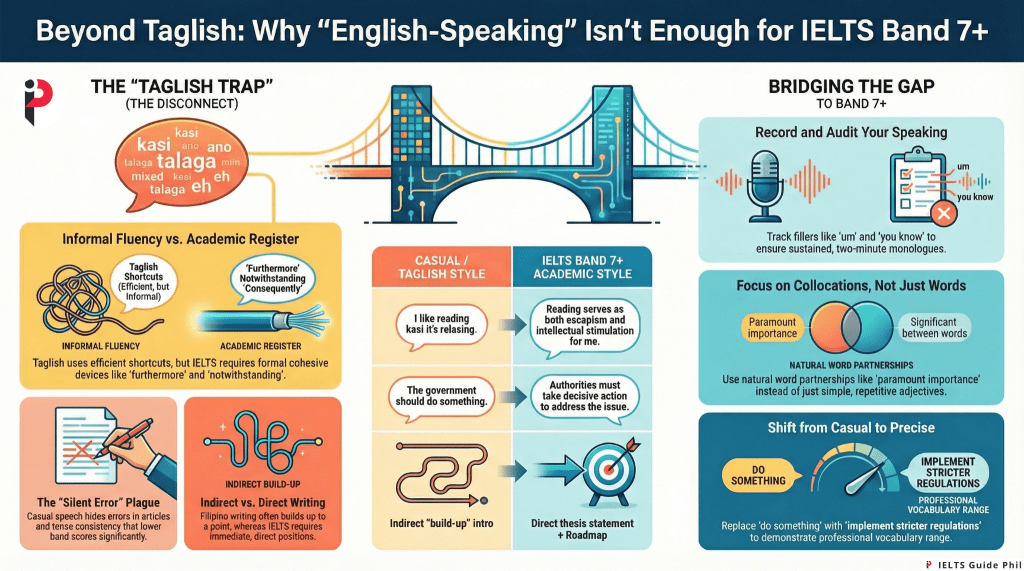
The Core Problem: Informal Fluency vs. Academic Register
IELTS requires you to operate in the academic register—a formal, structured, and precise way of using English that most conversational speakers rarely practice. Think about it: when was the last time you used words like “nevertheless,” “furthermore,” or “notwithstanding” in casual conversation? Probably never, because they sound pretentious sa normal na usapan.
But in IELTS Writing Task 2, these cohesive devices aren’t just recommended—they’re expected for Band 7 and above.
The Four Brutal Truths About IELTS for Taglish Speakers
1. Your Vocabulary Range is Narrower Than You Think
You might know 10,000 English words, but you probably use the same 500-800 in daily conversation. IELTS Writing and Speaking assess your ability to use less common vocabulary and collocations naturally.
Common Taglish mistake: “The government should do something about pollution.”
IELTS-appropriate alternative: “The government should implement stricter regulations regarding pollution” or “Authorities must take decisive action to address environmental degradation.”
See the difference? It’s not about using fancy words to show off—it’s about demonstrating vocabulary range and precision.
2. Your Grammar Accuracy Has Silent Errors
When you speak Taglish daily, certain grammatical mistakes become invisible because everyone understands you anyway. Your brain auto-corrects for meaning, not for structure.
Silent errors that plague Filipino test-takers:
- Article errors: “I went to ~~the~~ hospital” (we often drop articles in casual speech)
- Verb tense consistency: Switching between past and present in the same paragraph
- Subject-verb agreement: “The government are…” (British English uses plural, but you need consistency)
- Preposition errors: “Discuss about,” “explain about,” “reach to”
These errors cost you 0.5 to 1.0 band scores in Writing, and they’re the hardest to self-correct because they’re deeply embedded in your language habits.
3. Your Speaking Sounds Too Casual
In the IELTS Speaking test, the examiner isn’t your friend. They’re not your classmate or your colleague. Using conversational fillers and casual expressions that work perfectly in Taglish will lower your Fluency and Coherence score.
What Taglish speakers say: “Like, I think pollution is, you know, really bad kasi it affects, um, everyone.”
What Band 7+ speakers say: “Pollution poses significant challenges because it affects public health, environmental sustainability, and economic development across all sectors of society.”
The second response isn’t just more formal—it’s more specific, structured, and demonstrates the ability to extend ideas coherently.
4. You’re Not Used to Sustained Monologues
In real conversations, you exchange ideas back and forth. Taglish conversations are dynamic, collaborative, and filled with interruptions and confirmations (“Diba?” “Oo nga, ‘no?”).
But IELTS Speaking Part 2 requires you to speak continuously for 2 minutes about a topic. Most conversational speakers run out of things to say after 45 seconds because they’ve never practiced sustained, structured speaking.
The Specific Ways IELTS Trips Up Filipino Test-Takers
Reading Section: False Confidence Trap
You can read the passages easily, understand the general meaning, and still get answers wrong because IELTS Reading tests precision, not comprehension. The answers often hinge on subtle differences in meaning—the kind that get lost when you’re used to understanding the gist rather than the exact wording.
Common mistake: Assuming “some experts believe” and “experts agree” mean the same thing. They don’t. One indicates partial agreement; the other indicates consensus.
Writing Section: The Paragraph Structure Disaster
Filipino academic writing often follows a different organizational pattern than Anglo-American academic writing. We tend to build up to our main point (indirect approach), while IELTS expects you to state your position immediately (direct approach).
Typical Filipino approach: “There are many factors to consider regarding this issue. Different people have different opinions about it. Some think this way, others think differently. After considering all perspectives, I believe that…”
IELTS-appropriate approach: “I firmly believe that governments should prioritize environmental protection over economic growth. This essay will examine why ecological sustainability ultimately supports long-term prosperity and why short-term economic gains cannot justify environmental destruction.”
See how the second approach immediately signals your position and roadmap? That’s what gets Band 7+.
Listening Section: The Accent Assumption
You’re used to American accents from movies and maybe some British accents from Harry Potter. But IELTS Listening includes Australian, New Zealand, and various British regional accents. Words like “data” (DAY-ta vs. DAH-ta) or “schedule” (SHED-yool vs. SKED-yool) can throw you off if you’re not prepared.
Speaking Section: The Elaboration Failure
When the examiner asks, “Do you like reading?” most Taglish speakers say: “Yes, I like reading books kasi it’s relaxing.”
That’s Band 5 territory. Here’s why:
Lack of:
- Specific examples
- Extended reasoning
- Vocabulary range
- Complex structures
Band 7+ response: “Yes, I’m quite an avid reader, actually. I particularly enjoy contemporary fiction because it offers insights into different cultures and perspectives. For instance, I recently read a novel by a Japanese author that completely changed my understanding of family dynamics in Asian societies. Reading serves as both escapism and education for me—it’s one of the few activities that I find both relaxing and intellectually stimulating.”
The Dos: How to Bridge the Gap
DO: Start Writing Daily Academic Paragraphs
Not essays—just single paragraphs on IELTS-style topics. Focus on:
- Clear topic sentence
- 2-3 supporting sentences with examples
- Concluding sentence
- Proper use of cohesive devices
Example topic: “Some people prefer to live in the city while others prefer the countryside.”
Practice writing one paragraph taking a position and supporting it with specific reasons.
DO: Record Yourself Speaking for 2 Minutes
Choose random IELTS cue cards and practice speaking without stopping. Listen back and note:
- How many times you say “um,” “like,” “you know”
- Whether you actually spoke for the full 2 minutes
- If you used specific examples
- Your verb tense consistency
DO: Learn Collocations, Not Just Words
Don’t just learn “important”—learn:
- Vitally important
- Of paramount importance
- Play a crucial role
- Cannot be overstated
IELTS rewards natural word partnerships, not just big vocabulary.
DO: Read Academic Texts Out Loud
Get comfortable with the rhythm and structure of academic English by reading articles from sources like The Economist, The Guardian’s opinion section, or academic journals. Read them aloud to train your mouth and ear for formal register.
DO: Understand the Specific Task Requirements
IELTS isn’t testing whether you can communicate—it’s testing whether you can:
- Analyze and discuss abstract topics (Speaking Part 3)
- Present a well-structured argument (Writing Task 2)
- Describe data objectively (Writing Task 1)
- Follow specific word counts and time limits
Study the band descriptors obsessively. Know exactly what separates Band 6 from Band 7.
The Don’ts: Common Mistakes to Avoid
DON’T: Assume Your English is Already “Good Enough”
This is the #1 reason Filipinos underperform. Confidence is good, but overconfidence means you won’t prepare properly. You need specific IELTS preparation, not just English practice.
DON’T: Use Memorized Templates Excessively
Examiners can spot memorized chunks immediately. While having a general structure is helpful, robotically inserting phrases like “This essay will discuss both views and give my opinion” or “In conclusion, to sum up everything that has been stated” sounds unnatural and can actually lower your score.
DON’T: Code-Switch During Practice
When preparing for IELTS, discipline yourself to think in English completely. Every time you let Tagalog slip into your thoughts during practice, you’re reinforcing the neural pathways you need to suppress during the actual test.
DON’T: Rely on Spell-Check for Writing Practice
You won’t have spell-check on test day. Practice handwriting your essays to build muscle memory for correct spelling and to gauge how much you can write in 40 minutes.
DON’T: Ignore Your Specific Weaknesses
Just because you’re generally fluent doesn’t mean you don’t have gaps. Maybe your articles are weak, or you struggle with conditionals, or you can’t sustain abstract discussion. Identify your specific issues and drill them systematically.
DON’T: Practice Only with Other Filipino Test-Takers
While peer practice is useful, you need exposure to different accents and speaking styles. Use IELTS practice materials from various sources and watch/listen to speakers from different English-speaking countries.
Common Mistakes and How to Fix Them
Mistake #1: “I Can Wing the Speaking Test”
Why it fails: IELTS Speaking has very specific criteria. You need to demonstrate grammatical range and accuracy, lexical resource, fluency and coherence, and pronunciation—all simultaneously.
The fix: Practice with IELTS-specific questions, not just general conversation. Record yourself monthly and track your progress against the band descriptors. Get feedback from someone who knows IELTS criteria, not just from friends who speak good English.
Mistake #2: Writing How You Speak
Why it fails: Conversational English uses simple structures, informal vocabulary, and looser organization. Academic writing requires complex sentences, formal register, and tight logical structure.
The fix: Read your essays aloud. If they sound like something you’d say in casual conversation, rewrite them. Your writing should sound like an article from The Economist, not a Facebook post.
Mistake #3: Not Managing Time Properly
Why it fails: Filipino test-takers often spend too much time on Reading because the passages are long, then rush through Writing. Or they over-explain simple Speaking Part 1 questions, leaving less energy for Part 3.
The fix: Do full-length practice tests under strict time conditions. Learn to skim and scan for Reading (don’t read every word). Know your optimal time allocation: Reading (20-20-20), Writing (20-40), Speaking (adjust depth to the part).
Mistake #4: Focusing Only on Accuracy, Not Fluency
Why it fails: Some Filipino test-takers become so afraid of making mistakes that they speak very slowly and carefully, which actually lowers their fluency score.
The fix: In IELTS Speaking, fluency (maintaining flow) is weighted equally with accuracy. It’s better to speak at a natural pace with minor errors than to pause constantly for perfect grammar. Practice speaking faster while maintaining coherence.
Mistake #5: Using Filipino English Expressions
Why it fails: Expressions like “for a while” (meaning “in a moment”), “open/close the light,” “comfort room,” “take note,” or “high blood” are perfectly clear to other Filipinos but mark you as a non-standard English speaker to international examiners.
The fix: Learn standard international English equivalents. Study British and American usage guides. Watch content from BBC, CNN, or academic lectures to internalize standard expressions.
Frequently Asked Questions
Q: I got Band 8 in Reading but only Band 6 in Writing. Why?
A: This is extremely common for Filipino test-takers. Reading is a receptive skill (you just need to understand), while Writing is productive (you need to generate correct, well-structured language). Your reading comprehension is excellent, but your active command of academic writing conventions needs work. Focus on essay structure, cohesive devices, and grammatical accuracy in your output.
Q: Should I aim for British or American English?
A: IELTS accepts both, but be consistent within each response. The bigger issue for Filipinos is that we often use a hybrid influenced by both systems plus our own Filipino English conventions. Choose one variety (British is slightly more common in IELTS materials) and stick with it, especially for spelling (colour vs. color, organisation vs. organization).
Q: How long should I prepare if I’m already fluent in English?
A: Minimum 4-6 weeks of focused, daily IELTS-specific practice even if you’re fluent. This isn’t about learning English—it’s about learning the test format and academic register. Many fluent speakers underestimate this and score lower than their actual ability.
Q: Can I use contractions in Writing?
A: No. Academic writing should avoid contractions (don’t, can’t, won’t). Write them out fully (do not, cannot, will not). This is one area where your casual English habits will cost you marks.
Q: What band score do I realistically need?
A: This depends on your purpose. Most universities require 6.5-7.0 overall with no band below 6.0. Immigration often requires 7.0-8.0. Know your target and focus on your weakest section. There’s no point getting Band 8 in Reading if you need 7.0 overall but only score 5.5 in Writing.
Q: Should I take IELTS Academic or General Training?
A: Academic is for university admission; General Training is for immigration and work visas. Academic is harder, especially Writing Task 1 (describing graphs/charts) and Reading (longer, more complex texts). Don’t take Academic if you only need General Training.
Q: How can I improve my Writing score specifically?
A: Three focus areas: (1) Learn paragraph structure for Task 2 essays—four paragraphs with clear topic sentences; (2) Master Task 1 description language—compare, contrast, overview statements; (3) Expand your range of cohesive devices beyond “also,” “and,” “but.” Use “moreover,” “furthermore,” “conversely,” “nevertheless,” “consequently.”
Q: I keep running out of time in Writing. Help?
A: You’re probably planning too little and editing too much. Spend 5 minutes planning Task 2 with a clear outline. Then write continuously without stopping to perfect each sentence. Save 3 minutes at the end for checking obvious errors (articles, subject-verb agreement, spelling). Practice writing 250 words in 35 minutes until it becomes automatic.
Q: Can I succeed with self-study or do I need a review center?
A: Self-study can work if you’re disciplined and can objectively assess your writing and speaking against band descriptors. However, most test-takers benefit from at least some professional feedback, especially for Writing and Speaking. Consider a hybrid approach: self-study with occasional professional assessments.
Q: What’s the fastest way to improve my Speaking score?
A: Record yourself answering Part 2 cue cards daily. Listen back and note: filler words, repetition, lack of specific examples, simple grammar only. Then re-record with improvements. Also, practice extending your answers—every response should be at least 3-4 sentences with specific details or examples.
The Bottom Line: Respect the Test
Your fluency in Taglish is an asset in life—it makes you adaptable, creative, and capable of navigating multiple cultural contexts. But IELTS is a specific, standardized test with specific criteria that don’t care how well you communicate sa Jollibee or sa office.
The good news? Once you understand the gap between conversational fluency and academic English proficiency, you can bridge it systematically. You already have the foundation; you just need to build the specific skills that IELTS measures.
Treat IELTS preparation as learning a new dialect of English—the academic, formal, structured dialect. Give it the time and respect it deserves, and your natural fluency will become an advantage rather than a liability.
You’ve got this, pero you need to put in the work. Walang shortcut. Even for us na “English-speaking” na.
Ready to start your IELTS preparation properly? Stop relying on your conversational fluency and start training for the specific demands of the test. Your future self—holding that Band 7+ certificate—will thank you.
#IELTS #IELTSPreparation #IELTSTips #TaglishSpeakers #FilipinoTestTakers #AcademicEnglish #IELTSWriting #IELTSSpeaking #EnglishProficiency #StudyAbroad #IELTSPhilippines #Band7Plus #EnglishFluency #TestPrep #LanguageLearning #IELTSReview #OverseasFilipino #StudyTips #PinoyAbroad #EnglishExam #IELTSStrategies #LanguageTest #IELTSSuccess #FilipinoStudents #EnglishSkills #IELTSGuidePhil
 IELTS Guide Phil
Leave a comment