
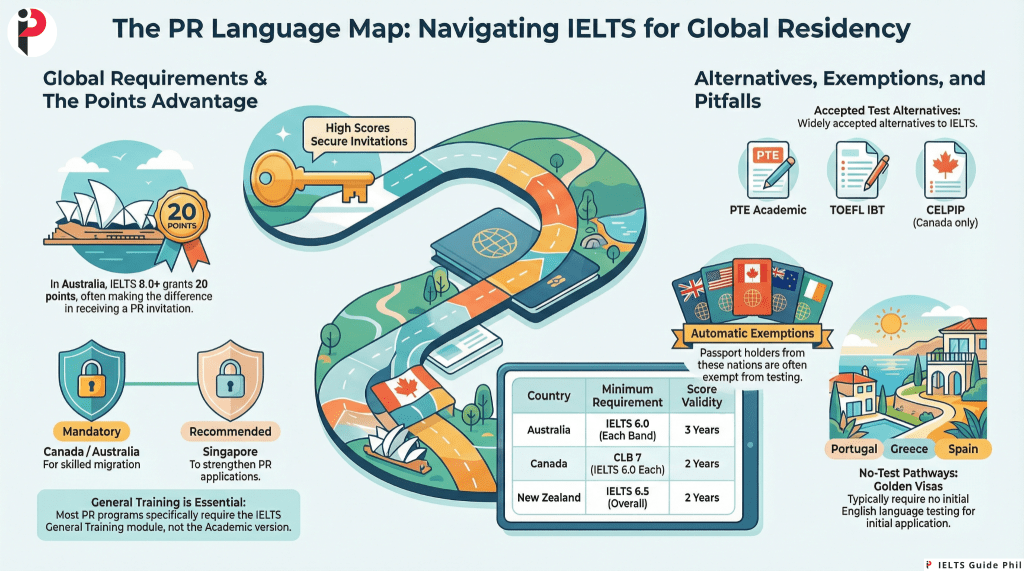
Stop wasting time and money on tests you don’t need—here’s your complete guide to IELTS requirements for permanent residency worldwide.
Introduction
If you’re planning to immigrate and pursue permanent residency (PR) abroad, you’ve likely encountered one persistent question: “Do I need IELTS?” The International English Language Testing System (IELTS) has become synonymous with immigration, but here’s the truth—not every PR pathway requires it, and some that do offer alternatives.
This comprehensive guide cuts through the confusion to show you exactly which PR routes genuinely require IELTS, which accept alternatives, and how to navigate language requirements strategically.
In this post, you’ll discover:
- PR pathways with mandatory IELTS requirements
- Country-specific language testing rules
- Alternative tests you can take instead
- Common mistakes that cost applicants time and money
- Expert strategies to maximize your score
Understanding IELTS and PR Applications
IELTS is an English language proficiency test accepted by immigration authorities in countries including Australia, Canada, New Zealand, and the UK. It measures your ability to communicate in English across four skills: listening, reading, writing, and speaking.
Why Do Countries Require Language Tests?
Immigration authorities use language tests to ensure applicants can:
- Integrate into the local community and workforce
- Contribute economically without language barriers
- Access services and navigate daily life independently
- Meet professional standards in regulated occupations
PR Pathways That ACTUALLY Require IELTS
1. Australia: Skilled Migration Programs
General Skilled Migration (GSM) – Subclass 189, 190, 491
- Minimum requirement: IELTS 6.0 in each band (Competent English)
- Points-based advantage: Higher scores earn more points
- Competent (IELTS 6.0 each): 0 points
- Proficient (IELTS 7.0 each): 10 points
- Superior (IELTS 8.0 each): 20 points
- Alternatives accepted: PTE Academic, TOEFL iBT, Cambridge C1 Advanced, OET
Example: Raj, a software engineer, achieved IELTS 7.0 in all bands (Proficient English), earning him 10 crucial points that pushed his Expression of Interest (EOI) score from 75 to 85, securing his invitation to apply.
Employer Nomination Scheme (Subclass 186)
- Requirement: IELTS 6.0 in each component (or equivalent)
- Exemptions: Passport holders from UK, USA, Canada, NZ, Ireland
- Alternatives accepted: Same as GSM
Business Innovation and Investment (Subclass 188/888)
- Requirement: IELTS 4.5 in each band (Vocational English)
- Note: Lower threshold than skilled migration
- Alternatives accepted: PTE, TOEFL iBT
2. Canada: Express Entry System
Federal Skilled Worker Program (FSWP)
- Minimum: CLB 7 (equivalent to IELTS 6.0 in each component)
- Maximum points: CLB 10+ (IELTS 8.0+) = 136 points for first language
- Mandatory: Yes, no exemptions
- Alternatives: CELPIP (Canadian English Language Proficiency Index Program)
Canadian Experience Class (CEC)
- NOC 0 or A jobs: CLB 7 minimum (IELTS 6.0)
- NOC B jobs: CLB 5 minimum (IELTS 5.0)
- Strategy: Higher scores dramatically improve CRS ranking
Example: Maria increased her Comprehensive Ranking System (CRS) score from 438 to 476 by improving her IELTS from 7.0 to 8.5, moving her above the cut-off threshold.
Provincial Nominee Programs (PNPs)
- Varies by province: Most require CLB 4-7 minimum
- Alberta, Ontario, BC: Typically CLB 7+ for skilled workers
- Atlantic Immigration Program: CLB 4 minimum
- Alternatives: CELPIP for all provinces
3. New Zealand: Skilled Migrant Category
Resident Visa (Skilled Migrant Category)
- Minimum: IELTS 6.5 overall (or equivalent)
- No individual band minimums: Overall score matters
- Points system: No additional points for higher scores
- Alternatives: PTE Academic, TOEFL iBT, Cambridge, OET
- Exemptions: Citizens of Canada, UK, Ireland, USA
Example: John from India needed IELTS for his SMC application despite having a master’s degree from an English-medium university, as India isn’t an exempt country.
4. United Kingdom: Skilled Worker Visa to ILR
Indefinite Leave to Remain (ILR) – Settlement
- Requirement: CEFR Level B1 (equivalent to IELTS 4.0 in all skills)
- When it’s required: At settlement stage (after 5 years)
- Alternatives: Trinity College London, LanguageCert, PTE
- Exemptions: Degree taught in English from majority English-speaking country
5. Singapore: Employment Pass to PR
Permanent Residence Application
- No official requirement: But English proficiency matters
- Assessment factor: Ability to integrate considered
- Recommendation: IELTS 6.5+ strengthens application
- Alternative proof: English-medium education certificates
PR Pathways That DON’T Require IELTS
Understanding exemptions can save you thousands of dollars and months of preparation.
Countries/Programs with No Mandatory IELTS:
- Portugal Golden Visa – No language requirement for residence
- Greece Golden Visa – Investment-based, no IELTS needed
- Spain Non-Lucrative Visa – No English or Spanish testing required initially
- Germany Blue Card – German language required (B1 level), not IELTS
- Austria Red-White-Red Card – German language requirement (A1-B1)
IELTS Exemptions in Major Countries:
Australia: Passport holders from UK, USA, Canada, NZ, Ireland, or degrees from these countries
Canada: None for Express Entry (all applicants need proof)
New Zealand: Citizens of Canada, USA, UK, Ireland
UK: Degree taught in English from majority English-speaking country
Alternative Language Tests Accepted
1. PTE Academic (Pearson Test of English)
- Computer-based, faster results (1-5 days)
- Accepted by Australia, New Zealand, UK
- PTE 50 = IELTS 6.0
2. TOEFL iBT
- Widely available globally
- Accepted by Australia, Canada (limited), New Zealand
- TOEFL 79 = IELTS 6.5
3. CELPIP
- Canada only
- Canadian context and accents
- Results in 4-5 business days
4. Cambridge English (C1 Advanced, C2 Proficiency)
- Lifetime validity
- Accepted by Australia, New Zealand, UK
- C1 Advanced 180 = IELTS 7.0
5. OET (Occupational English Test)
- For healthcare professionals
- Accepted by Australia, New Zealand, UK
Common Mistakes and How to Fix Them
Mistake #1: Taking IELTS Too Early
Problem: Scores expire in 2-3 years Fix: Take IELTS 3-6 months before planned submission
Mistake #2: Not Understanding Score Equivalencies
Problem: Different countries use different scoring systems Fix: Use official conversion charts; CLB 7 = IELTS 6.0 in each component
| IELTS Score | Canadian CLB | Australian Level | UK CEFR |
|---|---|---|---|
| 8.0+ each | CLB 9 | Superior | C1 |
| 7.0+ each | CLB 9 | Proficient | B2 |
| 6.0+ each | CLB 7 | Competent | B2 |
| 5.0+ each | CLB 5 | Vocational | B1 |
Mistake #3: Ignoring the Points System
Problem: Settling for minimum scores Fix: Higher scores = more points. In Canada, CLB 7 to CLB 9 adds up to 50 CRS points
Mistake #4: Not Preparing Adequately
Fix: Start preparation 2-3 months before test date
Mistake #5: Choosing the Wrong Test Type
Fix: PR applications require IELTS General Training, not Academic
Mistake #6: Assuming English-Medium Education Exempts You
Fix: Exemptions usually apply to degrees from specific countries only
Strategic Approach: Maximizing Your Score
Before the Test (3 Months Out):
- Take a diagnostic test
- Create a study schedule (30-60 minutes daily)
- Focus on one skill per week
Test Day Strategy:
Listening (40 minutes): Use preparation time wisely, transfer answers carefully
Reading (60 minutes): Skim questions first, 20 minutes per passage maximum
Writing (60 minutes): Task 1: 20 min (150 words), Task 2: 40 min (250 words), 5 min proofreading
Speaking (11-14 minutes): Speak naturally, expand with examples, don’t memorize
Score Improvement Tips:
To improve from 6.0 to 7.0:
- Learn 1,000+ topic-specific words
- Master complex sentence structures
- Practice speaking 2 minutes on random topics daily
To achieve 8.0+:
- Read extensively (The Economist, Scientific American)
- Write daily (300+ words)
- Consume native English media
- Get professional feedback
Country-Specific Requirements Summary
Australia:
- Minimum: IELTS 6.0 each band
- Optimal: IELTS 8.0 each (20 points)
- Validity: 3 years
Canada:
- Minimum: CLB 7 (IELTS 6.0 each)
- Optimal: CLB 10+ for maximum points
- Validity: 2 years
New Zealand:
- Minimum: IELTS 6.5 overall
- Validity: 2 years
United Kingdom:
- Minimum: CEFR B1 (IELTS 4.0 all skills)
- For settlement only
Singapore:
- Not mandatory but recommended 6.5+
Frequently Asked Questions (FAQs)
Q1: Can I use IELTS Academic for PR applications? A: No. Most PR programs require IELTS General Training.
Q2: How long is my IELTS score valid? A: 2-3 years depending on the country (Canada: 2 years, Australia: 3 years).
Q3: Can I retake IELTS? A: Yes, unlimited retakes allowed.
Q4: What if one band score is lower? A: Most programs require minimum scores in each component.
Q5: Is British or American spelling accepted? A: Both are accepted; be consistent.
Q6: I have a degree from the Philippines in English. Am I exempt for Australia? A: No. Only degrees from UK, USA, Canada, NZ, Ireland qualify.
Q7: Can I use TOEFL for Canada? A: TOEFL is not accepted for most Canadian immigration programs.
Q8: I’m a U.S. citizen. Do I need IELTS for Australian PR? A: No. U.S. passport holders are exempt.
Q9: Is PTE easier than IELTS? A: “Easier” is subjective. Try practice tests for both.
Q10: Can I request a re-mark? A: Yes, within 6 weeks for $40-$100.
Dos and Don’ts: Quick Reference
✅ DOs:
- Verify requirements from official immigration websites
- Check expiry dates before booking
- Take official practice tests
- Consider alternatives like PTE
- Prepare adequately (2-3 months minimum)
- Understand scoring systems
- Keep original test reports safe
- Check exemption eligibility
- Aim higher than minimum for points
- Practice time management
❌ DON’Ts:
- Don’t take IELTS Academic for PR
- Don’t assume English-medium education exempts you
- Don’t wait until the last minute
- Don’t settle for minimum scores
- Don’t ignore validity periods
- Don’t memorize Speaking answers
- Don’t leave answers blank
- Don’t use informal language in Writing
- Don’t skip practice tests
- Don’t rely solely on existing English skills
Cost Analysis
Direct Costs:
- Test fee: $215-$330
- Preparation: $0-$2,000
- Materials: $50-$200
- Retakes: $215-$330 each
- Total: $500-$3,000
Return on Investment:
- Higher IELTS scores = more points
- Faster PR approval
- Lifetime earnings potential: $1-3 million+
Verdict: IELTS is one of the best investments in your immigration journey.
Action Plan: Your Next Steps
Step 1: Determine if you need IELTS Step 2: Choose your test (IELTS vs. alternatives) Step 3: Plan your timeline Step 4: Register and prepare Step 5: Take the test Step 6: Use your scores strategically
Final Thoughts
IELTS requirements vary significantly by country and program. While mandatory for most skilled migration routes to Australia, Canada, and New Zealand, understanding exemptions and alternatives can save you time and money.
Key Takeaways:
- Not every PR pathway requires IELTS
- Higher scores = more immigration points
- Several alternatives exist (PTE, CELPIP, TOEFL)
- Exemptions available for certain nationalities
- Proper preparation is crucial
- Score validity matters—plan timing carefully
- The investment pays off exponentially
If IELTS is required for your chosen pathway, approach it strategically. Invest in quality preparation, aim for scores higher than the minimum, and view it as an opportunity to strengthen your application.
Good luck with your IELTS preparation and PR journey!
Additional Resources
Official IELTS Resources:
- IELTS Official Website
- British Council IELTS
- IDP IELTS
Immigration Authorities:
- Australia – Department of Home Affairs
- Canada – IRCC
- New Zealand – Immigration
- UK – GOV.UK Visas
Alternative Tests:
- PTE Academic
- CELPIP
- TOEFL iBT
- Cambridge English
Free Preparation:
- IELTS Liz
- British Council Learning English
- Road to IELTS
- IELTS Simon
#IELTS #PermanentResidency #ImmigrationTips #PRApplication #ExpressEntry #CanadaImmigration #AustraliaSkilledMigration #NewZealandPR #LanguageTest #IELTSPreparation #SkilledMigration #CanadaPR #AustraliaPR #ImmigrationGuide #PTEAcademic #CELPIP #StudyAbroad #MoveAbroad #VisaApplication #ImmigrationConsultant #IELTSTips #EnglishProficiency #LanguageRequirements #SkilledWorkerVisa #PathwayToPR #ImmigrationProcess #IELTSExam #GlobalMigration #SettleAbroad #PRPathway #IELTSGuidePhil
Disclaimer: Immigration policies change frequently. This guide is for informational purposes only. Always consult official government sources and licensed immigration consultants for your specific situation.
 IELTS Guide Phil
Leave a comment