
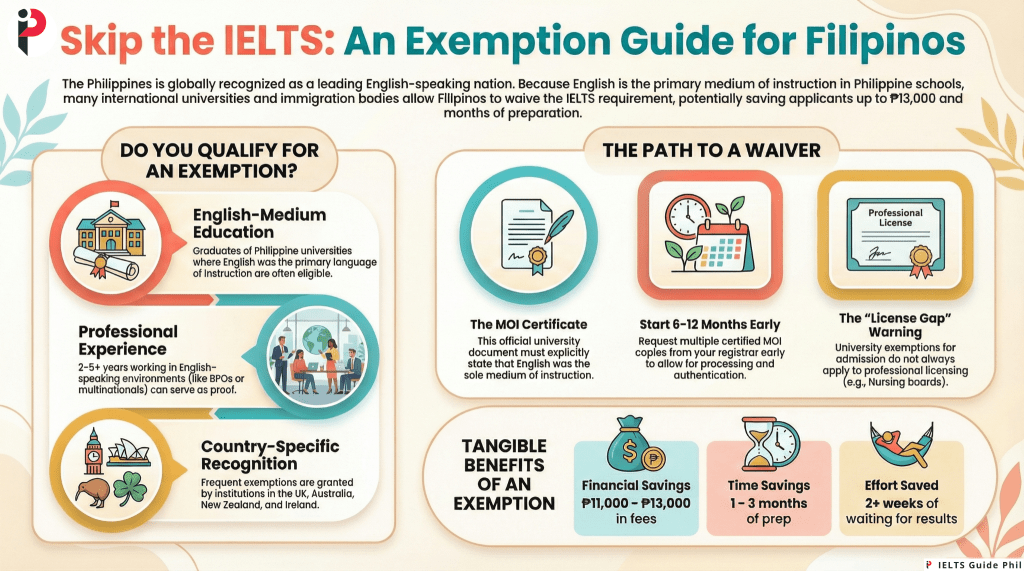
Are you a Filipino planning to study, work, or migrate abroad? You might be wasting time and money preparing for IELTS when you don’t even need it.
Many Filipinos spend months preparing for the IELTS exam and pay substantial fees, only to discover later that they qualified for an exemption all along. Understanding when you can skip this requirement can save you approximately ₱11,000-₱14,000 in test fees, countless hours of preparation, and weeks of waiting for results.
This comprehensive guide reveals exactly who qualifies for IELTS exemptions, how to leverage them, and the critical mistakes that could cost you your application.
Understanding IELTS Exemptions for Filipinos
What is an IELTS Exemption?
An IELTS exemption means that certain institutions, immigration authorities, or professional bodies waive the requirement to take the International English Language Testing System (IELTS) exam. Instead, they accept alternative proof of English proficiency based on your educational background, nationality, or previous qualifications.
Why Do Filipinos Qualify for Exemptions?
The Philippines is recognized globally as one of the largest English-speaking nations. English is an official language and the primary medium of instruction in Philippine schools from elementary through university. This widespread use of English in education and professional settings has led many institutions worldwide to grant exemptions to Filipino applicants.
Who Qualifies for IELTS Exemption?
1. Filipinos Who Studied in English-Medium Institutions
Primary Qualification Criteria:
- Completed a degree (Bachelor’s, Master’s, or PhD) where English was the primary language of instruction
- Attended schools in the Philippines or other English-speaking countries
- Can provide official documentation proving English as the medium of instruction
Countries/Institutions That Often Grant This Exemption:
- United Kingdom: Many UK universities exempt students who completed degrees in majority English-speaking countries
- Canada: Several Canadian universities and colleges recognize Philippine education credentials
- Australia: Numerous Australian institutions accept Philippine degrees as proof of English proficiency
- New Zealand: Many tertiary institutions grant exemptions
- Singapore: Most universities recognize Philippine educational backgrounds
- European Union: Various universities accept English-medium degree certificates
Real-World Example: Maria completed her Bachelor’s degree in Nursing at the University of Santo Tomas in Manila. When she applied for a Master’s program at the University of Manchester in the UK, she was granted an IELTS exemption because she submitted a Medium of Instruction (MOI) certificate from UST confirming that her entire degree was taught in English.
2. Philippine Passport Holders Applying to Specific Countries
Some countries recognize the Philippines as an English-speaking nation and grant exemptions based on citizenship.
Examples:
- Ireland: Some Irish universities grant automatic exemptions to Filipino nationals
- Select UK institutions: Certain universities maintain lists that include the Philippines
- Some Canadian provinces: For specific professional licensing paths
3. Professionals with Work Experience in English-Speaking Environments
Who Qualifies:
- Professionals with 2-5+ years working where English was the primary language
- Those in multinational companies, BPO companies, or international organizations
- Professionals applying for skilled worker visas
Example: Carlos worked as a software developer for a multinational company in Makati for 5 years. When applying for a skilled worker visa in Australia, his employment certificates and reference letters confirmed English was the primary workplace language. Combined with his Philippine degree, he qualified for an exemption under certain visa pathways.
4. Those Holding Previous Qualifications from English-Speaking Countries
Qualification Criteria:
- Completed a degree in the USA, UK, Canada, Australia, or New Zealand
- Minimum 1-2 years full-time study required
5. Citizens of Commonwealth Countries (Context-Dependent)
Benefits for Filipinos with:
- Dual citizenship (Filipino and a Commonwealth country)
- Previous residency or education in Commonwealth nations
Country-Specific Exemption Guidelines
United Kingdom
Exemption Criteria:
- Completed a degree equivalent to UK bachelor’s or higher
- Degree taught in majority English-speaking country OR English medium of instruction
- Usually completed within last 5 years (varies by institution)
How to Apply:
- Obtain MOI certificate from Philippine university
- Submit with application
- May require additional documentation
Universities Often Granting Exemptions:
- University of Manchester
- University of Edinburgh
- University of Birmingham
- King’s College London
Canada
Exemption Criteria:
- Varies by province and institution
- Some universities exempt students with English-medium degrees
- Express Entry may still require testing
Key Points:
- Study permits: Check individual universities
- Immigration: Most require IELTS/CELPIP
- Professional licensing: Varies by profession
Australia
Exemption Criteria:
- Completed 5-6 years of study in English
- Specific visa subclasses have different requirements
For Student Visas:
- Many universities grant exemptions with MOI
- Immigration may still require proof
For Skilled Migration:
- Most pathways require IELTS or equivalent
- Some employer-sponsored visas offer exemptions
New Zealand
Exemption Criteria:
- Completed qualification where English is primary language
- Work experience for some visa categories
European Union Countries
General Trends:
- Germany: Many universities accept English-medium degrees
- Netherlands: Often grant exemptions with proper documentation
- Sweden, Denmark, Finland: Variable policies
- Ireland: Favorable policies for Filipinos
Essential Documents You Need
1. Medium of Instruction (MOI) Certificate
What It Should Include:
- Your full name and student number
- Program name and degree obtained
- Dates of attendance
- Explicit statement: “The medium of instruction for this program was English”
- Official university seal and registrar’s signature
How to Obtain:
- Visit university registrar or academic records office
- Request MOI certificate
- Processing: 3-10 business days
- Cost: ₱100-₱500 per copy
Pro Tip: Request 3-5 certified copies
2. Official Transcripts
- Complete academic transcripts
- In English or with certified translations
- Official university seal
3. Diploma/Degree Certificate
- Original or certified copy
- Clear degree and graduation date
4. Employment Certificates (If Applicable)
- Official letterhead from employer
- English as working language statement
- Job description and responsibilities
- Duration of employment
- Supervisor signature and contact
5. Passport Copy
- Valid Philippine passport
- Biographical page showing nationality
The DO’s: Maximizing Your Exemption Chances
✅ DO Research Early
Start researching 6-12 months before applying. Policies change frequently.
✅ DO Contact Admissions Directly
Sample Email Template:
Subject: IELTS Exemption Inquiry - Philippine ApplicantDear Admissions Team,I am a Filipino citizen planning to apply for [Program Name] starting [Term/Year]. I completed my [Degree] at [University Name] in the Philippines, where English was the medium of instruction.Could you please confirm if I qualify for an IELTS exemption based on my educational background? If so, what documentation would I need to provide?Thank you for your assistance.Best regards,[Your Name]✅ DO Obtain MOI Certificates Early
Request as soon as you decide to apply abroad. Processing takes time.
✅ DO Get Multiple Certified Copies
Request 3-5 copies for:
- University applications
- Visa applications
- Professional licensing
- Backup copies
✅ DO Verify Authentication Requirements
Check if you need:
- Notarization
- DFA authentication
- Apostille
✅ DO Keep Digital Backups
- Scan documents in high resolution (PDF)
- Store in multiple cloud locations
- Keep organized folders
✅ DO Prepare a Backup Plan
- Know IELTS test dates
- Understand score requirements
- Familiarize yourself with the test
✅ DO Highlight Your English Proficiency
- Mention relevant English courses
- Highlight presentations/publications in English
- Showcase leadership in English-speaking environments
The DON’Ts: Critical Mistakes to Avoid
❌ DON’T Assume All Institutions Have Same Policy
Each institution sets its own exemption criteria.
Costly Mistake Example: Juan assumed exemption for university meant exemption for visa. He learned too late that UK Visas and Immigration has separate requirements.
❌ DON’T Rely on Outdated Information
Policies change frequently. Verify within 3-6 months of applying.
❌ DON’T Submit Incomplete Documentation
Checklist:
- MOI certificate with seal
- Transcripts (all pages)
- Degree certificate
- Authentication (if required)
- Cover letter
❌ DON’T Confuse University vs Visa Exemptions
These are separate processes:
- University exemption: For admission
- Visa exemption: For immigration
❌ DON’T Forget About Professional Licensing
Professions Often Requiring IELTS:
- Nurses (UK NMC, Australian AHPRA, Canadian colleges)
- Teachers
- Engineers
- Doctors and healthcare professionals
- Lawyers
❌ DON’T Misrepresent Qualifications
Never fabricate documents. Consequences include:
- Permanent ban
- Visa rejection
- Legal consequences
- Damage to future applications
❌ DON’T Wait Until Last Minute
Recommended Timeline:
- 12 months before: Research policies
- 9-10 months before: Request documents
- 6-8 months before: Complete authentication
- 6 months before: Submit applications
- 3-4 months before: Prepare for visa
❌ DON’T Ignore Specific Requirements
Some institutions may still require:
- Minimum GPA in English subjects
- Specific English courses
- Alternative assessments
Common Mistakes and How to Fix Them
Mistake #1: Applying Without Confirming Current Policy
The Problem: Relying on forum posts without verification
The Fix:
- Visit official university website
- Email admissions directly
- Call if information unclear
- Document all communications
Mistake #2: MOI Certificate Lacks Proper Details
The Problem: Certificate doesn’t explicitly mention English as medium
The Fix: Request revised certificate stating:
- “All courses conducted in English”
- “English was sole/primary medium”
- “Lectures, exams, assessments in English”
Template Request Letter:
To the University Registrar,I am requesting a revised Medium of Instruction Certificate for [Target Institution].The certificate should explicitly state:1. English was primary medium of instruction2. All lectures, examinations, materials in English3. Include program name, dates, degree obtainedRequires official signature and university seal.Thank you.[Your Name][Student Number]Mistake #3: Not Understanding Test Types
The Fix: Understand differences:
- IELTS Academic: University admissions
- IELTS General: Immigration and work
- IELTS UKVI: UK visa applications
- TOEFL iBT: Alternative
- PTE Academic: Computer-based alternative
- Duolingo: Online option (growing acceptance)
Mistake #4: Forgetting Document Expiry
The Problem: Some institutions only accept recent qualifications (2-5 years)
The Fix:
- Check validity period requirements
- Look for alternative exemption criteria
- Provide additional evidence of current proficiency
Mistake #5: Wrong Program Level
The Problem: Exemptions may differ by program level
The Fix:
- Check policies for specific program level
- Understand undergraduate vs postgraduate differences
Mistake #6: Not Preparing for Interviews
The Problem: Unprepared for English proficiency interviews
The Fix:
- Practice common interview questions
- Record and review yourself
- Research the program
- Practice with others
- Consider professional coaching
Frequently Asked Questions (FAQ)
Q1: I graduated 10 years ago. Can I still get an MOI certificate?
A: Yes. Most Philippine universities maintain records indefinitely. Processing may take 2-4 weeks for older records. Contact registrar with valid ID and graduation proof.
Q2: Can I use my high school diploma?
A: Generally no. Most exemptions require tertiary education (2-3 years minimum). Some foundation programs might accept high school credentials.
Q3: Some professors taught in Tagalog. Can I still claim exemption?
A: Yes. What matters is the official medium of instruction and assessment. Your MOI certificate states English as the medium, and examinations are in English.
Q4: Do I need IELTS for Canada’s Express Entry?
A: Yes, almost certainly. Express Entry requires proof of language proficiency (IELTS, CELPIP, or TEF). This is mandatory regardless of nationality.
Q5: Does BPO work count as proof of English proficiency?
A: It depends:
- For Study: Usually supporting evidence only
- For Immigration: Some visas accept employment certificates
- For Professional Licensing: Usually insufficient alone
Q6: What if my university refuses MOI certificate?
Options:
- Escalate within university (Dean, Department Head)
- Alternative documentation (prospectus, syllabi)
- CHED verification
- Take IELTS as backup
Q7: Can I use TOEFL instead of requesting exemption?
A: Yes! If you have valid TOEFL (or PTE, Duolingo):
- Check if institution accepts it
- Verify minimum score
- Confirm validity period (usually 2 years)
Q8: I have dual citizenship. Do I need IELTS?
A: Generally no. Use your passport from the English-speaking country. Check if residency requirements apply.
Q9: Does DFA apostille apply to MOI certificates?
A: Depends on destination:
- European countries: Usually yes (Hague Convention)
- Middle East: Often yes
- Process: ₱100-₱400 per document, 2-7 business days
Q10: What about online/distance learning degrees?
A: Varies significantly:
- Accredited Philippine universities generally accepted
- May need additional proof of legitimacy
- Be transparent about mode of study
Q11: Nursing in UK – need IELTS even if exempt for university?
A: Yes. Professional licensing is separate:
- UK NMC requires IELTS 7.0 minimum
- No exemptions for Filipino nurses
- Similar for Australian AHPRA, Canadian colleges
Q12: How long for exemption approval?
A:
- University: 4-8 weeks with application
- Visa: Adds 2-4 weeks to processing
- Professional licensing: 2-6 months
Q13: What score is equivalent to exemption?
A: No direct equivalent, but:
- Universities assume IELTS 6.5-7.5
- May have minimum GPA for English courses
- Some conduct own assessments
Q14: Can I transfer exemption between universities?
A: No. Each university evaluates independently. However, same documents can be used for multiple applications.
Q15: What if exemption request is denied?
Options:
- Appeal with additional documentation
- Take IELTS (results in 13 days-2 weeks)
- Apply to different institutions
- Consider alternative tests (PTE, TOEFL, Duolingo)
Don’t Panic: Average Filipino IELTS score is 6.5-7.0.
Real Success Stories
Success Story 1: The Corporate Professional
Jennifer, 32 – Marketing Manager
- Challenge: 10-year-old degree
- Solution: Updated MOI, comprehensive employment certificates, work portfolio
- Result: Accepted to 3 UK universities with exemption
- Saved: ₱12,000 and 3 months
Key Takeaway: Work experience overcomes concerns about older degrees.
Success Story 2: The Fresh Graduate
Miguel, 23 – Computer Science graduate
- Challenge: Multiple countries simultaneously
- Solution: 5 MOI copies, DFA authentication, organized spreadsheet
- Result: Exemptions from UK, Australia, Netherlands programs
- Chose: Netherlands with full scholarship
Key Takeaway: Early preparation maximizes opportunities.
Success Story 3: The Career Changer
Anna, 38 – Accounting to Nursing
- Challenge: Need AHPRA registration eventually
- Solution: Used exemption for admission, prepared for IELTS after arriving
- Result: Faster entry, improved English in Australia, scored 8.0
Key Takeaway: Strategic use speeds initial stages.
Additional Resources
Government Agencies
Commission on Higher Education (CHED)
- https://ched.gov.ph
- Degree authentication and verification
Department of Foreign Affairs (DFA)
- https://dfa.gov.ph
- Document authentication and apostille
Professional Regulation Commission (PRC)
- https://prc.gov.ph
- Professional license verification
Testing Centers
British Council Philippines
- https://www.britishcouncil.ph
- Locations: Manila, Makati, Cebu, Davao
IDP Education Philippines
- https://www.idp.com/philippines
- Multiple locations nationwide
Useful Websites
University Search:
- Universities UK: https://www.universitiesuk.ac.uk
- Study in Australia: https://www.studyinaustralia.gov.au
- Education in Ireland: https://www.educationinireland.com
- Study in Canada: https://www.educanada.ca
Immigration:
- UK Visas: https://www.gov.uk/browse/visas-immigration
- Canada Immigration: https://www.canada.ca/en/immigration-refugees-citizenship.html
- Australian Home Affairs: https://immi.homeaffairs.gov.au
- New Zealand Immigration: https://www.immigration.govt.nz
The Bottom Line: Should You Pursue an Exemption?
Pursue an Exemption If:
✅ Degree from Philippine university with English medium
✅ Target institution lists criteria you meet
✅ Time to gather documentation (3-6 months)
✅ Applying to known exemption-friendly institutions
✅ Can obtain comprehensive MOI certificate
✅ Comfortable with administrative processes
Consider Taking IELTS If:
⚠️ Deadline less than 2 months away
⚠️ Unclear or restrictive policies
⚠️ Applying for professional licensing (healthcare/education)
⚠️ Canada Express Entry
⚠️ University cannot provide MOI
⚠️ Want standardized score for multiple applications
⚠️ Need visa backup plan
⚠️ Confident in scoring well
Final Thoughts
Understanding IELTS exemptions can save significant time, money, and stress. Success depends on:
- Thorough research of specific requirements
- Early preparation of documentation
- Direct communication with admissions
- Backup planning if exemptions aren’t granted
- Realistic assessment of your situation
Remember: An exemption is a privilege, not a right. Be prepared for additional evidence requests or alternative assessments.
The smartest approach: Research exemption possibilities early, prepare strong documentation, but be ready to take IELTS if needed. Your goals are too important to risk on unclear status.
Whether exempt or not, your Filipino education has prepared you well for success in English-speaking environments.
Take Action Today
Immediate Steps:
- ✅ List target universities/countries
- ✅ Check English language requirements
- ✅ Contact university registrar about MOI
- ✅ Create document preparation timeline
- ✅ Join relevant support groups
Within 1 Month:
- ✅ Obtain MOI certificates
- ✅ Email institutions to confirm eligibility
- ✅ Begin authentication if required
- ✅ Research IELTS dates as backup
Within 3 Months:
- ✅ Submit applications with documentation
- ✅ Follow up on status
- ✅ Prepare for interviews
- ✅ Have IELTS registration ready
Did You Find This Helpful?
Share this guide with other Filipinos who might benefit. The more we share knowledge, the more successful we all become.
Questions not covered? Leave a comment – I’ll help or point you to resources.
Got an exemption? Share your story to inspire others!
Disclaimer: Policies change frequently. Always verify with official sources. This guide is for informational purposes only and does not constitute legal or professional advice.
#IELTSExemption #FilipinosAbroad #StudyAbroad #IELTSPhilippines #PinoyStudents #OFW #PhilippineEducation #UKUniversities #StudyInCanada #StudyInAustralia #InternationalStudents #FilipinoProfessionals #MediumOfInstruction #EnglishProficiency #ScholarshipTips #ImmigrationTips #PinoyInUK #PinoyInCanada #PinoyInAustralia #StudyAbroadTips #FilipinoNurses #FilipinoTeachers #CareerAbroad #PHEducation #SkipIELTS #NoIELTSRequired #FilipinoGraduates #OverseasStudy #InternationalEducation #PinoySuccess #IELTSGuidePhil
This comprehensive guide was created to help Filipino students and professionals navigate IELTS exemptions. While we strive for accuracy, policies change regularly. Always confirm with official sources.
 IELTS Guide Phil
Leave a comment