
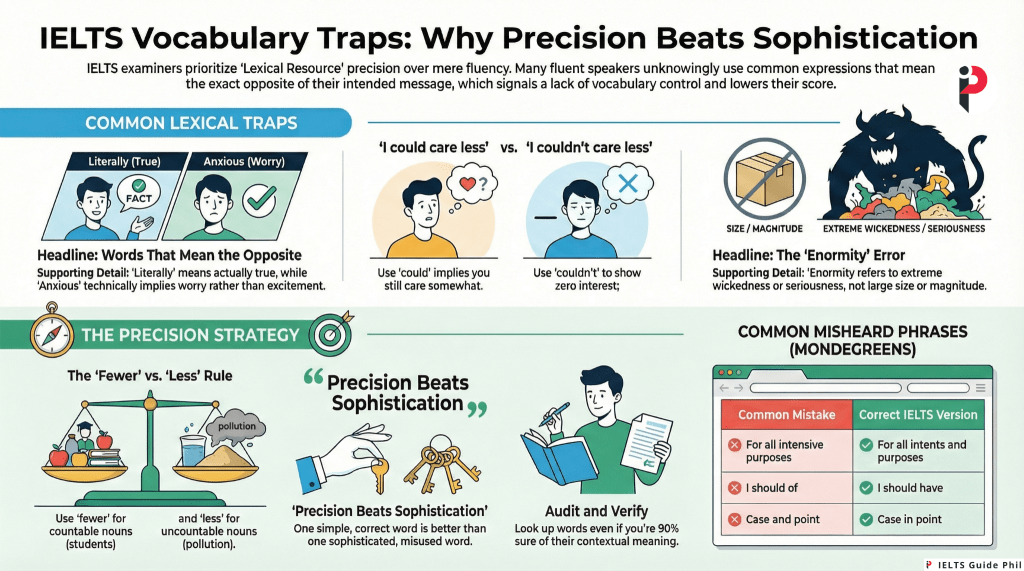
You’ve been saying “I could care less” to show you don’t care at all.
Plot twist: You’ve been saying the exact opposite of what you mean.
Every single day, millions of fluent English speakers—including educated professionals, confident test-takers, and people who’ve spoken English their whole lives—use words and phrases that mean the complete opposite of what they think. Or they misuse expressions so badly that they sound ridiculous to native speakers and IELTS examiners.
And here’s the brutal part: you probably don’t even know you’re doing it.
These aren’t exotic vocabulary words you’ve never encountered. These are common expressions you’ve heard in movies, read in books, and used in conversations hundreds of times. But somewhere along the way—through mishearing, logical assumptions, or just widespread misuse—you internalized the wrong meaning.
And in IELTS, where precision matters more than fluency, these mistakes will absolutely tank your Lexical Resource score.
An examiner might understand what you’re trying to say through context, but when you misuse words, you’re sending a clear signal: you don’t actually know what these words mean. And if you don’t know what common expressions mean, how can you demonstrate the vocabulary range required for Band 7+?
Let me show you the expressions that are probably hiding in your English right now, waiting to sabotage your IELTS score.
Why Smart, Fluent Speakers Get These Wrong
Here’s the thing about language learning: you often learn words through context, not definition. You hear “I could care less” in a movie when someone is dismissing something, so you assume that’s how to express indifference. You read “irregardless” in online comments and think it’s a stronger version of “regardless.” You hear “begs the question” used before someone asks a question, so you think that’s what it means.
But context can be misleading. Especially when the people around you—friends, classmates, even teachers—are also using these expressions incorrectly.
For IELTS, this creates a specific problem: examiners are trained to catch imprecise language use. While your friends might understand what you mean when you say something “begs the question,” an IELTS examiner will notice you’re using the phrase incorrectly and mark your Lexical Resource accordingly.
Let’s break down the most dangerous misused expressions that could be lurking in your IELTS responses.
Category 1: Expressions That Mean the OPPOSITE of What You Think
“I could care less”
What people think it means: I don’t care at all; I have zero interest.
What it actually means: I care at least somewhat (because if you could care less, that means you currently care to some degree).
The correct expression: “I couldn’t care less” or “I could not care less”
The logic: If you couldn’t care less, you’re already at zero care—there’s no lower level possible. That’s the correct way to express complete indifference.
Why people get it confused: “I could care less” has become so common in American English (through misuse) that many people think it’s correct. It’s not. It’s literally saying the opposite.
IELTS impact example:
❌ Speaking Part 3: “Young people could care less about traditional values these days.”
(This suggests young people DO care somewhat about traditional values)
✅ Correct: “Young people couldn’t care less about traditional values these days.”
Real talk: This mistake is so widespread that some dictionaries now list “could care less” as an informal variant. But IELTS examiners—especially British ones—will notice it as imprecise American usage. Use “couldn’t care less” to be safe.
“Literally”
What people think it means: A general intensifier meaning “really” or “very much”
What it actually means: In a literal, exact, non-metaphorical sense; actually and precisely true
Why it matters: Using “literally” when you mean “figuratively” is one of the most noticeable vocabulary mistakes in modern English.
IELTS disasters:
❌ Speaking Part 2: “I was literally dying of laughter during the movie.”
(Unless you actually experienced clinical death, this is wrong)
❌ Speaking Part 3: “The traffic in Manila is literally insane.”
(Traffic cannot be medically insane)
✅ Correct alternatives:
- “I was laughing hysterically”
- “I found it extremely amusing”
- “The traffic in Manila is absolutely chaotic”
- “The traffic is incredibly congested”
When “literally” IS correct:
✅ “The movie was literally four hours long” (It was actually, precisely 4 hours)
✅ “He literally ran a marathon yesterday” (He actually ran 42.195 km)
IELTS examiner perspective: Overusing “literally” as an intensifier makes you sound imprecise and overly informal. In Writing, it’s almost never appropriate. In Speaking, use it only when you mean something is actually, factually true.
“Anxious” (confused with “eager”)
What people think it means: Excited about something; looking forward to something
What it actually means: Worried, nervous, or uneasy about something
The confusion: People often say “I’m anxious to start my new job” when they mean they’re eager or excited to start.
IELTS disasters:
❌ Speaking Part 2: “I was anxious to visit Japan for the first time.”
(This suggests you were worried or nervous about visiting, not excited)
❌ Writing Task 2: “Students are anxious to learn new technologies.”
(This suggests students are worried about learning, not enthusiastic)
✅ Correct usage:
- “I was eager to visit Japan”
- “I was excited to experience Japanese culture”
- “Students are enthusiastic about learning new technologies”
- “Students are keen to acquire new skills”
When “anxious” IS correct:
✅ “I was anxious about the exam results” (worried, nervous)
✅ “Many people feel anxious before public speaking” (nervous, uneasy)
The nuance: Technically, “anxious to” can mean “eager to” in some contexts, but it carries a connotation of nervousness or impatience. If you mean pure excitement without worry, use “eager,” “excited,” or “keen” instead.
“Nonplussed”
What most people think it means: Unfazed, unimpressed, not bothered
What it actually means: So surprised and confused that you’re unsure how to react; perplexed
Why the confusion: In North American English, “nonplussed” has been increasingly used to mean its opposite—calm and unruffled—probably because the “non-” prefix suggests “not perturbed.”
IELTS disasters:
❌ Speaking Part 3: “When people face criticism, they should remain nonplussed and continue their work.”
(If you intended to say “unruffled/calm,” you’ve actually said they should be confused and bewildered)
✅ Correct alternatives:
- “They should remain composed”
- “They should stay unperturbed”
- “They should remain unfazed”
- “They should keep their composure”
When “nonplussed” IS correct:
✅ “I was completely nonplussed by his strange question—I had no idea how to respond.”
✅ “The sudden change in policy left employees nonplussed.”
IELTS examiner perspective: British examiners will definitely notice if you use “nonplussed” to mean “unfazed.” It’s a sophisticated word, but using it incorrectly signals that you’ve learned vocabulary without understanding precise meanings.
“Peruse”
What most people think it means: To skim or glance through quickly
What it actually means: To read carefully and thoroughly
Why the confusion: The word sounds like it should mean casual browsing (maybe because it sounds like “pursue” or “browse”), but it actually means the opposite.
IELTS disasters:
❌ Writing Task 1: “Consumers typically peruse product labels quickly before making purchase decisions.”
(You’ve said they read carefully, when you meant to say they skim)
✅ Correct alternatives for “skim/glance”:
- “Consumers typically scan product labels quickly”
- “Shoppers tend to skim through information”
- “People often glance at reviews briefly”
✅ When to use “peruse”:
- “Lawyers peruse contracts to identify potential issues”
- “Students should peruse the reading materials carefully before the exam”
IELTS examiner perspective: Using “peruse” when you mean “skim” is a precision error that affects your Lexical Resource score. It suggests you don’t understand the word’s actual meaning.
Category 2: Expressions That Don’t Mean What They Sound Like
“Begs the question”
What most people think it means: Raises the question; prompts us to ask
What it actually means: A logical fallacy where the conclusion is assumed in the premise (circular reasoning)
Why the confusion: In casual modern usage, “begs the question” is almost always used to mean “raises the question.” But technically, “beg the question” is a specific term from logic and philosophy.
IELTS disasters:
❌ Speaking Part 3: “The increase in online shopping begs the question: will physical stores survive?”
(Technically incorrect usage; you’re not describing circular reasoning)
✅ Correct alternatives:
- “This raises the question…”
- “This prompts us to ask…”
- “This leads us to wonder…”
- “We might ask…”
When “begs the question” IS technically correct:
✅ “His argument begs the question by assuming that economic growth is inherently good without proving it.”
(Describing circular reasoning in formal logic)
Real talk for IELTS: The phrase “begs the question” meaning “raises the question” is so common now that many dictionaries accept it. However, using “raises the question” is clearer, more precise, and won’t risk sounding incorrect to a well-educated examiner.
“Bemused”
What most people think it means: Amused, entertained
What it actually means: Confused, bewildered, lost in thought
Why the confusion: “Bemused” sounds like “amused” and shares some letters, so people assume they’re related. They’re not.
IELTS disasters:
❌ Speaking Part 2: “I was bemused by the comedian’s jokes—they were hilarious!”
(You’ve said you were confused by the jokes, not entertained)
✅ Correct alternatives:
- “I was amused by the comedian’s jokes”
- “I was entertained by the performance”
- “The comedian’s humor was delightful”
When “bemused” IS correct:
✅ “I was bemused by the complicated instructions—I wasn’t sure what to do first.”
✅ “She looked bemused, as if she couldn’t understand what was happening.”
IELTS examiner perspective: Confusing “bemused” and “amused” is a classic error that shows you’ve learned words by visual similarity rather than actual meaning.
“Enormity”
What most people think it means: Enormous size; hugeness
What it actually means: Extreme wickedness or outrageousness; the extreme seriousness of something bad
Why the confusion: “Enormity” looks like “enormous” + “-ity” suffix, so logically it should mean “the quality of being enormous.” But it doesn’t.
IELTS disasters:
❌ Writing Task 2: “The enormity of the internet has changed how we communicate.”
(You’ve said the extreme wickedness of the internet, not its large size)
❌ Speaking Part 3: “People don’t understand the enormity of climate change.”
(This could work if you mean the extreme seriousness/gravity, but if you mean the large scale, use “magnitude” instead)
✅ Correct alternatives for “huge size”:
- “The vastness of the internet”
- “The enormous scale of the internet”
- “The magnitude of climate change”
- “The immense scope of this issue”
When “enormity” IS correct:
✅ “The enormity of the crimes shocked the international community.”
✅ “We’re only beginning to understand the enormity of the environmental damage.”
(Here, “enormity” works because environmental damage is inherently negative/serious)
IELTS examiner perspective: Using “enormity” to mean “large size” is imprecise. While this usage is becoming more accepted, careful writers and examiners still distinguish between “enormity” (wickedness/gravity) and “enormousness” (size).
“Nauseous” vs. “Nauseated”
What most people think: These are interchangeable
The traditional distinction:
- Nauseous: Causing nausea; making others sick
- Nauseated: Feeling sick; experiencing nausea
IELTS disasters:
❌ “The smell of the food made me nauseous.”
(Traditional interpretation: The smell made you cause nausea in others—you became nauseating)
✅ More precise: “The smell of the food made me nauseated” or “The smell nauseated me”
✅ When “nauseous” IS traditionally correct: “The nauseous fumes from the factory affected nearby residents.”
(The fumes cause nausea; they are nauseating)
Real talk for IELTS: Using “nauseous” to mean “feeling sick” has become so common in American English that it’s now widely accepted. However, in formal British English (which IELTS leans toward), the distinction still matters. To be safe, use “nauseated” when you feel sick, and “nauseating/nauseous” when something causes sickness.
“Fortuitous”
What most people think it means: Fortunate, lucky
What it actually means: Happening by chance, accidental (without implying good or bad luck)
Why the confusion: “Fortuitous” sounds like “fortunate” and shares a Latin root related to luck, so people assume they mean the same thing.
IELTS disasters:
❌ Writing Task 2: “It was fortuitous that the government implemented the policy, resulting in economic growth.”
(You’ve said it was accidental/by chance, not that it was fortunate)
✅ Correct alternatives:
- “It was fortunate that…”
- “It was beneficial that…”
- “Fortunately, the government…”
When “fortuitous” IS correct:
✅ “Their meeting was entirely fortuitous—they happened to be at the same conference by chance.”
✅ “The discovery was fortuitous; the scientist wasn’t looking for it.”
IELTS examiner perspective: Using “fortuitous” when you mean “fortunate” is a subtle error that sophisticated examiners will catch. It suggests you’re using words based on how they sound rather than what they mean.
Category 3: Grammar Structures That Sound Right But Aren’t
“Each other” vs. “One another”
What most people think: Completely interchangeable
The traditional rule:
- Each other: For two people/things
- One another: For three or more people/things
IELTS usage:
Traditional: “The two countries support each other.”
Traditional: “All the team members help one another.”
Real talk for IELTS: Modern usage has blurred this distinction, and many native speakers use them interchangeably. However, in formal writing (like IELTS Writing Task 2), following the traditional rule shows precision and sophistication.
❌ Less precise: “Both candidates criticized one another during the debate.”
✅ More precise: “Both candidates criticized each other during the debate.”
✅ Correct: “The five committee members consulted one another before making a decision.”
“Less” vs. “Fewer”
What most people do: Use “less” for everything
The rule:
- Fewer: Countable nouns (fewer people, fewer cars, fewer opportunities)
- Less: Uncountable nouns (less water, less pollution, less time)
IELTS disasters:
❌ Writing Task 1: “There were less students enrolled in 2020 than in 2019.”
✅ Correct: “There were fewer students enrolled in 2020 than in 2019.”
❌ Writing Task 2: “Governments should hire less teachers.”
✅ Correct: “Governments should hire fewer teachers.”
When “less” IS correct:
✅ “There is less pollution in rural areas.”
✅ “Students have less time for extracurricular activities.”
IELTS examiner perspective: The “fewer/less” distinction is one of the most common grammatical errors in IELTS Writing. Using “less” with countable nouns consistently signals imprecise grammar and will lower your Grammatical Range and Accuracy score.
Memory trick: If you can count it (one student, two students, three students), use “fewer.” If you can’t count individual units (pollution, water, time), use “less.”
“Different than” vs. “Different from/to”
What most people do: Use “different than” (especially in American English)
The more precise form:
- Different from: Standard in both British and American English
- Different to: British English alternative
- Different than: Often considered less formal or imprecise
IELTS usage:
❌ Less precise: “Urban life is different than rural life.”
✅ More precise: “Urban life is different from rural life.”
✅ Also correct (British): “Urban life is different to rural life.”
Why it matters for IELTS: While “different than” is common in American speech, “different from” is more universally accepted and is considered more grammatically precise. In IELTS Writing, use “different from” to demonstrate careful language use.
“Try and” vs. “Try to”
What most people say: “I’ll try and finish my homework.”
What’s more precise: “I’ll try to finish my homework.”
Why it matters:
- “Try to” indicates an attempt to accomplish something
- “Try and” is informal and, taken literally, suggests two separate actions
IELTS usage:
❌ Informal: “Governments should try and reduce pollution levels.”
✅ Formal: “Governments should try to reduce pollution levels.”
❌ Speaking Part 3: “I think people should try and be more environmentally conscious.”
✅ Better: “I think people should try to be more environmentally conscious.”
Real talk: “Try and” is very common in spoken British English, so using it in IELTS Speaking won’t destroy your score. But in Writing Task 2, “try to” is more precise and formal.
Category 4: Words with Unexpected Meanings
“Terrific”
Historical meaning: Causing terror; frightening
Current common meaning: Excellent, wonderful
IELTS confusion: None, really—this is one case where the modern meaning has completely overtaken the original. But it’s worth knowing that “terrific” originally meant something terrible!
Usage: Feel free to use “terrific” to mean “excellent” in IELTS. The modern meaning is fully accepted.
✅ “The presentation was terrific—very informative and engaging.”
“Awesome”
Original meaning: Inspiring awe; causing feelings of reverential respect mixed with fear or wonder
Current common meaning: Great, cool, impressive (very informal)
IELTS impact:
❌ Too informal for Writing: “The government implemented awesome policies.”
✅ Better: “The government implemented excellent policies” or “highly effective policies”
In Speaking: “Awesome” is very informal and American. While it won’t destroy your score, it sounds casual and young. Better alternatives for IELTS Speaking Part 3:
- “Impressive”
- “Remarkable”
- “Excellent”
- “Outstanding”
When “awesome” IS appropriately used:
✅ “Standing at the edge of the Grand Canyon was an awesome experience.” (inspiring awe—original meaning)
“Presently”
What most people think it means (American English): Currently, right now
What it traditionally means (British English): Soon, in a little while
Why this matters for IELTS: IELTS uses primarily British English, so “presently” can be ambiguous or misunderstood.
IELTS disasters:
❌ Ambiguous: “The government is presently considering new environmental policies.”
(British interpretation: soon; American interpretation: currently)
✅ Clearer alternatives:
- For “right now”: “The government is currently considering…” or “The government is at present considering…”
- For “soon”: “The government will soon consider…” or “The government will shortly consider…”
IELTS examiner perspective: Avoid “presently” entirely in IELTS Writing to eliminate ambiguity. Use “currently” for present time and “soon” for near future.
“Momentarily”
British English meaning: For a moment; briefly
American English meaning: In a moment; very soon
IELTS disasters:
❌ Ambiguous: “The train will arrive momentarily.”
(British interpretation: The train will arrive for just a moment then leave?? American interpretation: The train will arrive very soon)
✅ Clearer alternatives:
- British/IELTS: “The train will arrive shortly” or “The train will arrive in a moment”
- If you mean “briefly”: “The train stopped momentarily at the station”
“Quite”
British English: Moderately, somewhat (weakens the following adjective)
American English: Very, completely (strengthens the following adjective)
This is DANGEROUS for IELTS because it can communicate the opposite of what you intend:
British interpretation: “The exam was quite difficult” = The exam was moderately difficult (not too bad)
American interpretation: “The exam was quite difficult” = The exam was very difficult
IELTS safety tip: Since IELTS uses primarily British English norms, “quite” will be interpreted as “moderately/somewhat” by examiners. If you want to say “very,” use “very,” “extremely,” or “particularly” instead.
❌ Ambiguous: “Air pollution is quite a serious problem in urban areas.”
(Could mean “somewhat serious” or “very serious” depending on variety)
✅ Clear: “Air pollution is a very serious problem in urban areas” or “…an extremely serious problem”
Category 5: Common Phrases That Are Actually Wrong
“Irregardless”
What people think it is: A more emphatic version of “regardless”
What it actually is: Not a real word (it’s a non-standard double negative)
Why it’s wrong: “Regardless” already means “without regard.” Adding “ir-” creates a double negative (like saying “without without regard”).
IELTS disasters:
❌ Wrong: “Irregardless of the challenges, the project continued.”
✅ Correct: “Regardless of the challenges, the project continued.”
✅ Alternatives: “Despite the challenges” or “Notwithstanding the challenges”
IELTS examiner perspective: Using “irregardless” is an immediate signal that you don’t understand word formation. It will significantly impact your Lexical Resource score. Never use it.
“For all intensive purposes”
What people say: “For all intensive purposes”
What the phrase actually is: “For all intents and purposes”
What it means: In every practical sense; essentially
Why people get it wrong: Mishearing. “Intents and purposes” sounds like “intensive purposes” when spoken quickly.
IELTS disasters:
❌ Wrong: “For all intensive purposes, the two systems are identical.”
✅ Correct: “For all intents and purposes, the two systems are identical.”
✅ Alternatives:
- “Essentially, the two systems are identical”
- “Practically speaking, the systems are identical”
- “In practical terms, the systems are identical”
IELTS examiner perspective: This error shows you’ve learned the phrase by ear, not by reading. It’s particularly damaging in Writing.
“I could of” / “I should of” / “I would of”
What people write: “I could of done better”
What’s correct: “I could have done better” or “I could’ve done better”
Why people get it wrong: “Could’ve” sounds like “could of” when spoken, so people write what they hear.
IELTS disasters:
❌ WRONG (kills your Writing score): “The government should of implemented the policy earlier.”
✅ Correct: “The government should have implemented the policy earlier.”
IELTS examiner perspective: Writing “could of,” “should of,” or “would of” is a severe grammatical error that will dramatically lower your Writing score. This is not a minor mistake—it shows fundamental misunderstanding of English verb structures.
Other variations to avoid:
- ❌ “must of” → ✅ “must have”
- ❌ “might of” → ✅ “might have”
- ❌ “would of” → ✅ “would have”
“Case and point”
What people say: “Case and point”
What the phrase actually is: “Case in point”
What it means: A relevant example that illustrates what you’re talking about
Why people get it wrong: Mishearing and folk etymology—”case and point” sounds logical (a case AND a point).
IELTS disasters:
❌ Wrong: “Many countries struggle with pollution; Manila is a case and point.”
✅ Correct: “Many countries struggle with pollution; Manila is a case in point.”
✅ Alternatives:
- “Manila is a prime example”
- “Manila illustrates this problem”
- “Manila exemplifies this issue”
“Nip it in the butt”
What people say: “Nip it in the butt”
What the phrase actually is: “Nip it in the bud”
What it means: Stop something at an early stage before it develops
The origin: From gardening—removing a bud before it flowers
Why people get it wrong: “Bud” and “butt” sound similar, and “nip in the butt” sounds like it could mean pinching someone’s rear end to stop them.
IELTS disasters:
❌ Wrong: “Governments should nip corruption in the butt before it spreads.”
✅ Correct: “Governments should nip corruption in the bud before it spreads.”
✅ Alternatives:
- “Stop corruption at its early stages”
- “Address corruption immediately”
- “Prevent corruption from developing”
“One in the same”
What people say: “One in the same”
What the phrase actually is: “One and the same”
What it means: The same thing; identical
IELTS disasters:
❌ Wrong: “Online learning and digital education are one in the same.”
✅ Correct: “Online learning and digital education are one and the same.”
✅ Alternatives:
- “Online learning and digital education are identical”
- “These terms are synonymous”
- “These concepts are equivalent”
“Escape goat”
What people say: “Escape goat”
What the phrase actually is: “Scapegoat”
What it means: A person or thing blamed for the mistakes or wrongdoings of others
Why people get it wrong: Mishearing and reanalysis—”scapegoat” sounds like “escape goat”
IELTS disasters:
❌ Wrong: “Politicians often use immigrants as escape goats for economic problems.”
✅ Correct: “Politicians often use immigrants as scapegoats for economic problems.”
IELTS examiner perspective: “Escape goat” is a particularly embarrassing error because “scapegoat” is a single word, not a phrase. This error signals poor reading habits.
The Dos: How to Use Words Correctly in IELTS
DO: Learn words in context with example sentences
Don’t just memorize definitions. Learn how words are used in real sentences from reliable sources.
Bad practice: Memorizing “fortuitous = lucky”
Good practice: Reading examples:
- “Their fortuitous encounter at the airport led to a business partnership” (happening by chance)
- Compare with: “Their fortunate encounter resulted in mutual benefits” (lucky)
Resources:
- Oxford Advanced Learner’s Dictionary (with example sentences)
- Cambridge Dictionary (shows British vs. American usage)
- Merriam-Webster (includes usage notes)
DO: Read high-quality publications regularly
Read sources where language is carefully edited:
- The Economist
- The Guardian
- The New York Times
- BBC News articles
- Academic journals in your field
Pay attention to how sophisticated words are actually used, not how you think they should be used.
DO: Look up words even when you think you know them
Before using a sophisticated word in IELTS Writing, verify its meaning and usage—even if you’re 90% sure you know it.
Example: You want to write “The enormity of the project required significant resources.”
Check the dictionary: “Enormity = extreme wickedness or seriousness of something bad”
Realize: You actually want “magnitude” or “scale,” not “enormity”
Write instead: “The magnitude of the project required significant resources.”
This 30-second check could be worth 0.5-1.0 band points.
DO: Practice with collocation dictionaries
Many word choice errors come from wrong collocations (word partnerships).
Wrong collocation: “Do a mistake”
Correct collocation: “Make a mistake”
Resources:
- Oxford Collocations Dictionary
- Cambridge English Collocations app
- Ozdic (online collocation dictionary)
Learn which verbs, adjectives, and prepositions naturally go with which nouns.
DO: Record yourself and transcribe your Speaking practice
When you transcribe your own speech, you’ll notice:
- Words you misuse regularly
- Phrases you say that don’t look right written down
- Expressions you’ve been mishearing
Example: You might discover you’ve been saying “for all intensive purposes” your entire life when you see it written and realize it should be “for all intents and purposes.”
DO: Get feedback from a qualified teacher or native speaker
Ask specifically: “Are there any words or phrases I’m using incorrectly?”
Don’t just ask, “How’s my English?”—that’s too vague. Target your vocabulary precision specifically.
The Don’ts: How NOT to Learn Vocabulary
DON’T: Learn words from social media or informal sources
Social media, online forums, and casual blogs are full of misused words and phrases. If you learn “literally” from how influencers use it (“I’m literally dying!”), you’ll use it wrong.
Bad sources for vocabulary learning:
- Twitter/X
- Reddit comments
- YouTube comments
- Instagram captions
- Casual blogs
Good sources:
- Academic publications
- Quality journalism
- Edited books
- Official IELTS materials
DON’T: Assume that if many people use a word a certain way, it’s correct
Language does evolve, but IELTS tests Standard English, not evolving informal usage.
Example: Millions of people use “literally” as an intensifier, but IELTS examiners still expect precise usage.
Example: “Irregardless” is widely used, but it’s still non-standard and will hurt your score.
DON’T: Use sophisticated words just to sound impressive
Using a complex word incorrectly is worse than using a simple word correctly.
❌ Bad: “The enormity of the building was impressive.” (You meant size, not wickedness)
✅ Good: “The building was impressively large.”
IELTS principle: Precision beats sophistication. Always.
DON’T: Rely on Google Translate or basic translation apps
Translation apps often give you a word without showing how it’s used in context, leading to errors.
Example: Translating “actually” to some languages and back might give you “actual” (the adjective), leading to errors like “I’m actual busy” instead of “I’m actually busy.”
DON’T: Use American slang in IELTS Writing
Words like “gonna,” “wanna,” “kinda” are informal American English. Never use them in IELTS Writing, and be careful in Speaking.
Speaking Part 1 (casual): Might be acceptable in small doses
Speaking Part 3 (abstract discussion): Avoid—use formal equivalents
Writing Tasks 1 and 2: Never use slang
Common Mistakes and How to Fix Them
Mistake #1: “I’ve been using these words wrong my whole life—how do I change now?”
Why it’s hard: Words you’ve misused for years are deeply embedded in your language habits. Your brain has automated them.
The fix:
- Make a personal “misused words” list of expressions you’ve been getting wrong
- Write correct sentences using each word 10 times
- Create flashcards with:
- Front: The correct sentence
- Back: The wrong version you used to say
- Review daily until the correct version becomes automatic
- Set a reminder to review your list before IELTS practice sessions
Timeline: Expect 2-4 weeks of conscious practice before new usage becomes natural.
Mistake #2: “I know the correct version, but I still use the wrong one when speaking”
Why it happens: Speaking is spontaneous. Under pressure, you default to deeply ingrained patterns.
The fix:
- Practice speaking drills with specific focus on problem words
- Record 2-minute responses on IELTS topics
- Transcribe your recordings
- Highlight every misused word
- Re-record the same response using correct vocabulary
- Repeat until correct usage appears in spontaneous speech
Key insight: You need to practice correct usage in spontaneous speaking, not just in careful writing.
Mistake #3: “I’m not sure if a word is correct—should I use it anyway?”
Why it’s tempting: You want to show vocabulary range, so you use sophisticated words even when unsure.
The fix: When in doubt, simplify.
If you’re 50-50 on whether “fortuitous” means “lucky” or “accidental,” don’t use it. Use a word you’re 100% confident about.
❓ Unsure: “It was fortuitous that we met.”
✅ Safe and correct: “It was lucky that we met” or “We were fortunate to meet.”
IELTS principle: One simple, correct word is better than one sophisticated, misused word.
Mistake #4: “Native speakers use these words wrong too, so why does it matter?”
Why this thinking is dangerous: IELTS doesn’t test how casual native speakers talk—it tests Standard English proficiency for academic and professional contexts.
The reality: Yes, many native speakers say “could care less” or use “literally” as an intensifier. But IELTS examiners are trained professionals assessing your language against specific criteria.
The fix: Separate “what native speakers say casually” from “what’s expected in formal/academic English.” IELTS tests the latter.
Mistake #5: “I changed all my vocabulary, but my Writing score didn’t improve”
Why it happens: Vocabulary is only one component. You might still have issues with:
- Grammar accuracy
- Essay structure
- Task achievement
- Coherence and cohesion
The fix: Correct word usage is necessary but not sufficient for Band 7+. You also need:
- Complex sentence structures
- Clear paragraphing
- Cohesive devices
- Addressing all parts of the task
- Developing ideas fully
Fix vocabulary AND these other elements.
Frequently Asked Questions
Q: Are there differences between British and American English I should know for IELTS?
A: Yes, but both are accepted. The key differences that matter:
Spelling:
- British: colour, organise, centre
- American: color, organize, center
Vocabulary:
- British: flat, lift, rubbish, cinema
- American: apartment, elevator, garbage, movies
Usage:
- British: “at the weekend,” “different to,” “presently” (= soon)
- American: “on the weekend,” “different than,” “presently” (= currently)
IELTS tip: Be consistent within each response. Don’t mix British and American forms.
Q: How do I know if a word has become acceptable through common usage?
A: Check major dictionaries (Oxford, Cambridge, Merriam-Webster). If they list it as “informal” or “non-standard,” avoid it in IELTS Writing. Use it cautiously in Speaking.
Example: “Literally” as an intensifier is now in dictionaries but marked as informal. Use it carefully in Speaking Part 1; avoid in Writing.
Q: Should I use British or American English for IELTS?
A: Either is fine, but British English is slightly safer because:
- IELTS is a British test (developed by Cambridge)
- Examiners more commonly use British standards
- Listening test includes British accents
However, consistent American English is also fully acceptable.
Q: What if I use a word incorrectly once during the Speaking test?
A: One error won’t destroy your score. Examiners assess your overall performance, not individual mistakes. However, repeated misuse of the same word creates a pattern that affects your Lexical Resource score.
Strategy: If you realize you’ve misused a word, you can self-correct naturally: “Actually, what I mean is…” This shows good self-monitoring.
Q: Are there any apps or tools to help me check if I’m using words correctly?
A: Yes, but use them wisely:
Good tools:
- Grammarly Premium (catches some vocabulary misuse)
- Ludwig.guru (shows real examples from reliable sources)
- YouGlish (shows how words are pronounced and used in videos)
- Oxford Collocations Dictionary app
Don’t rely solely on:
- Basic spell-checkers (they miss word choice errors)
- Translation apps (they lack context)
- AI chatbots (they sometimes use informal/incorrect forms)
Best tool: A qualified IELTS teacher who can identify your specific patterns of misuse.
Q: How many words do I need to know for Band 7+?
A: It’s not about quantity; it’s about precision and range.
You could know 10,000 words but misuse sophisticated ones and score Band 6. Or you could know 5,000 words but use them precisely and appropriately for Band 7.5.
Focus on:
- Using words accurately (not just knowing them)
- Demonstrating range (varied vocabulary)
- Using appropriate register (formal vs. informal)
- Collocations (natural word partnerships)
Q: What’s the most common vocabulary mistake Filipino IELTS takers make?
A: Based on patterns I see: confusing “discuss about,” “explain about,” and other prepositional errors with transitive verbs. Also, using “literally” as an intensifier and “could care less” instead of “couldn’t care less.”
These are all covered in this guide—eliminate them from your responses!
Q: Can I use idioms in IELTS?
A: Yes, but carefully:
✅ Good idioms (widely known):
- “A double-edged sword”
- “The tip of the iceberg”
- “A vicious cycle”
❌ Risky idioms (culturally specific or informal):
- “Raining cats and dogs”
- “Piece of cake”
- “Costs an arm and a leg”
IELTS principle: Use only idioms you’re 100% confident about. Misusing an idiom is worse than not using one at all.
Q: How long should I spend on vocabulary preparation for IELTS?
A: Vocabulary building should be ongoing, but for IELTS-specific preparation:
Minimum: 4-6 weeks of focused vocabulary work, including:
- Learning correct usage of commonly misused words
- Building topic-specific vocabulary (education, environment, technology, health)
- Practicing collocations
- Eliminating your personal vocabulary errors
Ideal: 2-3 months of systematic vocabulary development alongside other IELTS skills.
Q: Should I learn British English vocabulary if I’ve been using American English my whole life?
A: Not necessary. Consistent American English is fully acceptable. However, you should:
- Know the differences (lift vs. elevator)
- Be consistent within each response
- Understand British terms in the Listening test
- Avoid mixing varieties (don’t write “organisation” then “center” in the same essay)
The Bottom Line: Precision Wins Over Sophistication
Here’s what most IELTS test-takers get wrong about vocabulary: they think using big, impressive words will boost their score. So they pepper their responses with “fortuitous,” “enormity,” “nonplussed,” and “peruse”—and they use them incorrectly.
The result? Lower Lexical Resource scores, because precision matters more than sophistication.
An examiner would rather see you use simple, accurate vocabulary than complex, misused vocabulary. “I was lucky to meet her” is better than “Our meeting was fortuitous” if you think “fortuitous” means “lucky” (it doesn’t).
The IELTS vocabulary secret: Master the precise use of common words before attempting sophisticated ones.
Your action plan:
- Audit your vocabulary (today): Record yourself speaking for 5 minutes on an IELTS topic. Transcribe it. Circle every word you’re not 100% confident you’re using correctly.
- Create your personal error list (this week): Based on this article, list 10-15 words/phrases you’ve been misusing. Write correct example sentences for each.
- Build precision habits (next 4 weeks): Before using any sophisticated word, ask yourself: “Do I know EXACTLY what this means and how it’s used?” If not, use a simpler alternative.
- Practice with feedback (ongoing): Work with a qualified teacher who can catch your specific patterns of misuse.
- Read quality sources (daily): Spend 20 minutes reading well-edited publications to see how words are actually used in context.
You don’t need to know 20,000 words. You need to use 5,000 words correctly, precisely, and appropriately.
So here’s my challenge to you: Go through your recent IELTS practice essays or speaking recordings. How many of the words from this article have you been using incorrectly?
Fix those first. Master precision. Then—and only then—expand your vocabulary range.
Because in IELTS, using “fewer” instead of “less” with countable nouns matters more than knowing what “perspicacious” means.
And saying “I couldn’t care less” instead of “I could care less” makes you sound more competent than using “ubiquitous” in the wrong context.
Precision beats sophistication. Every single time.
Now go check if you’ve been saying “for all intensive purposes” your entire life. (Spoiler: it’s “for all intents and purposes.”)
You’re welcome. 😉
Ready to eliminate vocabulary errors from your IELTS responses? Start by making your personal list of misused words, then systematically replace them with correct usage over the next month. Your Band 7+ score is waiting for you—once you stop saying things literally mean the opposite of what you think they mean.
#IELTS #IELTSVocabulary #IELTSPreparation #EnglishVocabulary #IELTSTips #VocabularyMistakes #IELTSWriting #IELTSSpeaking #EnglishGrammar #LanguageLearning #EnglishMistakes #IELTSBand7 #WordUsage #EnglishPrecision #IELTSSuccess #LearnEnglish #EnglishLanguage #VocabularyBuilding #IELTSReview #CommonMistakes #EnglishFluency #LanguageTest #TestPreparation #AcademicEnglish #Band7Plus #IELTSPhilippines #StudyAbroad #EnglishProficiency #GrammarTips #IELTSExam #IELTSGuidePhil
 IELTS Guide Phil
Leave a comment