
The biggest change to IELTS test delivery in years just dropped — and whether you’re mid-preparation or just starting out, here’s your no-fluff breakdown of what’s changing, what isn’t, and what it means for YOU. You can watch this YouTube video explainer by IELTS Guide Phil.
1. Paper-Based IELTS Is Being Phased Out — Here’s the Timeline
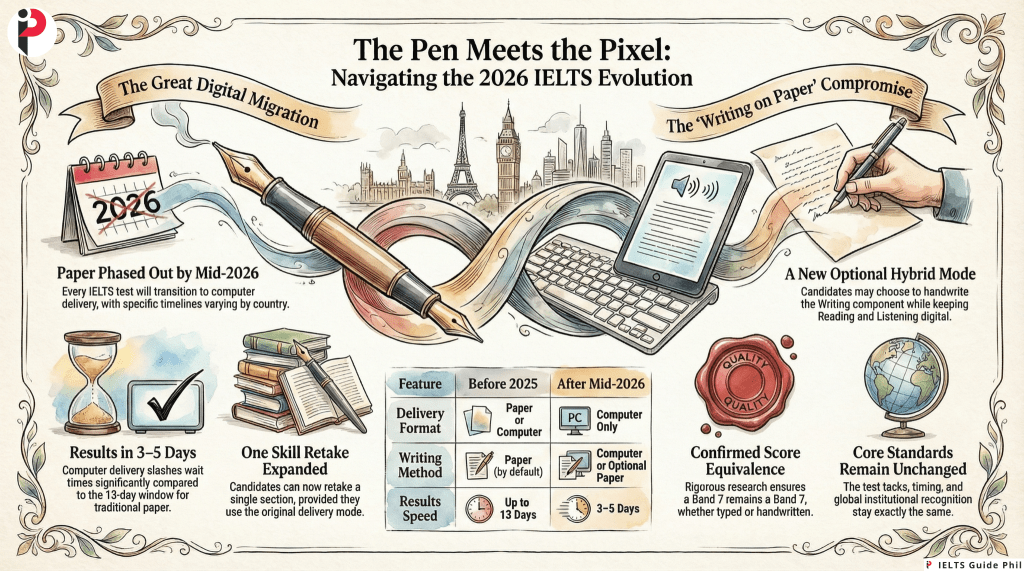
Starting mid-2026, IELTS will no longer be offered as a fully paper-based test. Every single IELTS test will be delivered on computer.
This isn’t a sudden decision — the IELTS partners (British Council, IDP, and Cambridge) reviewed test-taker satisfaction data and found that candidates who took the computer-delivered version reported higher satisfaction due to:
- Greater convenience
- Faster results
- Access to One Skill Retake (OSR)
Example: Imagine two candidates — Priya chose the computer test and got her results in 3–5 days. Marco chose paper and waited up to 13 days. From mid-2026, both will be on the same playing field.
Important caveat: Exact timelines will vary by market/country, so check with your local test centre for specifics.
2. Love Handwriting? Meet “Writing on Paper” — The New Hybrid Option
This is the headline feature for pen-and-paper loyalists. In selected markets, IELTS is introducing a new option called “Writing on Paper” within the computer-delivered test.
Here’s how it works:
- The Listening, Reading, and Speaking components remain on computer
- For the Writing component only, candidates can choose to handwrite their answers on paper
- It’s entirely optional — a personalisation feature, not a requirement
Example: Ahmed is a strong writer but prefers the feel of pen on paper. Under the new system, he can still sit his Listening and Reading on a computer screen but handwrite his Task 1 and Task 2 essays — the best of both worlds.
3. Your Score Is Not Affected — The Research Backs This Up
One of the most important reassurances: scores are comparable across formats.
Research conducted by the IELTS partners confirms:
- Scores are equivalent whether you write on screen or on paper
- This comparability holds overall AND within each score band
- Score reliability, validity, and standards alignment are all preserved
Example for IELTS Academic candidates: Whether you type your Task 2 essay or handwrite it, a Band 7 is a Band 7. Universities and immigration bodies will interpret your results exactly the same way.
This is critical for anyone worried that handwriting might be judged differently or disadvantage them — it won’t.
4. Nothing About the Test Itself Has Changed
Here is what has NOT changed:
| What Stays the Same | Details |
| Skills assessed | Listening, Reading, Writing, Speaking |
| Test construct | Same task types, timing, and structure |
| Score interpretation | Institutions read results identically |
| Global recognition | IELTS remains the world’s most trusted English test |
| Validity period | All existing paper results valid for the standard 2 years |
Example: If you’re applying to the University of Melbourne requiring Band 7 overall, your score report — regardless of how it was delivered — carries exactly the same weight as it always has.
5. One Skill Retake Gets a “Writing on Paper” Update — With One Catch
One Skill Retake (OSR) — the option to retake just one section of your test — is now available for Writing on Paper candidates.
However, there is a crucial rule:
You must retake in the same delivery mode as your original test.
This means:
- Chose Writing on Paper? Your OSR Writing must also be Writing on Paper
- Chose typing on computer? Your OSR must be on computer
Example: Lena sat her IELTS and used Writing on Paper for her essays. She scored Band 6.5 in Writing but needed 7. She can use OSR — but she must handwrite again, not switch to typing for the retake.
Why does this matter? It ensures score comparability and fairness — you can’t switch modes mid-assessment journey.
6. Access Arrangements Are Fully Protected
For test-takers who require accommodations, the existing Access Arrangement offer continues unchanged. This includes:
- Large print
- Braille
- Hearing impaired / lip reading support
- One Skill Retake for Access Arrangement candidates
No test-taker will be disadvantaged by the shift to computer delivery.
7. Already Have Paper-Based Results? You’re Fine.
If you’ve already taken the paper-based IELTS, breathe easy:
All existing paper-based results remain fully valid until the end of the standard two-year period.
Nothing about your current results changes. No re-sitting required because of a format change.
Quick-Reference Summary Table
| Feature | Before (2025) | After (Mid-2026) |
| Delivery format | Paper OR Computer | Computer only |
| Writing option | Paper by default | Computer (default) or ‘Writing on Paper’ |
| Results speed | Up to 13 days (paper) | 3–5 days (computer) |
| OSR availability | Computer only | Computer + Writing on Paper |
| Score equivalence | N/A | Confirmed by research |
| Existing results | Valid | Still valid (2-year period) |
What Should You Do Right Now?
- Check your local test centre for the exact date the paper test ends in your country
- Practice on computer — get used to typing essays if you’re not already (most candidates find they adapt quickly)
- Consider ‘Writing on Paper’ if you’re a slower typist or feel more confident handwriting — the scores are the same
- Don’t rush to sit paper-based just to avoid change — the computer test is backed by years of strong results data
- If you have Access Arrangements, confirm your accommodations are in place with your centre
Whether you’re a seasoned IELTS preparer or registering for the first time, the message is clear: the test is evolving in your favour — faster results, more flexibility, and the same gold-standard recognition worldwide.
#IELTS #IELTSPrep #IELTSOnComputer #IELTSWriting #EnglishTest #IELTSTips #StudyAbroad #IELTSUpdate2026 #OneSkillRetake #WritingOnPaper #IELTSBand7 #EnglishProficiency #IELTSAcademic #IELTSGeneral #TestTips #LanguageTesting #IELTSJourney #IELTSChange #IELTSCommunity #IELTSGuidePhil
 IELTS Guide Phil
Leave a comment