
Why your “good” isn’t good enough—and how to fix it without sounding like a walking thesaurus
Introduction: The Vocabulary Trap Filipino Test Takers Fall Into
You’ve studied hard. Your grammar is solid. You understand the questions. But when the IELTS examiner reviews your writing or listens to your speaking, you keep using the same words: “good,” “bad,” “thing,” “very.” Sound familiar?
This is the “pwede na” syndrome—settling for vocabulary that’s technically correct but academically weak. For Filipino IELTS takers aiming for Band 7 and above, this is the silent score killer.
The good news? You don’t need a PhD in English literature. You just need strategic vocabulary upgrades that sound natural, not forced.
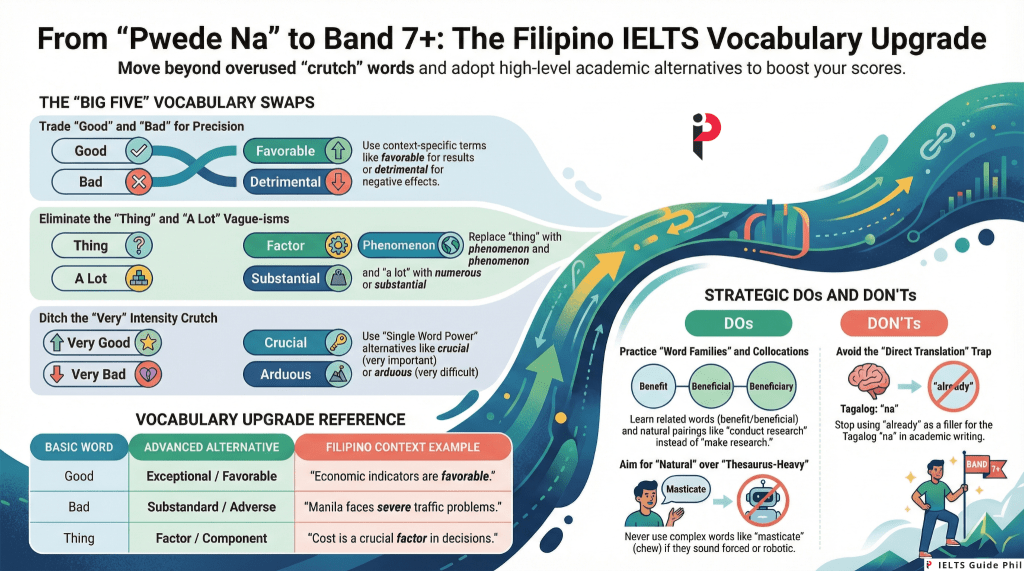
The Big Five: Basic Words Filipinos Overuse (And What To Use Instead)
1. GOOD → The Chameleon Word That Needs Retirement
Why Filipinos overuse it: In Tagalog, “maganda” and “mabuti” cover countless situations. We translate this habit directly into English.
The Problem: “Good” is vague and lacks sophistication in academic contexts.
Advanced Equivalents:
| Context | Instead of “Good” | Use This | Example |
|---|---|---|---|
| Quality | exceptional, superior, outstanding | The exceptional quality of the product impressed customers. | |
| Performance | commendable, impressive, remarkable | Her commendable performance earned her a promotion. | |
| Ideas | sound, valid, compelling | That’s a sound argument for renewable energy. | |
| Results | favorable, positive, encouraging | The study yielded favorable results. | |
| Behavior | admirable, exemplary, commendable | His exemplary conduct set a standard for others. | |
| Health | robust, excellent, optimal | She maintained robust health through regular exercise. |
Filipino Reality Check: Don’t say “The economy is very good.” Say “The economy is thriving” or “Economic indicators are favorable.”
2. BAD → The Lazy Criticism Word
Why Filipinos overuse it: We’re used to “masama” as our catch-all negative descriptor.
The Problem: “Bad” doesn’t explain how or why something is negative—crucial for IELTS band descriptors.
Advanced Equivalents:
| Context | Instead of “Bad” | Use This | Example |
|---|---|---|---|
| Quality | substandard, inferior, poor | The substandard infrastructure hampers development. | |
| Behavior | inappropriate, unacceptable, deplorable | His deplorable behavior violated company policy. | |
| Situations | adverse, unfavorable, detrimental | Adverse weather conditions delayed the flight. | |
| Effects | harmful, damaging, detrimental | Smoking has detrimental effects on health. | |
| Decisions | misguided, ill-advised, questionable | The ill-advised policy created more problems. | |
| Health | deteriorating, poor, declining | His deteriorating health required immediate attention. |
Filipino Reality Check: Don’t say “Traffic in Manila is very bad.” Say “Traffic congestion in Manila is severe” or “Manila faces crippling traffic problems.”
3. THING → The Vagueness Champion
Why Filipinos overuse it: “Bagay” is our go-to when we can’t quickly think of the specific word.
The Problem: “Thing” screams limited vocabulary and unclear thinking—exactly what IELTS penalizes.
Advanced Equivalents:
| What You Mean | Instead of “Thing” | Use This | Example |
|---|---|---|---|
| Abstract concepts | factor, aspect, element, component | Cost is a crucial factor in consumer decisions. | |
| Topics/Issues | matter, issue, subject, concern | Climate change is a pressing issue. | |
| Objects | item, object, device, tool | This device revolutionized communication. | |
| Situations | circumstance, situation, phenomenon | This phenomenon requires further study. | |
| Problems | challenge, obstacle, difficulty | The main challenge is funding. | |
| Features | characteristic, attribute, feature | Durability is a key attribute of this product. |
Filipino Reality Check: Don’t say “Many things affect education quality.” Say “Multiple factors influence education quality” or “Various elements determine educational outcomes.”
4. VERY → The Intensity Crutch
Why Filipinos overuse it: We love intensifiers! “Sobrang,” “talaga,” “super”—we bring this habit to English.
The Problem: Repeating “very” shows limited vocabulary range and weakens your writing impact.
Advanced Equivalents (Single-Word Power):
| Instead of… | Use This | Example |
|---|---|---|
| very good | excellent, superb, exceptional | The presentation was exceptional. |
| very bad | terrible, atrocious, abysmal | The service was atrocious. |
| very big | enormous, massive, substantial | The company faced substantial losses. |
| very small | tiny, minuscule, negligible | The difference is negligible. |
| very important | crucial, vital, essential, paramount | Education is paramount to development. |
| very interesting | fascinating, captivating, compelling | The documentary was compelling. |
| very beautiful | stunning, gorgeous, exquisite | The architecture is exquisite. |
| very difficult | challenging, arduous, demanding | The task proved arduous. |
| very easy | simple, straightforward, effortless | The process is straightforward. |
| very tired | exhausted, fatigued, drained | After the shift, she felt exhausted. |
| very happy | delighted, thrilled, elated | They were elated by the news. |
| very sad | devastated, heartbroken, despondent | The community was devastated. |
| very angry | furious, irate, livid | Customers were furious about the delay. |
| very smart | brilliant, intelligent, astute | She’s an astute businesswoman. |
| very hungry | starving, famished, ravenous | By noon, I was famished. |
Filipino Reality Check: Don’t say “Climate change is a very big problem.” Say “Climate change is an immense problem” or “Climate change poses a critical threat.”
5. A LOT OF → The Quantity Cop-Out
Why Filipinos overuse it: “Marami” directly translates, and it feels safe.
The Problem: It’s informal and imprecise—IELTS wants specificity and sophistication.
Advanced Equivalents:
| Instead of “A lot of” | Use This | Example |
|---|---|---|
| (countable nouns) | numerous, countless, many, several | Numerous studies support this conclusion. |
| (uncountable nouns) | substantial, considerable, significant | The project requires considerable investment. |
| (emphasis) | abundant, ample, extensive | There’s ample evidence of climate change. |
| (problems/issues) | widespread, prevalent, rampant | Corruption remains widespread. |
| (people) | a multitude of, a plethora of | A multitude of factors contributed to the crisis. |
Filipino Reality Check: Don’t say “A lot of Filipinos work abroad.” Say “Numerous Filipinos seek employment overseas” or “A substantial number of Filipinos work abroad.”
The DO’s and DON’Ts: Vocabulary Upgrade Strategy
✅ DO’s
1. DO learn word families, not just single words
- Know: benefit → beneficial, beneficiary, beneficially
- Know: analyze → analysis, analytical, analytically
2. DO use collocations (words that naturally go together)
- “make progress” not “do progress”
- “conduct research” not “make research”
- “raise awareness” not “lift awareness”
3. DO match formality to task
- Writing Task 1: technical, precise (substantial, considerable, fluctuated)
- Writing Task 2: academic, balanced (significant, noteworthy, arguably)
- Speaking: natural, varied (pretty good, quite impressive, rather challenging)
4. DO keep a “word upgrade list”
- Column 1: Basic word you overuse
- Column 2: 3-5 advanced alternatives
- Column 3: Your own example sentence
5. DO practice with Filipino contexts
- “Metro Manila experiences severe traffic congestion.”
- “The Philippines possesses abundant natural resources.”
- “Typhoons inflict considerable damage on infrastructure.”
❌ DON’Ts
1. DON’T use complex words you don’t fully understand
- Wrong: “The Philippines is very ostentatious.” (means showy/flashy—not what you meant!)
- Right: “The Philippines is very diverse.”
2. DON’T overuse thesaurus words awkwardly
- Awkward: “I masticate food every day.” (technically correct but weird)
- Natural: “I eat healthy meals daily.”
3. DON’T mix formal and informal in the same sentence
- Wrong: “The substantial traffic is super annoying.”
- Right: “Traffic congestion is considerably frustrating.”
4. DON’T replace EVERY basic word
- Over-the-top: “The exquisite edifice possessed remarkable portals.”
- Better: “The beautiful building had impressive doors.”
5. DON’T forget natural pronunciation
- Practice saying new words aloud—mispronunciation kills credibility in Speaking test
- Record yourself using new vocabulary in sentences
Common Filipino Mistakes and How to Fix Them
Mistake #1: Direct Tagalog Translation Syndrome
❌ Wrong: “The problem is very big already.”
- Why it’s wrong: “Already” here is a direct translation of “na” in Tagalog, unnecessary in this context
- ✅ Fix: “The problem has become significant” or “The problem is now substantial“
Mistake #2: Redundancy Overload
❌ Wrong: “In my opinion, I think that…”
- Why it’s wrong: “In my opinion” and “I think” mean the same thing
- ✅ Fix: “I believe that…” or “In my view,…” or “From my perspective,…”
Mistake #3: The “Very Much” Trap
❌ Wrong: “I am very much agree with this idea.”
- Why it’s wrong: Mixing “very much” with “agree” is grammatically incorrect
- ✅ Fix: “I strongly agree with this idea” or “I completely agree with this notion”
Mistake #4: Misusing “Get” for Everything
❌ Wrong: “Students can get knowledge from books.”
- Why it’s wrong: Too casual and imprecise for academic writing
- ✅ Fix: “Students can acquire knowledge from books” or “Students gain knowledge through reading”
Mistake #5: Overdoing the Upgrade
❌ Wrong: “The paramount individual masticated the exquisite sustenance.”
- Why it’s wrong: Sounds ridiculous and unnatural
- ✅ Fix: “The important person ate the delicious food” or better: “The dignitary enjoyed the excellent meal”
Mistake #6: Using “More Better” or “More Worse”
❌ Wrong: “This solution is more better than the previous one.”
- Why it’s wrong: “Better” already means “more good”—double comparative error
- ✅ Fix: “This solution is superior to the previous one” or “This solution is considerably better”
Mistake #7: Confusing Similar-Sounding Words
❌ Wrong: “The government should provide economic support.” (when you mean affordable/cheap)
- Why it’s wrong: “Economic” relates to the economy; you likely mean “economical” (cost-effective)
- ✅ Fix: “The government should provide affordable support” or “economical alternatives”
Context Matters: Choosing the Right Upgrade
For Describing Trends (Writing Task 1)
| Basic | Advanced | Example |
|---|---|---|
| went up | increased, rose, climbed, surged | Sales surged by 30% in Q4. |
| went down | decreased, declined, fell, plummeted | Unemployment declined gradually. |
| stayed the same | remained stable, plateaued, leveled off | Prices remained stable throughout the year. |
| changed | fluctuated, varied, oscillated | The rate fluctuated between 5% and 8%. |
For Expressing Opinions (Writing Task 2 & Speaking)
| Basic | Advanced | Example |
|---|---|---|
| I think | I believe, I contend, I maintain, In my view | I contend that education is the key solution. |
| shows | demonstrates, indicates, reveals, suggests | Research indicates a strong correlation. |
| because of | due to, owing to, as a result of | Due to technological advances, productivity improved. |
| but | however, nevertheless, nonetheless, conversely | However, this approach has limitations. |
For Filipino Social Issues (Common Topics)
Topic: Traffic
- ❌ Basic: “Manila has very bad traffic.”
- ✅ Advanced: “Manila experiences severe traffic congestion” or “Metro Manila suffers from chronic gridlock”
Topic: Education
- ❌ Basic: “Education quality is not good in some areas.”
- ✅ Advanced: “Educational standards are substandard in certain regions” or “Some areas face inadequate educational resources”
Topic: Employment
- ❌ Basic: “A lot of Filipinos work in other countries.”
- ✅ Advanced: “Numerous Filipinos seek overseas employment” or “The Philippines experiences substantial workforce migration”
Topic: Natural Disasters
- ❌ Basic: “Typhoons are very bad for the Philippines.”
- ✅ Advanced: “Typhoons inflict devastating damage on Philippine infrastructure” or “The Philippines faces severe typhoon-related challenges”
Practice Exercise: Upgrade These Filipino IELTS Responses
Exercise 1: Writing Task 2 Introduction
Before (Band 5-6): “Nowadays, a lot of people think that technology is very important in education. I think this is a good thing because students can learn a lot of things using computers. This essay will talk about this issue.”
After (Band 7+): “In contemporary society, numerous individuals believe technology plays a crucial role in education. I contend that this represents a positive development, as students can acquire diverse knowledge through digital platforms. This essay will examine this phenomenon in detail.”
Exercise 2: Speaking Part 2 Response
Before (Band 5-6): “My hometown is a very nice place with a lot of beautiful things. The people are very friendly and the food is very good. There are many good places to visit.”
After (Band 7+): “My hometown is a charming locale with abundant natural attractions. The residents are notably hospitable, and the cuisine is exceptional. There are numerous fascinating sites worth exploring.”
Frequently Asked Questions (Filipino Context)
Q1: “Won’t I sound ‘trying hard’ if I use these big words?”
A: Not if you use them correctly and naturally! The key is:
- Use advanced vocabulary where it fits naturally
- Don’t force complicated words into simple sentences
- Practice until it feels natural
- Mix levels: combine some advanced words with clear, simple ones
Example: “The substantial number of students means we need more classrooms” sounds better than “The big number of students means we need more classrooms”—but saying “I masticate my breakfast” instead of “I eat breakfast” sounds ridiculous.
Q2: “How many advanced words should I use per essay?”
A: Quality over quantity! For Writing Task 2 (250+ words):
- Aim for 15-20 instances of upgraded vocabulary
- Spread them naturally throughout your essay
- Don’t cluster them all in one paragraph
- Focus on high-impact words (academic verbs, precise adjectives, topic-specific vocabulary)
Q3: “What if I forget these words during the actual test?”
A: Build muscle memory:
- Create flashcards with Filipino examples: “Heavy Manila traffic = severe congestion”
- Use new words in daily conversation: “The movie was compelling” instead of “very interesting”
- Write practice essays weekly using your upgraded words
- Review your word list the night before (but not the morning of—avoid panic cramming!)
Q4: “Are there any words Filipinos commonly misuse that I should avoid?”
A: Yes! Watch out for these:
LIVID ≠ very lively
- Wrong: “The party was very livid!”
- Right: Livid means extremely angry (“He was livid about the delay”)
PERUSE ≠ browse casually
- Wrong: “I’ll just peruse the menu quickly”
- Right: Peruse means to read thoroughly (“She perused the contract carefully”)
BEMUSED ≠ amused
- Wrong: “I was bemused by the comedy show”
- Right: Bemused means confused (“He looked bemused by the instructions”)
NONPLUSSED ≠ unbothered
- Wrong: “She was nonplussed about the news”
- Right: Nonplussed means surprised and confused
Q5: “Can I use these words in Speaking, or only Writing?”
A: Absolutely use them in Speaking—but naturally!
Speaking tips:
- In Speaking Part 1 (casual): Mix basic and intermediate (“The traffic is pretty bad” or “quite terrible“)
- In Speaking Part 2 (personal story): Use some advanced words but keep it conversational (“It was a memorable experience”)
- In Speaking Part 3 (discussion): This is where you shine with academic vocabulary (“This raises significant concerns”)
Don’t sound like a robot: It’s okay to say “really good” sometimes. Just also sprinkle in “excellent,” “remarkable,” and “outstanding.”
Q6: “What if the examiner doesn’t understand my advanced word?”
A: If you’re using standard academic English (not obscure jargon), the examiner WILL know these words. They’re trained professionals.
However:
- Pronounce clearly
- Use words correctly in context
- Don’t make up words (common Filipino habit: “traffical” isn’t a word; use “traffic-related”)
Q7: “How long will it take to naturally use these words?”
A: Realistic timeline:
- Week 1-2: Feels forced, need to consciously recall
- Week 3-4: Starting to come naturally in writing
- Week 5-8: Comfortable using in speaking practice
- Week 8-12: Words feel natural and automatic
Filipino shortcut: Practice with Philippine contexts daily—it sticks faster when you connect words to familiar situations.
Q8: “Should I learn British or American vocabulary?”
A: IELTS accepts both, but be consistent.
Key differences:
- British: “whilst,” “amongst,” “favour”
- American: “while,” “among,” “favor”
Filipino advantage: We’re exposed to both! Just pick one style per essay and stick with it. Most Filipinos find American spelling easier since it’s what we use in Philippine schools.
Q9: “What about vocabulary for specific IELTS topics?”
A: Build topic clusters. Common IELTS topics for Filipinos:
Environment:
- Basic: save, protect, damage
- Advanced: conserve, preserve, sustainable, deterioration, degradation, ecological
Technology:
- Basic: new, modern, helpful
- Advanced: innovative, cutting-edge, beneficial, revolutionary, contemporary
Education:
- Basic: learn, teach, study
- Advanced: acquire, impart, pedagogical, curriculum, literacy
Health:
- Basic: sick, healthy, doctor
- Advanced: ailment, robust health, physician, medical practitioner, well-being
Q10: “What if my vocabulary is good but I still get Band 6?”
A: Vocabulary is just one criterion! Check:
- Grammar Range & Accuracy: Are you making tense errors? (“I am living here since 2010” ❌ → “I have been living here since 2010” ✅)
- Coherence & Cohesion: Are you using linking words correctly?
- Task Response: Are you fully answering the question?
Filipino-specific issue: We often have good vocabulary but lose points on grammar (article errors, prepositions, subject-verb agreement). Balance your preparation!
Your 30-Day Vocabulary Upgrade Challenge
Week 1: Foundation
- Choose 10 basic words you overuse
- Find 3 alternatives for each
- Write 1 sentence for each alternative using Philippine examples
Week 2: Application
- Rewrite 5 old practice essays replacing basic words
- Record yourself speaking about Filipino topics using new vocabulary
- Review and correct pronunciation
Week 3: Integration
- Write 3 new practice essays focusing on natural vocabulary use
- Do speaking practice on 5 IELTS topics
- Keep a “mistake journal” of words you misuse
Week 4: Mastery
- Do 2 full practice tests under timed conditions
- Review all upgraded vocabulary
- Focus on your weakest areas
Final Thoughts: From “Pwede Na” to Band 7+
Remember, Filipino IELTS takers have unique strengths: we’re naturally expressive, we understand nuance (thanks to Tagalog’s complexity), and we’re motivated. The vocabulary gap isn’t about intelligence—it’s about exposure and practice.
Stop settling for “pwede na.” Your target band score isn’t about cramming big words; it’s about expressing your already-strong ideas with precision and sophistication.
Your vocabulary upgrade isn’t about sounding British or American—it’s about sounding educated, clear, and confident.
Start today. Replace one “very good” with “excellent.” Turn one “a lot of” into “numerous.” Change one “thing” into a specific noun.
Small upgrades, consistent practice, Band 7+ results.
Kaya mo ‘yan! You’ve got this! 🇵🇭
Quick Reference Chart: Print and Practice
| AVOID | USE INSTEAD | EXAMPLE |
|---|---|---|
| good | excellent, beneficial, favorable, positive | This approach yields favorable results. |
| bad | detrimental, adverse, poor, substandard | The policy had detrimental effects. |
| thing | factor, aspect, element, issue, matter | Cost is a crucial factor. |
| very + adjective | Use a stronger single word | fascinating, enormous, crucial, terrible |
| a lot of | numerous, substantial, considerable, significant | Numerous studies confirm this. |
| big | substantial, significant, considerable, major | A substantial investment is required. |
| small | minor, minimal, negligible, slight | The impact was negligible. |
| get | obtain, acquire, receive, gain, achieve | Students acquire skills through practice. |
| show | demonstrate, illustrate, reveal, indicate | Data reveals an interesting trend. |
| help | assist, facilitate, contribute to, support | Technology facilitates learning. |
Ready to upgrade your IELTS vocabulary? Save this guide, practice daily, and watch your band score climb!
#IELTSGuidePhil #IELTSPhilippines #IELTSVocabulary #IELTSPreparation #IELTS2025 #StudyInUK #StudyAbroad #FilipinoProfessionals #IELTSWriting #IELTSSpeaking #IELTSTips #Band7 #Band8 #EnglishVocabulary #IELTSExam #OFW #PinoyAbroad #IELTSReview #AcademicEnglish #EnglishLearning #IELTSGoals #VocabularyUpgrade #IELTSSuccess #PinoyIELTS #LearnEnglish #TestPrep #IELTSCoaching #EnglishFluency #IELTSStudy #FilipinoDreams #GlobalPinoy
About This Guide: Created specifically for Filipino IELTS test takers who want to break through the Band 6-7 barrier by upgrading their vocabulary strategically and naturally.
Share this with your fellow IELTS warriors! Let’s help each other achieve those dream band scores. 💪📚✨
 IELTS Guide Phil
Leave a comment