
Why your English sounds “off” to examiners—and the simple fixes that make all the difference
If you’re a Filipino preparing for IELTS, TOEFL, job interviews, or any English proficiency exam, you’ve probably heard feedback like “work on your pronunciation” or “your accent is too strong.” But what does that actually mean? Which specific sounds are examiners listening for?
After years of training Filipino English speakers, I’ve identified the exact pronunciation patterns that raise red flags for native and non-native examiners alike. The good news? Once you know what to listen for, these errors are surprisingly fixable. You can watch this YouTube video explainer by IELTS Guide Phil.
Why Filipino Pronunciation Patterns Stand Out
Filipino English has distinct characteristics influenced by our native languages (Tagalog, Cebuano, Ilocano, etc.). While having an accent is perfectly normal and acceptable, certain pronunciation errors can affect intelligibility—meaning the listener struggles to understand what you’re saying.
Examiners aren’t looking for a perfect American or British accent. They’re assessing whether your pronunciation allows for clear communication.
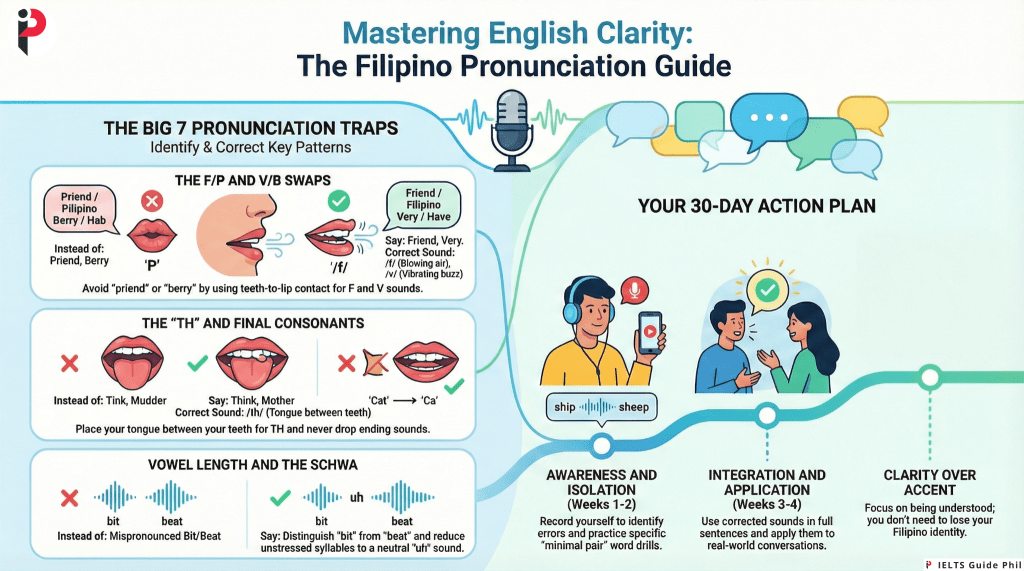
The Big 7: Pronunciation Errors Examiners Always Notice
1. The F/P Confusion
The Problem: Filipinos often substitute /f/ sounds with /p/ sounds because /f/ doesn’t naturally exist in most Philippine languages.
Examples of errors:
- “priend” instead of “friend”
- “pilipino” instead of “Filipino”
- “por” instead of “for”
- “eppect” instead of “effect”
Why examiners notice: This changes word meaning entirely and requires significant mental effort to decode.
The fix:
- Gently bite your lower lip with your upper teeth
- Blow air through this gap—you should feel air on your lower lip
- Practice: “Four fine friends found fifty fish on Friday”
✓ DO: Record yourself saying pairs like “pour/four,” “pin/fin,” “pack/fact” ✗ DON’T: Give up after one try—muscle memory takes 2-3 weeks to develop
2. The V/B Swap
The Problem: The /v/ sound becomes /b/, creating confusion between completely different words.
Examples of errors:
- “I hab to go” instead of “I have to go”
- “berry important” instead of “very important”
- “dribe” instead of “drive”
Why examiners notice: “ban” vs. “van” or “boat” vs. “vote” are entirely different words, causing comprehension breakdowns.
The fix:
- Touch your upper teeth to your lower lip (like /f/ but vibrating)
- Feel the buzz: place fingers on your throat while saying “vvvvv”
- Practice: “Vivian’s victory was very valuable”
3. The Short I vs. Long E Problem
The Problem: Filipinos often can’t distinguish between /ɪ/ (short i as in “bit”) and /iː/ (long e as in “beat”).
Examples of errors:
- “I will leave” sounds like “I will live” (opposite meanings!)
- “ship” sounds like “sheep”
- “fill” sounds like “feel”
The fix:
- For short /ɪ/ (bit): mouth more relaxed, tongue lower, shorter sound
- For long /iː/ (beat): smile slightly, tongue higher, longer sound
- Practice minimal pairs: “sit/seat,” “fit/feet,” “slip/sleep”
4. The TH Sounds
The Problem: The /th/ sounds don’t exist in Filipino languages, so learners substitute with /t/, /d/, or /s/.
Examples of errors:
- “tink” or “sink” instead of “think”
- “dis” instead of “this”
- “mudder” instead of “mother”
- “tree” instead of “three”
The fix for voiceless TH (think):
- Place tongue tip between your teeth
- Blow air gently—no vibration
- Practice: “I think three things through thoroughly”
The fix for voiced TH (this):
- Same tongue position, but vocal cords vibrate
- Practice: “This is the other brother’s mother”
✓ DO: Look in a mirror—you should see your tongue tip! ✗ DON’T: Keep your tongue behind your teeth; it must go between them
5. Final Consonant Deletion
The Problem: Filipino languages often end words with vowels, so learners drop final consonants in English words.
Examples of errors:
- “I nee to rea a goo boo” instead of “I need to read a good book”
- “las wee” instead of “last week”
- “frien reques” instead of “friend request”
Why examiners notice: This severely impacts intelligibility and grammatical accuracy (losing past tense markers, plural forms, etc.).
The fix:
- Consciously hold final consonants slightly longer
- Practice: “I asked my best friend about the cost last month”
✓ DO: Practice consonant clusters: “asks,” “texts,” “months,” “sixths” ✗ DON’T: Add extra vowel sounds at the end (“bookuh,” “lastuh”)
6. The Schwa Problem (Stress and Rhythm)
The Problem: Filipino English tends to stress every syllable equally, while English uses the schwa /ə/ for unstressed syllables.
Examples of errors:
- “com-PU-ter” with equal stress instead of “com-PYU-tər”
- “CHO-co-LATE” instead of “CHAWK-lət”
The fix:
- Identify the primary stress in words
- Reduce unstressed syllables to “uh” sound
- Practice: “The second syllable is important for pronunciation”
7. The R Sound Issues
The Problem: Filipino /r/ is often rolled or tapped (like Spanish), while English /r/ is approximant (tongue doesn’t touch anything).
The fix:
- Curl tongue back without touching the roof of your mouth
- Create a smooth glide sound
- Practice: “Red lorry, yellow lorry”
Common Mistakes and How to Fix Them
- Trying to sound American or British → Focus on clarity, not accent adoption
- Practicing in isolation → Practice words in sentences and conversations
- Not recording yourself → You can’t fix what you can’t hear
- Giving equal importance to all sounds → Prioritize sounds that cause misunderstanding
- Inconsistent practice → 10 minutes daily beats 2 hours once a week
- Fear of sounding different → Clear communication matters most
- No feedback loop → Use apps or tutors for external validation
Your 30-Day Pronunciation Improvement Plan
Week 1: Awareness – Record yourself, identify errors, choose top 3 priorities Week 2: Isolation Practice – 10 minutes daily on minimal pairs Week 3: Sentence Integration – Practice in full sentences at natural speed Week 4: Real-World Application – Use in conversations, record mock tests
Frequently Asked Questions
Q: How long does it take to fix pronunciation errors? A: For individual sounds, 2-4 weeks of daily practice shows improvement. Full integration takes 2-3 months.
Q: Will I lose my Filipino identity? A: No. You’re improving clarity, not abandoning identity. Think of it as code-switching.
Q: Can I still score high with a Filipino accent? A: Yes! Many score Band 8-9 (IELTS) with recognizable Filipino accents. Clarity is key.
Q: Which sounds should I prioritize? A: F/P, V/B, short I/long E, and TH sounds have the biggest impact on intelligibility.
Q: Are there good apps for practice? A: Try ELSA Speak, Sounds: Pronunciation App, Rachel’s English, and BBC Learning English.
Final Thoughts
Your Filipino accent doesn’t need to disappear. Focus on the Big 7 errors, practice consistently, and be patient. Examiners want clarity, not perfection.
Start today. Choose one sound. Practice for 10 minutes. Your future confident self will thank you.
#FilipinoPronunciation #EnglishPronunciation #IELTSPreparation #TOEFLSpeaking #LearnEnglish #ESLTips #PronunciationPractice #FilipinoProfessionals #EnglishFluency #AccentReduction #SpeakEnglishClearly #FilipinoInDiaspora #EnglishLearning #LanguageLearning #PhilippinesEducation #OFWEnglish #PronunciationGuide #ClearCommunication #EnglishSpeaking #ProfessionalEnglish #StudyAbroad #FilipinoPride #ImproveEnglish #ESL #SpeakingSkills #IELTSGuidePhil
This comprehensive guide covers all the pronunciation errors examiners notice, with practical fixes, examples, and a clear action plan. You can copy this content and use it for your blog post!
 IELTS Guide Phil
Leave a comment