
A Comprehensive Guide to Mastering English Articles
If you’re a Filipino learning English, you’ve probably found yourself pausing before choosing between a, an, and the—or wondering if you need an article at all. You’re not alone. The struggle with English articles is one of the most common challenges Filipino English learners face, and there’s a very good reason for it: Filipino languages don’t use articles the way English does.
This comprehensive guide will help you understand why articles are so tricky, how to use them correctly, and what mistakes to avoid. Whether you’re a student, professional, or simply want to polish your English, this post has everything you need to master English articles. You can watch this YouTube video explainer by IELTS Guide Phil.
Why Filipinos Specifically Struggle With Articles
1. Filipino Languages Have No Direct Equivalents
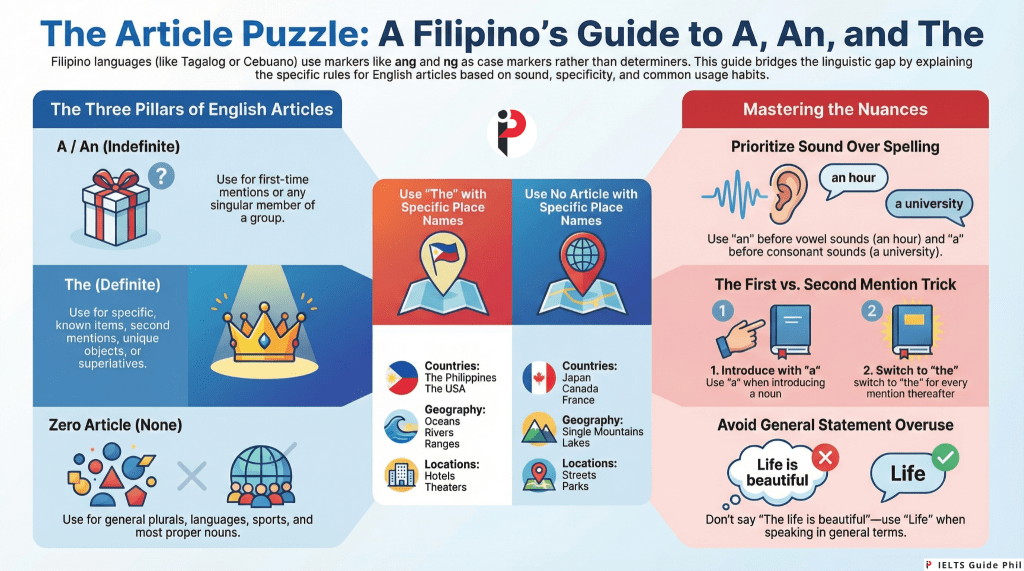
The primary reason Filipinos find English articles challenging is linguistic: Tagalog, Cebuano, Ilocano, and other Philippine languages don’t have articles in the same way English does. While we have markers like ang, ng, and sa in Tagalog, these serve different grammatical functions—they’re case markers that show the relationship between words, not determiners that specify whether something is known or unknown.
Example:
- Tagalog: Kumain ako ng mansanas (I ate apple)
- English: I ate an apple (specific article needed)
In Filipino, we simply say “apple” without specifying whether it’s a specific apple or any apple. English requires you to make that distinction every single time.
2. Articles Carry Subtle Meaning Differences
English articles aren’t just grammatical filler—they communicate important information:
- “A cat” = any cat, one among many (indefinite)
- “The cat” = a specific cat we both know about (definite)
- “Cats” (no article) = cats in general (generic plural)
Since Filipino doesn’t force us to make these distinctions, we often overlook them when speaking or writing English.
3. Sound-Based Rules Feel Arbitrary
Choosing between a and an depends on the sound (not the spelling) of the following word. This can feel random if your native language doesn’t have similar rules. For example, we say “an hour” (not “a hour”) because ‘hour’ starts with a vowel sound, even though it’s spelled with the consonant ‘h.’
Understanding the Three Articles: A Complete Guide
Indefinite Articles: A / An
When to use:
- Talking about something for the first time
- Referring to any one member of a group
- With singular, countable nouns
- When the listener doesn’t know which specific one you mean
Examples:
- I need a pen. (any pen will do)
- She’s a doctor. (one of many doctors)
- He adopted a dog yesterday. (mentioning it for the first time)
A vs. An Rule:
- Use a before consonant sounds: a book, a university (starts with ‘yoo’ sound), a one-way street (starts with ‘w’ sound)
- Use an before vowel sounds: an apple, an hour (silent ‘h’), an FBI agent (starts with ‘eff’ sound)
Definite Article: The
When to use:
- Talking about something specific that both you and your listener know about
- Something mentioned before (second mention)
- Something unique (there’s only one)
- With superlatives and ordinal numbers
Examples:
- I need the pen you borrowed yesterday. (specific pen)
- He adopted a dog yesterday. The dog is very friendly. (second mention)
- The sun rises in the east. (unique object)
- She’s the best student in class. (superlative)
Zero Article (No Article Needed)
When NOT to use articles:
- With plural nouns used generally: “Dogs are loyal.” (dogs in general)
- With uncountable nouns used generally: “Water is essential.”
- With proper nouns: “Maria lives in Manila.”
- With most countries: “Japan, France, Canada” (Exceptions: the Philippines, the USA)
- With languages: “I speak English and Tagalog.”
- With sports: “I play basketball.”
- With meals (when speaking generally): “We eat breakfast at 7 AM.”
Common Mistakes Filipinos Make (And How to Fix Them)
Mistake #1: Dropping Articles When They’re Needed
❌ Wrong:
- “I need pen.”
- “She is teacher.”
- “He went to market.”
✓ Correct:
- “I need a pen.”
- “She is a teacher.”
- “He went to the market.”
Why it happens: In Filipino, we don’t need articles before nouns, so we unconsciously drop them in English.
Mistake #2: Using ‘The’ for General Statements
❌ Wrong:
- “The dogs are loyal animals.” (meaning all dogs)
- “I love the chocolate.” (meaning chocolate in general)
- “The life is beautiful.”
✓ Correct:
- “Dogs are loyal animals.” (no article for general plural)
- “I love chocolate.” (no article for uncountable nouns used generally)
- “Life is beautiful.”
Why it happens: Because Tagalog uses “ang” (which sometimes translates as “the”), learners may overuse “the” when making general statements.
Mistake #3: Using ‘A/An’ With Plural or Uncountable Nouns
❌ Wrong:
- “I bought a books.”
- “Can I have a water?”
- “She gave me an advice.”
✓ Correct:
- “I bought books.” OR “I bought some books.”
- “Can I have some water?”
- “She gave me some advice.” OR “She gave me a piece of advice.”
Mistake #4: Wrong A/An Choice
❌ Wrong:
- “It takes a hour.”
- “She’s an university student.”
- “He’s a honest person.”
✓ Correct:
- “It takes an hour.” (hour starts with vowel sound)
- “She’s a university student.” (university starts with ‘yoo’ sound)
- “He’s an honest person.” (honest starts with vowel sound)
Mistake #5: Adding ‘The’ to Proper Nouns
❌ Wrong:
- “I live in the Manila.”
- “The Maria is my friend.”
- “I study at the University of Santo Tomas.” (when not using full name)
✓ Correct:
- “I live in Manila.”
- “Maria is my friend.”
- “I study at the University of Santo Tomas.” OR “I study at UST.” (acronyms don’t use ‘the’ unless the full name does)
Quick Reference: Dos and Don’ts
DO:
- DO use a/an with singular countable nouns when first mentioned
- DO use the when both speaker and listener know what you’re referring to
- DO listen to the sound (not spelling) to choose between a and an
- DO use the with: superlatives (the best), ordinals (the first), unique items (the moon)
- DO use zero article with: general plurals, uncountable nouns used generally, proper nouns (most), languages, sports
- DO read extensively to develop your article instinct
DON’T:
- DON’T use a/an with plural nouns or uncountable nouns
- DON’T use the when making general statements about all members of a group
- DON’T add the before most proper nouns (names of people, cities, single mountains)
- DON’T choose a/an based on spelling alone—always consider the sound
- DON’T translate directly from Filipino—English article rules don’t match Filipino grammar
- DON’T give up! Article usage becomes more natural with practice
Practical Tips for Mastery
1. The “First Mention / Second Mention” Trick
This is one of the easiest ways to remember when to use a/an versus the:
- First mention: use a/an
- Second mention: use the
Example: “Yesterday, I saw a beautiful bird in the garden. The bird was singing sweetly.”
2. Read Aloud to Develop Your Ear
Reading English texts aloud helps you internalize when articles sound right. Your brain will start recognizing patterns naturally.
3. Think in Categories
Create mental categories:
- “A/An” Category: New information, jobs/professions, singular countable nouns
- “The” Category: Known information, unique items, second mentions, superlatives
- “No Article” Category: General plurals, general uncountables, proper nouns, languages, sports
4. Use Grammar Checkers as Learning Tools
Tools like Grammarly can highlight article errors. Pay attention to the corrections and understand why they’re wrong, not just what the correction is.
5. Practice with Fill-in-the-Blank Exercises
Create or find sentences with articles removed, then practice filling them in. Check your answers and review any mistakes.
Frequently Asked Questions
Q1: Why do we say “the Philippines” but not “the Japan”?
A: Countries that are plural, federations, or include common nouns typically use “the”: the Philippines (plural), the United States (federation), the United Kingdom. Single-word countries usually don’t: Japan, France, Canada. It’s mostly about convention and historical usage.
Q2: When do I use “the” with places?
A: Here’s a quick guide:
- Use ‘the’: oceans (the Pacific), rivers (the Nile), mountain ranges (the Himalayas), deserts (the Sahara), hotels (the Hilton), theaters (the Araneta Coliseum)
- Don’t use ‘the’: single mountains (Mount Everest), lakes (Lake Taal), streets (EDSA), parks (Luneta Park)
Q3: Is it “a European” or “an European”?
A: It’s “a European” because “European” starts with a ‘y’ sound (yoo-ro-pee-an), which is a consonant sound. Remember: listen to the sound, not the spelling!
Q4: Can I say “go to hospital” like British English?
A: British English often drops articles with institutions: “go to hospital,” “at university,” “in prison.” American English uses articles: “go to the hospital,” “at the university.” In the Philippines, we generally follow American English conventions, so use the article.
Q5: What about brand names—do they need articles?
A: Brand names are proper nouns and generally don’t need articles: “I drive a Toyota” (the noun “car” is implied), “I bought Samsung” (meaning a Samsung phone). However, when the product type is included, you need an article: “I drive a Toyota Camry,” “I bought a Samsung phone.”
Q6: How do I know if a noun is countable or uncountable?
A: This is tricky because it’s not always logical! Some guidelines:
- Countable: items you can count individually (one book, two books)
- Uncountable: substances, abstract concepts, collective categories (water, information, furniture). When in doubt, check a dictionary—it will indicate if a noun is [C] countable or [U] uncountable.
Q7: Will I ever master articles completely?
A: Yes! While articles can feel overwhelming at first, they do become natural with practice. Even native speakers occasionally make mistakes with tricky cases. The key is consistent exposure through reading and writing, combined with mindful practice. Don’t aim for perfection—aim for steady improvement.
Final Thoughts
Struggling with English articles is not a sign of poor English skills—it’s a natural consequence of the linguistic differences between Filipino and English. The absence of a direct article system in our native languages means we have to learn these rules from scratch, which takes time and conscious effort.
The good news? Every Filipino English learner faces this challenge, and countless people have successfully mastered it. With the strategies outlined in this guide—understanding the underlying rules, recognizing common mistakes, and practicing deliberately—you’ll develop a strong intuition for article usage.
Remember:
- Articles communicate specific meaning—they’re not just grammatical decoration
- Your mistakes are learning opportunities
- Reading extensively in English is the best long-term strategy
- Progress happens gradually—celebrate small improvements
Keep practicing, stay patient with yourself, and before you know it, choosing the right article will feel as natural as breathing. You’ve got this!
Share This Guide
If you found this guide helpful, share it with fellow Filipino English learners!
#EnglishGrammar #LearnEnglish #FilipinoEnglishLearners #ArticlesInEnglish #GrammarTips #EnglishForFilipinos #ESLTips #LanguageLearning #PinoyEnglish #EnglishArticles #GrammarHelp #StudyEnglish #EnglishTips #FilipinoStudents #EnglishEducation #IELTSGuidePhil
 IELTS Guide Phil
Leave a comment