
A Comprehensive Guide to Avoiding Common Filipino English Patterns in Academic Writing
Introduction
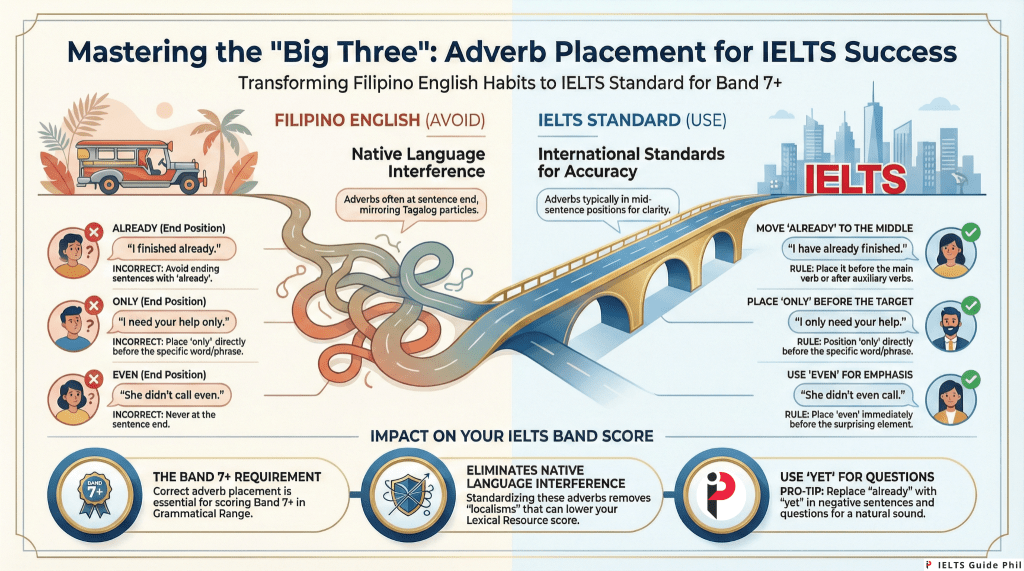
If you’re a Filipino preparing for the IELTS exam, you’ve likely encountered feedback about your use of certain adverbs—particularly already, only, and even. These seemingly simple words are used differently in Filipino English compared to international academic standards, and understanding these differences can significantly boost your IELTS Writing and Speaking scores.
This comprehensive guide will help you identify common mistakes, understand the proper usage, and master these adverbs for IELTS success. Whether you’re aiming for Band 7 or higher, getting these details right demonstrates grammatical accuracy and linguistic sophistication. You can watch this YouTube video explainer by IELTS Guide Phil.
Understanding the Filipino English Influence
Filipino English has been shaped by Tagalog grammar patterns and local usage conventions. The words already (influenced by na), only (influenced by lang), and even (influenced by kahit) are often placed differently than in standard international English.
While Filipino English is perfectly valid in local contexts, IELTS examiners assess your writing and speaking against international standards used in British, American, Australian, and Canadian English. Mastering these distinctions is crucial for achieving high band scores.
1. ‘ALREADY’ – The Premature Marker
Filipino English Pattern
In Filipino English, already is frequently used as an emphatic marker or to indicate completion, mirroring the Tagalog particle na. It often appears at the end of sentences or in positions that sound unnatural to international English speakers.
Common Filipino English Uses:
- “I finished already.”
- “We ate already.”
- “She knows already.”
- “Go already!”
- “It’s late already.”
IELTS Standard Usage
In standard English, already indicates that something happened earlier than expected or before now. It typically appears in mid-position (between the subject and main verb, or after auxiliary verbs) in affirmative sentences.
Correct IELTS Usage:
- “I have already finished.” or “I’ve finished.”
- “We have already eaten.” or “We’ve eaten.”
- “She already knows.”
- “It’s already late.”
Comparison Table
| Filipino English ✗ | IELTS Standard ✓ |
| I finished already. | I have already finished. / I’ve finished. |
| Did you eat already? | Have you already eaten? / Have you eaten yet? |
| Go already! | Go now! / Just go! / Go ahead! |
2. ‘ONLY’ – The Misplaced Modifier
Filipino English Pattern
Influenced by the Tagalog word lang, Filipino English speakers often place only at the end of sentences or in emphatic positions, regardless of what element they intend to modify.
Common Filipino English Uses:
- “I need your help only.”
- “She wants to go only.”
- “I’m asking only.”
- “One piece only.”
IELTS Standard Usage
In standard English, only should be placed directly before the word or phrase it modifies. Its position significantly affects the meaning of the sentence.
Correct IELTS Usage:
- “I only need your help.” (emphasizes ‘need’ — nothing more than needing)
- “I need only your help.” (emphasizes ‘your help’ — no one else’s)
- “She only wants to go.” (she doesn’t want to do anything else)
- “I’m only asking.” (just asking, nothing more)
- “Only one piece.” (emphasizes quantity)
Position Matters: How Placement Changes Meaning
| Sentence | Meaning |
| Only I called her yesterday. | No one else called her, just me. |
| I only called her yesterday. | I didn’t do anything else, just called. |
| I called only her yesterday. | I didn’t call anyone else. |
| I called her only yesterday. | I called her as recently as yesterday. |
3. ‘EVEN’ – The Emphasizer
Filipino English Pattern
The Tagalog word kahit influences how Filipino speakers use even. It’s often placed at the end of sentences or used with different connotations than in standard English.
Common Filipino English Uses:
- “She didn’t call even.”
- “You can come even.”
- “I tried even.”
IELTS Standard Usage
In standard English, even is used to emphasize something surprising or extreme. It must be placed directly before the word or phrase being emphasized.
Correct IELTS Usage:
- “She didn’t even call.”
- “Even you can come.” (surprising that you’re invited)
- “I even tried.” (emphasizing the effort)
- “Even the experts were surprised.”
Comparison Table
| Filipino English ✗ | IELTS Standard ✓ |
| He didn’t respond even. | He didn’t even respond. |
| Small children can understand even. | Even small children can understand. |
| I tried even but failed. | I even tried but failed. |
Quick Reference: DO’s and DON’Ts
DO’s ✓
- DO place ‘already’ before the main verb or after auxiliary verbs: “I have already finished.”
- DO position ‘only’ directly before what you’re limiting: “I need only five minutes.”
- DO place ‘even’ before the surprising element: “Even experts struggle with this.”
- DO use ‘yet’ in questions and negatives instead of ‘already’: “Haven’t you finished yet?”
- DO consider the emphasis when placing ‘only’: position changes meaning significantly.
- DO read your sentences aloud to check if adverb placement sounds natural.
DON’Ts ✗
- DON’T place ‘already’ at the end of sentences: ✗ “I finished already.”
- DON’T use ‘already’ as an emphatic marker like ‘na’: ✗ “Go already!”
- DON’T put ‘only’ at the end of sentences: ✗ “I need your help only.”
- DON’T place ‘even’ at the end: ✗ “She didn’t call even.”
- DON’T translate directly from Tagalog particle positions (na, lang, kahit).
- DON’T assume Filipino English patterns will work in IELTS—they often won’t.
Common Mistakes and How to Fix Them
Mistake #1: End-position ‘Already’
❌ Wrong: “The meeting finished already.”
✅ Correct: “The meeting has already finished.” or “The meeting’s finished.”
Why it matters: End-position ‘already’ immediately signals non-native usage and can cost you points in Grammatical Range and Accuracy.
Mistake #2: Floating ‘Only’
❌ Wrong: “I want to ask you a question only.”
✅ Correct: “I only want to ask you a question.” or “I want to ask you only one question.”
Why it matters: Misplaced ‘only’ creates ambiguity and demonstrates poor understanding of English word order conventions.
Mistake #3: Trailing ‘Even’
❌ Wrong: “The professor didn’t know the answer even.”
✅ Correct: “Even the professor didn’t know the answer.” or “The professor didn’t even know the answer.”
Why it matters: Incorrect ‘even’ placement weakens the emphasis and sounds unnatural to native speakers.
Mistake #4: Confusing ‘Already’ with ‘Yet’
❌ Wrong: “Did you submit your assignment already?”
✅ Correct: “Have you already submitted your assignment?” or “Have you submitted your assignment yet?”
Why it matters: In questions, ‘yet’ is generally preferred. Using ‘already’ in questions implies surprise that something happened so soon.
Mistake #5: Multiple Emphatic Adverbs
❌ Wrong: “I already finished it only yesterday even.”
✅ Correct: “I only finished it yesterday.” or “I just finished it yesterday.”
Why it matters: Overusing emphatic adverbs creates cluttered, unclear sentences that reduce your coherence score.
Practice Exercise: Correct These Sentences
Identify and correct the errors in these sentences. Answers are provided below.
- I submitted the report already.
- She wants to borrow the book only.
- My parents didn’t approve even.
- Did you finish already your homework?
- I need five minutes only.
- The children can understand even the complex topic.
- We discussed this already last week.
- He studied for two hours only.
Answer Key
- I have already submitted the report. / I’ve submitted the report.
- She only wants to borrow the book. / She wants to borrow only the book.
- Even my parents didn’t approve. / My parents didn’t even approve.
- Have you already finished your homework? / Have you finished your homework yet?
- I need only five minutes. / I only need five minutes.
- Even the children can understand the complex topic.
- We already discussed this last week. / We discussed this last week.
- He studied for only two hours. / He only studied for two hours.
Frequently Asked Questions (FAQs)
Q1: Can I use Filipino English patterns in the IELTS Speaking test if the examiner understands me?
A1: While the examiner will understand you, IELTS assesses your English against international standards, not local varieties. Filipino English patterns will likely reduce your Grammatical Range and Accuracy score, potentially limiting you to Band 6 or below in this criterion.
Q2: Is it ever acceptable to put ‘already’ at the end of a sentence?
In standard English, ‘already’ rarely appears at the end of sentences. The few exceptions include emphatic responses like “I told you already!” (informal, showing frustration). For IELTS Writing and formal speaking, avoid end-position ‘already.’
Q3: How can I remember the correct position for ‘only’?
A3: Use this simple rule: place ‘only’ directly before what you want to limit or emphasize. Ask yourself “What am I restricting?” and put ‘only’ right before that word or phrase.
Q4: Does the placement of ‘even’ really matter that much?
A4: Yes! Incorrect ‘even’ placement immediately signals non-native usage. It’s a simple fix that can noticeably improve your grammatical accuracy score.
Q5: What’s the difference between ‘already’ and ‘yet’?
A5: Use ‘already’ in affirmative sentences and questions expressing surprise. Use ‘yet’ in questions and negative sentences. Examples: “I’ve already eaten.” (affirmative) vs. “I haven’t eaten yet.” (negative) vs. “Have you eaten yet?” (question).
Q6: Will fixing these issues really improve my IELTS score?
A6: Absolutely. These small changes demonstrate grammatical accuracy and natural English usage, which are crucial for Band 7+ scores. Combined with other improvements, correcting these patterns can make a significant difference.
Q7: Should I avoid these words altogether?
A7: No! These are useful words when used correctly. The goal is to master proper placement, not to avoid them. Using them correctly actually demonstrates sophisticated grammar.
Q8: How long will it take to break these habits?
A8: With conscious practice, most students see improvement within 2-4 weeks. The key is active awareness—catch yourself making mistakes and immediately correct them. Regular writing practice with feedback accelerates this process.
Impact on IELTS Band Scores
Understanding how these errors affect your scores can motivate your improvement:
Grammatical Range and Accuracy: Frequent misplacement of these adverbs typically limits scores to Band 5-6. Correct usage is expected for Band 7+.
Lexical Resource: While these are common words, using them precisely demonstrates lexical control necessary for higher bands.
Coherence and Cohesion: Incorrect adverb placement can create ambiguity, reducing clarity and coherence scores.
Fluency and Coherence (Speaking): Natural adverb usage contributes to fluent, native-like speech patterns expected at Band 7+.
Practical Tips for Breaking the Habit
- Read extensively: Notice how native English writers position these adverbs in newspapers, academic journals, and novels.
- Self-record and review: Record yourself speaking and identify instances where you misplace these words.
- Write and revise: After writing, specifically check for ‘already,’ ‘only,’ and ‘even.’ Circle each instance and verify correct placement.
- Create personal examples: Write your own sentences using these words correctly. Personal examples are easier to remember.
- Get feedback: Ask teachers, tutors, or native speakers to specifically monitor your use of these adverbs.
- Use grammar checkers wisely: Tools like Grammarly can flag some issues, but understand the rules yourself rather than relying on software.
- Practice transformation exercises: Convert Filipino English sentences to standard English daily until it becomes automatic.
- Think in English: Try to compose sentences directly in English rather than translating from Tagalog structures.
Conclusion
Mastering the placement of already, only, and even is a crucial step for Filipino IELTS candidates aiming for high band scores. While these differences may seem minor, they significantly impact how native-like and grammatically accurate your English appears to examiners.
Remember that Filipino English is a legitimate variety of English with its own rules and contexts. However, IELTS assesses your ability to use international standard English, which requires adjusting these patterns. With conscious practice and awareness, you can successfully make these adjustments while maintaining your natural communication style.
The good news? These are learnable, correctable patterns. Unlike learning entirely new vocabulary or complex grammar structures, fixing adverb placement is simply a matter of awareness and practice. Start today by reviewing your recent writing samples and identifying these patterns. Then, consciously practice correct placement in both writing and speaking.
Your IELTS success is within reach—sometimes, the smallest changes make the biggest difference!
Share This Article
Help other Filipino IELTS candidates by sharing this guide!
#IELTSPreparation #IELTSTips #FilipinoEnglish #IELTSWriting #IELTSSpeaking #EnglishGrammar #IELTSPhilippines #Band7Plus #IELTSSuccess #GrammarTips #EnglishLearning #IELTSExam #FilipinoProfessionals #StudyAbroad #IELTSCoach #EnglishAdverbs #IELTSBandScore #PhilippinesEducation #IELTSStudents #EnglishMastery #IELTSGoals #TestPrep #AcademicEnglish #LanguageLearning #IELTSHelp #IELTSGuidePhil
 IELTS Guide Phil
Leave a comment